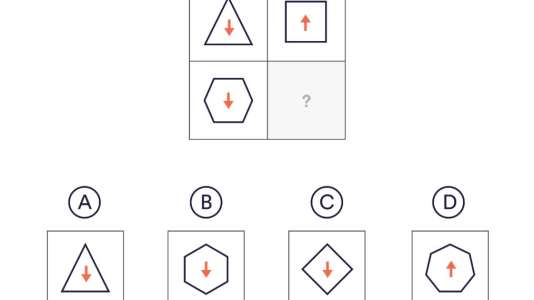

To do an abstract reasoning test well, stop hunting for the answer and run a checklist instead. Almost every question is built from a few kinds of rule: counting, movement, rotation, reflection, steady change, adding or removing parts, and shading. Check for them in the same order every time, confirm each rule across at least two steps, and predict the answer before you look at the options.
That fixed order is what raises scores. People who struggle usually spot one plausible rule, commit to it, and never check for a second. People who do well test the simple rules first and only reach for a complicated explanation when nothing simple fits. You can practise the method on a free abstract reasoning test, which explains every answer.
How abstract reasoning tests work
An abstract reasoning test is timed, multiple choice and entirely visual. Each question shows a pattern and several possible answers, and only one answer follows the same rule. Questions usually get harder as you go, and the time limit is tight enough that most people feel rushed.
Before you start, read the instructions carefully. Note how many questions there are and the total time, and check whether wrong answers lose marks. Most tests do not take marks away for a wrong answer, but if yours does, the instructions will say so. If there are practice questions at the start, use them to settle into the format.
If you are new to the formats, our guide to abstract reasoning question types explains sequences, matrices, odd one out, analogies and sets.
The checklist, in order
Run the checks cheapest first, because the cheap ones solve most questions.
- Counting. Write a number under each frame: shapes, sides, dots, lines or enclosed spaces. A run such as 2, 3, 4, 5 is a steady change. A run such as 2, 3, 2, 3 is an alternation. If the numbers make no pattern, count a different feature before you give up on counting.
- Position and movement. Number the possible positions, such as the four corners, and note where an element sits in each frame. Movement is almost always a fixed number of steps in a fixed direction, so one inconsistent step means you have the wrong rule.
- Rotation, then reflection. Pick one lopsided feature, such as a notch or an arrowhead, and track only that. Check the turn is the same size and direction every step. If the parts of the shape have swapped sides, it is a reflection, not a rotation.
- Steady change. Size, number of sides, line thickness or the amount of shading grows or shrinks by a fixed step. State the step in words and apply it to the last frame.
- Adding and removing parts. When two frames combine to make a third, test three rules: keep everything (union), keep only what both share (intersection), or keep only what appears in one of them (difference).
- Shading and colour. Try alternation and fixed cycles first. If neither works, test whether the shading depends on something else, for example every shape with an even number of sides is black.
- Size and layering. Look at scaling, overlap and which shape sits in front.
Anything that stays identical in every frame is there to take up your attention. Note it once, then ignore it.
When two rules run at once, which is normal beyond the easiest questions, you will find the first rule quickly and then stall. That stall is your signal to go back to the checklist and carry on down it, not to stare harder at the frames.
Worked walk-throughs
Walk-through 1: a sequence with two rules. Four frames each show a square with a dot in one corner and a number of small triangles.
| Frame | Dot position | Triangles |
|---|---|---|
| 1 | Top left | 2 |
| 2 | Top right | 3 |
| 3 | Bottom right | 4 |
| 4 | Bottom left | 5 |
| 5 | ? | ? |
Counting first: 2, 3, 4, 5, so frame 5 has 6 triangles. Position second: the dot moves one corner clockwise each time, so from the bottom left it wraps back to the top left. Rotation, reflection, shading and size never change, so you can stop there. The answer is 6 triangles with the dot at the top left.
Expect one wrong option with 6 triangles and the dot in the wrong corner, and another with the dot right and 5 triangles. When two rules run together, the distractors usually satisfy exactly one of them.
Walk-through 2: a matrix that combines cells. In a three by three grid, the third cell in each row is built from the first two.
| Cell 1 | Cell 2 | Cell 3 | |
|---|---|---|---|
| Row 1 | Vertical line, circle | Horizontal line, circle | Vertical line, horizontal line |
| Row 2 | Triangle, square | Square, star | Triangle, star |
| Row 3 | Circle, cross | Cross, arrow | ? |
Test the three combination rules on row 1. Union would keep the circle, and cell 3 has no circle, so union is out. Intersection would keep only the circle, which is wrong too. Difference keeps what appears in exactly one cell: the vertical line and the horizontal line. That matches.
Confirm it on row 2 before trusting it. The square appears in both cells and is dropped, and the triangle and star each appear once and stay. It matches again. Now apply it to row 3. The cross appears in both cells and is dropped. The circle and the arrow each appear once and stay. The missing cell holds a circle and an arrow.
Walk-through 3: an odd one out that turns on reflection. Five options each show the same right-angled triangle, with one short side and one long side meeting at the right angle. Four are the triangle turned to different angles. The fifth has been flipped over.
Counting does not separate them, because every option has three sides. Shading does not separate them either. The difference is which way round the shape is. Start at the right angle in each option and trace the outline clockwise. Note whether you travel along the short side or the long side first. A turn never changes that order, but a flip reverses it. Four options give one order and the fifth gives the reverse. That fifth option is the odd one out.
This is the most useful distinction to practise, because a turned shape and a flipped shape look almost the same at speed.
Tips for managing your time
- Set a rough time per question and keep to it. Divide the total time by the number of questions at the start.
- Eliminate as soon as you have one confirmed rule. You often do not need the full explanation to rule out three options.
- If you are stuck, move on. A question you cannot crack is worth the same as an easier one later in the test.
- Do not patch a rule that has failed. If your rule breaks on one step, go back to the checklist rather than adding an exception.
- Guess sensibly at the end. If wrong answers do not lose marks, never leave a question blank.
How to practise so your score improves
After each practice set, write down every wrong answer and the kind of rule it involved: counting, movement, rotation, reflection, steady change, combination, shading or size. After a couple of sets, most of your mistakes will usually sit in one or two of those. Practising those rules is what moves your score. Your total score on its own tells you very little you can act on.
A simple week of preparation could look like this:
- Days 1 and 2. Learn the checklist in short, untimed sessions.
- Days 3 and 4. Untimed practice, naming the rule type before you solve each question.
- Day 5. Mixed practice with the clock running.
- Day 6. Review your error log and practise your weakest rule type.
- Day 7. A full test under exam conditions.
Short sessions of 15 to 25 minutes on one rule type tend to work better than long, unfocused ones. If you want to see more questions solved before you start, our abstract reasoning examples walk through every format, and our guide to what abstract reasoning is covers what the test measures and why employers use it.
Do you need maths for an abstract reasoning test?
No. You may count sides or dots, but there is no arithmetic beyond that. The test measures pattern recognition and logic, not numerical ability.
Put the checklist into practice
The checklist only becomes fast through use. Work through a timed abstract reasoning practice test, log what you get wrong by rule type, and repeat.