
Aptitude test practice
Practice Aptitude Tests
Free, full-length practice tests for every assessment employers set, with a worked solution for every question. Start with one now, no sign-up.
Free · No sign-up · Scored the moment you finish
Cognitive Ability: Test 1
You have 10 minutes to answer 10 questions. The questions move between numerical, verbal, situational judgement, error-checking and deductive reasoning, so read each one carefully before answering. Every question carries one mark and the questions get harder as you go. Calculators and rough paper are permitted.
-
Question 1 of 10
A Thornleigh Air aircraft is scheduled to fly three sectors to Jervaulx on Tuesday, each lasting 2 h 45 min. What is the total flying time in hours?
- 7.35 hours
- 8.25 hours
- 9.00 hours
- 12.25 hours
Show the answer
Answer: B. 8.25 hours
Turn the sector length into decimal hours first, then multiply. 45 minutes is 45 divided by 60 = 0.75 hours, so each sector is 2.75 hours. 3 x 2.75 = 8.25 hours. A common error here is writing 2 h 45 min as 2.45 hours, which gives 7.35 hours. Minutes run to 60, not to 100, so 45 minutes is three quarters of an hour.
-
Question 2 of 10
Skelwith Group declared a final dividend of 7.4 pence a share, taking the total for the year to 11.2 pence. The results say the dividend is covered twice by earnings and that the board intends to keep cover at about that level. They give free cash flow of £74 million and note that the group bought back no shares during the year. Skelwith has paid a final dividend in each of the last twelve years.
Based only on the information in the passage, is the following statement True, False, or Cannot say?
Statement: “The group’s final dividend is 7.4 pence a share.”
- True
- False
- Cannot say
Show the answer
Answer: A. True
The statement is True. The passage says Skelwith “declared a final dividend of 7.4 pence a share”, which is the statement. The rule: where the passage states the claim, the answer is True. The most tempting wrong answer is False, from reading the 11.2 pence total for the year as the final dividend.
-
Question 3 of 10
Four meetings are held from Monday to Thursday, one per day.
- The budget meeting is before the hiring meeting.
- The safety meeting is on Wednesday.
Which statement must be true?
- The hiring meeting is on Thursday.
- The budget meeting is on Monday.
- The training meeting is after the safety meeting.
- The budget meeting is not on Thursday.
Show the answer
Answer: D. The budget meeting is not on Thursday.
The safety meeting takes Wednesday, leaving Monday, Tuesday and Thursday for the other three. Rule 1 puts the hiring meeting after the budget meeting, so the budget meeting cannot take the last day of the week. Nothing else is settled. The budget and hiring meetings take Monday and Tuesday, Monday and Thursday, or Tuesday and Thursday, with training taking whichever day is left, so the hiring meeting on Thursday, the budget meeting on Monday and training after safety each hold in some of those weeks and fail in others. The most tempting trap is the hiring meeting on Thursday, because Thursday is the obvious home for the later of a pair. Tuesday works too.
-
Question 4 of 10
Route Turnarounds Total ground time (minutes) Ilkeston to Jervaulx 20 900 Ilkeston to Longmoor 150 9,750 Ilkeston to Newbold 30 1,110 Jervaulx to Longmoor 50 1,600 The table shows Thornleigh Air’s turnarounds last month. Taking every turnaround at Ilkeston as a single group, what was the mean ground time per turnaround?
- 45.0 minutes
- 49.0 minutes
- 53.4 minutes
- 58.8 minutes
Show the answer
Answer: D. 58.8 minutes
Keep only the routes that start at Ilkeston, pool both columns, then divide once. Turnarounds: 20 + 150 + 30 = 200. Ground time: 900 + 9,750 + 1,110 = 11,760 minutes. 11,760 divided by 200 = 58.8 minutes. A common error here is averaging the three routes’ own figures, which gives 49.0 minutes. The Longmoor route carries three quarters of the turnarounds and the slowest ground time, so an unweighted average sits well below the true figure.
-
Question 5 of 10
Cooper’s Field is a development of eighteen houses on the site of a former dairy. Plot 14 has a garden of 210 square metres, and plot 15, on the corner, has a garden of 260 square metres. Plot 14 is the larger house, with four bedrooms against plot 15’s three. Gardens are turfed and fenced before completion, with a paved path to the rear gate. Both plots face the retained oak at the centre of the development, and both carry the same estate management charge for the shared landscaping.
Based only on the information in the passage, is the following statement True, False, or Cannot say?
Statement: “Plot 14 at Cooper’s Field has a larger garden than plot 15.”
- True
- False
- Cannot say
Show the answer
Answer: B. False
The statement is False. The passage says “plot 14 has a garden of 210 square metres, and plot 15, on the corner, has a garden of 260 square metres”. On the stated garden areas plot 14’s is smaller, so the claim is contradicted. The rule: comparing two stated figures on the same measure settles the claim either way. The most tempting wrong answer is True, from carrying the house-size comparison onto the gardens.
-
Question 6 of 10
You are a purchase ledger clerk. Two hundred invoices must be coded before the ledger closes at 6pm and you are ninety behind at 5pm. The coding sheet requires each invoice to be marked as checked against its purchase order. Nobody reviews the sheet. Which response below would be most effective, and which would be least effective?
- Tell your manager at 5pm that ninety will not be coded properly by 6pm, and ask whether to hold the close or code them without the purchase order check.
- Code as many as you properly can by 6pm and leave the rest for tomorrow, without telling anybody that the ledger has closed with invoices outstanding.
- Stay until eight to code all ninety properly, and say nothing about how close the deadline came to being missed this month.
- Code the ninety quickly and mark them all as checked against their purchase orders, since the coding itself is right and nobody ever reviews the sheet afterwards.
Show the answer
Most effective: A. Tell your manager at 5pm that ninety will not be coded properly by 6pm, and ask whether to hold the close or code them without the purchase order check.
Least effective: D. Code the ninety quickly and mark them all as checked against their purchase orders, since the coding itself is right and nobody ever reviews the sheet afterwards.
B: Lets a close happen incomplete in silence: whoever relies on the closed ledger has no idea part of it is missing.
C: Absorbs the shortfall: the ledger closes right and nobody learns that two hundred invoices does not fit in the day.
D: Marks ninety invoices as checked when they were not: the sheet is the only evidence the check happened, and everybody downstream reads it as meaning exactly that.
The most effective response is to tell your manager at 5pm that ninety will not be coded properly by 6pm, and ask whether to hold the close or code them without the purchase order check: an hour before the close she can still choose, and only she can make that trade. It beats coding as many as you properly can and leaving the rest without telling anybody the ledger closed with invoices outstanding, because an incomplete close nobody knows about is the worst version of it. It beats staying until eight to code all ninety properly and saying nothing, because three hours of your own time hides a capacity problem. The least effective response is coding the ninety quickly and marking them all as checked against their purchase orders: ninety invoices are recorded as checked against documents nobody opened. That is falsifying the record rather than under-delivering or absorbing it. The principle: the sheet says what you did, and a deadline is not a reason to change that.
-
Question 7 of 10
Row Master Entered 1 LS25 4GH LS25 4GH 2 CV34 6RP CV34 6RP 3 PE21 9WD PE21 9WD 4 TS18 3LQ TS188 3LQ Which row was copied incorrectly?
- Row 1
- Row 2
- Row 3
- Row 4
Show the answer
Answer: D. Row 4
Row 4 reads TS18 in the master list but TS188 in the entry: the 8 has been typed twice. The doubled digit sits immediately before the space, so the second half of the postcode still lines up and reads correctly, which is what makes the extra character easy to pass over.
-
Question 8 of 10
Five hearings are held one after another.
- Fowey is heard first.
- Dunkeld is heard immediately after Corfe.
- Brackley is heard after Dunkeld.
- Ewhurst is heard before Corfe.
Which hearing is third?
- Brackley
- Corfe
- Dunkeld
- Ewhurst
Show the answer
Answer: B. Corfe
Fowey takes first place, leaving positions 2 to 5. Rule 2 ties Dunkeld directly behind Corfe, rule 4 puts Ewhurst in front of Corfe and rule 3 puts Brackley behind Dunkeld, so the order is Fowey, Ewhurst, Corfe, Dunkeld, Brackley. Corfe is third. Eliminate the rest: Ewhurst is second, Dunkeld is directly behind Corfe so it is fourth, and Brackley is at the end of the chain. The most tempting trap is Dunkeld, which is where the pair lands if rule 2 is read the other way round.
-
Question 9 of 10
You are a check-in agent. A colleague applying for a role in another department asks you to write a short statement about how she handles difficult passengers. She is competent but that is the part of the job she finds hardest, and the statement she has drafted for you describes her as outstanding at it. She asks you to sign it as it stands. Which response below would be most effective, and which would be least effective?
- Tell her you cannot sign her draft as it stands, and offer to write something yourself covering what you can honestly say about her work.
- Decline to sign it and leave it there, since a statement about somebody else's work is not something you should be drawn into either way.
- Sign the draft as she has written it, since statements of this kind are always generous, everybody knows that, and it costs nothing to help a colleague.
- Sign it with the wording softened enough that it is not quite untrue, so that she gets her statement without you saying anything you would have to defend.
Show the answer
Most effective: A. Tell her you cannot sign her draft as it stands, and offer to write something yourself covering what you can honestly say about her work.
Least effective: C. Sign the draft as she has written it, since statements of this kind are always generous, everybody knows that, and it costs nothing to help a colleague.
B: Refuses without offering the alternative: she has real strengths you could describe, and a flat no leaves her with nothing and no idea why.
C: Puts your name to a description you know to be wrong: whoever reads it relies on it precisely because it comes from somebody who has worked beside her.
D: Writes to be defensible rather than accurate: the reader still takes it as a recommendation of the part she is weakest at, and the care has gone into wording rather than truth.
The most effective response is to tell her you cannot sign her draft as it stands, and offer to write something yourself covering what you can honestly say: the draft says something you do not believe, and writing your own gives her a genuine statement from somebody who has seen her work. It beats declining to sign and leaving it there, because she has real strengths and a refusal with nothing after it helps neither of you. It beats signing it with the wording softened enough not to be quite untrue, because carefully worded ambiguity still leaves the reader believing what the draft claims. The least effective response is signing the draft as she has written it because statements of this kind are always generous: it endorses a description of a colleague you know to be wrong, for a reader relying on your having worked beside her. That is worse than the other two, which stop short of endorsing the claim outright. The principle: write what you can honestly say and offer that, rather than signing somebody else’s version or hiding behind wording.
-
Question 10 of 10
Row Original Keyed 1 WHS-52836-DL WHS-52836-DL 2 WHS-52683-DL WHS-52863-DL 3 WHS-52368-DL WHS-52368-DL 4 WHS-52638-DL WHS-52638-DL Which row was copied incorrectly?
- Row 1
- Row 2
- Row 3
- Row 4
Show the answer
Answer: B. Row 2
Row 2 reads WHS-52683 in the original but WHS-52863 in the keyed version: the 6 and the 8 have swapped places. All four references open WHS-52 and close DL, and the three digits in between are orderings of 3, 6 and 8, so no reference can be recognised by its shape or by the digits it holds. Only their order separates them, and the keyed value for row 2 is an ordering that appears nowhere in the original column.






What is an aptitude test?
An aptitude test measures a candidate's cognitive abilities, work behaviours or personality traits. Aptitude tests examine your numeracy, logic and problem-solving skills, as well as how you deal with work situations, and they are a proven method of assessing employability skills.
There are a number of different types, because employers screen for different things. The most commonly used are numerical reasoning, verbal reasoning, diagrammatic reasoning, situational judgement, mechanical reasoning and personality tests.
Every test below is free to try, built to replicate the real exams used by leading employers, and scored the moment you finish, with the full worked solution for each question.
Take a free practice test
Each has a strict time limit. At the end you can see your score, your benchmark and the full solutions.
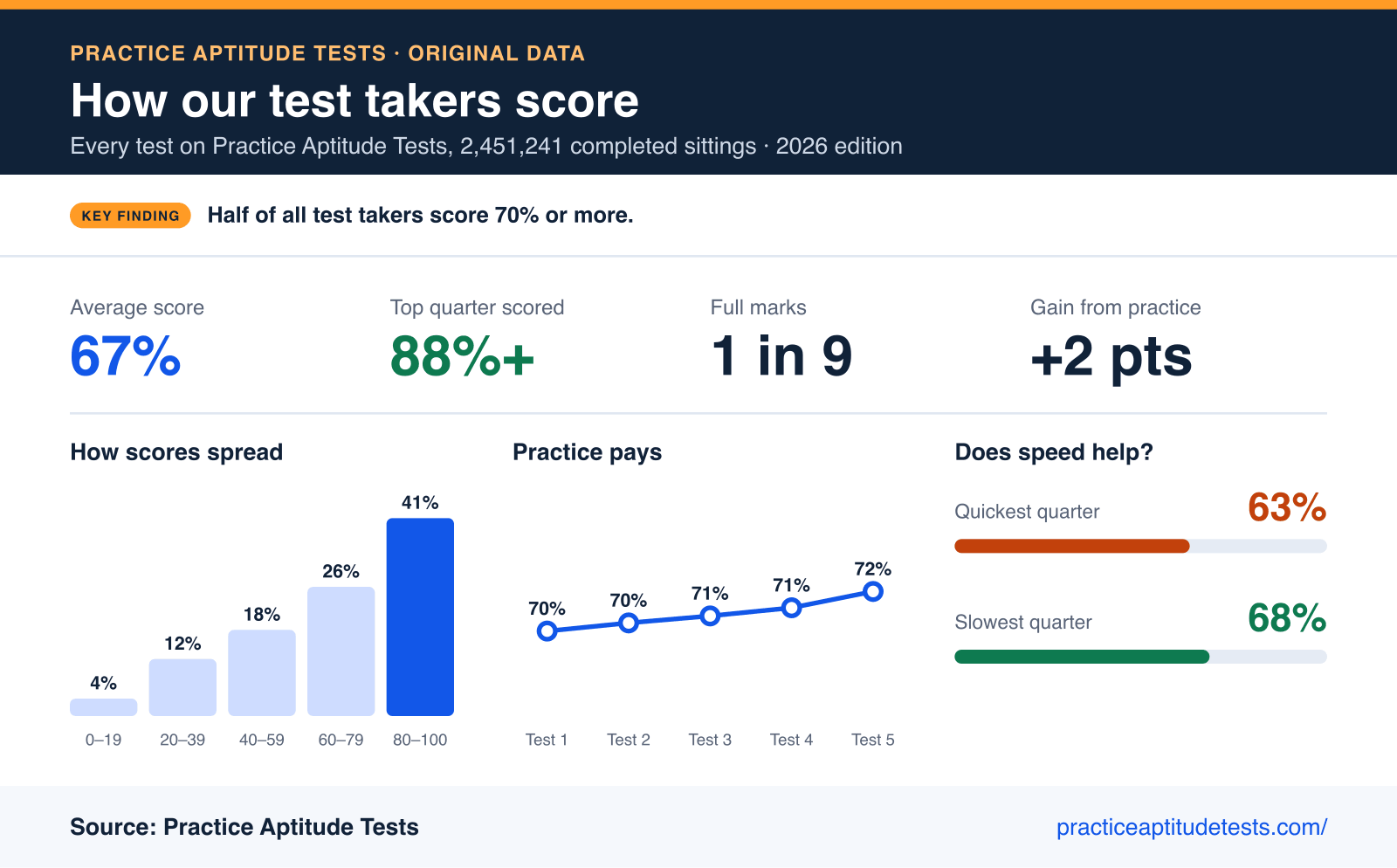
Practice Aptitude Tests · Original data
How our test takers score
Results from every test on Practice Aptitude Tests.
Key findingHalf of all test takers score 70% or more.
How scores spread
41% scored 80% or more, and 15% scored under 40%.
Share of sittings in each score band.
Practice pays
Regular practisers went from 70% on their first test to 72% on their fifth.
62,023 people who took five or more tests.
Does speed help?
Rushing costs marks. The quickest quarter scored 5 points lower than the slowest.
Typical pace: 41 seconds a question.
Share this data
Know who is testing you?
Practising the right format matters more than practising more. Start from the publisher or the employer named in your invitation, or from the sector you are applying into.
By test publisher
22 publishersMost employers licence their tests rather than writing them.
By employer
235 employersAssessment guides with the tests each employer sets.
By industry
31 sectorsThe tests employers in each sector use to shortlist.
How to pass aptitude tests
Seven habits that separate candidates who pass from candidates who could have.
- Practice aptitude tests. This advice sounds repeated and old, but it remains true. The more you practice, the more likely you are to succeed. The key is to take as many practice tests as you can before the actual test, so that you are prepared enough and feel confident on the day of your exam. Practice tests will help you assess your weak points so that you can focus on them and improve them. It will also help you to manage time so you have enough time to answer the whole test.
- Use the right equipment. There's no excuse for not being equipped before your tests. Ensure you have a good calculator, a few pens, pencils, and some draft paper. Do not forget to wear a watch so you can manage your time too. Practice using your equipment before attempting the actual test to make sure everything works perfectly and you give yourself the best chance of passing.
- Take the sample question. You are usually given a sample test question before the test starts. Make good use of it: assess the type of question asked, and review the format. This way, once the real test starts, there will be no unexpected surprises.
- Read the instructions. Before you start the test, read the instructions given on it carefully. Note how much time you have and how many questions there are. This allows you to work out how long you have for each question, so you can pace yourself accordingly.
- Move on if you get stuck. If you have trouble solving a question, move on. It's important not to fret too much and waste time on a single question. There is a possibility that you'll find the following questions easier, so move on and let yourself tackle them. Plus, if you have time later on, you can always go back to the question you were stuck on.
- Work on increasing your speed. The more questions you answer, the higher the score you can potentially get. Work carefully and as quickly as you can, but try not to rush. The key to increasing speed is to practice and get familar with the types of questions you'll face. The more questions you practice, the quicker you will get.
- Get a good night's sleep. Give your brain the best chance of doing well by being well rested. Tests can be stressful but try and get a full eight hours of sleep (or whatever you need) the night before.
Choose a plan and start practising
Immediate access. Cancel anytime.
Basic
One free test in every format, so you can see what you are buying before you buy it.
Sign up free- One free test in every format
- Basic performance tracking
- Your score and test results
- Tips and resources
- The full package libraries
- Peer comparison in the dashboard
Pro
Save £309Twelve months of access, billed once. Works out at £3.25 a month.
Rolling monthly access. Switch to annual at any time and pay £309 less over a year.
Get Pro- 17Aptitude
- 10Personality
- 236Employer
- 22Publisher
- 32Industry
- Dashboard performance tracking
- Full solutions and explanations
- Tips, tricks, guides and resources
Aptitude test FAQs
The questions candidates ask us most often
How are aptitude tests scored?
There are various scoring systems, but the two most common are raw score and comparative score. Raw score is when all your correct answers are summarized and displayed in percentage ratio. Comparative score is when your results are compared to the results of other people who took the test in your group.
What are aptitude tests used for?
Aptitude tests are used for the evaluation of a person’s cognitive skills and character profile. They are increasingly used in recruitment to help hiring managers streamline their applicants. It’s the efficiency and accuracy of aptitude testing compared with hiring methods like interviewing that has made them so popular.
What do aptitude tests involve?
Aptitude tests assess a person’s skills, abilities, professional attitude and personality traits. There are a whole range of aptitude tests and the challenges you’ll face will depend on each. They’ll involve a combination of numerical tests, verbal concepts, abstract thinking, field-specific reasoning problems (financial, mechanical etc), personality tests and others.
What do aptitude tests measure?
Aptitude tests measure a huge range of skills such as numerical aptitude, language comprehension and logical thinking. Different aptitude tests measure different aptitudes and employers specifically hand-pick aptitude tests to reveal the traits they’re looking for. Aptitude tests in the financial industry will be totally different to those in healthcare.
Why do employers use aptitude tests?
Employers use aptitude tests due to analyze a potential worker’s profile. The test results are a strong predictor of how an employee will perform and fit in with the rest of the company. For instance, there are tests that estimate how well a potential hire will work in a team, or how strong their communication and problem-solving skills are.
Which employers use aptitude tests?
Aptitude tests are very common in the modern recruitment industry. Almost every big enterprise uses such tests as an additional tool for employee selection. Smaller companies often follow the practices of bigger business and are currently adopting aptitude tests as well. It is fair to assume that the majority of employers are using aptitude tests for HR purposes.
Why are aptitude tests so hard?
Aptitude tests are hard as they’re used to filter and differentiate candidates. By making them hard, assessors get a spread of results that provides a far more revealing view of test-takers. Some tests are made deliberately difficult to reveal how a potential hire performs under stress, or when facing unfamiliar information.
Where can I practice aptitude tests?
You’ll find many resources for practicing aptitude tests online. We suggest trying a handful to see which works for you. Feel free to begin with our full catalogue of psychometric tests – they’re all written by accredited professionals. You can also use our fully worked solutions and interactive dashboards to help you improve.
Start practising today
Take a free test in any format, then upgrade when you know which one you need.