Numerical, verbal, logical, mechanical and spatial questions mixed in one sitting, like the real thing. Every question below comes with a worked solution.
A cognitive ability test measures how quickly and accurately you learn, reason and solve problems across different kinds of question. Employers use it as a broad predictor of job performance before interview. You answer a mix of verbal, numerical and logical questions against the clock, choosing the best answer each time. It is one of the strongest single indicators of how well someone picks up a new role.
A cognitive ability test measures your general mental ability, the
all-round reasoning capacity that sits behind performance in almost any
role. Rather than testing one skill in depth, it samples several at once,
which gives an employer a rounded picture of your strengths and weaknesses.
That breadth is the point. Where a numerical or verbal test drills into a
single aptitude, a cognitive ability test moves between numerical, verbal,
logical, mechanical and spatial questions to gauge overall intelligence and
how well you cope when the type of thinking keeps changing.
Employers value it because a strong cognitive ability score is one of the
better predictors of how quickly someone learns a job and how well they make
decisions under pressure. It shows not just raw aptitude but the ability to
stay accurate while shifting between very different problems.
How are cognitive ability tests scored?
Most employers score you against other candidates, not against a fixed
pass mark: your raw score becomes a percentile. Competitive graduate
schemes commonly sift at around the 70th to 80th percentile. Attempting
questions matters, because most tests are built so few candidates finish,
and guessing usually pays: negative marking is rare, but check the
instructions.
The time pressure is deliberate, usually around a minute a question, and few candidates finish comfortably. ** A minute lost struggling with one mechanical item is a numerical question you never reach, and both are worth the same mark.
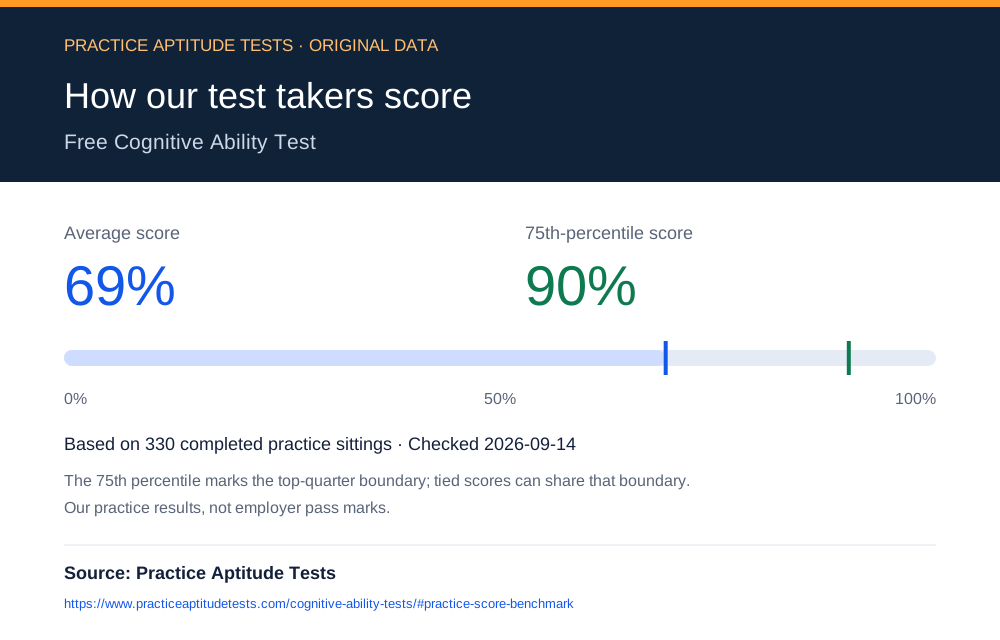
Based on 330 completed practice sittings, all time. Checked 14 September 2026.
The 75th percentile marks the boundary of the top quarter of recorded scores; tied scores can share that boundary. These are our practice results, not employer pass marks.
How we calculate these figures
We use all-time completed, scored attempts at this practice test. Repeat attempts count separately, so the sample is sittings rather than unique people.
The average is the mean score across those sittings. The 75th percentile comes from their recorded score distribution. The “checked” date is when we retrieved the figures, not the period when the tests were taken.
Sharing these figures? Please credit Practice Aptitude Tests and link to this page.
Why do employers rely on cognitive tests?
Employers use cognitive ability tests because general mental ability is one
of the strongest single predictors of job performance, especially in roles
that involve complex, fast-moving decisions. The test signals not just
aptitude but adaptability and composure under pressure.
It is also efficient. One sitting assesses several skills at once, giving a
broad read on a candidate at modest cost, which is why it has become one of
the most common recruitment tools in use.
That is why it turns up across industries as different as finance and the
armed forces, and why it is especially favoured for roles built on
high-stakes judgement, such as pilot, doctor, lawyer and engineer, where the
link between test score and on-the-job performance is considered particularly
close.
Who uses cognitive ability tests?
Cognitive ability tests are set across a wide range of sectors, and finding
out which publisher your employer uses lets you prepare with the right style
and format. A few dominate the UK market.
Most employers license their tests from a small number of publishers,
and the timing and question style vary between them, so find out which
publisher your employer uses before you prepare seriously. It is usually
named in the invitation email. Our test publisher guides
cover each format, and the employer guides
cover specific companies’ processes.
Video tutorials
The methods behind the questions above, from our team
Can you improve your cognitive ability test score with practice?
Yes, more than people expect. While the test aims at underlying ability, much of your score depends on familiarity with the formats and comfort switching between them, both of which improve with practice. The biggest gains usually come from drilling the one or two subjects you are weakest at.
How is a cognitive ability test different from a normal aptitude test?
An aptitude test such as numerical or verbal reasoning goes deep on a single skill, whereas a cognitive ability test samples several skills in one sitting to gauge overall mental ability. That breadth, and the constant switching between question types, is what makes it distinctive.
Can I use a calculator?
In the numerical section a basic calculator is often allowed, and many online tests provide one on screen. The other sections rarely need one. It matters less than expected, since estimating first is usually faster, so check your invitation for the rules rather than relying on the calculator to save you.
Do I need to revise physics for the mechanical questions?
A little familiarity helps. The mechanical section tests specific principles such as levers, pulleys, gears and pressure, and unlike the reasoning sections it does reward prior reading. You do not need formal physics, but running through a few mechanical practice tests beforehand is worthwhile.
What is the best way to prepare?
Practise under the real time limit from the start, and review every answer you got wrong; untimed work builds accuracy but not the speed the test measures. Our cognitive preparation guide covers the full sequence. The top 10 tips guide and our guide to handling the mix go deeper.
Reviews
Rated 4.8 out of 5 across 371 reviews. A selection:
Good
I like the test it's very difficult to solve in one attempt. It is very good test for practice the exam. But they are almost same type of questions still it is very difficult to solve. I would like to attempt more questions like this for practice. I try to understand the pattern.
Preeti Borra · India · October 2023
Patterns
I liked that there was more than a pattern to keep track of. That really challenged my concentration and focus. The patterns were also uniquely difficult!
Mwansa Ng'andu · South Africa · March 2023
Important to follow patterns and recognize repetition
It definitely made me think. One or two of the questions was very challenging, but the others were managable, if you paid attention to the shapes and behaviours of shapes.
Marko Simovic · USA · March 2022
Start practising today
Take a free test in any format, then upgrade when you know which one you need.