Illustrative example
Find the difference
OriginalAB–4729CopyAB–4792
The last two digits have swapped.
GIA
Short timed tasks measure how quickly and accurately you process information.
The PPA behavioural profile, the GIA speed test and its five sections, and the HPTI and TEIQue questionnaires. What each one asks, how long you get, why speed counts on the GIA and honesty on the rest, and what the employer sees at the end.
Free · No sign-up · Scored the moment you finish
The Thomas GIA is five short tests taken in one sitting, each timed separately at between two and five minutes, inside a session Thomas put at 30 to 45 minutes. This is the Reasoning section, and its items follow the three forms Thomas’s own example booklet works through: a direct comparison, one flipped to the opposite word, and one built on a negative. The real section keeps serving questions until its clock stops, so how many you see depends on how fast you work; this test is a fixed set against the same kind of clock.
Each question gives you one sentence comparing two people, then asks a question about it. Work as quickly and accurately as you can: for example, if Anna is taller than Carl, then Carl is the shorter of the two. In the real Thomas GIA the sentence disappears from the screen before the question appears, so read each sentence, look away from it, and then answer. The real Thomas GIA scores speed as well as accuracy and takes marks off for a wrong answer, so guessing is not free. You are not expected to finish. Thomas International now also call this assessment the Aptitude assessment.
Question 1 of 45
Vince is stronger than Ellis. Who is stronger?
Answer: B. Vince
The sentence says Vince is stronger than Ellis, and the question asks for the same word, so it is answered straight from the sentence.
Question 2 of 45
Ursula is kinder than Yusuf. Who is kinder?
Answer: B. Ursula
The sentence says Ursula is kinder than Yusuf, and the question asks for the same word, so it is answered straight from the sentence.
Question 3 of 45
Laura is older than Wanda. Who is older?
Answer: B. Laura
The sentence says Laura is older than Wanda, and the question asks for the same word, so it is answered straight from the sentence.
Question 4 of 45
Zara is harsher than Ursula. Who is harsher?
Answer: B. Zara
The sentence says Zara is harsher than Ursula, and the question asks for the same word, so it is answered straight from the sentence.
Question 5 of 45
Tessa is taller than Sam. Who is taller?
Answer: A. Tessa
The sentence says Tessa is taller than Sam, and the question asks for the same word, so it is answered straight from the sentence.
Question 6 of 45
Ursula is faster than Anna. Who is faster?
Answer: B. Ursula
The sentence says Ursula is faster than Anna, and the question asks for the same word, so it is answered straight from the sentence.
Question 7 of 45
Paula is heavier than Hugh. Who is heavier?
Answer: A. Paula
The sentence says Paula is heavier than Hugh, and the question asks for the same word, so it is answered straight from the sentence.
Question 8 of 45
Carl is slower than Keith. Who is slower?
Answer: A. Carl
The sentence says Carl is slower than Keith, and the question asks for the same word, so it is answered straight from the sentence.
Question 9 of 45
Ursula is poorer than Zara. Who is poorer?
Answer: B. Ursula
The sentence says Ursula is poorer than Zara, and the question asks for the same word, so it is answered straight from the sentence.
Question 10 of 45
Ursula is tidier than Owen. Who is tidier?
Answer: B. Ursula
The sentence says Ursula is tidier than Owen, and the question asks for the same word, so it is answered straight from the sentence.
Question 11 of 45
Paula is cheerier than Dawn. Who is cheerier?
Answer: B. Paula
The sentence says Paula is cheerier than Dawn, and the question asks for the same word, so it is answered straight from the sentence.
Question 12 of 45
Anna is brighter than Rosa. Who is brighter?
Answer: A. Anna
The sentence says Anna is brighter than Rosa, and the question asks for the same word, so it is answered straight from the sentence.
Question 13 of 45
Gail is gentler than Anna. Who is gentler?
Answer: B. Gail
The sentence says Gail is gentler than Anna, and the question asks for the same word, so it is answered straight from the sentence.
Question 14 of 45
Hugh is louder than Yusuf. Who is louder?
Answer: A. Hugh
The sentence says Hugh is louder than Yusuf, and the question asks for the same word, so it is answered straight from the sentence.
Question 15 of 45
Dawn is politer than Mark. Who is politer?
Answer: A. Dawn
The sentence says Dawn is politer than Mark, and the question asks for the same word, so it is answered straight from the sentence.
Question 16 of 45
Gail is messier than Yusuf. Who is tidier?
Answer: B. Yusuf
The sentence says Gail is messier than Yusuf. The question asks for tidier, the opposite, so it is the other person of the two.
Question 17 of 45
Zara is politer than Yusuf. Who is ruder?
Answer: B. Yusuf
The sentence says Zara is politer than Yusuf. The question asks for ruder, the opposite, so it is the other person of the two.
Question 18 of 45
Yusuf is happier than Anna. Who is sadder?
Answer: A. Anna
The sentence says Yusuf is happier than Anna. The question asks for sadder, the opposite, so it is the other person of the two.
Question 19 of 45
Carl is cheerier than Wanda. Who is gloomier?
Answer: A. Wanda
The sentence says Carl is cheerier than Wanda. The question asks for gloomier, the opposite, so it is the other person of the two.
Question 20 of 45
Rosa is shyer than Sam. Who is bolder?
Answer: A. Sam
The sentence says Rosa is shyer than Sam. The question asks for bolder, the opposite, so it is the other person of the two.
Question 21 of 45
Laura is bolder than Ivan. Who is shyer?
Answer: A. Ivan
The sentence says Laura is bolder than Ivan. The question asks for shyer, the opposite, so it is the other person of the two.
Question 22 of 45
Rosa is rougher than Paula. Who is gentler?
Answer: A. Paula
The sentence says Rosa is rougher than Paula. The question asks for gentler, the opposite, so it is the other person of the two.
Question 23 of 45
Vince is ruder than Carl. Who is politer?
Answer: A. Carl
The sentence says Vince is ruder than Carl. The question asks for politer, the opposite, so it is the other person of the two.
Question 24 of 45
Gail is shakier than Sam. Who is steadier?
Answer: B. Sam
The sentence says Gail is shakier than Sam. The question asks for steadier, the opposite, so it is the other person of the two.
Question 25 of 45
Keith is younger than Gail. Who is older?
Answer: A. Gail
The sentence says Keith is younger than Gail. The question asks for older, the opposite, so it is the other person of the two.
Question 26 of 45
Frank is fitter than Owen. Who is frailer?
Answer: B. Owen
The sentence says Frank is fitter than Owen. The question asks for frailer, the opposite, so it is the other person of the two.
Question 27 of 45
Mark is frailer than Hugh. Who is fitter?
Answer: B. Hugh
The sentence says Mark is frailer than Hugh. The question asks for fitter, the opposite, so it is the other person of the two.
Question 28 of 45
Sam is older than Quinn. Who is younger?
Answer: A. Quinn
The sentence says Sam is older than Quinn. The question asks for younger, the opposite, so it is the other person of the two.
Question 29 of 45
Sam is stronger than Quinn. Who is weaker?
Answer: A. Quinn
The sentence says Sam is stronger than Quinn. The question asks for weaker, the opposite, so it is the other person of the two.
Question 30 of 45
Keith is gentler than Zara. Who is rougher?
Answer: A. Zara
The sentence says Keith is gentler than Zara. The question asks for rougher, the opposite, so it is the other person of the two.
Question 31 of 45
Paula is not as gloomy as Dawn. Who is cheerier?
Answer: A. Paula
Not as gloomy as means less gloomy, so Dawn is the gloomier of the two and Paula is the cheerier.
Question 32 of 45
Zara is not as harsh as Dawn. Who is kinder?
Answer: A. Zara
Not as harsh as means less harsh, so Dawn is the harsher of the two and Zara is the kinder.
Question 33 of 45
Wanda is not as young as Ellis. Who is older?
Answer: A. Wanda
Not as young as means less young, so Ellis is the younger of the two and Wanda is the older.
Question 34 of 45
Mark is not as shaky as Anna. Who is steadier?
Answer: B. Mark
Not as shaky as means less shaky, so Anna is the shakier of the two and Mark is the steadier.
Question 35 of 45
Wanda is not as rude as Hugh. Who is politer?
Answer: B. Wanda
Not as rude as means less rude, so Hugh is the ruder of the two and Wanda is the politer.
Question 36 of 45
Tessa is not as bold as Wanda. Who is shyer?
Answer: A. Tessa
Not as bold as means less bold, so Wanda is the bolder of the two and Tessa is the shyer.
Question 37 of 45
Vince is not as happy as Jane. Who is sadder?
Answer: B. Vince
Not as happy as means less happy, so Jane is the happier of the two and Vince is the sadder.
Question 38 of 45
Tessa is not as sad as Gail. Who is happier?
Answer: B. Tessa
Not as sad as means less sad, so Gail is the sadder of the two and Tessa is the happier.
Question 39 of 45
Ellis is not as loud as Frank. Who is quieter?
Answer: A. Ellis
Not as loud as means less loud, so Frank is the louder of the two and Ellis is the quieter.
Question 40 of 45
Keith is not as tidy as Quinn. Who is messier?
Answer: B. Keith
Not as tidy as means less tidy, so Quinn is the tidier of the two and Keith is the messier.
Question 41 of 45
Rosa is not as steady as Ellis. Who is shakier?
Answer: A. Rosa
Not as steady as means less steady, so Ellis is the steadier of the two and Rosa is the shakier.
Question 42 of 45
Owen is not as kind as Mark. Who is harsher?
Answer: B. Owen
Not as kind as means less kind, so Mark is the kinder of the two and Owen is the harsher.
Question 43 of 45
Ellis is not as messy as Tessa. Who is tidier?
Answer: B. Ellis
Not as messy as means less messy, so Tessa is the messier of the two and Ellis is the tidier.
Question 44 of 45
Tessa is not as frail as Rosa. Who is fitter?
Answer: A. Tessa
Not as frail as means less frail, so Rosa is the frailer of the two and Tessa is the fitter.
Question 45 of 45
Jane is not as fast as Hugh. Who is slower?
Answer: B. Jane
Not as fast as means less fast, so Hugh is the faster of the two and Jane is the slower.






A Thomas test is a workplace psychometric test from Thomas, the UK company formerly known as Thomas International. The two best known are the PPA behavioural profile, a DISC based questionnaire of 24 forced choice question sets taking about eight minutes, and the GIA aptitude test, a speed based measure of reasoning, perception and number and word skills lasting 30 to 45 minutes overall. Personality and emotional intelligence questionnaires round out the range.
Which Thomas International test you sit depends on the employer and the role: an entry-level position will not be given the same assessment as a graduate or managerial one.
Four things to know before you sit one. Timings and difficulty vary with the level of the role.
Match the name in your invitation to the assessment below. Timings marked “approx.” are completion estimates; other published durations are limits for the named version.
| Assessment | What it measures | Questions | Timing |
|---|---|---|---|
| PPA (Personal Profile Analysis) | DISC working style, from 24 sets of four adjectives | 24 sets | Untimed; approx. 8 min |
| GIA (General Intelligence Assessment) | Perceptual speed, reasoning, number speed and accuracy, spatial visualisation, word meaning | Five timed sections | 2 to 5 min per section; allow 30 to 45 min total |
| HPTI (High Potential Trait Indicator) | Six leadership traits, from conscientiousness to competitiveness | 78 statements | Untimed; approx. 8 to 10 min |
| TEIQue (Trait Emotional Intelligence Questionnaire) | How you handle your own and other people's emotions | Varies by version | Untimed |
Counts and timings vary by role level and by the version an employer licences. Check the instructions on the screen before you start. Facts checked 11 September 2026.
PPA, HPTI and emotional intelligence questionnaires are untimed. GIA’s total includes instructions and practice, with separate timed sub-tests.
A visual guide to the skills and response formats covered on this page. Your invitation tells you which assessments to prepare for.
Illustrations by Practice Aptitude Tests · not official test screenshots
Find the difference
The last two digits have swapped.
Short timed tasks measure how quickly and accurately you process information.
Most like you / least like you
Choose the words most and least like your behaviour at work.
“I enjoy exploring new ideas.”
A preference, not a right answer.
Rate your agreement with statements about your personality on a seven-point scale.
The free test shows you the style. A pack gives you the pace: timed and marked, with the working shown.
Practice Aptitude Tests · Original data
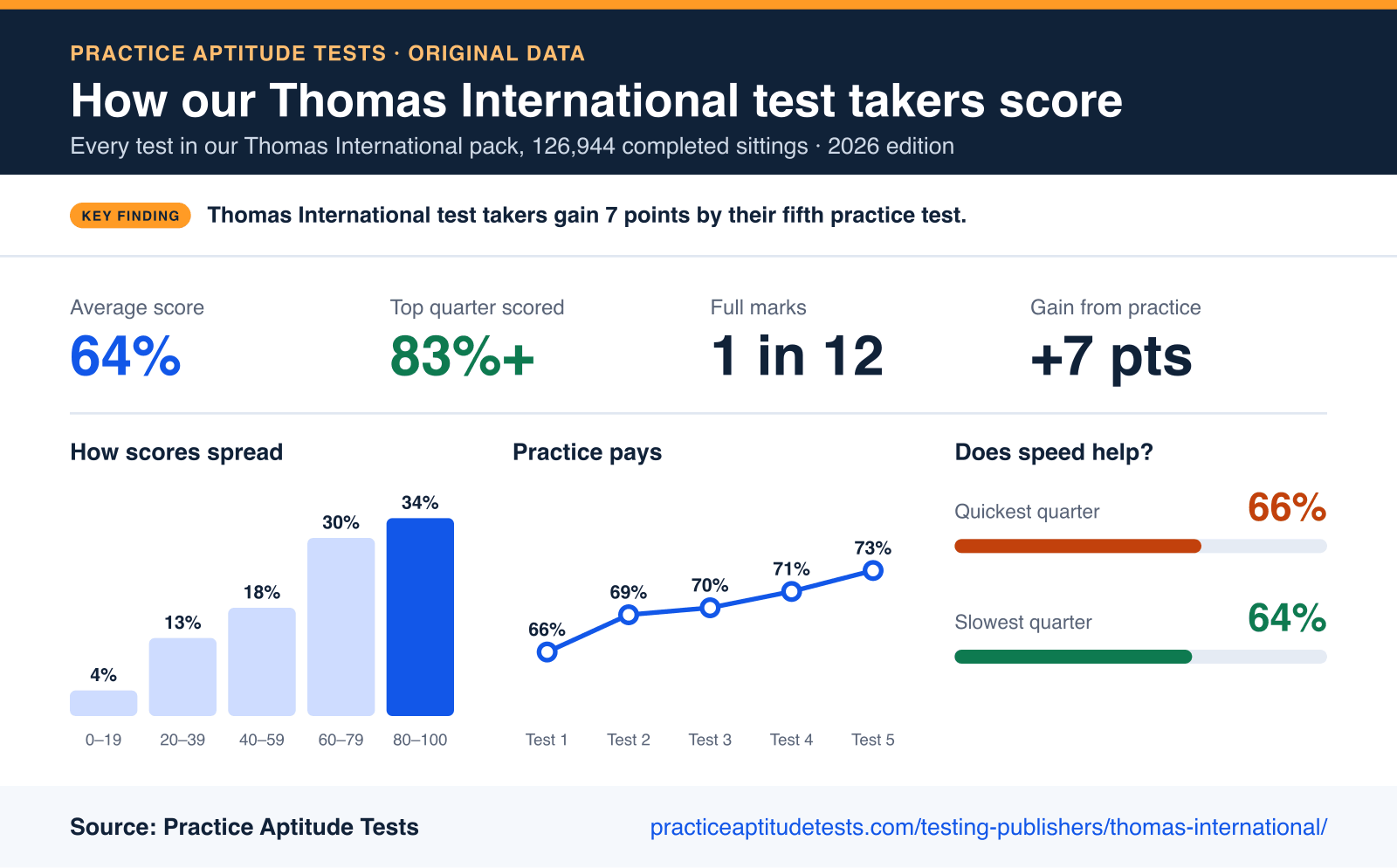
Results from every test in our Thomas International pack, past and present.
Key findingThomas International test takers gain 7 points by their fifth practice test.
34% scored 80% or more, and 18% scored under 40%.
Share of sittings in each score band.
Regular practisers went from 66% on their first test to 73% on their fifth.
3,894 people who took five or more tests.
Speed makes little difference here.
Typical pace: 47 seconds a question.
Thomas International is a trademark of its respective owner. Practice Aptitude Tests is not affiliated with Thomas International and our practice tests are not endorsed by them.