Illustrative example
80 Before→100 After
What is the percentage increase?
Swift aptitude
Short aptitude combinations include numerical tasks; the exact mix depends on the Swift version.
View guidanceThe Analysis and Comprehension levels, the Swift blended batteries, the numerical, verbal, diagrammatic, mechanical, abstract, spatial and error checking tests with their timings, the Wave Professional and Focus Styles questionnaires, and how the percentile is read against an international norm group.
Free · No sign-up · Scored the moment you finish
Saville Assessment was founded in 2004 by Professor Peter Saville, who co-founded SHL. Swift Analysis Aptitude is its combination test for graduates, professionals and managers. Saville publish it at 18 minutes and their own practice version runs 24 questions across verbal, numerical and diagrammatic, which is exactly the shape of this test.
You have 18 minutes to answer 24 questions. The test moves between verbal, numerical and diagrammatic reasoning, in that order, so read each question carefully before answering. Every question has four options and exactly one is correct. The real assessment gives each section its own clock and does not let unused time carry over. This practice test runs the whole 18 minutes on one clock, so pace yourself: about 45 seconds a question is the speed the real thing asks for.
Question 1 of 24
Ferndale Bakeries, a family-owned firm supplying supermarkets across northern England, produces a range of breads, cakes and morning goods. Until last year its gluten-free range was made on a shared production line at the company’s main site in Leeds. The gluten-free range is now made at a dedicated facility, opened to remove any risk of cross-contamination. That facility is in Harrogate, where the company converted a former warehouse at a cost of £1.8 million. Ferndale employs around 240 people in total, and its gluten-free products account for roughly a tenth of turnover. The company is trialling a new sourdough range with two supermarket chains.
According to the passage, where is the gluten-free range made now?
Answer: B. At a dedicated facility in Harrogate
The passage says the gluten-free range is now made at a dedicated facility, and names Harrogate as where that facility is. Leeds is the main site and holds the shared line the range used to run on, and the two supermarket chains belong to the sourdough trial at the end of the passage.
Question 2 of 24
Bexfield Water supplies drinking water to around 300,000 households across the East Midlands. In January, a burst trunk main near the town of Ollerton left roughly 3,000 homes without running water. Supply was restored to most of the affected homes within a day, with bottled water handed out from two collection points in the meantime. The final 200 homes were reconnected on the Thursday evening, four days after the main burst. Bexfield has paid each affected household £45 in compensation and attributed the failure to a corroded joint dating from the 1960s. The company plans to replace eleven kilometres of similar main over the next three years.
According to the passage, what did Bexfield Water say caused the burst?
Answer: C. A corroded joint dating from the 1960s
The passage says Bexfield attributed the failure to a corroded joint dating from the 1960s. The eleven kilometres of similar main are the planned replacement programme that follows from that diagnosis, and neither nearby work nor demand is mentioned anywhere in the text.
Question 3 of 24
Ferndale Bakeries, a family-owned firm supplying supermarkets across northern England, produces a range of breads, cakes and morning goods. Until last year its gluten-free range was made on a shared production line at the company’s main site in Leeds. The gluten-free range is now made at a dedicated facility, opened to remove any risk of cross-contamination. That facility is in Harrogate, where the company converted a former warehouse at a cost of £1.8 million. Ferndale employs around 240 people in total, and its gluten-free products account for roughly a tenth of turnover. The company is trialling a new sourdough range with two supermarket chains.
Which one of the following can be concluded from the passage?
Answer: C. The gluten-free range shared equipment with other products until last year
Until last year the range was made on a shared production line, and a shared line is by definition used by other products as well. The move concerns one range rather than all production, the new facility is described as removing risk rather than answering a failure, and the tenth of turnover is a size rather than a growth rate.
Question 4 of 24
Ferndale Bakeries, a family-owned firm supplying supermarkets across northern England, produces a range of breads, cakes and morning goods. Until last year its gluten-free range was made on a shared production line at the company’s main site in Leeds. The gluten-free range is now made at a dedicated facility, opened to remove any risk of cross-contamination. That facility is in Harrogate, where the company converted a former warehouse at a cost of £1.8 million. Ferndale employs around 240 people in total, and its gluten-free products account for roughly a tenth of turnover. The company is trialling a new sourdough range with two supermarket chains.
Which one of the following does the passage suggest about the Harrogate facility?
Answer: D. The building was in other use before the company took it on
The passage says the company converted a former warehouse in Harrogate, and a former warehouse is a building that was serving another purpose until the conversion. What it was built as is a separate question the passage does not settle, so the conclusion stops at the use it was put to. The 240 employees are a company total, the sourdough trial is given no location, and no cost is stated for the Leeds site.
Question 5 of 24
Bexfield Water supplies drinking water to around 300,000 households across the East Midlands. In January, a burst trunk main near the town of Ollerton left roughly 3,000 homes without running water. Supply was restored to most of the affected homes within a day, with bottled water handed out from two collection points in the meantime. The final 200 homes were reconnected on the Thursday evening, four days after the main burst. Bexfield has paid each affected household £45 in compensation and attributed the failure to a corroded joint dating from the 1960s. The company plans to replace eleven kilometres of similar main over the next three years.
Which one of the following can be concluded from the passage?
Answer: D. The homes reconnected last were fewer than one in ten of those left without water
Roughly 3,000 homes lost supply and the last 200 of them were reconnected on the fourth day, and 200 is under a tenth of 3,000. The four days apply to that last group rather than to everyone, the compensation is stated for each affected household, and the passage does not say how long the collection points ran.
Question 6 of 24
Bexfield Water supplies drinking water to around 300,000 households across the East Midlands. In January, a burst trunk main near the town of Ollerton left roughly 3,000 homes without running water. Supply was restored to most of the affected homes within a day, with bottled water handed out from two collection points in the meantime. The final 200 homes were reconnected on the Thursday evening, four days after the main burst. Bexfield has paid each affected household £45 in compensation and attributed the failure to a corroded joint dating from the 1960s. The company plans to replace eleven kilometres of similar main over the next three years.
The passage suggests that the replacement programme is intended to do which one of the following?
Answer: A. Reduce the chance of a similar failure elsewhere on the network
The company attributes the burst to a corroded 1960s joint and plans to replace eleven kilometres of similar main, so the works target the same weakness where it remains. The 200 homes were already reconnected, the passage describes replacement rather than new capacity, and the compensation has been paid.
Question 7 of 24
Ferndale Bakeries, a family-owned firm supplying supermarkets across northern England, produces a range of breads, cakes and morning goods. Until last year its gluten-free range was made on a shared production line at the company’s main site in Leeds. The gluten-free range is now made at a dedicated facility, opened to remove any risk of cross-contamination. That facility is in Harrogate, where the company converted a former warehouse at a cost of £1.8 million. Ferndale employs around 240 people in total, and its gluten-free products account for roughly a tenth of turnover. The company is trialling a new sourdough range with two supermarket chains.
Which one of the following provides the best summary of the main point of the passage?
Answer: A. A bakery has moved its gluten-free range to a dedicated site so it cannot be contaminated by other production
The passage contrasts the old shared line with the new dedicated facility and gives the reason for the change in the same sentence, so the move and its purpose are the point. The conversion cost, the share of turnover and the sourdough trial are details around it, and no other bakery is described.
Question 8 of 24
Bexfield Water supplies drinking water to around 300,000 households across the East Midlands. In January, a burst trunk main near the town of Ollerton left roughly 3,000 homes without running water. Supply was restored to most of the affected homes within a day, with bottled water handed out from two collection points in the meantime. The final 200 homes were reconnected on the Thursday evening, four days after the main burst. Bexfield has paid each affected household £45 in compensation and attributed the failure to a corroded joint dating from the 1960s. The company plans to replace eleven kilometres of similar main over the next three years.
Which one of the following provides the best summary of the main point of the passage?
Answer: B. A water company has explained and compensated a burst that cut supply to thousands of homes, and will replace the main
The passage runs from the burst and its scale, through the restoration of supply and the compensation, to the cause and the replacement programme, so the summary has to hold the incident and the response together. The payment and the collection points are parts of that response, and one corroded joint is not a region-wide failure.
Question 9 of 24
| Room type | March | April | May |
|---|---|---|---|
| Standard | 212 | 246 | 268 |
| Deluxe | 118 | 134 | 152 |
| Twin | 96 | 88 | 104 |
| Suite | 41 | 37 | 45 |
A hotel records monthly bookings by room type. How many Suite rooms were booked in April and May combined?
Answer: A. 82
Find the Suite row, then read the April and May columns: 37 + 45 = 82 rooms. Common trap: slipping onto the adjacent Twin row, which gives 88 + 104 = 192, option d.
Question 10 of 24
| Branch | Members |
|---|---|
| Central | 1450 |
| Riverside | 1720 |
| Hillcrest | 1310 |
| Docklands | 1580 |
| Parkway | 1150 |
The chart shows a gym chain’s membership by branch. How many more members does Riverside have than Hillcrest?
Answer: B. 410
Read the two named bars: Riverside = 1,720 and Hillcrest = 1,310. Difference = 1,720 − 1,310 = 410 members. A common error here is reading the Docklands bar as Riverside, giving 1,580 − 1,310 = 270 (option a).
Question 11 of 24
| Consultant | H1 | H2 |
|---|---|---|
| Amara | 44 | 48 |
| Ben | 15 | 18 |
| Chloe | 32 | 30 |
| Dev | 14 | 12 |
| Elena | 40 | 42 |
A consultancy shares a £45,000 profit-share pool among its five consultants in proportion to their H2 billable days, shown in the chart. How much does Ben receive?
Answer: B. £5,400
Use the H2 series only. Total H2 billable days = 48 + 18 + 30 + 12 + 42 = 150. Ben’s share = 18 ÷ 150 = 0.12, so he receives 0.12 × £45,000 = £5,400. A common error here is leaving one consultant out of the total: dividing by 108 instead of 150 gives £7,500, answer c. The H1 series is not needed.
Question 12 of 24
| Item | Daily rate (£) |
|---|---|
| Cement mixer | 38 |
| Floor sander | 46 |
| Mini digger | 145 |
| Scaffold tower | 62 |
A builder hires the Floor sander for 3 days. A 15% trade discount applies, and VAT at 20% is then added to the discounted amount. What is the total payable?
Answer: B. £140.76
Hire cost: £46 × 3 = £138. Apply the 15% discount: £138 × 0.85 = £117.30. Add VAT at 20%: £117.30 × 1.20 = £140.76. A common error here is netting the two percentages to a single +5% step, giving £144.90 (answer c). Sequential percentages multiply; they do not add.
Question 13 of 24
| Channel | 2024 | 2025 |
|---|---|---|
| Organic | 128,400 | 151,512 |
| Paid | 61,200 | 54,468 |
| 44,000 | 38,720 | |
| Social | 27,300 | 32,760 |
The table shows a publisher’s website sessions by channel. What was the percentage change in Email sessions from 2024 to 2025?
Answer: B. -12.0%
Percentage change = (new − old) ÷ old × 100. Email: (38,720 − 44,000) ÷ 44,000 × 100 = −5,280 ÷ 44,000 × 100 = −12.0%. A common error here is dividing by the new value, 5,280 ÷ 38,720 = 13.6% (option a). The other channels are not needed.
Question 14 of 24
| Product | Price (£) | Unit cost (£) | Loaves sold |
|---|---|---|---|
| Sourdough | 4.20 | 1.80 | 650 |
| Baguette | 3.10 | 1.30 | 820 |
| Focaccia | 3.80 | 1.60 | 540 |
A bakery tracks last week’s sales of its three breads. What was the total gross profit across all three lines?
Answer: C. £4,224
Take profit per loaf on each line, then weight it by the loaves sold. Sourdough: £2.40 × 650 = £1,560. Baguette: £1.80 × 820 = £1,476. Focaccia: £2.20 × 540 = £1,188. Total = £1,560 + £1,476 + £1,188 = £4,224. A common error here is multiplying price by loaves, which gives revenue, £7,324 (option d), not profit.
Question 15 of 24
| Currency | Units per £1 |
|---|---|
| US dollar (USD) | 1.25 |
| Euro (EUR) | 1.15 |
| Australian dollar (AUD) | 1.90 |
| Singapore dollar (SGD) | 1.71 |
An Australian supplier’s invoice of AU$15,200 qualifies for a 5% early-settlement discount. The company settles the discounted amount from its US dollar account. Using the rates shown, how much is paid, in US dollars?
Answer: C. $9,500
Apply the discount first: AU$15,200 × 0.95 = AU$14,440. Both rates are quoted per £1, so convert through sterling. Australian dollars to pounds: 14,440 ÷ 1.90 = £7,600. Pounds to US dollars: 7,600 × 1.25 = $9,500. A common error here is skipping the discount, which gives $10,000 (option d). The EUR and SGD rows are not needed.
Question 16 of 24
| Stock line | Units | Price per unit (£) |
|---|---|---|
| Batch 1 | 1,200 | 5.50 |
| Batch 2 | 1,800 | 8.00 |
| Clearance stock | 400 | 3.00 |
A merchant sold the two batches of the same part shown below, plus some clearance stock. What was the average selling price per unit across Batches 1 and 2?
Answer: D. £7.00
An average price must be weighted by units sold. Revenue = 1,200 × £5.50 + 1,800 × £8.00 = £6,600 + £14,400 = £21,000. Units = 1,200 + 1,800 = 3,000. Average = £21,000 ÷ 3,000 = £7.00. A common error here is averaging the two prices, (5.50 + 8.00) ÷ 2 = £6.75 (option c). The clearance line is excluded by the question.
Question 17 of 24
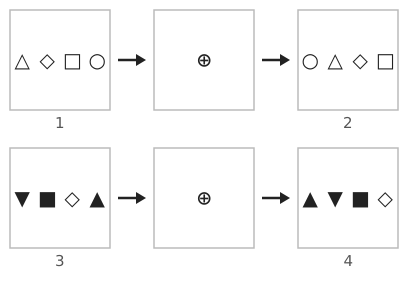
What does operator ⊕ do?
Answer: C. Moves the last symbol to the front, shifting the others one place right
In both worked rows the operator moves the last symbol to the front, shifting the others one place right: △◇□○ becomes ○△◇□, and ▼■◇▲ becomes ▲▼■◇. Each of the other readings is contradicted by at least one of the two worked rows, so a single check against either row rules it out.
Question 18 of 24
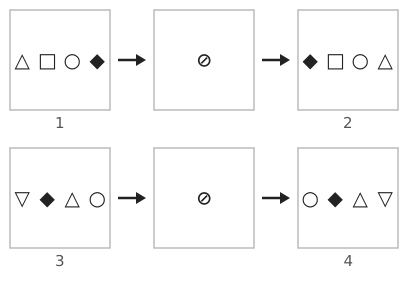
What does operator ⊘ do?
Answer: D. Exchanges the first and last symbols, leaving the middle pair in place
In both worked rows the operator exchanges the first and last symbols, leaving the middle pair in place: △□○◆ becomes ◆□○△, and ▽◆△○ becomes ○◆△▽. Each of the other readings is contradicted by at least one of the two worked rows, so a single check against either row rules it out.
Question 19 of 24
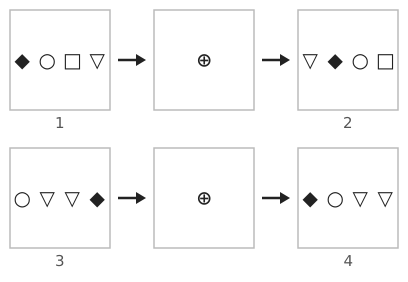
What does operator ⊕ do?
Answer: A. Moves the last symbol to the front of the row
In both rows ⊕ moves the last symbol to the front, shifting the rest one place right: ◆○□▽ becomes ▽◆○□, and ○▽▽◆ becomes ◆○▽▽. The common error is the inverse reading (the first symbol moving to the end), which would produce ○□▽◆ from panel 1 and contradicts both worked examples.
Question 20 of 24
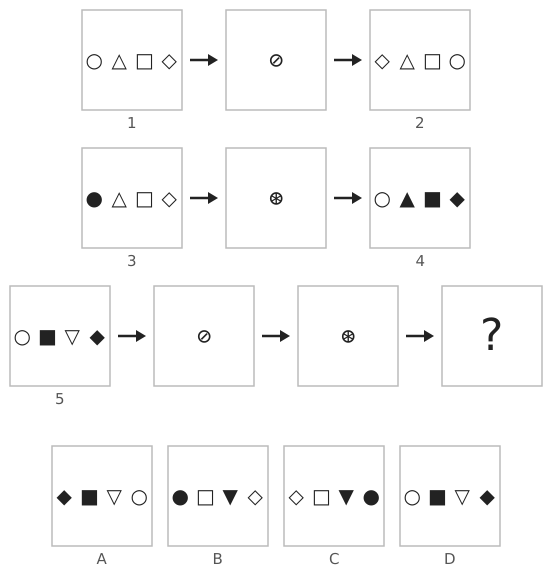
Which figure completes the chain?
Answer: C. Figure C
Each operator is fixed by its own worked row. Working the chain from left to right: ⊘ exchanges the first and last symbols, leaving the middle pair in place, so ○■▽◆ becomes ◆■▽○; ⊛ inverts the fill of every symbol, leaving all positions unchanged, so ◆■▽○ becomes ◇□▼●. The result is ◇□▼●, which is Figure C. The other three figures are each what a different single mistake would give.
Question 21 of 24
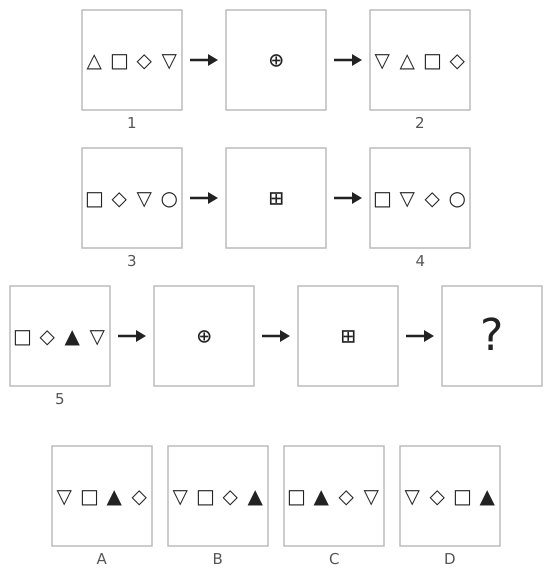
Which figure completes the chain?
Answer: D. Figure D
Each operator is fixed by its own worked row. Working the chain from left to right: ⊕ moves the last symbol to the front, shifting the others one place right, so □◇▲▽ becomes ▽□◇▲; ⊞ exchanges the two middle symbols, leaving the outer pair in place, so ▽□◇▲ becomes ▽◇□▲. The result is ▽◇□▲, which is Figure D. The other three figures are each what a different single mistake would give.
Question 22 of 24
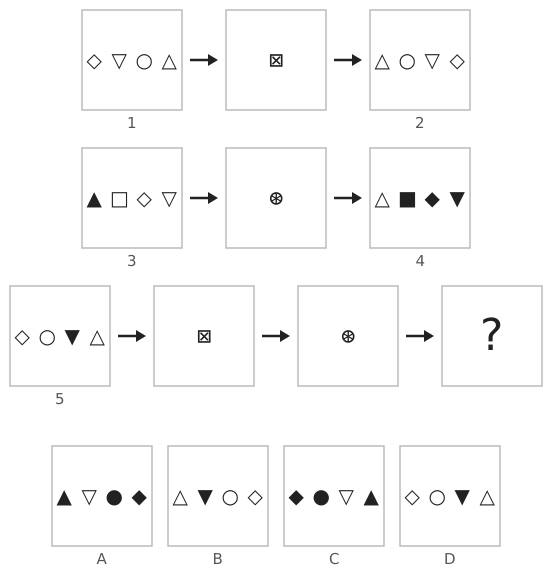
Which figure completes the chain?
Answer: A. Figure A
Each operator is fixed by its own worked row. Working the chain from left to right: ⊠ reverses the order of all four symbols, so ◇○▼△ becomes △▼○◇; ⊛ inverts the fill of every symbol, leaving all positions unchanged, so △▼○◇ becomes ▲▽●◆. The result is ▲▽●◆, which is Figure A. The other three figures are each what a different single mistake would give.
Question 23 of 24
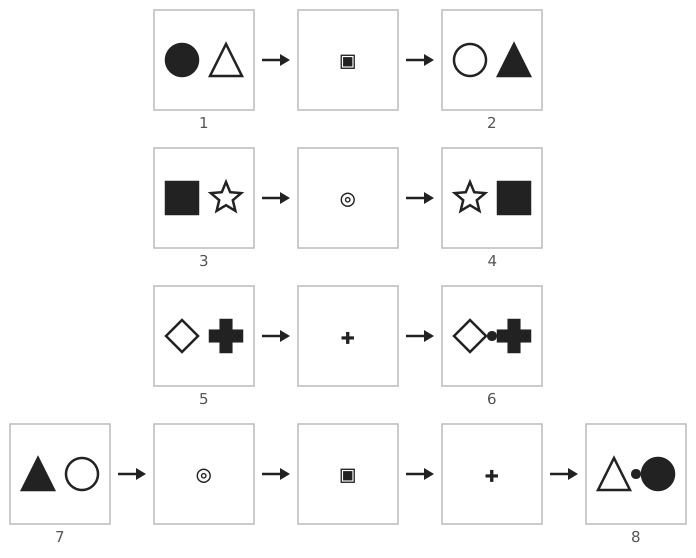
Rows 1 to 3 show each operator’s effect. Panel 8 shows the chain’s actual output. Which operator is malfunctioning?
Answer: B. Operator ◎
▣ inverts every element’s fill (panels 1 to 2), ◎ swaps the two shapes’ positions (panels 3 to 4), and ✚ adds a dot at the centre (panels 5 to 6). Applying the chain to panel 7 correctly: ◎ gives circle left, triangle right; ▣ then gives solid circle left, open triangle right; ✚ adds the dot. Panel 8 instead keeps the triangle on the left; the fills and the dot are right, but the swap never happened, so ◎ is malfunctioning: Operator ◎. The common error is answering None: panel 8 matches the chain with ◎ skipped, so checking only ▣ and ✚ makes the output look correct.
Question 24 of 24
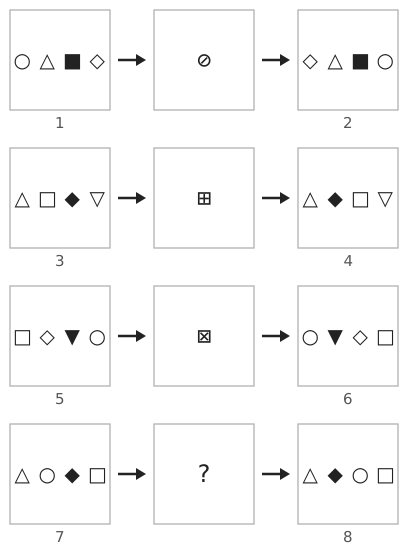
Panels 1 to 6 show what each operator does. Which operator turned panel 7 into panel 8?
Answer: B. Operator ⊞
Panel 7 becomes panel 8 by the rule that exchanges the two middle symbols, leaving the outer pair in place: △○◆□ becomes △◆○□. That is the rule the worked rows give for ⊞. Each of the other two operators, applied to the same panel, gives a different result, so only Operator ⊞ fits.






A Saville assessment is an online assessment from Saville Assessment, the UK publisher founded by Professor Peter Saville and independently owned since 2023, when Willis Towers Watson sold the business. Its aptitude range includes standalone tests and Swift combinations. Current Swift Analysis combinations take 18 to 24 minutes, while Swift Comprehension takes 9.5 to 16 minutes. The Wave questionnaires cover workplace personality and styles.
Which Saville test you sit depends on the employer and the role: an entry-level position will not be given the same assessment as a graduate or managerial one.
Four things to know before you sit one. Timings and difficulty vary with the level of the role.
Match the name in your invitation to the assessment below. Timings marked “approx.” are completion estimates; other published durations are limits for the named version.
| Assessment | What it measures | Questions | Timing |
|---|---|---|---|
| Swift Analysis Aptitude | Verbal, numerical, diagrammatic or abstract reasoning | 2 to 3 aptitude areas | 18 to 24 min |
| Swift Comprehension Aptitude | Verbal, numerical and error checking | 2 to 3 aptitude areas | 9.5 to 16 min |
| Swift Technical Aptitude | Spatial, mechanical and diagrammatic reasoning | 3 aptitude areas | 10 min |
| Swift Global Aptitude | Number reasoning, abstract reasoning and memory | 3 aptitude areas | 12 min |
| Swift Executive Aptitude | Numerical, verbal and abstract reasoning | 3 aptitude areas | 18 min |
| Single aptitude tests | Standalone verbal, numerical, checking and technical tests | Depends on test | See invitation |
| Wave Professional Styles | Work preferences, motives and talents | 216 statements | Approx. 40 min |
| Wave Focus Styles | A shorter work-style questionnaire | 72 statements | Approx. 13 min |
Counts and timings vary by role level and by the version an employer licences. Check the instructions on the screen before you start. Facts checked 11 September 2026.
Swift combinations have different timings from the standalone aptitude tests. Wave durations below are approximate completion times, not countdown limits. Check the precise test name in your invitation.
A visual guide to the skills and response formats covered on this page. Your invitation tells you which assessments to prepare for.
Illustrations by Practice Aptitude Tests · not official test screenshots
What is the percentage increase?
Short aptitude combinations include numerical tasks; the exact mix depends on the Swift version.
View guidanceFind the missing shape
Visual patterns test your ability to recognise rules and relationships.
“I enjoy exploring new ideas.”
A preference, not a right answer.
Rate work-related preferences; follow the questionnaire’s own response scale and ranking instructions.
If you know which company invited you, start there: the employer guide tells you which Saville assessment sits at which stage of that firm's process.
Not listed? Browse all employer guides.
The free test shows you the style. A pack gives you the pace: timed and marked, with the working shown.
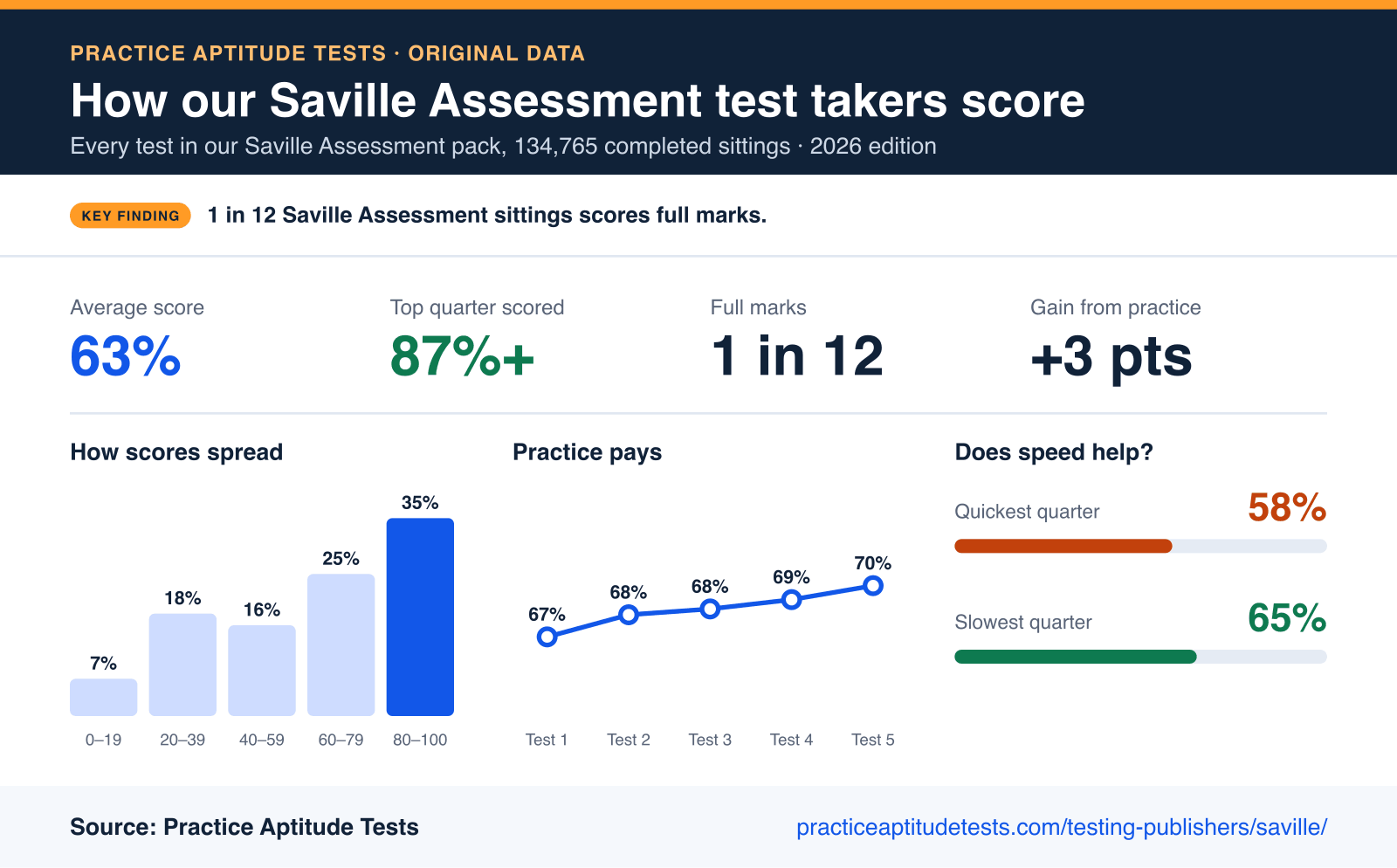
Practice Aptitude Tests · Original data
Results from every test in our Saville Assessment pack, past and present.
Key finding1 in 12 Saville Assessment sittings scores full marks.
35% scored 80% or more, and 24% scored under 40%.
Share of sittings in each score band.
Regular practisers went from 67% on their first test to 70% on their fifth.
4,951 people who took five or more tests.
Rushing costs marks. The quickest quarter scored 7 points lower than the slowest.
Typical pace: 43 seconds a question.
Saville is a trademark of its respective owner. Practice Aptitude Tests is not affiliated with Saville and our practice tests are not endorsed by them.