
Office Administrative Assistant Tests
Admin roles are usually screened with a situational judgement test, often with short numerical, verbal or error checking tests and a typing or spreadsheet check. Practise with a free situational judgement test set in admin work.
- 10 questions
- 13 minutes
- Worked solutions
Free · No sign-up · Scored the moment you finish
Administration Situational Judgement Test
You have 13 minutes to answer 10 questions. Each question describes a workplace situation and four possible responses. For every question, select the response you believe would be MOST effective and the response you believe would be LEAST effective. There are no trick questions; judge each response on how well it would work in the situation described.
About this test: this is one of a set of practice tests covering the areas Administration assessment processes typically include. It is written by us and is not any employer’s own assessment.
-
Question 1 of 10
You are a facilities coordinator for an office building. At 9am you learn that the lift has failed with nobody inside, that a meeting room booked for a client presentation at 10am has no working projector, and that the quarterly fire alarm test is scheduled for 11am. A wheelchair user works on the third floor and is due in at 9.30am. The lift engineer can attend within two hours if called now. Which response below would be most effective, and which would be least effective?
- Call the lift engineer immediately, tell the third-floor colleague and her manager before she travels in, then deal with the projector and confirm the alarm test.
- Deal with the projector and the alarm test as planned and wait to see whether the lift resets itself, since calling an engineer out is expensive and it may come back on its own.
- Sort the projector first since the client presentation is at 10am and is the nearest deadline, then call the lift engineer and confirm the alarm test.
- Call the lift engineer, then postpone the fire alarm test since a failed lift makes evacuation arrangements unreliable, and deal with the projector afterwards.
Show the answer
Most effective: A. Call the lift engineer immediately, tell the third-floor colleague and her manager before she travels in, then deal with the projector and confirm the alarm test.
Least effective: B. Deal with the projector and the alarm test as planned and wait to see whether the lift resets itself, since calling an engineer out is expensive and it may come back on its own.
B: Fails to escalate a genuine risk: it leaves a wheelchair user arriving at a building she cannot move around in, and gambles the two-hour repair window on the lift fixing itself, to save a call-out fee.
C: Substitutes own judgement for the stakeholder's: the projector is the nearest deadline and the smallest consequence. A colleague who cannot use the stairs is due in at 9.30 and the engineer's two-hour window starts only when he is called.
D: Escalates prematurely: postponing a scheduled alarm test is a decision with its own consequences, taken before anyone has checked whether the test is affected, while a colleague is still travelling in to a building she cannot get around.
The most effective response is to call the lift engineer immediately, tell the third-floor colleague and her manager before she travels in, then deal with the projector and the alarm test: the lift is the only item with both a closing window, the engineer’s two hours, and a person affected who is already travelling. Calling starts the clock, and warning her before she sets off is the part that cannot wait. The projector and the alarm test both still fit afterwards. It beats sorting the projector first for the 10am presentation, because that puts the smallest consequence first and leaves a colleague to discover on arrival that she cannot reach her desk. It beats calling the engineer and then postponing the fire alarm test, because postponing it is a further decision with its own effects, taken before checking whether it is even affected. The least effective response is waiting to see whether the lift resets itself to avoid a call-out charge: that spends the repair window and leaves a wheelchair user stranded on arrival. That is worse than the other two, which misorder the work but call the engineer. The principle: start the longest lead time first, warn the person affected before they are committed, and fit the rest around it.
-
Question 2 of 10
You are a junior designer at a graphic design studio. You and a colleague, Ines, are producing a brand pack due to the client on Friday. It is Wednesday. Ines has been given a second urgent project and tells you she can now only do about half her share of the brand pack. You have capacity for some but not all of the rest. Your studio manager assigns work and is in the office. Which response below would be most effective, and which would be least effective?
- Take on all of Ines's remaining share and work late Wednesday and Thursday so the brand pack is delivered on Friday as promised.
- Work out with Ines exactly what is left, then tell the studio manager today what the two of you can cover and what still needs someone, before Friday.
- Tell Ines the brand pack has to come first since it has a client deadline on Friday, and ask her to push back on the second project herself.
- Carry on with your own share and let Ines deliver what she can, and raise it on Friday if the brand pack turns out to be incomplete.
Show the answer
Most effective: B. Work out with Ines exactly what is left, then tell the studio manager today what the two of you can cover and what still needs someone, before Friday.
Least effective: D. Carry on with your own share and let Ines deliver what she can, and raise it on Friday if the brand pack turns out to be incomplete.
A: Hides the strain until failure: it absorbs a shortfall the studio manager created and never learns about, so she keeps assigning on the assumption that both projects fit.
C: Passes responsibility to others: the studio manager assigns the work, so asking Ines to argue about her own workload leaves the person who made the clash out of the conversation.
D: Hides the problem / silent deadline slip: it is known on Wednesday that the pack will be short, and the plan is to mention it on the day it is due, when nothing can be done. Waiting to report a certainty is concealment.
The most effective response is to work out with Ines exactly what is left, then tell the studio manager today what the two of you can cover and what still needs someone: the shortfall is known on Wednesday, its size can be worked out in ten minutes, and she both created the clash and is the only person who can resolve it. Bringing her the specifics rather than the problem lets her act. It beats taking on all of Ines’s remaining share and working late, because quietly absorbing the gap hides from the manager that two projects were assigned into one person’s week, so she does it again. It beats telling Ines to push back on the second project herself, because that leaves the person who assigns the work out of a conversation about her own assignment. The least effective response is letting Ines deliver what she can and raising it only if the pack turns out incomplete: it knows on Wednesday that Friday will fall short and plans to mention it when no resource can be added. That is worse than absorbing the work, which delivers, and worse than asking her to push back, which at least raises it. The principle: size the gap, then take it to whoever controls the resource while there is still time to fill it.
-
Question 3 of 10
You are a production planner at a commercial bakery. Tomorrow’s production schedule must be in the system by 5pm today; without it, the overnight shift bakes to last week’s quantities, and this week’s wholesale orders are noticeably different. This morning the owner asked you to prepare a costing summary he needs for a bank meeting at ten tomorrow morning; he is driving between suppliers all afternoon and cannot be reached. It is 2pm, each task takes about two hours, and you start at 7:30 tomorrow. Which response below would be most effective, and which would be least effective?
- Build the schedule now so it is in the system by 5pm, then leave the owner a message that his summary will be ready before his ten o'clock meeting, since the schedule's cut-off is fixed and the summary is not needed until mid-morning.
- Keep trying the owner's phone before committing to either task, so the person whose meeting it is chooses what comes first, and start immediately on whichever he picks once you get through.
- Spend the afternoon making the costing summary as strong as it can be, adding the comparison charts a bank is likely to ask for, since the loan decision matters more to the bakery's future than one night's baking quantities.
- Rough out both pieces of work in the time available, entering a part-finished schedule before 5pm and drafting the summary's headline figures, then complete whichever still needs work when you arrive at 7:30 tomorrow.
Show the answer
Most effective: A. Build the schedule now so it is in the system by 5pm, then leave the owner a message that his summary will be ready before his ten o'clock meeting, since the schedule's cut-off is fixed and the summary is not needed until mid-morning.
Least effective: C. Spend the afternoon making the costing summary as strong as it can be, adding the comparison charts a bank is likely to ask for, since the loan decision matters more to the bakery's future than one night's baking quantities.
B: Delays the decision: asking the owner would normally be right, but he is stated to be unreachable all afternoon, so time spent waiting for an answer burns down the one window in which the 5pm schedule can still be completed.
C: Gold-plates one task while the other burns: the summary has until mid-morning tomorrow, yet this option spends today's only remaining hours adding unrequested extras to it while the single fixed deadline (the 5pm schedule) is knowingly allowed to pass, sending the overnight shift to bake the wrong quantities.
D: Splits effort so nothing finishes: a part-finished schedule still leaves the overnight shift guessing on the lines you did not reach, and the drafted figures gain nothing from being started today, since the summary can be finished tomorrow morning before it is needed.
The most effective response is to build the schedule now and leave the owner a message that his summary will be ready before his ten o’clock meeting: the schedule’s 5pm cut-off is the only deadline that expires today, a whole shift bakes from it overnight, and a 7:30 start tomorrow still finishes the summary comfortably, so the defensible call is to protect the fixed deadline and say exactly when the rest will arrive. It beats trying the owner’s phone before committing to either task, because the stem says he is unreachable all afternoon, so the waiting itself is what puts the 5pm cut-off at risk. It beats roughing out both pieces of work and finishing tomorrow, because a part-finished schedule still leaves the overnight shift guessing on the unentered lines, while starting the summary early gains nothing that tomorrow’s spare half-hour does not already provide. The least effective response is spending the afternoon polishing the costing summary and adding comparison charts: unlike chasing the owner, which at least tries to get the right person deciding, and unlike roughing out both, which at least gets most of the schedule entered, it knowingly abandons the only fixed deadline to add polish nobody asked for to a task with hours of slack, so the whole overnight bake runs on wrong quantities. The principle: when a stakeholder is unreachable, protect the deadline that cannot move, make the defensible call, and communicate it. Waiting or polishing is a decision too, just an unowned one.
-
Question 4 of 10
You are a process operator at a waste water treatment works. Passing a monitoring screen that is not part of your round, you notice the outflow ammonia reading has been climbing steadily for three days and is close to the permitted limit. Exceeding it is reportable to the environmental regulator. The operator responsible is on leave. Your works manager is on site. Which response below would be most effective, and which would be least effective?
- Adjust the aeration settings yourself to bring the ammonia down, since the trend is clear and the limit is close.
- Take the three-day trend to your works manager now, show him the readings and how close they are to the limit, and let him decide what to do.
- Record the trend in the shift log so the operator responsible picks it up when he returns from leave next week.
- Leave it, since the screen is not on your round, the reading is still inside the permitted limit and the plant's alarms would trigger if it went over.
Show the answer
Most effective: B. Take the three-day trend to your works manager now, show him the readings and how close they are to the limit, and let him decide what to do.
Least effective: D. Leave it, since the screen is not on your round, the reading is still inside the permitted limit and the plant's alarms would trigger if it went over.
A: Acts outside own authority: changing process settings on a plant running near a permitted limit can drive the reading the wrong way, and the works manager has not been told the trend exists.
C: Delays the decision: the log reaches the right person on the wrong day. The reading is close to a reportable limit now, and next week is after any breach would have happened.
D: Fails to escalate a genuine risk: a three-day climb towards a reportable limit is exactly the signal that precedes a breach, and relying on the alarm means acting only once the limit has already been exceeded.
The most effective response is to take the three-day trend to your works manager now, show him the readings and how close they are to the limit, and let him decide: a steady climb towards a reportable limit is a developing breach rather than a stable reading, you are the only person who has noticed with the responsible operator away, and he can act today. It beats adjusting the aeration settings yourself to bring the ammonia down, because that is a process decision beyond your authority on a plant running close to a limit, and could make the reading worse. It beats recording the trend in the shift log for the operator returning next week, because that arrives after the breach it should have prevented. The least effective response is leaving it because the reading is still inside the permitted limit and the alarms would trigger: it waits for an alarm that by definition sounds only once the limit has been exceeded and the breach is already reportable. That is worse than the other two, which act wrongly or slowly but do act. The principle: a trend towards a limit is information somebody needs before the limit is reached, so take it to whoever can act while it is still preventable.
-
Question 5 of 10
You are a resourcing coordinator at a recruitment agency. A candidate you placed in a temporary warehouse role two weeks ago rings to say his shifts have been changed to nights without notice and he cannot do them because of childcare. Your agency’s contract with the client says shift patterns are agreed in advance. Your account manager, who owns the client relationship, is in a pitch until 4pm. The candidate is due on a night shift this evening. Which response below would be most effective, and which would be least effective?
- Get the details from the candidate, check the agreed pattern on the contract file, and put the facts to your account manager before 4pm so she can raise it with the client before tonight's shift.
- Tell the candidate that shift changes are between him and the site supervisor and that he should raise it there, since the agency only placed him and does not run the client's rotas.
- Ring the client's site supervisor yourself, point out that the contract requires shift patterns to be agreed in advance, and ask for the candidate to be put back on days from tonight.
- Tell the candidate not to attend tonight's night shift, since the change breaches the agreed pattern, and confirm to him that the agency will sort it out with the client afterwards.
Show the answer
Most effective: A. Get the details from the candidate, check the agreed pattern on the contract file, and put the facts to your account manager before 4pm so she can raise it with the client before tonight's shift.
Least effective: B. Tell the candidate that shift changes are between him and the site supervisor and that he should raise it there, since the agency only placed him and does not run the client's rotas.
B: Passes responsibility to others: the agreed pattern is in your agency's own contract, so this is exactly the agency's business. Sending a temporary worker to argue it alone with the site abandons the person you placed.
C: Substitutes own judgement for the stakeholder's: your account manager owns this relationship and a contractual challenge to the client is hers to frame. Making it yourself commits the agency to a position she has not seen.
D: Acts on assumptions without checking: it tells a worker to miss a shift before anyone has confirmed the pattern or spoken to the client, which risks his placement on a reading of the contract nobody senior has looked at.
The most effective response is to get the details, check the agreed pattern on the contract file, and put the facts to your account manager before 4pm: this is a contractual point the agency owns, it needs the person who owns the client relationship, and there is time to reach her before the shift. Gathering the facts first means she can act rather than investigate. It beats ringing the client’s site supervisor yourself, because a challenge to a client about their contract is the account manager’s to make, and pre-empting it commits the agency to a position she has not agreed. It beats telling the candidate not to attend tonight, because that risks his placement on your reading of a contract, before anyone has checked the agreed pattern or spoken to the client. The least effective response is telling him shift changes are between him and the site supervisor: it is the only response that denies the agency has any part in this, when the agreed pattern sits in the agency’s own contract, and it leaves a temporary worker to argue his own case against the site. That is worse than the other two, which are both wrong about who acts, but at least act. The principle: when something is genuinely yours to own, take it to the person who owns the relationship, with the facts, in time for them to use them.
-
Question 6 of 10
You are a receptionist at a serviced office building. At 9am a courier arrives needing a signature for a package marked urgent for one of the tenant companies. A visitor is waiting to be signed in for a 9am meeting. Your building manager has asked you to update the tenant contact list this morning, a job of about an hour with no fixed time. You are alone on the desk. Which response below would be most effective, and which would be least effective?
- Take the courier's package first since he is waiting to get on with his round, then sign the visitor in and update the contact list during the morning.
- Sign for the courier's package and tell the visitor to take a seat and wait until you have finished the contact list, since she can be signed in at any point.
- Start the contact list update since your building manager asked for it this morning, and deal with the courier and the visitor as you work through it.
- Sign the visitor in first since her meeting starts now, take the courier's signature next, and update the contact list once the desk is clear.
Show the answer
Most effective: D. Sign the visitor in first since her meeting starts now, take the courier's signature next, and update the contact list once the desk is clear.
Least effective: B. Sign for the courier's package and tell the visitor to take a seat and wait until you have finished the contact list, since she can be signed in at any point.
A: Acts on assumptions without checking: the courier's round is his schedule, not yours, while the visitor's meeting is at 9am. Serving whoever seems most impatient is not the same as judging what is time-critical.
B: Ignores the visitor's actual need: it makes someone who is due in a 9am meeting wait an hour for a task with no deadline, so the tenant's meeting is delayed to suit the reception desk.
C: Substitutes own judgement for the stakeholder's: an hour of internal admin with a whole morning available is put ahead of two people standing at the desk, one of them late for a meeting.
The most effective response is to sign the visitor in first since her meeting starts now, take the courier’s signature next, and update the contact list once the desk is clear: hers is the only fixed time on the desk, the signature takes seconds and the list has the whole morning. It beats taking the courier’s package first because he is waiting to get on with his round, since his hurry is about his own schedule while she is late for a meeting a tenant is holding. It beats starting the contact list because your building manager asked for it this morning, because an hour of internal admin should not precede two people standing at the desk. The least effective response is telling the visitor to take a seat until the contact list is finished: it makes someone due at a 9am meeting wait an hour so that a task with no deadline can be completed. That is worse than the other two, which mis-sequence but do not park someone deliberately. The principle: serve the fixed appointment first, then the quick task, then the work that can be done at any point.
-
Question 7 of 10
You are a reporter at a local newspaper. You and a colleague, Suzanne, have both been working on the same council story without realising it, and she has told a contact that the story is hers. The contact has now stopped returning your calls. The story is due to run this week and the editor does not know there has been any overlap. Which response below would be most effective, and which would be least effective?
- Speak to Suzanne today, work out what each of you has, agree who takes it forward and how the contact is approached, then tell the editor where the story stands.
- Drop your version and let Suzanne run with it, since the contact is talking to her now and arguing about who started first would only damage the newsroom.
- Tell the editor that Suzanne has claimed the story with your contact and ask him to decide which of you should take it forward.
- Go back to the contact directly, explain that you were working on the story first, and ask him to deal with you rather than with Suzanne.
Show the answer
Most effective: A. Speak to Suzanne today, work out what each of you has, agree who takes it forward and how the contact is approached, then tell the editor where the story stands.
Least effective: B. Drop your version and let Suzanne run with it, since the contact is talking to her now and arguing about who started first would only damage the newsroom.
B: Avoids the difficult conversation: it abandons work and material the story may need, so the paper runs a weaker piece and the duplication that caused it is never addressed. The editor never learns two reporters duplicated a week.
C: Escalates prematurely: Suzanne may not know you were working on it at all, and the editor's first knowledge of the overlap being a complaint makes an argument out of a misunderstanding.
D: Personalises the conflict: it asks a source to choose between two reporters from the same paper, which puts an internal muddle in front of a contact and is likely to lose him altogether.
The most effective response is to speak to Suzanne today, work out what each of you has, agree who takes it forward and how the contact is approached, then tell the editor where the story stands: two reporters have duplicated work on a story running this week, the fastest way to a good piece is to pool what you both have, and the editor needs an accurate picture rather than a complaint. Agreeing how the contact is approached also protects the source. It beats telling the editor she has claimed the story with your contact, because she may not know you were on it, and taking it upward first frames a misunderstanding as a dispute. It beats going back to the contact to say you were working on it first, because asking a source to choose between two reporters from the same paper exposes the muddle and risks losing him. The least effective response is dropping your version and letting her run with it: it discards material the story may need and leaves the duplication unexamined, so the paper runs a weaker piece and it happens again. That is worse than the other two, which handle it badly but keep both reporters’ work in play. The principle: sort out the overlap with your colleague first, protect the source, then give the editor the true position.
-
Question 8 of 10
You are a receptionist at a physiotherapy practice. At 11am the practice’s online booking system goes down; patients are ringing and cannot book. A patient in the waiting room needs her follow-up appointments arranged before she leaves, which takes ten minutes. Your practice manager wants the insurance paperwork for three patients completed today, taking an hour. The IT contractor answers within minutes when called. Which response below would be most effective, and which would be least effective?
- Take patients' details by phone and tell them the practice will call back to book when the system returns, without reporting the outage to the IT contractor.
- Book the waiting patient's follow-up appointments first since she is in front of you, then ring the IT contractor and start the insurance paperwork.
- Ring the IT contractor about the booking system straight away, book the waiting patient's follow-ups while you wait for them, and do the insurance paperwork afterwards.
- Start the insurance paperwork since your manager wants it today, and deal with the booking system and the waiting patient as the morning allows.
Show the answer
Most effective: C. Ring the IT contractor about the booking system straight away, book the waiting patient's follow-ups while you wait for them, and do the insurance paperwork afterwards.
Least effective: A. Take patients' details by phone and tell them the practice will call back to book when the system returns, without reporting the outage to the IT contractor.
A: Fails to escalate a genuine fault: it builds a manual workaround for an outage nobody has been told about, so the system stays down all day and the backlog grows with it.
B: Delays the decision: the contractor answers in minutes and then works in the background, so calling first costs almost nothing and starts a repair that every ringing patient is waiting on.
D: Substitutes own judgement for the stakeholder's: an hour of paperwork due at some point today is put ahead of a system outage affecting every patient trying to book and a patient waiting at the desk.
The most effective response is to ring the IT contractor about the booking system straight away, book the waiting patient’s follow-ups while you wait for them, and do the insurance paperwork afterwards: the contractor answers within minutes and then works in the background, so that call sets the longest-running fix going at almost no cost, and the ten minutes with the patient fits neatly into the wait. The paperwork has the rest of the day. It beats booking her follow-up appointments first because she is in front of you, since the call is the thing that unblocks everyone else and takes moments. It beats starting the insurance paperwork because your manager wants it today, because an hour of paperwork with a whole day available should not precede an outage affecting every patient trying to book. The least effective response is taking details by phone for a callback without reporting the outage at all: it manages the symptoms of a fault nobody has been told about, so it persists all day and the callback list grows. That is worse than the other two, which sequence badly but do not leave the fault unreported. The principle: start the fix with the longest lead time first, then use the waiting time for the people in front of you.
-
Question 9 of 10
You are an invigilator at a training centre running a professional certification exam. Ten minutes before the end, you see a candidate glance repeatedly at a phone in his lap. He is a colleague from your own department and you know he needs this qualification for a promotion. The exam rules require any suspected use of a device to be reported to the exam supervisor, who is in the next room. Which response below would be most effective, and which would be least effective?
- Note what you saw and report it to the exam supervisor as the rules require, letting her decide what happens.
- Say nothing at all, since he is a colleague, you cannot be certain what he was looking at, and reporting him could cost him a promotion.
- Walk over and stand near his desk so he puts the phone away, and say nothing afterwards since the exam ends in ten minutes and no harm will have been done.
- Quietly ask him after the exam whether he was using his phone, and report it to the supervisor only if he admits that he was.
Show the answer
Most effective: A. Note what you saw and report it to the exam supervisor as the rules require, letting her decide what happens.
Least effective: B. Say nothing at all, since he is a colleague, you cannot be certain what he was looking at, and reporting him could cost him a promotion.
B: Breaches process to protect a colleague: the rule requires suspected device use to be reported, and certainty is the supervisor's job to establish, not yours. Staying silent because of who he is undermines every other candidate in the room.
C: Prioritises harmony over honesty: it stops the behaviour and leaves the ten minutes already elapsed unexamined, so a candidate who may have gained an advantage keeps it and every other candidate is scored against him.
D: Acts on assumptions without checking the right thing: it makes the report depend on the candidate's own admission, which is the one account least able to settle it, and it happens after the exam has been collected.
The most effective response is to note what you saw and report it to the exam supervisor as the rules require: the rule asks you to report what you suspect, not to prove it, and she is next door and is the person who decides what it means. Reporting protects the other candidates and, if there is an innocent explanation, gives him a proper hearing rather than a rumour. It beats walking over and standing near his desk so he puts the phone away, because that stops the behaviour without addressing the ten minutes already passed, and leaves the result unsafe. It beats asking him afterwards whether he was using his phone and reporting only if he admits it, because making the report conditional on his own admission puts the decision in the hands of the person with most to lose. The least effective response is saying nothing at all because he is a colleague who could lose a promotion: it suppresses a suspected breach for exactly the interest the rule exists to remove. That is worse than the other two, which handle it badly but do not choose silence. The principle: report what the rule asks you to report, and let the person who owns the process establish what actually happened.
-
Question 10 of 10
You work behind the counter of a bakery. A customer ordered a birthday cake for collection at noon today with ‘Happy Birthday Amelie’ piped on it. It is 11am and you notice the cake in the fridge reads ‘Happy Birthday Amelia’. The decorator is in until 1pm and could re-pipe the inscription in twenty minutes. The customer’s phone number is on the order. Which response below would be most effective, and which would be least effective?
- Hand the cake over at noon as it is, since the difference is one letter, the customer may not notice and it is too late to change it now.
- Ring the customer, explain the spelling error, and ask whether she would like it corrected or would rather collect the cake as it is.
- Have the decorator re-pipe the inscription and say nothing about the error, since the cake will be correct by the time the customer collects it at noon.
- Ask the decorator to re-pipe the inscription now, and ring the customer to let her know it is being corrected and will be ready at noon as arranged.
Show the answer
Most effective: D. Ask the decorator to re-pipe the inscription now, and ring the customer to let her know it is being corrected and will be ready at noon as arranged.
Least effective: A. Hand the cake over at noon as it is, since the difference is one letter, the customer may not notice and it is too late to change it now.
A: Ignores the customer's actual need: a misspelled name on a child's birthday cake is the whole point of the order, and it is not too late, since the decorator is in and there is an hour. Relying on her not noticing is concealment of a known defect.
B: Delays the decision: it hands her a choice she does not need to make. The name is simply wrong, the decorator is in, and twenty minutes is available before noon.
C: Hides the problem: the outcome is right and the customer is never told that a cake with her daughter's name misspelled nearly went out, so she cannot check the spelling on the order for next time.
The most effective response is to ask the decorator to re-pipe the inscription now and ring the customer to say it is being corrected and will be ready at noon: the name is wrong, there is an hour and a decorator on site, so it can be put right and still be ready. Telling her means she is not surprised and can confirm the spelling. It beats ringing to ask whether she would like it corrected or would rather collect it as it is, because that puts a decision to her that does not need making, when the fix is already possible. It beats having it re-piped and saying nothing about the error, because that gets the cake right but leaves her unaware of a mistake that came from the order itself. The least effective response is handing it over as it is on the grounds that the difference is one letter she may not notice: it claims the change is too late when an hour and a decorator are available, and relies on a misspelled name on a child’s birthday cake going unremarked. That is worse than the other two, which both produce a correct cake. The principle: when there is time to put a mistake right, put it right and tell the customer you have.






What are Office Administration tests?
Office administration tests are the online assessments employers use to screen admin applicants. The most common is a situational judgement test, often alongside short verbal or numerical reasoning tests, and the job advert should say which ones you will take. In the Civil Service, for example, the Civil Service Judgement Test is not timed, but GOV.UK advises allowing at least an hour.
The tests you are likely to sit
The exact tests depend on the role, so check the job advert or your invitation. These are the ones office administration applicants most often meet.
| Assessment | What it measures |
|---|---|
| Situational judgement test | How you would handle typical office situations |
| Numerical reasoning test | Working accurately with figures, tables and percentages |
| Verbal reasoning test | Understanding and drawing conclusions from written information |
| Work styles questionnaire | How you prefer to behave and work |
| Error checking test | Spotting mistakes in data and text quickly |
| Typing or spreadsheet test | Practical speed and accuracy with office tasks |
Employer guides
If you know which company you are applying to, start with its guide: it covers the tests that employer sets and when.
- Civil ServiceVerbal, numerical and situational judgement tests
- HMRCProblem-solving and job-related skills tests
Not listed? Browse all employer guides.
Practise the real thing
Practice moves scores fastest on the tests set under time pressure, and every question in the pack comes with the working shown.
- 10
- practice tests
- 100
- questions, all solved
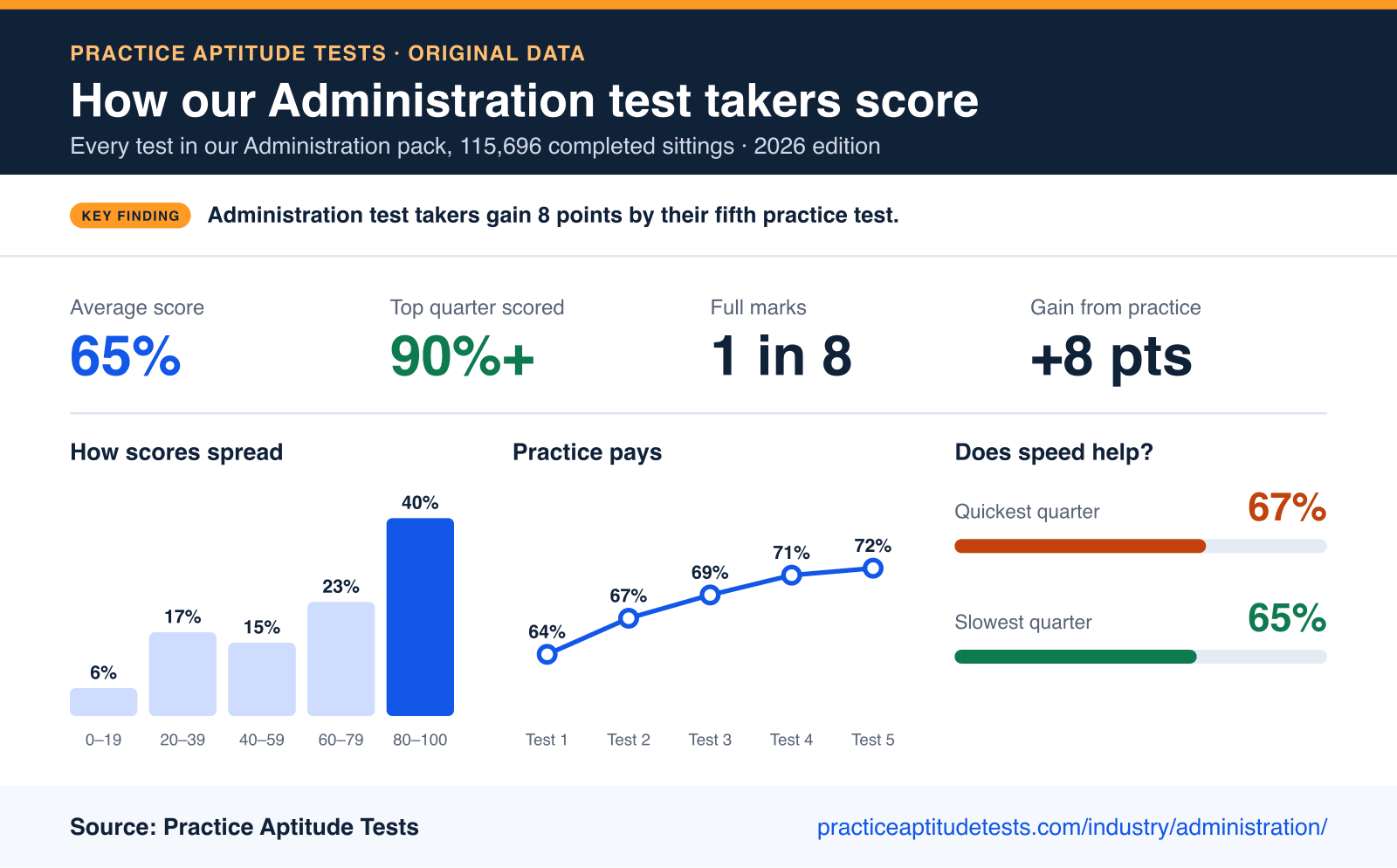
Practice Aptitude Tests · Original data
How our test takers score
Results from every test in our Administration pack, past and present.
Key findingAdministration test takers gain 8 points by their fifth practice test.
How scores spread
40% scored 80% or more, and 22% scored under 40%.
Share of sittings in each score band.
Practice pays
Regular practisers went from 64% on their first test to 72% on their fifth.
3,140 people who took five or more tests.
Does speed help?
Speed makes little difference here.
Typical pace: 36 seconds a question.
Share this data
Our practice tests mirror the formats used in Office Administration hiring. They are written by Practice Aptitude Tests and are not affiliated with or endorsed by any individual employer.