Illustrative example
80 Before→100 After
What is the percentage increase?
Numerical reasoning
Work out what numerical information tells you. Content and difficulty depend on the job level.
The abstract, numerical and verbal reasoning tests at three job levels, the timing guidance in your invitation, the Business Attitudes Questionnaire, and the report with an overall level and three sub-scores that the employer receives.
Free · No sign-up · Scored the moment you finish
The Hudson that publishes these tests is the Belgian one, based in Ghent and part of the Randstad Group since December 2021. Two other companies share the name and neither publishes them, so an invitation to a Hudson test is an invitation from this one. Its reasoning range covers verbal, numerical and abstract reasoning alongside specific skills including accuracy. Hudson do not publish how many questions their numerical test holds, and no total duration can be worked out without that, but they clock each question separately at about ninety seconds and move you on when it expires. This practice test gives you that same ninety seconds a question over ten questions, as one clock you can spend as you like, which makes it gentler than the real one.
You have 15 minutes to answer 10 questions. Every question carries one mark, the questions get harder as you go, and there is no penalty for a wrong answer, so answer every one. Calculators and rough paper are permitted.
Question 1 of 10
| Cause | Bags mishandled |
|---|---|
| Transfer | 486 |
| Loading | 312 |
| Ticketing | 162 |
| Other | 240 |
The table shows every bag Kirkbourne Handling mishandled at Newbold last month, by cause. What percentage of them were caused by transfer?
Answer: C. 40.5%
Add every cause to get the total, then take transfer as a share of it. 486 + 312 + 162 + 240 = 1,200 bags. 486 divided by 1,200 x 100 = 40.5%. A common error here is leaving the other row out of the total, which gives 50.6%. All four rows are mishandled bags, so all four belong in the denominator.
Question 2 of 10
Rowsley Handling charges Ryedale Airways £150 for each turnaround at Vernham, plus £2.60 for every passenger carried. One turnaround at Vernham carried 180 passengers. The invoice is settled in euros, and £1 buys €1.25. What is that turnaround’s invoice total in euros?
Answer: D. €772.50
Build the sterling invoice first, then convert it once. Passenger charge: 180 x 2.60 = £468.00. Sterling total: 150 + 468 = £618.00. 618.00 x 1.25 = €772.50. A common error here is stopping at £618.00 and reading it as euros. Another is dividing by 1.25 rather than multiplying, which gives €494.40; £1 buys €1.25, so a sterling figure is multiplied to reach euros.
Question 3 of 10
| Line | Units produced | Cost per unit (£) |
|---|---|---|
| Line A | 84,000 | 12.50 |
| Line B | 36,000 | 18.20 |
| Line C | 20,000 | 27.40 |
Taking every unit produced across the three lines as a single group, what is the mean cost per unit?
Answer: A. £16.09
Pooling every unit means weighting each cost by the volume behind it. Total cost: (84,000 x 12.50) + (36,000 x 18.20) + (20,000 x 27.40) = 1,050,000 + 655,200 + 548,000 = 2,253,200. Total units: 84,000 + 36,000 + 20,000 = 140,000. 2,253,200 ÷ 140,000 = £16.09. A common error here is averaging the three figures in the last column, giving £19.37: Line A makes three fifths of the units, so it must count for more.
Question 4 of 10
| Category | 2023 | 2024 | 2025 |
|---|---|---|---|
| Garden tools | 985 | 1,022 | 1,143 |
| Outdoor furniture | 1,240 | 1,550 | 1,798 |
| Plants | 2,380 | 2,905 | 3,570 |
| Barbecues | 655 | 702 | 838 |
What was the percentage change in Outdoor furniture orders between 2023 and 2025?
Answer: C. +45.0%
Percentage change = (new − old) ÷ old × 100, using the 2023 and 2025 columns directly; the 2024 column is not needed. (1,798 − 1,240) ÷ 1,240 × 100 = 558 ÷ 1,240 × 100 = +45.0%. A common error here is adding the two annual changes (25.0% + 16.0% = 41.0%, option b). Percentage changes compound, they do not add.
Question 5 of 10
| Lane | 06:00 | 07:00 | 08:00 | 09:00 |
|---|---|---|---|---|
| Lane 1 | 420 | 510 | 640 | 580 |
| Lane 2 | 380 | 465 | 605 | 540 |
| Lane 3 | 310 | 405 | 515 | 470 |
| All lanes | 1,110 | 1,380 | 1,760 | 1,590 |
An airport logs passengers through security by lane. How many passengers used Lane 2 in the 07:00, 08:00 and 09:00 hours?
Answer: C. 1,610
Read the Lane 2 row for the three named hour columns: 465 + 605 + 540 = 1,610 passengers. A common error here is stopping before the 09:00 column, 465 + 605 = 1,070 (option a). The 06:00 column and the All lanes row are not needed.
Question 6 of 10
| Cost line | Vernham (£) | Upwell (£) |
|---|---|---|
| Landing | 4,820 | 3,960 |
| Handling | 6,360 | 3,900 |
| Parking | 1,180 | 1,540 |
| Passenger charges | 2,460 | 2,120 |
The table shows Ryedale Airways’ station costs at two stations last month. What percentage of the Vernham total was handling?
Answer: D. 42.9%
Total the Vernham column first, then take handling as a share of it. 4,820 + 6,360 + 1,180 + 2,460 = £14,820. 6,360 divided by 14,820 x 100 = 42.9%. A common error here is dividing by the two stations’ combined total of £26,340, which gives 24.1%. The question asks about Vernham only, so the Upwell column stays out of both the numerator and the denominator.
Question 7 of 10
A building site mixes mortar from sand and cement in the ratio 5:2 by weight. How much sand is needed for 210 kg of mortar?
Answer: D. 150 kg
Total parts = 5 + 2 = 7. One part = 210 ÷ 7 = 30 kg. Sand = 5 × 30 = 150 kg. A common error here is giving the cement share, 60 kg (option b).
Question 8 of 10
| Firm | Capital resources (£m) | Risk-weighted assets (£m) |
|---|---|---|
| Northbank | 4.8 | 32.0 |
| Meridian | 3.6 | 30.0 |
| Calder | 2.1 | 12.0 |
A firm’s capital ratio is its capital resources as a percentage of its risk-weighted assets, and every firm must hold at least 11.5%. By how many percentage points does Meridian exceed that minimum?
Answer: B. 0.5
Work out the ratio, then measure it against the minimum. 3.6 ÷ 30.0 x 100 = 12.0%. 12.0 − 11.5 = 0.5 percentage points of headroom. A common error here is reading the Calder row and answering 6.0, which is Calder’s headroom rather than Meridian’s.
Question 9 of 10
| Court | Claims issued | Fee per claim |
|---|---|---|
| Ashfield | 1,600 | £145 |
| Calderbrook | 1,100 | £190 |
| Vanteuil | 1,500 | 253 euros |
| Rothenau | 900 | 322 euros |
Fees convert at £1 = 1.15 euros, and the court refunds the fee on 5% of the claims it issues. How much did the Vanteuil court collect in fees, after refunds, in pounds?
Answer: A. £313,500
Vanteuil charges in euros: 1,500 x 253 = 379,500 euros. The refunds take off 5%, leaving 95%: 379,500 x 0.95 = 360,525 euros. At £1 = 1.15 euros, 360,525 / 1.15 = £313,500. A common error here is stopping at the euro figure and reading it as pounds, which gives £360,525. The two sterling courts and the other euro court are not asked for.
Question 10 of 10
32, 25, 38. Find the highest and the lowest of these three numbers. Which of those two is further from the third number?
Answer: B. 25
The highest is 38 and the lowest is 25, and the third number is 32. 38 is 6 away from 32 and 25 is 7 away, so 25 is the further of the two.






A Hudson test is an online reasoning test from Hudson, the Belgian assessment publisher headquartered in Ghent and part of Randstad since 2021. Its abstract, numerical and verbal reasoning tests come at three job levels, from operational to senior management, and are timed multiple choice assessments usually taken online during screening. Personality and motivation questionnaires such as the Business Attitudes Questionnaire sit alongside the ability range.
Which Hudson test you sit depends on the employer and the role: an entry-level position will not be given the same assessment as a graduate or managerial one.
Four things to know before you sit one. Timings and difficulty vary with the level of the role.
Match the name in your invitation to the assessment below. Timings marked “approx.” are completion estimates; other published durations are limits for the named version.
| Assessment | What it measures | Questions | Timing |
|---|---|---|---|
| Hudson numerical reasoning | Ratios, percentages, number series, data interpretation, currency conversion | Varies by assessment | See invitation |
| Hudson verbal reasoning | A six to ten line passage, then true, false or cannot say | Varies by assessment | See invitation |
| Hudson abstract reasoning | Shapes, patterns and figures; which box comes next | Varies by assessment | See invitation |
| Business Attitudes Questionnaire | Five personality traits from rated statements | Varies by assessment | See invitation |
Counts and timings vary by role level and by the version an employer licences. Check the instructions on the screen before you start. Facts checked 11 September 2026.
Hudson adapts its assessment programme to the role and job level. Its public candidate guide does not specify universal question counts or a 90-second allowance; check your invitation.
A visual guide to the skills and response formats covered on this page. Your invitation tells you which assessments to prepare for.
Illustrations by Practice Aptitude Tests · not official test screenshots
What is the percentage increase?
Work out what numerical information tells you. Content and difficulty depend on the job level.
“A delivery arrives at 2 pm.”
Use written information to select a supported answer.
Find the missing shape
Solve visual problems that assess reasoning beyond previous job knowledge.
The free test shows you the style. A pack gives you the pace: See invitation a question, marked, with the working shown.
Practice Aptitude Tests · Original data
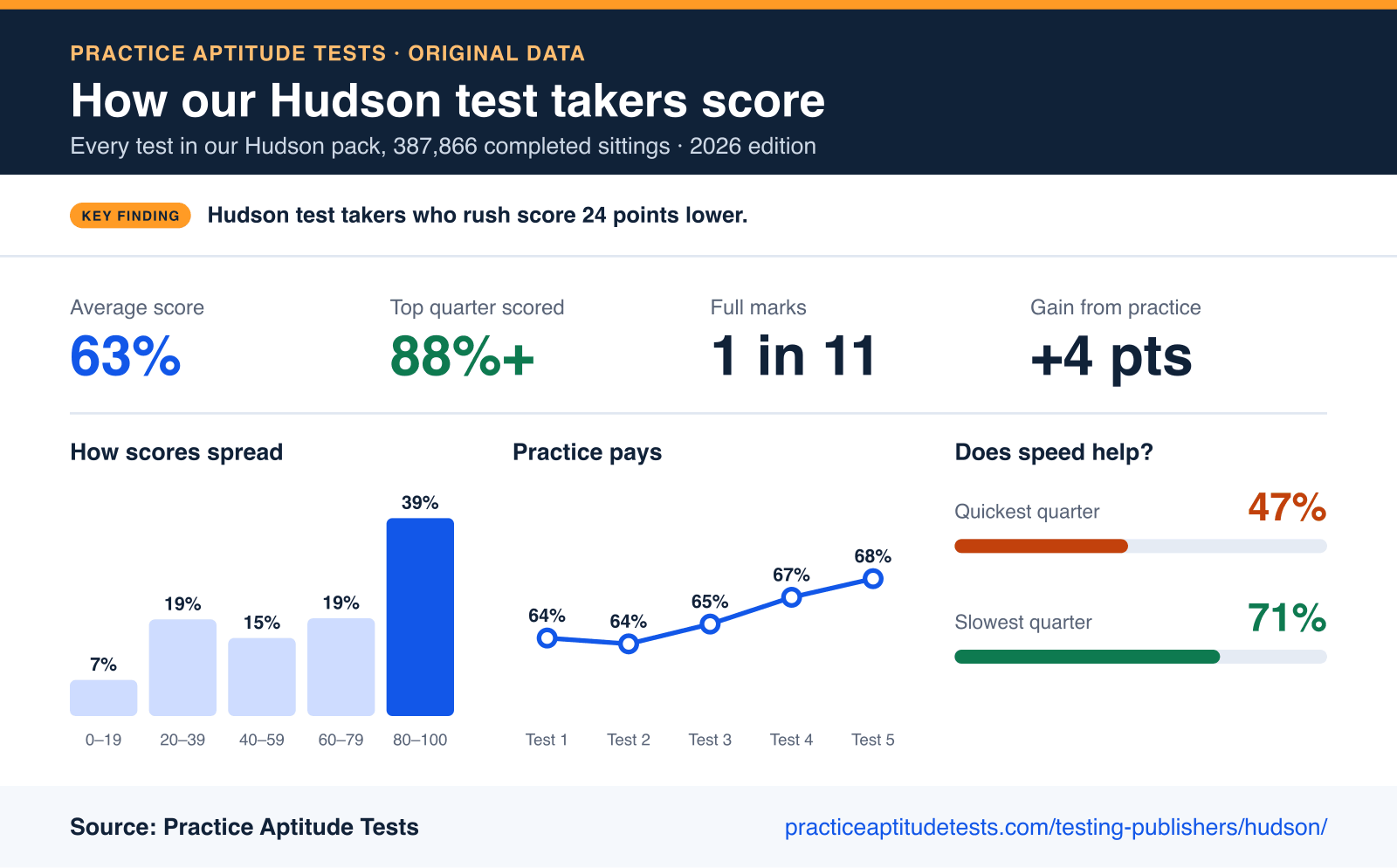
Results from every test in our Hudson pack, past and present.
Key findingHudson test takers who rush score 24 points lower.
39% scored 80% or more, and 26% scored under 40%.
Share of sittings in each score band.
Regular practisers went from 64% on their first test to 68% on their fifth.
5,394 people who took five or more tests.
Rushing costs marks. The quickest quarter scored 24 points lower than the slowest.
Typical pace: 50 seconds a question.
Hudson is a trademark of its respective owner. Practice Aptitude Tests is not affiliated with Hudson and our practice tests are not endorsed by them.