
Army Tests
Army candidates take the Army Cognitive Test, team tasks and an interview at an Army Assessment Centre. Practise with a free situational judgement test set in armed forces work.
- 10 questions
- 13 minutes
- Worked solutions
Free · No sign-up · Scored the moment you finish
Armed Forces Situational Judgement Test
You have 13 minutes to answer 10 questions. Each question describes a workplace situation and four possible responses. For every question, select the response you believe would be MOST effective and the response you believe would be LEAST effective. There are no trick questions; judge each response on how well it would work in the situation described.
About this test: this is one of a set of practice tests covering the areas Armed Forces assessment processes typically include. It is written by us and is not any employer’s own assessment.
-
Question 1 of 10
You are an exercise support assistant and you keep the site register of completed pre-use checks. Yesterday you entered all twelve stands as checked, signed off by the safety officer. Overnight a storm brought branches down across four of them. The safety officer has already ruled that those four must be rechecked and has booked to do it on Friday. Groups use the stands on Monday. Which response below would be most effective, and which would be least effective?
- Record all twelve as checked on Monday's register, since the entries were properly made yesterday and the officer is rechecking four of them on Friday anyway.
- Ask the safety officer to bring the recheck forward from Friday to today, and leave the register untouched until you know which day it happens on.
- Add a note to the four entries saying that a storm passed overnight, and leave the entries themselves standing until the officer has been out on Friday.
- Mark the four entries as superseded today and note the officer's Friday recheck against them, so the register shows which stands have actually been checked as they now stand.
Show the answer
Most effective: D. Mark the four entries as superseded today and note the officer's Friday recheck against them, so the register shows which stands have actually been checked as they now stand.
Least effective: A. Record all twelve as checked on Monday's register, since the entries were properly made yesterday and the officer is rechecking four of them on Friday anyway.
A: Records a check that no longer describes the stands: the register is what anybody reads to know what has been inspected, and it will say twelve when four have not been looked at since the storm.
B: Waits on a date before recording anything: the officer may well come today, and until then the register says twelve stands are checked and nobody has flagged the four.
C: Annotates rather than corrects: a note beside an entry that still reads checked is not what somebody scanning the register for Monday's stands actually sees.
The most effective response is marking the four entries as superseded today and noting the officer’s Friday recheck against them, so the register shows which stands have actually been checked as they now stand. The officer has already ruled on the four, Friday is booked, and the register’s job between now and then is to say which stands that ruling covers. It beats adding a note that a storm passed overnight while leaving the entries themselves standing, because an entry that still reads checked is what a reader takes from it. It beats asking the safety officer to bring the recheck forward and leaving the register untouched until you know which day it happens on, because the register stays wrong while the date is settled. The least effective response is recording all twelve as checked on Monday’s register: it is made to say twelve stands are checked when four have not been seen since the storm, which is a different kind of wrong from recording it awkwardly. The principle: when events undo finished work, the record is corrected first and the rest follows.
-
Question 2 of 10
You are an exercise support assistant. Putting together next week’s stand timings, you need the vehicle plan from one colleague and the ground allocation from another. The two fell out a fortnight ago and now send everything through you. Each is waiting for the other’s part before finalising their own. The timings are due on Thursday. Which response below would be most effective, and which would be least effective?
- Put the two of them in a room together on Wednesday morning to settle the vehicle plan and the ground allocation between them at the same time.
- Ask each of them separately for the one piece you need from them by Wednesday, and make it clear that you are not asking either to deal with the other.
- Draft both parts yourself from last month's plan and ask each of them only to confirm their own section, so that nothing has to pass between them at all.
- Tell each of them what the other has been saying about the delay, in front of the rest of the office, so that neither can go on blaming the other for Thursday.
Show the answer
Most effective: B. Ask each of them separately for the one piece you need from them by Wednesday, and make it clear that you are not asking either to deal with the other.
Least effective: D. Tell each of them what the other has been saying about the delay, in front of the rest of the office, so that neither can go on blaming the other for Thursday.
A: Forces a reconciliation the task does not need: neither part actually depends on the other, and a meeting risks Thursday on whether two people can be civil.
C: Does their work to avoid the friction: last month's plan is not this week's, and a confirmation of somebody else's draft is not the same as their own allocation.
D: Personalises the conflict in public: the timings are no closer, the falling out now has an audience, and two people who were merely not speaking have been given something new to be angry about.
The most effective response is asking each of them separately for the one piece you need by Wednesday, making clear that you are not asking either to deal with the other. Neither part actually needs the other, so the deadlock is a belief rather than a dependency, and saying so directly to each of them dissolves it. It beats putting the two of them in a room together on Wednesday morning to settle the vehicle plan and the ground allocation between them, because it stakes Thursday on a reconciliation nobody has asked for. It beats drafting both parts yourself from last month’s plan and asking each only to confirm their own section, because a confirmed draft is not their plan. The least effective response is telling each of them what the other has been saying, in front of the rest of the office: the deadlock is untouched and a private falling out has been made a public one. The principle: separate what the work needs from what the argument is about, and never take the argument to an audience.
-
Question 3 of 10
You are a candidate liaison assistant. An applicant rings and asks you to tell him how he scored on last week’s reasoning tests. Scores are not released to applicants, and you can see them on your screen. He says he wants to know whether to keep applying elsewhere. Which response below would be most effective, and which would be least effective?
- Tell him scores are not released and leave it there, since the rule is clear and there is nothing else about it that you are able to discuss with him.
- Assure him that his scores were fine and that he has nothing to worry about, so that he stops asking for a number you are not allowed to give him.
- Tell him plainly that scores are never released, explain what he will be told and when, and say that applying elsewhere in the meantime costs him nothing here.
- Offer to ask whether his scores can be released to him this once, given that he is trying to make a decision about other applications.
Show the answer
Most effective: C. Tell him plainly that scores are never released, explain what he will be told and when, and say that applying elsewhere in the meantime costs him nothing here.
Least effective: B. Assure him that his scores were fine and that he has nothing to worry about, so that he stops asking for a number you are not allowed to give him.
A: Answers the rule and not the question: what he actually asked is whether to keep applying elsewhere, and that has an answer you are allowed to give.
B: Gives an assurance the role forbids: it is a score in all but the digits, and he may stop applying elsewhere on the strength of a reassurance nobody authorised.
D: Raises a hope the rule will not meet: scores are never released, so the question is asked only to come back refused a week later.
The most effective response is telling him plainly that scores are never released, explaining what he will be told and when, and saying that applying elsewhere in the meantime costs him nothing here. The score is genuinely not his to have, and the decision he is trying to make can be helped by two facts you are free to give. It beats telling him scores are not released and leaving it there as the end of what you can discuss, because that stops at the rule and ignores the question. It beats offering to ask whether his scores can be released to him this once, because it raises a hope that has no chance. The least effective response is assuring him his scores were fine and he has nothing to worry about: he is given a reassurance about the very thing that may not be given, and he may act on it by stopping his other applications. The principle: when you cannot give the thing asked for, give the truth and whatever else actually helps.
-
Question 4 of 10
You are a families office assistant. A parent rings about the childcare grant and says she will apply after her course starts in October. The stated rule is that applications must be in before the course begins, and late ones are not considered until the following year. She is planning around October. Which response below would be most effective, and which would be least effective?
- Assure her that applying in October will be fine: plenty of people apply once their course is under way, and the office is not usually strict about the order of things.
- Send her the guidance notes so that she can read the timing rule for herself and see that it has to be in before the course starts.
- Make a note to ring her back in September to check she has applied, and leave her to carry on with her own plan in the meantime.
- Tell her on this call that the application has to be in before the course starts, so she has the weeks between now and October to get it in rather than losing a year.
Show the answer
Most effective: D. Tell her on this call that the application has to be in before the course starts, so she has the weeks between now and October to get it in rather than losing a year.
Least effective: A. Assure her that applying in October will be fine: plenty of people apply once their course is under way, and the office is not usually strict about the order of things.
A: Gives an assurance the rule contradicts: she plans around October on the strength of it, and the consequence of being wrong is that she waits a full year.
B: Sends the document instead of the message: she has already told you her plan, and a set of notes may not be read before October arrives.
C: Sets a reminder in place of a correction: September is close to the deadline, and she spends the summer believing October is available to her.
The most effective response is telling her on this call that the application has to be in before the course starts, so she has the weeks between now and October to get it in rather than losing a year. She is on the telephone, she has told you her plan, and the plan costs her a year, so the correction belongs in this call. It beats sending her the guidance notes so she can read the timing rule for herself, because guidance notes may not be read in time. It beats making a note to ring her back in September to check she has applied, because she spends the summer planning around a date that does not work. The least effective response is assuring her that applying in October will be fine because the office is not usually strict: she is told a rule does not apply when it does, and the price of believing it is a year. The principle: correct a misreading in the conversation where you found it.
-
Question 5 of 10
You are a recruitment office assistant. An applicant has emailed to say he is bringing his passport to Thursday’s document check. The stated requirement is a passport and a birth certificate, and people without both are turned away and rebooked six weeks out. He has misread it. He lives four hours away. Which response below would be most effective, and which would be least effective?
- Send him the standard requirements page again without comment, since it contains both documents and he will see the difference when he reads it properly.
- Reply today setting out both documents, so that he has three days to find the birth certificate rather than four hours of travelling for nothing.
- Leave it, on the ground that the requirement was set out plainly in what he was sent and that reading it is not yours to do for every applicant.
- Ring him on Thursday morning before he sets off, to check that he has everything he needs for the document check that afternoon.
Show the answer
Most effective: B. Reply today setting out both documents, so that he has three days to find the birth certificate rather than four hours of travelling for nothing.
Least effective: C. Leave it, on the ground that the requirement was set out plainly in what he was sent and that reading it is not yours to do for every applicant.
A: Resends what has already been misread: nothing in the page has changed, and the reason he got it wrong the first time is untouched.
C: Declines to act on something you have already noticed: the requirement was indeed clear, and the one person who has spotted that he has misread it lets him travel four hours to be turned away.
D: Leaves it to the morning: a birth certificate cannot be found in the hour before a four hour drive, and the three days that would have been useful are gone.
The most effective response is replying today setting out both documents, so he has three days to find the birth certificate rather than four hours of travelling for nothing. He has misread it, you have seen that he has, and three days is enough to find a document that an hour is not. It beats sending him the standard requirements page again without comment on the basis that he will see the difference, because resending an unread page changes nothing. It beats ringing him on Thursday morning before he sets off to check he has everything, because Thursday morning is too late to find a certificate. The least effective response is leaving it because the requirement was set out plainly in what he was sent: that is true and irrelevant, and a man drives four hours to be turned away by the one office that could have stopped it. The principle: whether somebody should have understood has nothing to do with whether you can still help.
-
Question 6 of 10
You are a selection centre assistant and you keep the waiting list for cancelled interview slots. It runs strictly in the order people joined it. An applicant twelfth on the list emails to say he is being posted abroad for work in three weeks and asks to be moved up. Two slots have come free for next week. Which response below would be most effective, and which would be least effective?
- Offer him the first slot that comes free after these two, and tell the eleven ahead of him that a posting case has been raised so that nobody is surprised.
- Leave the list as it is and assume he will raise it again if the posting really does make next week his only chance at an interview this year.
- Ask him for the dates of the posting and put the case to whoever owns the list, so a decision about jumping eleven people is made by somebody who can make it.
- Reply that the list runs strictly in order and cannot be changed, so that everybody on it is treated the same way whatever their circumstances.
Show the answer
Most effective: C. Ask him for the dates of the posting and put the case to whoever owns the list, so a decision about jumping eleven people is made by somebody who can make it.
Least effective: B. Leave the list as it is and assume he will raise it again if the posting really does make next week his only chance at an interview this year.
A: Invents a middle answer: it is open and it still changes the order on one applicant's unverified account, which is the decision the list's owner exists to take.
B: Assumes the applicant will come back: he has already asked once, two slots are free next week, and nothing about his request reaches anybody who could decide it.
D: Applies the rule and stops there: whether the list can flex for a posting is a real question, and it is answered without being put to anybody who could answer it.
The most effective response is asking him for the dates of the posting and putting the case to whoever owns the list, so a decision about jumping eleven people is made by somebody who can make it. A posting abroad may well be a good reason to move somebody up, and it is not your decision, so the useful act is to get it in front of the person it belongs to. It beats replying that the list runs strictly in order and cannot be changed whatever the circumstances, because that refuses without asking. It beats offering him the first slot that comes free after these two and telling the eleven ahead of him a posting case has been raised, because it changes the order on an account nobody has checked. The least effective response is leaving the list as it is and assuming he will raise it again: two slots go to the ordinary order while a request that might have changed it sits unanswered on your desk. The principle: when a rule might reasonably bend, the person who owns the rule decides, and your job is to ask them.
-
Question 7 of 10
You are a recruit. Your section has to hand in a written exercise by four o’clock, and you have also promised to help another recruit prepare for the fitness reassessment he has to pass tomorrow. Both need the rest of the afternoon. He cannot practise without somebody timing him and the exercise is marked for the whole section. Which response below would be most effective, and which would be least effective?
- Ask him to find somebody else to time him this afternoon, and offer to go through the reassessment with him after five if he still wants it.
- Pass the timing on to somebody else in the section, so that he turns up this afternoon and finds a recruit he never asked for waiting instead of you.
- Time him for twenty minutes now and finish the section's exercise afterwards, so that he gets something and four o'clock is still met.
- Finish the section's exercise first because four o'clock is fixed and the whole section is marked on it, and tell him now that you can time him at five.
Show the answer
Most effective: D. Finish the section's exercise first because four o'clock is fixed and the whole section is marked on it, and tell him now that you can time him at five.
Least effective: B. Pass the timing on to somebody else in the section, so that he turns up this afternoon and finds a recruit he never asked for waiting instead of you.
A: Puts the finding on him: he has to arrange his own timer at short notice, when you already know you are free at five.
B: Passes a promise on to a third party: somebody does time him, and the person the promise was made to finds out you are not coming by arriving and meeting a stranger.
C: Splits the promise rather than moving it: twenty minutes is not a reassessment session, and five o'clock was available and would have given him a whole one.
The most effective response is finishing the section’s exercise first because four o’clock is fixed and the whole section is marked on it, and telling him now that you can time him at five. Four o’clock cannot move and the reassessment can, so protecting the deadline and moving the timing to five costs him nothing at all. It beats timing him for twenty minutes now and finishing the exercise afterwards, because twenty minutes is not the session he needs and five o’clock was free. It beats asking him to find somebody else to time him this afternoon and offering to go through it after five, because it makes him do the arranging. The least effective response is passing the timing on to somebody else in the section: the promise is handed over and the person it was made to finds out by turning up. The principle: reschedule the thing that can move, and tell the person waiting before they are waiting.
-
Question 8 of 10
You are a unit administration assistant and you keep the leave record. You are also the only person who reconciles it at the end of each quarter. Doing this quarter’s reconciliation you find a day you took in June that was never entered against your own allowance. Nobody has queried it and nobody else checks the figures. Which response below would be most effective, and which would be least effective?
- Enter the June day against your allowance and say nothing about it, so the record is right from now on and nobody has to be told there was ever a gap.
- Enter the June day against your own allowance and tell the person who signs the reconciliation that you found and corrected it, so the correction is on the record as yours.
- Record the quarter as checked and complete with the June day left out, since the figures balance without it and you are the only person who will ever look at them.
- Leave June as it stands and raise at the next quarter that days are going unrecorded, so the process gets looked at rather than one person's allowance.
Show the answer
Most effective: B. Enter the June day against your own allowance and tell the person who signs the reconciliation that you found and corrected it, so the correction is on the record as yours.
Least effective: C. Record the quarter as checked and complete with the June day left out, since the figures balance without it and you are the only person who will ever look at them.
A: Corrects the number and hides the correction: the figure ends up right, and the person signing it off cannot see that the reconciliation found anything at all.
C: Records a reconciliation you know to be untrue: the whole worth of the figure is that somebody checked it, and the only person who checks has quietly excluded their own day from it.
D: Turns your own case into a general point: the process question is real, and the day still sits unrecorded in the record you are responsible for.
The most effective response is entering the June day against your own allowance and telling the person who signs the reconciliation that you found and corrected it. The day is yours, the record is yours, and the one thing that makes a correction credible is that somebody other than you knows it was made. It beats entering the June day and saying nothing so that nobody has to be told there was ever a gap, because a silent correction by the only checker cannot be told from no correction at all. It beats leaving June as it stands and raising at the next quarter that days are going unrecorded, because a process point does not put the day back. The least effective response is recording the quarter as checked and complete with the June day left out: a reconciliation is signed as done while the one discrepancy in it is left out by the person doing it. The principle: when you are both the subject and the checker, the correction has to be visible to somebody else.
-
Question 9 of 10
You are a welfare office assistant. Two things are due by four o’clock. A hardship payment form has to reach the finance team or a family waits another fortnight for money they have asked about twice. A room booking for tomorrow’s support session lapses at four and eight people are expected. Each takes two hours and it is now half past one. Which response below would be most effective, and which would be least effective?
- Do the hardship form first because the fortnight cannot be given back, and ring the room desk now to say the booking will be late and ask what happens if it lapses.
- Do the hardship form and ask a colleague to make the room booking before four, giving them the time and the number expected as you hand it over.
- Do the hardship form, then rebook the room tomorrow morning for an hour later and tell the eight people that the session has moved.
- Do the hardship form and assume the room booking will hold until the morning, since bookings are rarely released the moment they lapse and somebody usually sorts the room out.
Show the answer
Most effective: A. Do the hardship form first because the fortnight cannot be given back, and ring the room desk now to say the booking will be late and ask what happens if it lapses.
Least effective: D. Do the hardship form and assume the room booking will hold until the morning, since bookings are rarely released the moment they lapse and somebody usually sorts the room out.
B: Delegates a booking you understand better: the colleague can make it, and the room desk's questions about the session will reach somebody who cannot answer them.
C: Buys certainty with other people's time: the session does happen, and eight people are moved for something a telephone call this afternoon might have prevented.
D: Assumes somebody else has it: the four o'clock lapse is stated, eight people are expected tomorrow, and nobody has been asked whether the room will still be there.
The most effective response is doing the hardship form first because the fortnight cannot be given back, and ringing the room desk to say the booking will be late and ask what happens if it lapses. The fortnight is the only loss here that cannot be recovered, and a call costs nothing and may save the room as well. It beats asking a colleague to make the room booking before four, because the room desk will ask about the session and the colleague cannot answer. It beats rebooking the room tomorrow morning for an hour later and telling the eight people the session has moved, because it moves eight people before trying to save the booking. The least effective response is assuming the room booking will hold until the morning because bookings are rarely released at once: it protects the right thing and then leaves the room to chance, when one call would have settled whether eight people have anywhere to sit. The principle: when you cannot do both, protect what cannot be recovered and check the other rather than assuming it.
-
Question 10 of 10
You are an expedition support assistant. A group of twelve leaves at six tomorrow morning. Packing the stores this afternoon in a hurry, you realise the food you loaded is for four days and the itinerary is five. There is a resupply point on day three that would have to be arranged tonight. The person who arranges it goes home at six and it is now half past five. Which response below would be most effective, and which would be least effective?
- Load the four days as they are and hope it will not be noticed: the group can spread the food out, and the mistake is yours to fix quietly.
- Ring the person who arranges resupply in the next half hour and say plainly that you loaded four days instead of five, so that there is time to get day five covered.
- Buy a day's food from the town shop first thing in the morning and put it on the vehicle, telling the leader at six exactly what happened and what you have done.
- Tell the expedition leader now that the food is a day short, and leave the leader to decide whether to raise it with the resupply desk before six o'clock.
Show the answer
Most effective: B. Ring the person who arranges resupply in the next half hour and say plainly that you loaded four days instead of five, so that there is time to get day five covered.
Least effective: A. Load the four days as they are and hope it will not be noticed: the group can spread the food out, and the mistake is yours to fix quietly.
A: Conceals your own error: the resupply that would fix it has to be arranged tonight by somebody who leaves in half an hour, so the quiet fix does not exist after six o'clock.
C: Solves it out of your own pocket: the group is fed and the unit's own resupply arrangement, which exists for precisely this, is never used or told.
D: Passes responsibility to others: it is honest, and it spends the half hour that is left routing the problem through somebody who then has to make the same call you could make now.
The most effective response is ringing the person who arranges resupply in the next half hour and saying plainly that you loaded four days instead of five. There are thirty minutes before the only person who can cover the missing day goes home, and the shortest route to him is your own account of what happened. It beats telling the expedition leader now and leaving him to decide whether to raise it with the resupply desk, because that spends the last half hour passing the problem through somebody who cannot arrange resupply either. It beats buying a day’s food from the town shop first thing in the morning and putting it on the vehicle, because the arrangement that exists for exactly this is bypassed and paid for privately. The least effective response is loading the four days as they are and hoping it will not be noticed: twelve people leave at six a day’s food short, and the reason nobody can fix it is that nobody has been told. The principle: a mistake found while there is still time is a message you make immediately, and owning it costs less than the hour it buys.
What are Army tests?
Army tests are the assessments British Army soldier candidates take at an Army Assessment Centre over three days and two nights. They include medical checks, computer-based tests, fitness and team tasks and an interview. Everyone sits the Army Cognitive Test, a series of five tests whose score decides which jobs you can apply for.
The tests you are likely to sit
Every applicant takes these. Your invitation will tell you when each one is due.
| Assessment | What it measures |
|---|---|
| Army Cognitive Test | Five tests; your score sets which jobs you can apply for |
| Team tasks | How you work with others on practical tasks |
| Interview | Your motivation and suitability for Army life |
Practise the real thing
Practice moves scores fastest on the tests set under time pressure, and every question in the pack comes with the working shown.
- 10
- practice tests
- 100
- questions, all solved
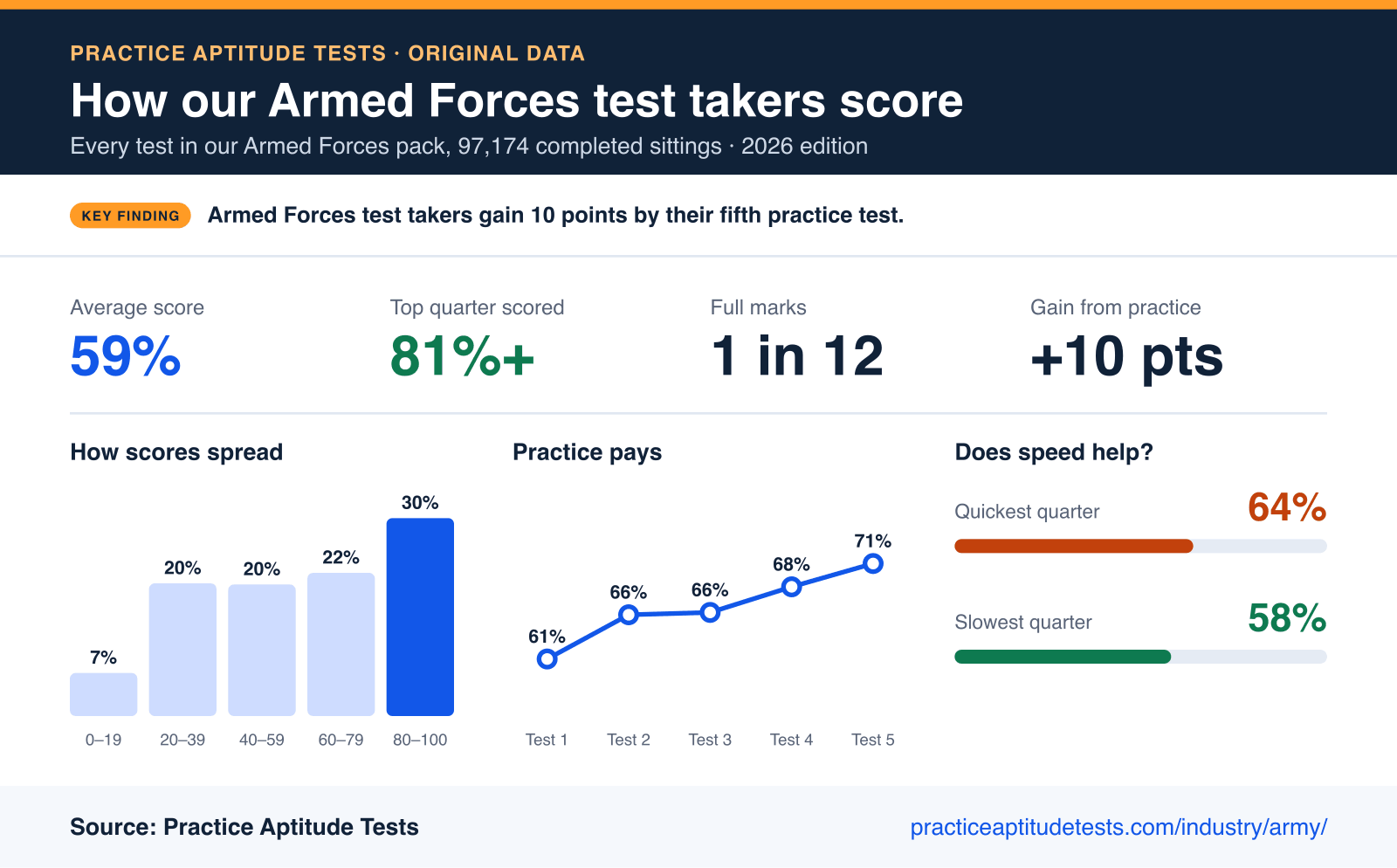
Practice Aptitude Tests · Original data
How our test takers score
Results from every test in our Armed Forces pack, past and present.
Key findingArmed Forces test takers gain 10 points by their fifth practice test.
How scores spread
30% scored 80% or more, and 27% scored under 40%.
Share of sittings in each score band.
Practice pays
Regular practisers went from 61% on their first test to 71% on their fifth.
2,047 people who took five or more tests.
Does speed help?
Speed pays here. The quickest quarter scored 6 points higher than the slowest.
Typical pace: 47 seconds a question.
Share this data
Our practice tests mirror the formats used in Army hiring. They are written by Practice Aptitude Tests and are not affiliated with or endorsed by any individual employer.