


Clear questions and good graphics
I liked how the questions were framed. I also thought the graphics were fairly easy to understand. I wish there could be more questions, and that it would score you as you go.
Forces, gears, levers, pulleys, springs and electrical circuits, in the formats employers actually set. Every question below comes with the principle explained, not just the answer.
Free · No sign-up · Scored the moment you finish






A mechanical reasoning test measures how well you apply basic physical and mechanical principles to practical problems. Employers use it for technical, engineering and skilled trade roles before interview. You are shown diagrams of levers, gears, pulleys, forces and circuits and asked what will happen, choosing the correct answer from the options given. It rewards a clear grasp of how everyday mechanisms work rather than advanced physics.
Start the free test. It opens full screen, without leaving this page.
Prefer paper?
Download this test as a PDF or a second practice paper with different questions.
Worked solutions included. No sign-up.
| Score | What it suggests |
|---|---|
| 9 to 10 | Comfortably above the bar for most graduate schemes |
| 7 to 8 | Around the typical pass mark. Worth practising for speed |
| 5 to 6 | Below most employer thresholds. Focus on method before speed |
| 4 or fewer | Work through the worked solutions above before retrying |
Employers set their own thresholds and many sift on the top percentage of applicants rather than a fixed mark, so treat these as a guide.
One test tells you the style. A pack gives you the pace: batches under time pressure, marked, with the working shown.
Questions draw on a defined set of physics topics. The four below carry most of the marks; forces and motion, springs and simple tools follow the same principles.
Meshed gears turn in opposite directions, and the one with fewer teeth turns faster. Most gear questions are that one principle in disguise.
How gear questions workA lever balances when force times distance is equal on both sides of the pivot.
How lever questions workThe more rope sections support the load, the less force you need. Count the ropes.
How pulley questions workSeries circuits fail whole; parallel circuits fail one branch at a time. Trace the current's path.
How circuit questions workA mechanical reasoning test measures how well you apply mechanical and physical principles to solve practical problems. Unlike verbal or numerical tests, it is knowledge-based: it assumes you already understand topics such as forces, gears, levers, pulleys and electrical circuits, and it checks whether you can translate that understanding into a real working situation.
Because scores reflect knowledge as much as raw aptitude, preparation makes a measurable difference, and the standard scales with the role. An entry-level technical position tests fundamental principles; an engineering or armed-forces role demands a more rigorous standard and may require calculation. This is the key way mechanical tests differ from the abstract and numerical families, where no prior subject knowledge is assumed.
Questions are almost always multiple choice, presented as an image of a mechanical or electrical scenario followed by a question, and answered under a tight time limit.
A mechanical reasoning test is a timed, multiple-choice assessment, typically around 20 to 30 questions in 20 to 30 minutes, which works out at roughly a minute per question and sometimes less. Each question shows an image of a mechanical or electrical scenario followed by a set of options.
The difficulty and focus vary by role. Military and emergency-services assessments tend to test fundamental principles without heavy calculation, while engineering and technical roles may require you to work figures out. Knowing which sector you are applying into tells you how deep to revise: fundamentals for a uniformed or entry-level role, and the underlying calculations for an engineering one.
Most employers score you against other candidates, not against a fixed pass mark: your raw score becomes a percentile. Competitive graduate schemes commonly sift at around the 70th to 80th percentile. Attempting questions matters, because most tests are built so few candidates finish, and guessing usually pays: negative marking is rare, but check the instructions.
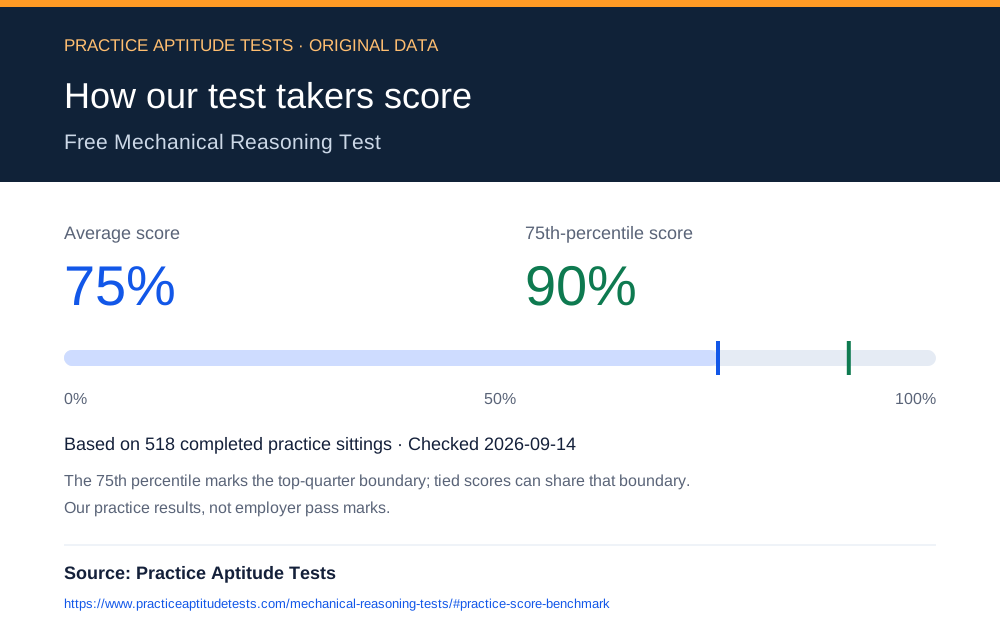
Results from our mechanical reasoning test.
Source: Practice Aptitude Tests
Based on 518 completed practice sittings, all time. Checked 14 September 2026.
The 75th percentile marks the boundary of the top quarter of recorded scores; tied scores can share that boundary. These are our practice results, not employer pass marks.
We use all-time completed, scored attempts at this practice test. Repeat attempts count separately, so the sample is sittings rather than unique people.
The average is the mean score across those sittings. The 75th percentile comes from their recorded score distribution. The “checked” date is when we retrieved the figures, not the period when the tests were taken.
Sharing these figures? Please credit Practice Aptitude Tests and link to this page.
Mechanical reasoning tests are specialised, so you tend to meet them only for roles that genuinely require mechanical or electrical knowledge. That means engineering and technical positions, the armed forces, and the emergency services, along with major employers such as Mercedes-Benz, Shell and Amazon that run them as part of their technical hiring.
Most employers license their tests from a small number of publishers, and the timing and question style vary between them, so find out which publisher your employer uses before you prepare seriously. It is usually named in the invitation email. Our test publisher guides cover each format, and the employer guides cover specific companies’ processes.
The methods behind the questions above, from our team
What candidates ask us most often
It is understanding how everyday mechanical equipment and tools work, and being able to apply that in practice. It covers key principles such as force and movement, hydraulics, velocity and simple electrical circuits, the same ideas a mechanical reasoning test draws on.
Not for every role. Military and entry-level technical tests focus on fundamental principles that most people can revise from scratch. Engineering roles expect more, including calculation, so the depth you need depends on the job. Either way, targeted revision of the core topics closes most of the gap.
Repairing mechanical equipment, running tests and analysing the results, carrying out equipment and system calculations, troubleshooting faults, and designing devices and components. A mechanical reasoning test is a proxy for whether you can pick up and apply skills like these.
Sometimes, depending on the publisher and role. Where calculation is involved a basic calculator may be provided or permitted, but many questions are designed to be solved with ratios and simple arithmetic you can do in your head. Check the instructions in your invitation email.
Most run 20 to 30 minutes for 20 to 30 questions, so around a minute each and sometimes less. The exact length depends on the publisher and the role, and is usually stated in your invitation email.
It is one of the most established mechanical aptitude tests, produced by Bennett and used as a benchmark for many technical and engineering roles. It covers the same core principles, forces, gears, levers, pulleys and circuits, so practising general mechanical questions prepares you well for it.
Practise under the real time limit from the start, and review every answer you got wrong; untimed work builds accuracy but not the speed the test measures. Our mechanical preparation guide covers the full sequence. The how to pass guide and study guide go deeper.
Rated 4.8 out of 5 across 229 reviews. A selection:
I liked how the questions were framed. I also thought the graphics were fairly easy to understand. I wish there could be more questions, and that it would score you as you go.
I feel this is a wonderful test for determining a wide range of skills necessary for employers to properly gauge the aptitude of the potential employee. They are challenging questions, yet easy enough to understand what the questions are wanting to know.
Some of the questions being somewhat obvious definitely helps a beginner like myself, whilst the harder questions would keep my reasoning for minutes at a time if I hadn't made a decision.
Take a free test in any format, then upgrade when you know which one you need.