
Mechanical reasoning tests draw on a short list of physics topics: levers, pulleys, gears and belts, springs, pressure and hydraulics, electrical circuits, forces and motion, and work and energy. Each topic rests on one or two rules, and most questions test whether you can apply that rule to a diagram quickly. This guide explains each topic, the rule to remember and the trap to watch for.
Every topic here appears in our free mechanical reasoning test, with a worked solution for each question.
Levers and moments
A lever is a rigid bar that turns about a pivot, or fulcrum. Its turning effect, the moment, is the force multiplied by its distance from the pivot. A lever balances when the moments on each side are equal.
Rule: load × load distance = effort × effort distance.
Example. A 500 N load sits 0.4 m from the pivot of a crowbar. You push 2 m from the pivot on the other side. The effort needed is 500 × 0.4 ÷ 2 = 100 N.
Questions often ask about the three classes of lever:
- First class: the pivot is between effort and load, as in a crowbar, see-saw or scissors.
- Second class: the load is between the pivot and the effort, as in a wheelbarrow or nutcracker. The effort arm is always longer, so it always reduces the force. A wheelbarrow with a 900 N load 0.5 m from the wheel and handles 1.5 m from it needs 900 × 0.5 ÷ 1.5 = 300 N to lift.
- Third class: the effort is between the pivot and the load, as in tweezers or a fishing rod. You need more force than the load, but the load moves further and faster.
Trap: measure distances from the pivot, not from the end of the bar.
Pulleys
A single fixed pulley only changes the direction of the pull. Movable pulleys share the load across several rope sections.
Rule: effort = load ÷ number of rope sections supporting the moving block (ignoring friction and pulley weight).
Example. A 1,200 N engine hangs from a block supported by 3 rope sections. The effort is 1,200 ÷ 3 = 400 N. To raise it 1 m you pull 3 m of rope.
Trap: count only the sections holding up the moving block. The free end you pull downward over a fixed pulley does not count.
Gears and belts
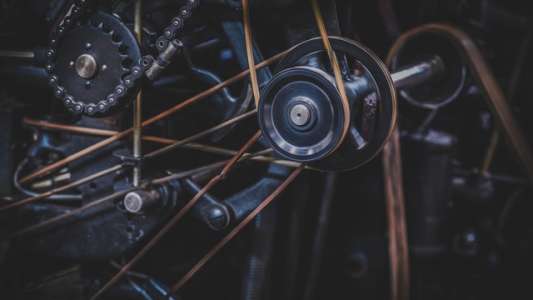
Meshed gears turn in opposite directions. Along a row of meshed gears, direction alternates. Speed depends on size.
Rule: speed is inversely proportional to the number of teeth (or the diameter, for belt wheels). Driver speed × driver teeth = driven speed × driven teeth.
Example. An 8 tooth gear at 120 rpm drives a 24 tooth gear. The larger gear turns at 120 × 8 ÷ 24 = 40 rpm, in the opposite direction, with three times the turning force.
Two more ideas come up often:
- Gears on the same axle turn together at the same speed and in the same direction. This is how compound gear trains build large reductions. A motor at 1,200 rpm driving a 10 tooth gear into a 40 tooth gear gives 300 rpm. If a second 10 tooth gear on that same axle drives a 30 tooth gear, the output is 300 × 10 ÷ 30 = 100 rpm.
- Belts and chains: an open belt keeps both wheels turning the same way; a crossed belt reverses the second wheel. A bicycle chain is an open drive.
Trap: a single idler gear between two others changes direction but not the overall speed ratio.
Springs
Rule: within its working range, a spring’s extension is proportional to the force (force = stiffness × extension).
Example. A spring with a stiffness of 200 N per metre carries 50 N. It stretches 50 ÷ 200 = 0.25 m.
Two identical springs in series (end to end) each carry the full load, so the total stretch doubles. Two identical springs in parallel (side by side) share the load, so the stretch halves.
Trap: do not assume more springs always means more stretch. It depends on how they are joined.
Pressure and hydraulics
Rule: pressure = force ÷ area. In a sealed fluid, pressure is the same everywhere.
Example. A 600 N person standing on 0.02 m² of floor exerts 600 ÷ 0.02 = 30,000 Pa. In a hydraulic jack, 30 N on a 2 cm² piston creates 15 N per cm², which on a 50 cm² piston gives 15 × 50 = 750 N.
Two other fluid facts recur:
- Pressure in a liquid depends on depth, not on the shape or width of the container. Water pressure at the bottom of a tall, narrow tank is greater than in a wide, shallow one.
- Flow speeds up where a pipe narrows, because the same volume must pass each second.
Trap: check units. Square centimetres and square metres differ by a factor of 10,000.
Electrical circuits
Rules: voltage = current × resistance. Charge = current × time.
- Series circuit: one path. The same current flows through every component, resistances add, and the supply voltage is shared. Break the loop anywhere and everything stops.
- Parallel circuit: several paths. Each branch gets the full supply voltage and works independently. Adding branches lowers the total resistance and increases the current drawn from the supply.
Example. A 6 V battery runs a 2 Ω bulb and a 4 Ω bulb in series. Total resistance is 6 Ω, so the current is 6 ÷ 6 = 1 A. The voltage splits 1 × 2 = 2 V and 1 × 4 = 4 V. And a 3 Ω heater on 9 V draws 9 ÷ 3 = 3 A. A current of 2 A for 30 seconds moves 2 × 30 = 60 coulombs of charge.
Trap: a switch in a branch controls only that branch; a switch in the main line controls everything.
Forces and motion
These questions are usually conceptual rather than numerical.
- Gravity: without air resistance, objects fall at the same rate whatever their weight.
- Inertia: a moving object keeps moving unless a force acts, which is why a load slides forward when a vehicle brakes.
- Momentum = mass × velocity. A 1,500 kg car at 20 m/s has momentum of 1,500 × 20 = 30,000 kg m/s.
- Centre of gravity: an object is more stable with a low centre of gravity and a wide base.
- Circular motion: an object on a curved path needs a force towards the centre. If the force is removed, it carries on in a straight line.
Work, energy and simple machines
Rule: work = force × distance moved in the direction of the force. Pushing a trolley 4 m with 250 N does 250 × 4 = 1,000 J of work.
Machines trade force for distance but never create energy. A ramp, a screw and a lever all follow this. A screw is a ramp wrapped round a cylinder: one with a 2 mm pitch advances 2 mm per turn, so 10 turns move it 2 × 10 = 20 mm. A finer thread means more turns and less force per turn.
Energy changes form: a raised weight has potential energy that becomes kinetic energy as it falls.
Magnets
Opposite poles attract and like poles repel. In a row of magnets, check each facing pair in turn.
Putting the topics to use
Most tests weight these topics differently depending on the role, so check what your test covers. To see each one in a full question, work through our mechanical reasoning examples, then use these tips for passing a mechanical reasoning test to plan your preparation. When the rules feel automatic, test them under time pressure with a mechanical reasoning practice test.