Illustrative example
All deliveries arrive before noon.
“A delivery arrives at 2 pm.”
Verbal reasoning
Select an answer using the meaning of the written information.
The Core Skills Profile for Adults, the Vocational Selection Test and the tertiary admissions test. What the verbal, quantitative, abstract and mechanical modules ask, how the adaptive versions change level as you go, and how the result is used.
Free · No sign-up · Scored the moment you finish
ACER, the Australian Council for Educational Research, is an independent not-for-profit organisation founded in 1930, and it is still independent: nothing has been sold or renamed. Its Select range is the employment side of its catalogue, with General Select aimed at technical, clerical and administrative roles and Professional Select at graduate and managerial ones. This is a practice test covering the areas the General Select verbal test assesses, not a copy of it. ACER publish the length of that test, fifteen minutes, but not how many questions it holds, so no per-question pace can be worked out from it and this test keeps our own standard pace.
You have 8 minutes to answer 10 questions. Every question carries one mark, the questions get harder as you go, and there is no penalty for a wrong answer, so answer every one. Calculators and rough paper are permitted.
Question 1 of 10
The Saltings, a nature reserve on a silted estuary, is managed by a wildlife trust with help from village volunteers. The reserve’s bird hide is open from dawn to dusk, unlocked and locked by a volunteer who lives by the sea wall. A logbook in the hide records sightings, copied monthly to the trust’s website. Cattle graze the marsh in summer under an agreement with a local farmer. The car park takes a dozen cars, with an honesty box for the trust. Dogs are not permitted beyond the sea wall.
Based only on the information in the passage, is the following statement True, False, or Cannot say?
Statement: “The Saltings bird hide is open from dawn to dusk.”
Answer: A. True
The statement is True. The passage says “the reserve’s bird hide is open from dawn to dusk”, and the statement repeats that fact in the same terms. The rule: a claim the passage states outright is True. The most tempting wrong answer is False, from reading the volunteer arrangement as shortening the stated hours.
Question 2 of 10
The appeal in Larkhill against Brindle Manufacturing was heard by three judges over two days in March. The court allowed the appeal on one ground and dismissed it on the other two. It substituted a declaration for the order the judge below had made, and remitted the question of costs. The judgment was given by one judge with whom the other two agreed. It has been published on the court’s own site and runs to twenty-six paragraphs.
Based only on the information in the passage, is the following statement True, False, or Cannot say?
Statement: “The appeal was heard by three judges.”
Answer: A. True
The statement is True. The passage says the appeal “was heard by three judges over two days in March”, which is the statement in the same words. The rule: a statement the passage states outright is True. The most tempting wrong judgement is False, because the passage later says the judgment was given by one judge, and a reader who reads that as the whole court will halve the bench.
Question 3 of 10
The Conflicts Standard requires a firm to keep its conflicts policy under annual review and to record the outcome of each review. It requires the policy to be approved by the firm’s governing body when it is first adopted and after any material change. The Standard does not prescribe a format for the policy. It applies to all authorised firms and was last amended two years ago, when the recording requirement was added.
Based only on the information in the passage, is the following statement True, False, or Cannot say?
Statement: “The Standard requires an annual review of a firm’s conflicts policy.”
Answer: A. True
The statement is True. The Standard “requires a firm to keep its conflicts policy under annual review”, which is the statement. The rule: where the passage states the claim, the answer is True. The most tempting wrong answer is False, from reading the absence of a prescribed format as the absence of the review requirement.
Question 4 of 10
Aldenshaw Parish Council has adopted a plan that aims to plant five hundred street trees across the village by 2028. The first hundred and forty trees went in over the winter, on verges chosen with the county highways team. A tree warden scheme recruits residents to water young trees through their first two summers. Species are picked from a list agreed with the highways team, favouring small rooting trees near footways. The council reports planting numbers in its annual parish meeting each April.
Based only on the information in the passage, is the following statement True, False, or Cannot say?
Statement: “Five hundred street trees will be planted in Aldenshaw by 2028.”
Answer: C. Cannot say
The statement is Cannot say. The passage says the plan “aims to plant five hundred street trees across the village by 2028” and reports the first winter’s hundred and forty. Whether the five hundred will be reached is not settled by an aim and a start. The rule: an aim or target never entails the outcome. The most tempting wrong answer is True, because the early progress makes the target feel certain.
Question 5 of 10
Eastmarch Airport has confirmed that a second airline agreed in March to open a crew base at the airport. The agreement runs for ten years and covers stands on the west apron, which were resurfaced last year. The airport’s existing based airline has held a base at Eastmarch for nine years. Recruitment for the new base is being run by the airline and not by the airport, and the airport has not been told how far it has gone. The airport publishes a traffic report each month, and the most recent report does not name the airlines based at the airport.
Based only on the information in the passage, is the following statement True, False, or Cannot say?
Statement: “The second airline’s crew base at Eastmarch Airport has not yet opened.”
Answer: C. Cannot say
The statement is Cannot say. The passage says a second airline “agreed in March to open a crew base at the airport”, and that the airport “has not been told how far” recruitment has gone. The monthly traffic report “does not name the airlines based at the airport”. Whether the base has opened is withheld in both directions. The rule: an agreement announced, however firm its terms, never settles that the thing agreed has happened, and it does not settle that it has not happened either. The most tempting wrong option is False, from a reader who takes the confirmed agreement and the resurfaced stands as the base itself.
Question 6 of 10
The Wool Hall, a fifteenth-century cloth hall, houses the town museum across four floors. The hall’s lift serves the lower three floors; the top floor, under the crown-post roof, is reached by the spiral stair only, a limit the listed structure sets. The top floor shows the roof itself, lit to throw the carpentry into relief, with a film of the space shown on the ground floor for those who stay below. Handling trolleys ride the lift on Mondays when displays change.
Based only on the information in the passage, is the following statement True, False, or Cannot say?
Statement: “The Wool Hall’s lift serves all four of its floors.”
Answer: B. False
The statement is False. The passage says “the hall’s lift serves the lower three floors; the top floor… is reached by the spiral stair only”. A lift serving three of four floors contradicts the claim that it serves all four. The rule: False needs a stated contradiction, and the stated limit supplies one. The most tempting wrong answer is True, from assuming a museum lift reaches every floor.
Question 7 of 10
Pendrey and Garrowby’s board has said it wants every one of its five departments represented by a partner at the second office within three years. Two of the five are represented today. The board has approved a budget for two further partner appointments at that office. The firm has met each of the three headcount targets its board has set since the second office opened. The board reviews progress against the target twice a year.
Based only on the information in the passage, is the following statement True, False, or Cannot say?
Statement: “The board’s target for the second office will be met.”
Answer: C. Cannot say
The judgement is Cannot say. The passage gives the target, the current position, a budget for two further appointments, the board’s record on earlier targets, and how often it reviews progress. Whether the target will be met is never stated. The boundary the question turns on is the step from a target, and evidence of progress towards it, to an outcome. The most tempting wrong judgement is True, because the firm’s record on targets is unbroken and the money is already approved.
Question 8 of 10
Croweswood & Sage, land agents, keep their office over the corn exchange arch with a brass plate polished by rule. The firm feeds its staff a cooked lunch at the long table, a habit unbroken since the senior partner’s grandfather. Anniversaries of joining are marked with a bottle from the cellar. Two of the six agents trained at the firm from school. The long table seats staff, articled clerks and whichever client calls at one o’clock, sat by the fire in winter.
Based only on the information in the passage, is the following statement True, False, or Cannot say?
Statement: “Turnover at Croweswood & Sage is lower than at other firms its size.”
Answer: C. Cannot say
The statement is Cannot say. The passage describes the firm’s customs and two long careers, but gives no staff turnover figures for the firm or for any comparable firm. The comparison is not settled. The rule: however typical it is for such a firm to keep its people, the claim is Cannot say unless the passage settles it. The most tempting wrong answer is True, because the customs make the assumption feel safe.
Question 9 of 10
An order made in February required the defendant in Larkhill against Brindle Manufacturing to file a list of documents by 20 March. The order said that if the list were not filed the claimant could apply to strike out the defence. The case came before the court again in June for a case management hearing, and the defence was still on the record. The order made in June sets a trial window for the following spring. The court file was scanned in July.
Based only on the information in the passage, is the following statement True, False, or Cannot say?
Statement: “The order was complied with before the hearing in June.”
Answer: C. Cannot say
The judgement is Cannot say. The passage says what the order required, what it said would follow if the requirement were not met, that the defence was still on the record in June, and what the June order did. Whether the list was filed is never stated. The boundary the question turns on is the step from an order to compliance with it. A stated consequence tells the reader what should follow, and the state of the record is not a finding about the list. The most tempting wrong judgement is True, because the defence survived, and a reader supplies the application that would have removed it.
Question 10 of 10
Nine in ten of the conversions completed by Longstrop & Daughters have passed their airtightness test first time, a record the firm prints on its site boards. The chapel conversion on Beulah Row, the firm’s current job, keeps the box pews as panelling and lifts a study into the organ loft. Tests are booked once the plaster cures, the fan rig sealing the west door for the afternoon. The firm’s joiners make their shutters in the chapel’s own vestry, floored over as a site shop.
Based only on the information in the passage, is the following statement True, False, or Cannot say?
Statement: “The chapel conversion passed its airtightness test.”
Answer: C. Cannot say
The statement is Cannot say. The passage says nine in ten of the firm’s completed conversions passed first time, and that the chapel is the current job with its test booked once the plaster cures. The chapel’s own result is not yet stated, so the claim is not settled. The rule: a rate for the whole group never settles a claim about a named member, and this member’s test has not even been reported. The most tempting wrong answer is True, from carrying the firm’s record down to the current job.






An ACER test is a selection assessment from the Australian Council for Educational Research, an independent not for profit research organisation based in Melbourne. Its most common recruitment tests are the Core Skills Profile for Adults and the Vocational Selection Test, which measure verbal, numerical, abstract and mechanical reasoning alongside literacy and numeracy. Tests are taken online and are mostly multiple choice, and the adaptive versions adjust question difficulty to your performance.
Which ACER test you sit depends on the employer and the role: an entry-level position will not be given the same assessment as a graduate or managerial one.
Four things to know before you sit one. Timings and difficulty vary with the level of the role.
Match the name in your invitation to the assessment below. Timings marked “approx.” are completion estimates; other published durations are limits for the named version.
| Assessment | What it measures | Questions | Timing |
|---|---|---|---|
| CSPA (Core Skills Profile for Adults) | Core literacy and numeracy skills for adult education and training | Varies by module | Varies by module |
| Vocational Selection Test (historical catalogue) | Verbal, quantitative and abstract reasoning, with optional mechanical and interpersonal modules | Usually three of five | Varies by module |
| STAT (Special Tertiary Admissions Test) | Verbal and quantitative reasoning for mature and non-standard university entry | Two modules | Varies |
| ACER Mechanical Reasoning Test – Second Edition (MRT-2) | Basic mechanics and physics from diagrams; pulleys, levers, cause and effect | See invitation | See invitation |
Counts and timings vary by role level and by the version an employer licences. Check the instructions on the screen before you start. Facts checked 11 September 2026.
ACER offers distinct education and employment assessments. VST appears in its historical catalogue; current offerings and delivery arrangements should be confirmed with your institution. There is no single ACER question count or time limit.
A visual guide to the skills and response formats covered on this page. Your invitation tells you which assessments to prepare for.
Illustrations by Practice Aptitude Tests · not official test screenshots
“A delivery arrives at 2 pm.”
Select an answer using the meaning of the written information.
What is the percentage increase?
Apply numerical reasoning to the data in the question.
Find the missing shape
Find the visual rule linking shapes or patterns.
The free test shows you the style. A pack gives you the pace: timed and marked, with the working shown.
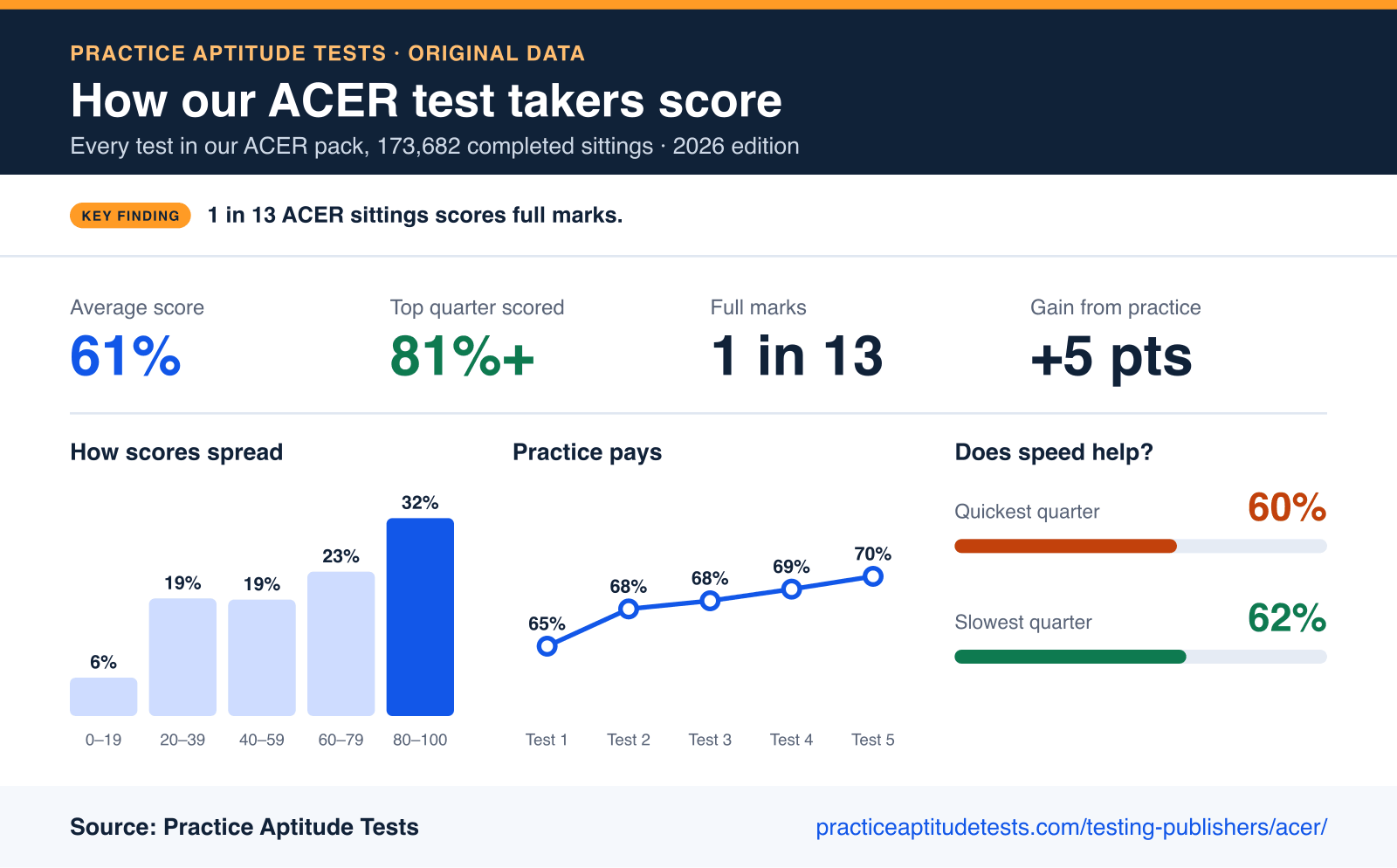
Practice Aptitude Tests · Original data
Results from every test in our ACER pack, past and present.
Key finding1 in 13 ACER sittings scores full marks.
32% scored 80% or more, and 26% scored under 40%.
Share of sittings in each score band.
Regular practisers went from 65% on their first test to 70% on their fifth.
4,242 people who took five or more tests.
Speed makes little difference here.
Typical pace: 51 seconds a question.
ACER is a trademark of its respective owner. Practice Aptitude Tests is not affiliated with ACER and our practice tests are not endorsed by them.