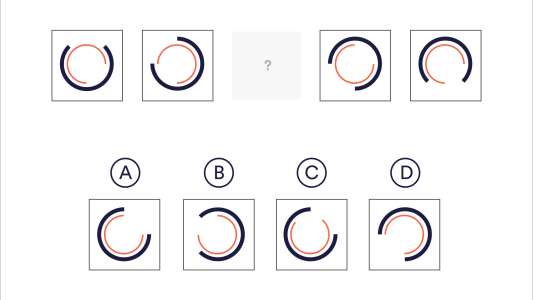
Inductive reasoning is the process of drawing a general conclusion from specific observations. You notice a pattern in a set of examples or data, and infer a rule that explains it and predicts what will happen next. The conclusion is probable rather than certain, because new evidence could always overturn it.
It is one of the most common ways people reason at work, and one of the most common things employers test. In recruitment it usually appears as a free inductive reasoning test style of question: a series of shapes, a rule to find, and a choice of what comes next.
Inductive reasoning definition
Inductive reasoning means reasoning from particular cases to a general rule. Its meaning is easiest to see in three parts:
- Observations. Specific facts you have seen, such as “the last 20 deliveries from this supplier arrived on time”.
- An inference. A step that goes beyond those facts.
- A conclusion. A general claim or a prediction, such as “this supplier delivers on time” or “the next delivery will probably be on time”.
The word “probably” matters. In inductive reasoning the conclusion says more than the evidence strictly proves. That is what makes it useful, because it lets you predict and plan, and it is also what makes it fallible. The classic illustration is the European belief, built on centuries of observations, that all swans are white. Every observation was true, yet the conclusion fell the moment black swans were recorded in Australia.
Inductive thinking is the everyday version of the same thing. When you decide a colleague is reliable because they have always delivered, or that a meeting will overrun because the last five did, you are thinking inductively.
The inductive process, step by step
The inductive process follows a loop of five steps.
- Observe. Collect specific cases, ideally plenty of them and from a fair spread of situations.
- Spot the pattern. Ask what the cases have in common or how they change.
- Form a hypothesis. State a general rule that would explain the pattern.
- Test it. Check the rule against cases you have not used yet, or use it to make a prediction you can check.
- Revise. Keep the rule if it holds, refine it if it nearly holds, and drop it if it fails.
Worked example. An IT helpdesk normally receives about 40 tickets a day. A team lead looks back at the first working day after each of the last four software updates and finds 95, 110, 102 and 88 tickets. Every one of those days was between 2 and 3 times the normal level (88 ÷ 40 = 2.2 and 110 ÷ 40 = 2.75).
- The observations are the four ticket counts.
- The pattern is that the day after an update is always much busier than normal.
- The hypothesis is that software updates cause a spike in tickets the next day.
- The test is the next update. If the following day brings 90 or more tickets, the rule gains support. If it brings 45, the team lead needs to look for what else was different on those four days.
- The practical conclusion is to roster extra staff the day after an update, which is a sensible decision even though the rule is not proven.
That last point is the real value of induction. It lets you act sensibly on incomplete information, which is most of the information you have at work.
Types of inductive reasoning
Inductive reasoning comes in several familiar forms:
- Generalisation. From a sample to a whole group: most customers surveyed in the north prefer email updates, so most northern customers probably do.
- Statistical reasoning. From a group to an individual: most graduate hires complete training within six months, so a new graduate hire probably will too.
- Causal reasoning. From a pattern to a cause: sales rise whenever the newsletter goes out, so the newsletter probably drives sales.
- Analogy. From one similar case to another: the new office has the same layout as the old one, so the same desk plan will probably work.
- Prediction. From past to future: the last four quarters each grew, so next quarter probably will.
Each of these is an inductive argument, and each can be strong or weak. For definitions and more examples, see what an inductive argument is.
Strengths and limits of inductive reasoning
Inductive reasoning is how we learn from experience, so it is hard to work without it. It turns data into rules of thumb, and rules of thumb into decisions.
Its weaknesses are predictable, which means you can guard against them:
- Too few cases. Two good experiences do not make a pattern.
- Unrepresentative cases. Feedback gathered only from people who stayed tells you little about people who left.
- Ignoring counterevidence. One clear exception can matter more than many confirming cases.
- Confusing correlation with cause. Two things rising together may both be driven by a third.
Asking “how many cases, how typical, and what would prove me wrong?” catches most of these.
How inductive reasoning differs from deductive reasoning
Deductive reasoning runs the other way. It starts from general premises and works down to a specific conclusion, and if the premises are true and the logic is valid, the conclusion is certain. Inductive reasoning starts from specific cases and works up to a general conclusion that is only probable. The two often work together: induction suggests a rule, and deduction works out what the rule implies so it can be tested. There is a full comparison in inductive vs deductive reasoning.
How employers test inductive reasoning
Employers use inductive reasoning tests because finding a rule in unfamiliar information is close to what people do when they meet a new problem at work. Most tests use shapes rather than words or numbers, so they do not depend on your language or maths background.
You will usually see one of these formats:
- Sequences. A row of figures that change by a rule, and you choose the one that comes next.
- Odd one out. Several figures that share a feature, and one that does not.
- Sets. Two groups of figures defined by different rules, and a new figure to place.
- Matrices. A grid with one cell missing, where rules run across the rows and down the columns.
The method is the same in every format. Look at one element at a time, work out how it changes, predict the answer before you look at the options, and check your choice against every rule you found. You can see this applied in these worked inductive reasoning examples.
Inductive reasoning is a skill, and it improves with practice. The quickest way to find your starting point is to sit an inductive reasoning practice test under timed conditions and review every question you missed.