An inductive argument is one whose premises support its conclusion without guaranteeing it. For example: “Every client who joined through our partner scheme has renewed after the first year, so the next client from the scheme will probably renew.” Even if every premise is true, the conclusion could still turn out false, so inductive arguments are judged as strong or weak rather than valid or invalid.
Inductive arguments sit behind most everyday decisions at work, and the same skill is what employers measure with an inductive reasoning test. You can try one in a free inductive reasoning test.
Inductive argument definition
An argument is a set of statements, called premises, offered as reasons to accept another statement, the conclusion. In an inductive argument the premises make the conclusion more likely. They do not make it certain.
That is the key difference from a deductive argument, where the premises are meant to force the conclusion. In a deductive argument, true premises and a valid form leave no room for a false conclusion. In an inductive argument there is always some room, and the question is how much.
So the right questions to ask of an inductive argument are:
- Is it strong? If the premises were true, would the conclusion be likely?
- Is it cogent? Is it strong, and are the premises actually true?
The parts of an inductive argument
Every inductive argument has three parts, and spotting them makes the argument easier to judge.
- Premises. The evidence: observations, figures or past cases.
- An indicator. A word that signals the move to the conclusion, often with a hedge, such as “so it is likely that”, “this suggests”, “we can expect” or “probably”.
- The conclusion. A general rule, a prediction or an explanation that goes beyond the premises.
Here is one laid out in full.
- Premise: the Glasgow team has missed its monthly target in each of the last three months.
- Premise: nothing about the team’s staffing or market has changed.
- Conclusion: the team will probably miss its target this month as well.
Examples of inductive arguments
Inductive arguments come in a handful of familiar shapes. Here is an example of each.
Generalisation. “We surveyed 300 customers from every region and most preferred email to phone calls. So most of our customers probably prefer email.” The argument moves from a sample to a whole group.
Statistical argument. “Most graduate hires on last year’s scheme finished their training within six months. Priya is a graduate hire on this year’s scheme. So Priya will probably finish within six months.” The argument moves from a group to an individual.
Causal argument. “Each time we sent the monthly newsletter, website sales rose that week. So the newsletter probably drives sales.” The argument moves from a pattern to a cause.
Argument from analogy. “The new warehouse has the same layout and the same stock as the old one, and the picking routes worked well there. So the same routes will probably work in the new warehouse.” The argument moves from one similar case to another.
Prediction. “Energy costs for the office have risen every winter for five years. So they will probably rise this winter.” The argument moves from the past to the future.
For a wider set of everyday and test-style cases, see these inductive reasoning examples.
What makes an inductive argument strong or weak
Because an inductive conclusion always goes beyond its evidence, its strength depends on the quality of that evidence. Four checks cover most cases.
- How many cases? Two good interviews with former staff are weak evidence. Exit data from every leaver over three years is much stronger.
- How typical were they? A survey sent only to customers who renewed tells you little about customers who left.
- Is there evidence the other way? One well-documented exception can outweigh many confirming cases.
- Is the comparison fair? An analogy is only as strong as the similarities that matter. Two warehouses with the same layout but different stock may not share the same best routes.
A weak argument. “The two people I spoke to at the open day loved working there, so everyone at the company enjoys their job.” The sample is tiny, and the people sent to an open day are unlikely to be typical.
A stronger version. “In the company’s anonymous staff survey, which most employees completed, a large majority said they enjoyed their job. So most employees probably enjoy their job.” The sample is larger, more representative and less likely to be filtered.
There is one more feature worth knowing. Adding a premise can weaken an inductive argument. “The Glasgow team has missed its target three months running” supports a fourth miss. Add “and it gained two experienced sales staff last week”, and the same argument becomes much weaker. That never happens with a valid deductive argument, where extra premises cannot undo the conclusion.
Inductive vs deductive arguments
| Inductive argument | Deductive argument | |
|---|---|---|
| What the premises do | Make the conclusion likely | Make the conclusion certain |
| Judged as | Strong or weak, cogent or not | Valid or invalid, sound or unsound |
| Effect of new premises | Can strengthen or weaken it | Cannot make a valid argument invalid |
| Typical indicator | “Probably”, “likely”, “suggests” | “Therefore”, “must”, “it follows that” |
The same topic can support either kind. “All contracts over £50,000 need legal review, and this contract is worth £64,000, so it needs legal review” is deductive. “Every contract over £50,000 that we have checked had a legal review, so this one probably did too” is inductive. There is a full comparison in inductive vs deductive reasoning.
Inductive arguments in aptitude tests
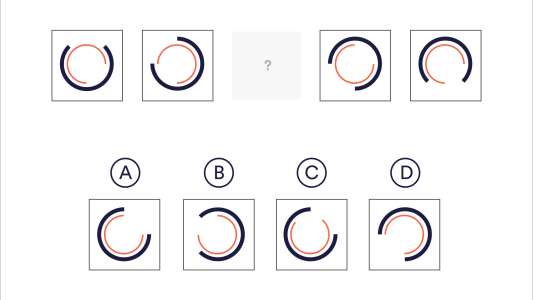
Inductive reasoning tests rarely spell out an argument in words. Instead they give you the premises as a series of figures and ask you to supply the conclusion yourself: the rule that explains the pattern and the figure that comes next. The judgement is the same. Your answer should be the conclusion best supported by all the evidence, not one that fits most of it.
Critical thinking tests sometimes ask about inductive arguments directly, for example which extra fact would most weaken a conclusion. The checks above apply there too: look for the answer that shows the sample was too small, untypical or contradicted.
Practising with real questions is the quickest way to sharpen this judgement. Try an inductive reasoning practice test and, for each answer, say what evidence in the figures supports it.