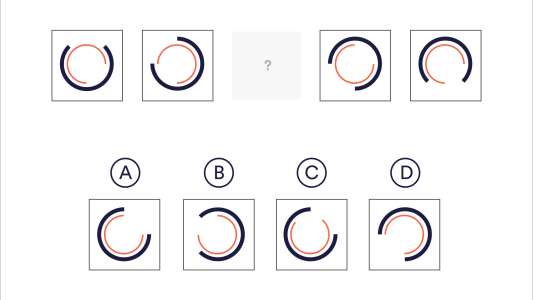
Inductive reasoning moves from specific observations to a general conclusion, so its conclusions are probable rather than certain. Deductive reasoning moves from general premises to a specific conclusion, and if the premises are true and the logic is valid, the conclusion must be true. Put simply, induction builds a rule from evidence, and deduction applies a rule to a case.
Employers test both, and each one asks for a different habit of mind. You can see the inductive side at work in a free inductive reasoning test, where you find the rule behind a series of shapes and use it to predict what comes next.
The difference at a glance
| Inductive reasoning | Deductive reasoning | |
|---|---|---|
| Direction | Specific to general | General to specific |
| Starts from | Observations, examples or data | Premises, rules or definitions |
| Conclusion | Probable, and open to revision | Certain, if the premises are true and the step is valid |
| Judged as | Strong or weak | Valid or invalid, sound or unsound |
| Main risk | Generalising from too few or unusual cases | A false premise or an invalid step |
| In a test | Find the rule behind a pattern | Decide whether a conclusion follows from statements |
The difference between inductive and deductive reasoning
The clearest way to see the difference is to run both on the same situation.
Inductive. The Leeds office has submitted its monthly report on time for each of the last 12 months. So next month’s report will probably be on time too.
Deductive. Every monthly report is due on the 5th of the month. This is a monthly report. So it is due on the 5th.
The inductive conclusion goes beyond the evidence. Twelve on-time reports make a thirteenth likely, but a staff change or a system failure could break the pattern, and the argument would still have had true premises. That is the defining feature of induction: true premises make the conclusion more likely, never certain.
The deductive conclusion adds nothing new. It only spells out what the premises already contain. If every monthly report is due on the 5th, and this is one, there is no way for it to be due on any other day. That is the defining feature of deduction: if the premises are true and the form is valid, the conclusion cannot be false.
A useful test is to ask what new evidence would do. New evidence can weaken or overturn an inductive conclusion. It cannot touch a valid deductive conclusion unless it shows that one of the premises was false.
Inductive vs deductive thinking
People often describe the two as thinking styles. Inductive thinking is bottom-up: you start with details and work towards a general picture. Deductive thinking is top-down: you start with a principle and work out what it means for a particular case.
In real work the two run in a loop. A customer service manager notices that complaints rise every Monday. That is induction: a pattern spotted in data, leading to a hunch that Monday staffing is too thin. She then reasons deductively from the hunch: if thin staffing is the cause, adding one person on Mondays should bring complaints down. She tests it, and the result either supports the hunch or sends her back to look for another pattern.
Induction is how you form ideas. Deduction is how you work out what those ideas commit you to, so that you can check them. For a fuller look at the first half of that loop, see what inductive reasoning is and how it works.
Examples of deductive and inductive reasoning
Each pair below covers the same ground, once each way.
Approvals
- Inductive: every invoice over £5,000 this year has been signed off by a director, so the next one probably will be.
- Deductive: all invoices over £5,000 need director approval. This invoice is for £7,200. So it needs director approval.
Systems
- Inductive: the website has slowed down on each of the last four product launch days, so it will probably slow down on the next one.
- Deductive: if the server goes down, the website goes offline. The server has gone down. So the website is offline.
Number patterns
- Inductive: the figures 3, 6, 12 and 24 each double the one before, so the next is probably 48.
- Deductive: the rule is “each figure is double the one before”. The last figure is 24. So the next figure is 48.
The number pair shows the difference neatly. When you only see the figures, doubling is the best explanation, but other rules could produce the same four numbers, so 48 is the most likely answer rather than the only possible one. Once the rule is stated, 48 follows with certainty.
Inductive vs deductive argument
An argument is a set of premises offered in support of a conclusion, and the two types are judged by different standards.
A deductive argument is valid when the conclusion must be true if the premises are true. It is sound when it is valid and its premises really are true. An argument can be valid with a false premise: “All managers work in London. Sam is a manager. So Sam works in London” is valid, but unsound if some managers work elsewhere.
An inductive argument is strong when its premises make the conclusion likely, and weak when they do not. Strength depends on things like how many cases you observed, how typical they were, and whether any evidence points the other way. A conclusion drawn from two conversations at an open day is weak. One drawn from a year of records across every team is much stronger.
There is also a structural difference. Adding a premise can never make a valid deductive argument invalid. Adding a premise can easily weaken an inductive one, for example “but the Leeds office lost its finance lead last week”. For definitions and more worked cases, read what an inductive argument is.
A common mix-up: the detective’s “deduction”
In everyday speech, “deduce” often just means “work out”. A detective who notices mud on someone’s boots and concludes they walked across a field is usually said to have deduced it. Strictly, that is not deduction. Reasoning from clues to the most likely explanation is a form of inductive reasoning, sometimes called abductive reasoning, because the conclusion could still be wrong. True deduction would need a premise such as “anyone with this mud on their boots has walked across that field”, which the clues alone do not give you.
How each one appears in aptitude tests
The two types of reasoning are usually tested in different formats.
- Inductive reasoning tests show a series of shapes or symbols and ask which comes next, which figure is the odd one out, or which set a new figure belongs to. There are no premises to read. You have to find the rule yourself, and the right answer is the option that fits every part of the pattern. See these inductive reasoning examples for worked questions.
- Deductive reasoning tests give you statements and ask whether a conclusion is true, false or cannot be determined, or which conclusion follows. The rule is handed to you. Your job is to apply it exactly and add nothing from your own knowledge.
The habits are different. Inductive questions reward generating a hypothesis and testing it against every figure. Deductive questions reward discipline: accept the premises as given, even if they sound odd, and refuse any conclusion they do not force.
The best way to get comfortable with the inductive side is to work through a timed inductive reasoning practice test and check each answer against the rule you found.