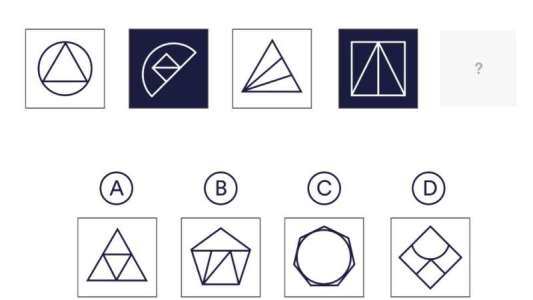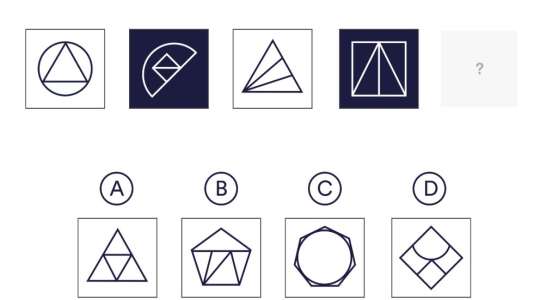

Logical reasoning is an umbrella term covering several question formats, and each has its own method. This guide covers the technique for the four you will meet most often.
Practise the real thing: these formats appear in our free logical reasoning test, with a worked solution for every question. No sign-up.
How to spot the rule in an abstract question
Change one feature at a time and see what moves in step with it. Inductive and abstract questions almost always combine two or three simple rules, and the trick is to isolate them rather than stare at the whole picture.
Run through the features in turn:
- Number: are shapes being added or removed by a fixed amount each step?
- Position and rotation: is an element moving around the frame, or turning by a set angle?
- Colour or shading: does an item cycle through, for example, white, dotted, then filled?
- Size: does an element grow or shrink across the sequence?
Take a worked example: if the count of triangles rises by two at every step, the sixth shape has fourteen. Confirm your rule against every frame you have been given, not just the last two, and then apply it once. Where several options fit part of the pattern, the correct one obeys all the rules at once.
How to solve diagrammatic questions
Work out what each operator does first, then trace the input through to the output. A diagrammatic question is really a small machine: symbols act on shapes, and your job is to learn the machine’s rules from the examples given.
A dependable method:
- Study the worked examples where an input and its output are both shown, and note what each operator changes: it might rotate, add, remove or recolour.
- Confirm each rule on a second example before you trust it, since one instance can be a coincidence.
- Apply the operators in order to the question’s input, one step at a time, writing down the intermediate state.
For grids where one cell is missing, identify the rule the other cells share first. If, say, the number of stars in a column always equals the number of circles, the missing cell is whichever option keeps that balance. Find the shared rule, then pick the only option that respects it.
How to approach a deductive question
Take the statements as given and accept only the conclusion they force. Deductive logical questions are word problems, and the wrong options are built from reasonable-sounding leaps the premises do not actually support.
Consider a worked example. All footballers are fit and healthy. All famous sports players are footballers. The only conclusion that follows is that all famous sports players are fit and healthy. Reversing a premise (“all fit and healthy people are footballers”) or introducing a new fact (“all footballers are men”) produces the distractors.
The discipline that catches them: before accepting any conclusion, point to the premises that make it certain. If you cannot trace it back, it is not the answer, however plausible it reads.
How to evaluate critical reasoning arguments
Judge an argument on whether it is both relevant and directly connected to the question, not on whether you agree with it. Critical reasoning questions often present a yes or no answer with a supporting statement and ask whether that statement is a strong or a weak argument.
A strong argument does two things: it bears directly on the specific question asked, and it gives a reason that would actually change the conclusion. A weak argument is off to one side, relies on a generalisation, or restates the claim without supporting it.
Two habits help:
- Set your own opinion aside. The test is whether the argument works, not whether its conclusion happens to be true.
- Check the link, not just the topic. An argument can be on the right subject yet fail to connect to the precise point at issue, and that is what makes it weak.
More on logical reasoning tests
Go back to the full logical reasoning tests guide, or go straight to the family that matches your invitation: deductive, inductive, diagrammatic or abstract reasoning.