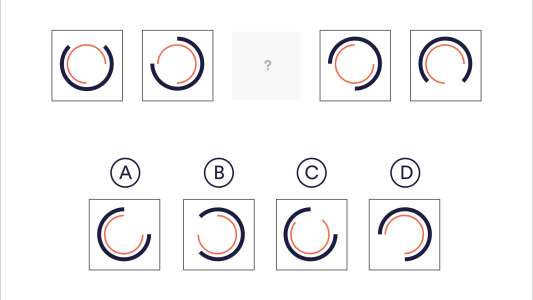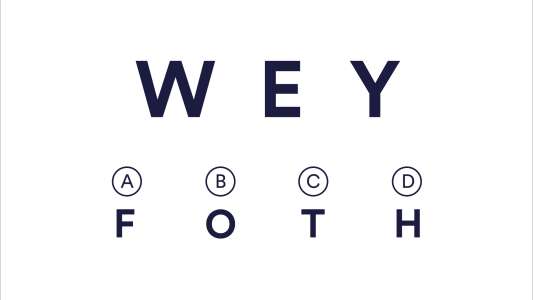

Inductive reasoning tests use a small set of recognisable formats built from an even smaller list of pattern rules. This guide covers the rules first, then the method for each format.
Practise the real thing: every format below appears in our free inductive reasoning test, with a worked solution for every question. No sign-up.
The common pattern rules
Almost every inductive question is built from a short list of pattern rules, and learning them turns the test from guesswork into recognition.
- Alternation: a feature switches on and off, or between two states, on a regular cycle.
- Rotation: a shape turns by a fixed angle each step.
- Reflection: a shape flips to its mirror image, which rotation alone cannot reproduce.
- Replacement: one element is substituted for another according to a rule.
- Translation: an element moves a set distance or around the figure on a fixed path.
- Combination: two or more of the above run at once, which is what makes harder questions harder.
The reason to memorise this list is speed. Instead of staring at a figure hoping the rule jumps out, you check each element against the list, which is faster and far more reliable under time pressure.
How to find the rule in a shape sequence
Track one element at a time across every frame rather than trying to read the whole figure at once. A sequence that looks complicated is usually two or three simple rules running independently, and reading them together is where most people go wrong.
A reliable method:
- Pick one element and follow only it across the frames. Does it rotate, move, change size, change shading, or appear on a cycle?
- Repeat for each remaining element, treating every one as its own separate rule.
- Note what stays constant, since an unchanging feature still rules options in or out.
- Apply every rule to predict the next figure, then find it in the options. Predicting first stops a plausible distractor talking you into the wrong answer.
Because inductive answers are the most probable conclusion rather than a certain one, you are choosing the option that best fits the pattern, not proving a single truth. Pick the answer that satisfies every rule you have found.
How odd-one-out and A/B set questions work
Find the single feature that the group shares, then the odd one out is whichever figure lacks it, and a set question is answered by whichever set’s feature the new figure matches. The defining feature is usually simpler than the figures make it look, because size, colour and position are often deliberate decoys.
For an odd one out, test a candidate rule against every figure: if all but one have a single line of symmetry, the one that does not is your answer. For A/B sets, work out the feature that every member of Set A shares and the different feature that defines Set B, then check the new figure against both. If it matches Set A’s feature it is Set A; if it matches Set B’s it is Set B; if it matches neither, that is the answer.
Always confirm your rule against the whole group before trusting it. A rule that fits most but not all of the figures is the wrong rule, not a near miss.
More on inductive reasoning tests
Go back to the full inductive reasoning tests guide, or try the closely related abstract reasoning and diagrammatic reasoning tests.