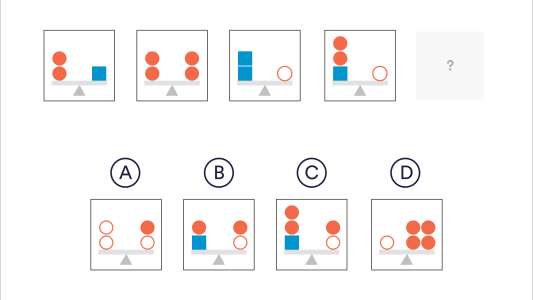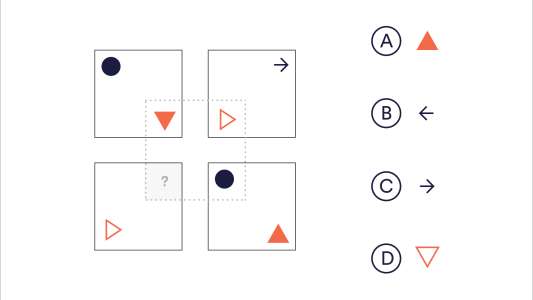

Diagrammatic reasoning tests use two broad families of question. Process questions show inputs passing through operators to outputs, and ask you to find a missing output, input or operator. Pattern questions show sequences or sets of shapes, and ask what comes next or where a diagram belongs. Each type has a method of its own, but all of them come down to finding a rule and applying it accurately.
Every type described here appears in our free diagrammatic reasoning test, with a worked solution for each question.
How operators work
An operator is a symbol that stands for one fixed change. A box marked with a star might always mean “reverse the order”. A box marked with a circle might always mean “swap black and white”. Whatever an operator does on one path, it does on every path in that question.
Two points cause most mistakes:
- Order matters. Operators apply strictly in the order the diagram shows. Some pairs give a different result if you swap them, and that wrong result is usually one of the options.
- The rule is the full list of changes. An operator may change two things at once, such as turning a shape and changing its colour. If you spot one change and stop, you will pick a distractor that gets only half the rule.
To decode an operator, find the simplest path it appears on, ideally one with no other operators. List everything that differs between input and output, and everything that stays the same. Then state the rule as one sentence and check it on every other path where the operator appears.
Process question 1: find the output
What you see. A new input and a path of operators you have already decoded. You choose the output.
How to solve it. Apply the operators one at a time and write down the result after each step. Do not try to do two steps in your head at once.
Mini example. Operator ◎ adds 1 to every digit. Operator ✚ swaps the first and last digits. The input 2468 passes through ◎ then ✚. ◎ gives 3579. ✚ swaps the 3 and the 9, giving 9573. The output is 9573.
Process question 2: find the input
What you see. An output and the operators that produced it. You choose the input.
How to solve it. Work backwards. Undo the last operator first, then the one before it, and so on. Then run your answer forwards once to check it.
Mini example. Using the same operators, a number passes through ✚ then ◎ and comes out as 8236. Undo ◎ by taking 1 from every digit: 7125. Undo ✚ by swapping the first and last digits back: 5127. The input was 5127. Check: ✚ gives 7125, then ◎ gives 8236.
Process question 3: find the missing operator
What you see. A path with one operator box left blank, plus the input and output.
How to solve it. Work forwards from the input as far as the gap and backwards from the output as far as the gap. Compare the two results. The change between them is the missing operator. If the options are a short list of known operators, test each one.
Mini example. 1357 passes through an unknown operator, then ✚, and comes out as 8462. Undo ✚ on the output: 2468. So the missing operator turned 1357 into 2468, adding 1 to every digit. The missing operator is ◎.
Process question 4: conditional operators
What you see. Some tests include a decision box. It checks a condition, such as “is the shape black?” or “does the string start with a vowel?”, and sends the input down one path if the answer is yes and another if the answer is no.
How to solve it. Treat the decision box as a fork in the road, not as a change. Check the condition on the input as it arrives at the box, which may not be the same as the original input if operators come before it. Then follow only the path the answer gives you.
Mini example. A decision box asks whether the first letter is a vowel. The yes path reverses the string. The no path moves the first letter to the end. EBCD starts with E, a vowel, so it takes the yes path and becomes DCBE. The output is DCBE. BCDE, starting with a consonant, would take the no path and become CDEB.
Pattern question 1: sequences
What you see. A row of frames with one missing, often the next frame and sometimes one in the middle.
How to solve it. Treat each feature as a separate track: number of shapes, position, rotation, shading and size. Fill in each track across the frames, then extend only the tracks that are moving. If the gap is in the middle, use the frame after it to check your answer.
Mini example. A square rotates 90 degrees clockwise each step while its shading alternates between black and white. If frame 3 is a white square with a marked corner at the bottom right, frame 4 has the marked corner at the bottom left and is black.
Pattern question 2: sorting into sets
What you see. Two groups of diagrams, Set A and Set B, and a new diagram to place in one of them or in neither.
How to solve it. Find the one feature every diagram in Set A shares, and the one every diagram in Set B shares. It is usually about a single element, while the rest is decoration. Check the rule against every diagram in the set, because a rule that fits five out of six is the wrong rule.
Mini example. Every Set A diagram has an arrow pointing at a circle, and every Set B diagram has an arrow pointing away from a circle. Size, colour and the other shapes vary freely. A new diagram with an arrow pointing at a circle belongs to Set A, whatever else it contains.
The common operators
Most operators, whether they act on shapes, letters or numbers, come from a short list:
| Change | On shapes | On letters or numbers |
|---|---|---|
| Rotation | Turns by 45, 90 or 180 degrees | Not usually used |
| Reflection | Flips to a mirror image | Reverses the order |
| Colour swap | Black becomes white and white becomes black | Not usually used |
| Adding or removing | An element is added, deleted or copied | A character is added, deleted or repeated |
| Moving | Elements move around the frame | The first item moves to the end, or two items swap |
| Changing value | One shape is replaced by another | Each letter or digit moves up or down by a fixed amount |
Real operators sometimes combine two of these. Once you suspect one change, keep checking for a second before you commit to a rule.
Where to go next
To see these question types worked through in full, read our diagrammatic reasoning examples. For the bigger picture, start with what diagrammatic reasoning is, and for test-day technique see how to pass a diagrammatic reasoning test. Then put each method into practice with a timed diagrammatic reasoning test.