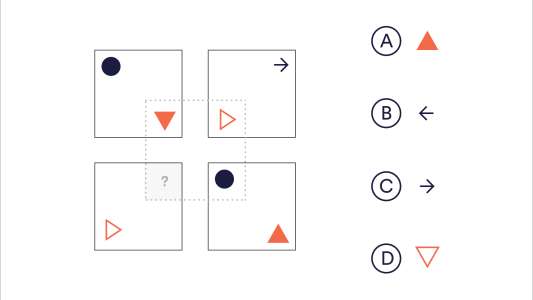
To pass a diagrammatic reasoning test, learn the small set of rules the questions are built from, decode one operator at a time, and work out each answer before you look at the options. Then practise under the same time pressure as the real test, so that recognising a rule becomes quick rather than a puzzle you solve from scratch. Preparation works because everything you need is on the screen and the rules repeat from question to question.
The fastest way to see the rules in action is to sit a free diagrammatic reasoning test and read the explanation for each answer. The tips below show you how to approach each question.
1. Find out what format to expect
Diagrammatic tests differ between providers in length, timing and question style. Some focus on flowcharts of operators, some on shape sequences, and many mix the two. If your invitation does not say which test you will sit, it is reasonable to ask the recruitment team. Knowing the format means you can practise the right questions and avoid surprises on the day.
Read the instructions carefully when the test starts. Check how many questions there are, how the time limit works and whether wrong answers lose marks.
2. Work out the rule before you look at the options
The options are written to look plausible, so reading them first plants ideas that are hard to shake. Look only at the diagram and put each change into words: “turns 90 degrees clockwise”, “reverses the order”, “swaps black and white”. Then use the options to confirm the answer you already hold.
3. Decode one operator at a time
In an operator question, look for the path with the fewest operators and start there. Better still, find two paths that differ by exactly one operator. Whatever differs in their outputs is that operator’s job.
Worked example. You are shown two completed paths:
- Path 1. A white triangle goes into box P and a black triangle comes out. Nothing else changes.
- Path 2. A black square goes into box P, then box Q, and a white square standing on one corner comes out.
Path 1 suggests P turns white into black. If P simply painted shapes black, the square in path 2 would leave P black. Q would then have to turn it white as well as turning it. A simpler reading fits both paths: P swaps the colour, so white becomes black and black becomes white. In path 2, P turns the black square white, and what is left for Q is a 45 degree turn that stands the square on one corner.
Question. A white square passes through Q, then P. Q turns it 45 degrees, so it stands on a corner. P swaps the colour, so it becomes black. The answer is a black square standing on one corner.
Two lessons come out of this. An operator has one effect and keeps it everywhere, so a reading that fits one path but not another is the wrong reading. And the chain runs strictly in the order shown. Some pairs of operators give different results in a different order, a turn combined with a mirror image being the usual case.
4. Write each rule down as you settle it
Note each operator in a word or two as soon as you are sure of it, and keep the wording exact. “Swap the colour” and “make it black” look the same on one path and contradict each other on the next. Scrap paper is usually allowed, and a short list of rules means you never have to decode the same operator twice.
5. Track each feature separately in sequences
In a sequence question, name the features: number of sides, number of shapes, shading, size, rotation and position. Fill in each one across the frames you are given, then extend only the ones that are changing.
Worked example. The first four frames are:
| Frame | Shape | Shading | Dot position |
|---|---|---|---|
| 1 | Triangle | White | Top |
| 2 | Square | Black | Right |
| 3 | Pentagon | White | Bottom |
| 4 | Hexagon | Black | Left |
Three tracks are running. The number of sides goes 3, 4, 5, 6, so the fifth frame has 7 sides. The shading goes white, black, white, black, so the fifth frame is white. The dot moves a quarter turn clockwise each time, so it returns to the top. The answer is a white seven-sided shape with the dot at the top.
Then use the options as a check. If two of them are white seven-sided shapes that differ only in where the dot sits, the dot is the feature the question is really testing.
6. Watch for distractors
Some shapes, colours or symbols are there only to take up your attention. Features that never change across the frames or paths can usually be set aside once you have noticed them. In operator questions, a shape may carry a detail that no operator touches. Note that it stays the same, then stop thinking about it.
7. Check your answer against every rule
Before you commit, run your chosen option back through every rule you found. A wrong option in a well-written question usually satisfies most of the rules and breaks one, so an answer that looks right at a glance proves nothing. If two options both survive the check, you have missed a rule. Go back to the diagram rather than guessing between them.
8. Work backwards only when it is quick
Testing each option against the diagram can help on short questions with few operators. On longer chains it eats time and can lead you to a wrong conclusion. Work forwards from the question by default, and keep working backwards for questions that ask for a missing input or when you are down to two options.
9. Pace yourself
Diagrammatic tests are tightly timed. At the start, divide the total time by the number of questions so you know your rough budget. If a question is taking far longer than that, choose the best-supported option and move on. Most tests do not take marks off for a wrong answer, so never leave a question blank unless the instructions say guessing is penalised.
Some tests set a time limit for each question rather than for the whole paper. If yours does, unused time does not carry forward, so give each question your full attention and then let it go.
10. Practise under real timing
The skill you are building is recognising a rule quickly, not solving a puzzle at leisure. Practise with a clock running from your first attempt. After each set, note which operator or rule caught you out, and practise that one specifically.
Puzzles that use logic and patterns can help keep your mind sharp, but they are no substitute for questions in the real format. Our diagrammatic reasoning examples walk through six questions step by step, and diagrammatic reasoning question types explained gives a method for each format. If you are still getting to grips with the basics, start with what diagrammatic reasoning is.
Start practising
The rules change very little from one test to the next, so the fastest gain comes from seeing enough of them that recognition replaces deduction. Work through a full diagrammatic reasoning practice test under timed conditions and review every answer you get wrong.