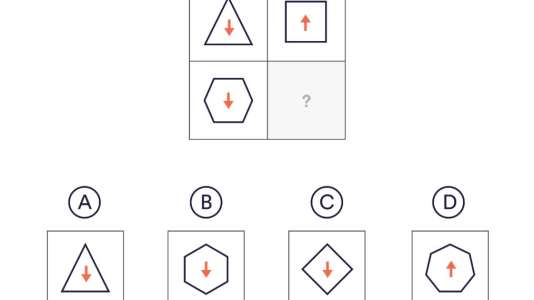

Abstract reasoning tests use five main question types: sequences, matrices, odd one out, analogies and sets. Each one asks you to find a rule in a group of shapes and apply it, and the rules themselves come from a short list such as rotation, reflection, movement, counting and shading. Once you know the five formats and the rules behind them, most questions become a matter of recognition rather than guesswork.
Every type below appears in our free abstract reasoning test, with a worked solution for each question.
Sequence questions
What you see. A row of four or five frames, followed by a blank. You choose the frame that comes next. Some tests put the blank in the middle of the row instead.
How to solve it. Work through one element at a time rather than staring at the whole frame. A frame that looks busy is usually two or three simple rules running side by side.
- Pick one element and track only it across every frame. Does it turn, move, grow, change shading or appear and disappear?
- Repeat for the next element until you have accounted for everything that changes.
- Note what stays the same. A shape that never moves still rules out any option that moves it.
- Predict the next frame from all the rules, then find it among the options.
Mini example. A star sits in the top left corner of frame 1 and moves two corners clockwise each step: top left, bottom right, top left, bottom right. Meanwhile a circle beside it alternates between black and white. If frame 4 has the star bottom right and a white circle, frame 5 has the star top left and a black circle.
Matrix questions
What you see. A grid, usually three by three, with one cell missing, often the bottom right.
How to solve it. Read along the rows and down the columns separately, because a rule may run in one direction or both. Common matrix rules are:
- each row contains the same three shapes in a different order
- something changes by a fixed amount across a row, such as one extra side or a quarter turn
- the third cell combines the first two, keeping everything, only what they share, or only what appears once
When a rule runs both ways, the missing cell has to satisfy both, which usually leaves one option. If a row rule and a column rule seem to disagree, you have misread one of them. Check both against a cell that sits in a complete row and a complete column.
Mini example. In each row, the shape gains one side from left to right: triangle, square, pentagon. If the bottom row starts with a square and then a pentagon, the missing cell is a hexagon.
Odd one out questions
What you see. Four to six shapes. All but one follow a rule.
How to solve it. Work out what most of the shapes have in common first, then find the one that breaks it. The difference is often small: a count that is one out, a shape that has been flipped instead of turned, or shading in the wrong section. Because only one option breaks the rule, you can test a possible rule quickly. If two options break it, it is the wrong rule.
Mini example. Five arrows point in different directions. Four have a black head and a white tail, and one has a white head and a black tail. The direction is a distraction. The odd one out is the arrow with the white head.
Analogy questions
What you see. A pair in the form “A is to B as C is to ?”.
How to solve it. List every change from A to B, including the ones that are easy to miss, such as a change in size or position. Then apply the same full list to C. The wrong options are usually C with only some of the changes applied.
Mini example. A is a black square in the top half of the frame. B is the same square, now white, in the bottom half. So the change is “invert the colour and move to the other half”. If C is a white triangle in the bottom half, the answer is a black triangle in the top half.
Set questions
What you see. Two groups of boxes, often called Set A and Set B, and one or more test boxes. You decide whether each test box belongs to Set A, Set B or neither.
How to solve it. Find the single feature that every box in Set A shares, then the one every box in Set B shares. The feature is often about one element while everything else is decoration. Test your rule against every box in the set, because a rule that fits five boxes out of six is the wrong rule. A test box that matches neither rule belongs to neither set.
Mini example. Every Set A box contains a shape touching the edge of the box. In every Set B box, no shape touches the edge. A test box with one small circle touching the bottom edge belongs to Set A, however many other shapes it holds.
The rules behind every question type
Almost every question, whatever its format, is built from the same short list of changes. Learning them turns the test from guesswork into checking.
- Rotation. A shape turns by a fixed angle each step, usually 45, 90 or 180 degrees, clockwise or anti-clockwise.
- Reflection. A shape flips to its mirror image. A turn can never produce a mirror image, which is often the key to an odd one out.
- Movement. An element moves a set number of places, often round the corners or edges of the frame, wrapping back to the start.
- Counting. The number of sides, dots, lines or shapes goes up or down by a fixed amount, or alternates.
- Alternation. Something switches between two states, such as black and white, on a regular cycle.
- Shading. Fill changes on its own cycle, or depends on another feature, such as every shape with an odd number of sides being black.
- Size. Shapes grow or shrink, or a large and a small shape swap sizes.
- Combining. Two frames combine to make a third by keeping all elements, shared elements only, or elements that appear once.
Real questions layer two or three of these at once. The wrong options are built from common mistakes: the rotation right but the shading wrong, or the movement one step too far. That is why predicting the answer before you read the options is so effective.
Where to go next
To see each format solved in full, with tables you can follow step by step, read our abstract reasoning examples. For a fixed checking order and advice on timing, see how to do abstract reasoning tests. Then put it into practice with a timed abstract reasoning test.