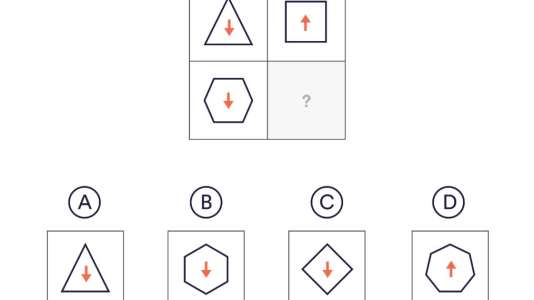
A typical example of abstract reasoning is a row of four squares in which a black dot moves one corner clockwise each time: top left, top right, bottom right, bottom left. You are asked what the fifth square looks like. The rule is “one corner clockwise”, so the dot wraps back round to the top left. Every abstract reasoning question works the same way: find the rule in shapes you have never seen, then apply it.
Below are worked examples of each common question format, written out in words and simple grids so you can follow the reasoning step by step. When you are ready to try them with real images and a timer, take a free abstract reasoning test.
Example 1: a sequence with two rules
Each frame shows an arrow and a row of dots.
| Frame | Arrow points | Dots |
|---|---|---|
| 1 | Up | 1 |
| 2 | Right | 2 |
| 3 | Down | 3 |
| 4 | Left | 4 |
| 5 | ? | ? |
Options: A) arrow up, 4 dots. B) arrow left, 5 dots. C) arrow up, 5 dots. D) arrow down, 5 dots.
Working. Track the arrow on its own: it turns 90 degrees clockwise each step, so after left it points up again. Now track the dots: 1, 2, 3, 4, so the next frame has 5.
Answer: C. Option A has the right arrow but the wrong count. Option B repeats the last arrow instead of turning it. Option D turns it the wrong way. Each wrong option breaks exactly one rule, which is how most distractors are built.
Example 2: a matrix
A three by three grid has the bottom-right cell missing. Each cell holds one shape with some dots inside it.
| Column 1 | Column 2 | Column 3 | |
|---|---|---|---|
| Row 1 | Circle, 1 dot | Square, 2 dots | Triangle, 3 dots |
| Row 2 | Square, 2 dots | Triangle, 3 dots | Circle, 1 dot |
| Row 3 | Triangle, 3 dots | Circle, 1 dot | ? |
Working. Read along the rows first. Each row contains a circle, a square and a triangle once each. Row 3 already has a triangle and a circle, so the missing shape is a square. The dots work the same way: each row has 1, 2 and 3 dots once each. Row 3 has 3 and 1, so the missing cell has 2.
Now check down the columns. Column 3 has a triangle and a circle, so it also needs a square, and it has 3 dots and 1 dot, so it also needs 2. Both directions agree.
Answer: a square with 2 dots. Notice that every circle has 1 dot, every square 2 and every triangle 3. Spotting that link is a useful check, and in harder questions it is often the second rule you need.
Example 3: odd one out
Five shapes each have some dots inside them.
| Option | Shape | Sides | Dots |
|---|---|---|---|
| A | Square | 4 | 4 |
| B | Pentagon | 5 | 5 |
| C | Triangle | 3 | 3 |
| D | Hexagon | 6 | 5 |
| E | Octagon | 8 | 8 |
Working. The shapes are all different, so the shape type alone cannot be the rule. Count something else. Compare each shape’s sides with its dots: four of the five have the same number of dots as sides. The hexagon has 6 sides but only 5 dots.
Answer: D. In a real question you would not have the counts written for you, so write them down yourself. When the shapes look unrelated, counting is usually the fastest way in.
Example 4: an analogy
Shape A changes into shape B. Apply the same change to shape C.
- A: a large white circle with a small black square inside it.
- B: a large black square with a small white circle inside it.
- C: a large white triangle with a small black star inside it.
Working. List everything that changed from A to B. The inner shape and the outer shape swapped places: the square moved outside and the circle moved inside. The colours also swapped: the outer shape is now black and the inner one white. Size did not change. The large shape is still large and the small one is still small.
Apply both changes to C. The star moves outside and becomes large, the triangle moves inside and becomes small. The outer shape turns black and the inner one white.
Answer: a large black star with a small white triangle inside it. A common wrong option swaps the shapes but keeps the old colours, giving a large white star with a small black triangle.
Example 5: which set does it belong to?
Some tests show two groups of boxes, Set A and Set B, and ask where a new box belongs.
| Set A box | Shapes in the box |
|---|---|
| 1 | 3 white circles, 1 black square |
| 2 | 1 black triangle, 2 white squares |
| 3 | 4 white triangles, 1 black circle |
| Set B box | Shapes in the box |
|---|---|
| 1 | 2 white circles, 2 black squares |
| 2 | 2 black triangles, 1 white star |
| 3 | 3 white triangles, 2 black circles |
Test box: 1 white square, 2 black stars, 2 white circles.
Working. The number of shapes in each box varies in both sets, so the total is not the rule. The shape types vary too. Now count only the black shapes. Every Set A box has exactly 1 black shape. Every Set B box has exactly 2. The test box has 2 black stars and no other black shapes.
Answer: Set B. Check the rule against all six boxes before you trust it. A rule that fits five out of six is the wrong rule.
Examples of abstract reasoning outside a test
Abstract reasoning is not only something you meet in a test. You use it whenever you spot a pattern in unfamiliar information and act on it. For example:
- noticing that customer complaints rise every time a particular product ships from one warehouse
- working out how a new piece of software is organised from a few menus, without reading the manual
- seeing that a fault only happens when two conditions are true at the same time
Each of these follows the same steps as a test question: notice what changes, state a rule, and check the rule against new cases.
What these examples have in common
Every example above was solved the same way. Pick one feature, track it across every frame or box, state the rule in words, then repeat for the next feature. Only then look at the options. For a fuller explanation of each format, read abstract reasoning question types explained. For a checking order and timing advice, see how to do abstract reasoning tests. And if you want the background first, start with what abstract reasoning is.
Try more examples
Written examples help you learn the method, but the real test is visual and timed. Practise with a full abstract reasoning test and read the worked solution for any question you miss.