
Apprenticeship Tests
Apprenticeship applications often include numerical, verbal and situational judgement tests, written questions and a video interview. Practise with a free situational judgement test set in apprenticeship work.
- 10 questions
- 13 minutes
- Worked solutions
Free · No sign-up · Scored the moment you finish
Apprenticeships Situational Judgement Test
You have 13 minutes to answer 10 questions. Each question describes a workplace situation and four possible responses. For every question, select the response you believe would be MOST effective and the response you believe would be LEAST effective. There are no trick questions; judge each response on how well it would work in the situation described.
About this test: this is one of a set of practice tests covering the areas Apprenticeships assessment processes typically include. It is written by us and is not any employer’s own assessment.
-
Question 1 of 10
You work in the membership office of a golf club. Members’ subscriptions are due, and a discounted rate applies to anyone who joined before 2015. A member who joined in 2018 asks you to record him as a pre-2015 member, saying he has been coming as a guest since 2012 and that nobody would ever check. He is friendly and well known at the club. The club secretary is in her office. Which response below would be most effective, and which would be least effective?
- Tell him you cannot change the joining date and suggest he takes it up with the club secretary himself if he believes his guest years should count.
- Record him at the pre-2015 rate, since he has genuinely been coming to the club since 2012 and the discount is meant to reward long- standing members.
- Apply the standard rate but note on his file that he has attended since 2012, so that the club can consider a discretionary discount at some point in the future.
- Tell him the joining date is a matter of record and you cannot change it, and offer to ask the secretary whether guest years have ever been counted towards the discount.
Show the answer
Most effective: D. Tell him the joining date is a matter of record and you cannot change it, and offer to ask the secretary whether guest years have ever been counted towards the discount.
Least effective: B. Record him at the pre-2015 rate, since he has genuinely been coming to the club since 2012 and the discount is meant to reward long- standing members.
A: Passes responsibility to others: the refusal is right and the handoff is thin. He has raised a question about how guest years are treated, and sending him to make his own case leaves you having merely declined.
B: Falsifies a membership record: his joining date is a fact, and rewriting it to produce a discount he is not entitled to is dishonesty dressed as fairness. It also charges every other member for the shortfall.
C: Delays the decision: it charges him correctly, which is right, and parks his actual question on a file note that nobody is due to read. The secretary is in her office today.
The most effective response is to tell him the joining date is a matter of record and offer to ask the secretary whether guest years have ever counted: the date is a fact and not yours to alter, but the question underneath it is legitimate and the secretary can answer it. Refusing clearly and taking the question forward does both jobs. It beats telling him to take it up with the club secretary himself, because that refuses in the same way but leaves him to make his own case, when you are standing beside the person who decides. It beats applying the standard rate and noting on his file that he has attended since 2012, because a note for future consideration answers nobody today, and the secretary is available now. The least effective response is recording him at the pre-2015 rate: it rewrites a factual record to create an entitlement that does not exist, and the reasoning offered, that he has been around a long time, is exactly the reasoning that makes small falsifications feel reasonable. That is worse than the other two, which charge him correctly. The principle: refuse to alter a record, then take the fair question underneath it to the person who can actually decide it.
-
Question 2 of 10
You work as a machine operative at a joinery workshop. Changing over the crosscut saw, you notice its blade guard is cracked and no longer locks into position. Workshop rules say a defective guard must be reported to the supervisor, who takes the machine out of use until it is repaired. It is the only crosscut saw in the workshop, several colleagues rely on it every day, and losing it would slow the whole team’s work; the last repair took most of a week. Which response below would be most effective, and which would be least effective?
- Say nothing about the guard and plan your own jobs around the other machines, leaving the crosscut saw available for the colleagues who rely on it.
- Carry on using the saw with extra care yourself, warning colleagues to do the same, and raise the guard at the team meeting later in the week.
- Report the cracked guard to your supervisor straight away, so the saw comes out of use until it has been repaired.
- Email the company's health and safety officer asking for an urgent inspection of every machine in the workshop, assuming other guards are probably wearing out as well.
Show the answer
Most effective: C. Report the cracked guard to your supervisor straight away, so the saw comes out of use until it has been repaired.
Least effective: A. Say nothing about the guard and plan your own jobs around the other machines, leaving the crosscut saw available for the colleagues who rely on it.
A: Stays silent about a known safety risk: keeping quiet while steering only yourself away from the saw protects you and nobody else; colleagues keep using a machine you know is unsafe, which is self-protective silence rather than a defensible reading of the risk.
B: Fails to escalate a genuine risk: care and warnings do not fix a guard that no longer locks, and waiting days for a meeting keeps a known hazard in daily use when the rules give you a route that acts today.
D: Escalates on assumptions without checking: widening one observed fault into a workshop-wide inspection request is built on a guess, bypasses the supervisor the rules name, and leaves the one saw you know is unsafe in use while the bigger process gets arranged.
The most effective response is to report the cracked guard to your supervisor straight away so the saw comes out of use: a guard that is cracked and no longer locks is a genuine injury risk, the rules name exactly who to tell, and the supervisor can act today. The disruption to the team is real, but it is the trade the workshop’s own rules have already made. It beats carrying on with extra care and raising it at the team meeting, because care and warnings do not make a broken guard safe, and waiting days keeps the hazard in daily use for the sake of avoiding a difficult report. It beats emailing the health and safety officer for a workshop-wide inspection, because that inflates one observed fault into an assumed general problem, bypasses the supervisor who can act now, and leaves the one saw you know is unsafe running while a bigger inspection is arranged. The least effective response is saying nothing and working around the saw yourself: unlike carrying on with warnings, which at least alerts the people at risk, and unlike the inspection request, which at least tells someone with authority, it tells nobody and quietly protects only you, leaving colleagues to use a machine you know is unsafe. The principle: a genuine safety risk is raised at once through the stated route, whatever the disruption, and never managed silently around yourself.
-
Question 3 of 10
You are an administrator in a secondary school office. You and your colleague Marek share responsibility for the trips inbox. He believes parents’ consent queries should be answered only by the trip lead teacher; you have always answered the routine ones yourself. Yesterday he forwarded three of your answers to the trip lead with a note saying they should not have been sent. A parent deadline falls on Friday and forty replies are outstanding. Which response below would be most effective, and which would be least effective?
- Ask Marek to sit down with you today, work out which queries each of you will answer before Friday, and agree to take the underlying disagreement to the trip lead afterwards.
- Carry on answering the queries as you always have and, since Marek went over your head to the trip lead, copy the trip lead into your replies so she can see the standard of them for herself.
- Answer all forty replies yourself before Friday so the parents' deadline is met, and leave the question of who should be answering them until the trips have gone out.
- Email the trip lead teacher setting out why routine consent queries have always been answered in the office, and ask her to confirm the position before any more replies go out.
Show the answer
Most effective: A. Ask Marek to sit down with you today, work out which queries each of you will answer before Friday, and agree to take the underlying disagreement to the trip lead afterwards.
Least effective: B. Carry on answering the queries as you always have and, since Marek went over your head to the trip lead, copy the trip lead into your replies so she can see the standard of them for herself.
B: Personalises the conflict: it answers a professional disagreement by scoring a point through a third party. Forty parent replies become the ground on which two colleagues argue, which is a different order of wrong from the other options.
C: Avoids the difficult conversation: it hits Friday and guarantees the same clash next term, with Marek now watching for replies he thinks you should not be sending.
D: Delays the decision: it seeks a ruling that may not arrive before Friday, and pauses forty parent replies while waiting for it. The boundary question is real; the parents' deadline will not wait for it.
The most effective response is to ask Marek to sit down with you today, work out which queries each of you answers before Friday, and take the underlying disagreement to the trip lead afterwards: there are two problems here, a deadline on Friday and a genuine disagreement about who answers what, and only the first is urgent. It beats answering all forty replies yourself before Friday, because that meets the deadline and leaves the disagreement exactly where it was, with the same clash guaranteed next term. It beats emailing the trip lead to confirm the position before any more replies go out, because that puts forty parent replies behind a decision that may not come before Friday. The least effective response is copying the trip lead into your replies so she can see the standard of them: it uses the parents’ replies as a way of answering Marek, copying her in to make a point rather than to solve anything, which turns a workable disagreement into a contest. That is worse than the other two, which handle the conflict badly but do not weaponise the work. The principle: separate the deadline from the disagreement, meet the deadline together, and settle the disagreement with the person who owns the rule afterwards.
-
Question 4 of 10
You work in credit control at a builders’ merchant. A long-standing customer is two months overdue and his account should be put on stop, which would block a delivery he needs tomorrow. He rings you personally, explains his cash flow problem, and asks you to delay the stop by a week as a favour, mentioning that he has always paid eventually. Your credit manager is in the office. Which response below would be most effective, and which would be least effective?
- Apply the stop as the process requires and tell him the decision is automatic once an account reaches two months, so there is nothing you can do about it.
- Apply the stop, but tell him informally which day the account is reviewed so that he can time a part payment to get the delivery released.
- Hold off applying the stop for a week as he asks, since he has always paid eventually and applying it now would cost him a delivery he needs tomorrow.
- Tell him you cannot delay the stop yourself, take the details of his cash flow position, and put the request to your credit manager today so she can decide before tomorrow's delivery.
Show the answer
Most effective: D. Tell him you cannot delay the stop yourself, take the details of his cash flow position, and put the request to your credit manager today so she can decide before tomorrow's delivery.
Least effective: C. Hold off applying the stop for a week as he asks, since he has always paid eventually and applying it now would cost him a delivery he needs tomorrow.
A: Passes responsibility to others: it hides behind the process to avoid a difficult conversation, when a genuine request from a long- standing customer is exactly the kind that the credit manager exists to consider.
B: Coaches the customer around the control: it applies the rule and then coaches the customer on how to work around it, which achieves the same favour as delaying the stop while leaving no record that anyone decided anything.
C: Breaches confidentiality or process: the credit limit is the merchant's control on its own exposure, and quietly suspending it as a personal favour is a decision taken outside the process by someone without the authority to take it.
The most effective response is to tell him you cannot delay the stop yourself, take the details of his cash flow position, and put the request to your credit manager today: you have no authority to suspend a credit stop, the request is a reasonable one for a long-standing customer, and she is in the office with a day in hand to decide. Taking the facts to her keeps the decision with the person who owns the exposure. It beats telling him the decision is automatic and there is nothing you can do, because that is untrue: something can be done, it is simply not yours to do, and the process has a person in it. It beats telling him informally which day the account is reviewed so he can time a part payment, because that achieves the favour without a record that any decision was taken. The least effective response is holding off applying the stop for a week as he asks: it suspends a control on the merchant’s own credit exposure as a personal favour, with no authority and no record. That is worse than the flat refusal, which is unhelpful but correct, and worse than the informal tip, which at least applies the stop. The principle: when a request is reasonable but outside your authority, take it to the person whose authority it is, in time for them to use it.
-
Question 5 of 10
You work in an HR shared service team. It is Wednesday. Three things are outstanding: a new starter’s contract must go out today or she cannot begin on Monday, a manager wants a report on absence figures by Friday, and a colleague has asked you to review her draft policy whenever you have time. The contract takes an hour, the report three hours. You have five hours left today. Which response below would be most effective, and which would be least effective?
- Work through all three in the order they were asked for, and let your manager know at the end of the day if anything has not been finished.
- Start the absence report because it is the longest job, then do the contract at the end of the day once the bulk of the report is behind you.
- Do the contract and the policy review first because they are the two shorter jobs, then start the absence report and continue it tomorrow morning.
- Send the new starter's contract first, then work on the absence report, and tell your colleague you will review her policy tomorrow.
Show the answer
Most effective: D. Send the new starter's contract first, then work on the absence report, and tell your colleague you will review her policy tomorrow.
Least effective: A. Work through all three in the order they were asked for, and let your manager know at the end of the day if anything has not been finished.
A: Hides the problem / silent deadline slip: the contract is the one item that cannot slip, and reporting at the end of the day is after the point at which anyone could rescue it. Reporting a missed deadline once it is missed is not communication.
B: Delays the decision: it leaves an hour-long task with a today-or- never deadline to the end of a five-hour day, so any overrun on the report costs the new starter her start date.
C: Splits effort so nothing finishes: it fits the favour in ahead of a report with a named Friday deadline, and pushes three hours of work into a day that already has other demands.
The most effective response is to send the new starter’s contract first, then work on the absence report, and tell your colleague the policy review waits until tomorrow: only the contract has a deadline of today with a consequence attached, a start date, and it takes one of the five hours available. That leaves four hours for a three-hour report due Friday, and the policy review has no deadline at all. It beats starting the absence report first because it is the longest job, since that puts a fixed, unrecoverable deadline behind an open-ended one. It beats doing the contract and the policy review first as the two shorter jobs, because that fits an unscheduled favour ahead of a report with a stated deadline. The least effective response is working through all three in the order they were asked for and reporting at the end of the day: it works to the order things were asked in rather than to their deadlines, and reports the failure only once the new starter’s Monday cannot be saved. That is worse than the other two, which sequence badly but at least do the contract today. The principle: identify the task that cannot slip, do it first, and say early which of the others will move.
-
Question 6 of 10
You are a call handler for a housing repairs line. A storm overnight has produced four times the usual call volume and you have taken complaints for three hours. A tenant tells you that you sound like you do not care and that she has been let down repeatedly. She has a genuinely urgent repair, a leaking roof over her child’s bedroom. Your team leader is available. Which response below would be most effective, and which would be least effective?
- Explain that the team is dealing with four times the normal call volume because of the storm and that everyone is being helped as quickly as possible.
- Acknowledge that she has been let down, confirm the leak over the child's bedroom as an urgent repair, and tell her exactly what happens next and when.
- Tell her that comments about whether you care are not helping and ask her to let you take the details so the repair can be logged.
- Apologise and offer to pass her to your team leader, since she is unhappy with how the call is going and may get further with someone more senior.
Show the answer
Most effective: B. Acknowledge that she has been let down, confirm the leak over the child's bedroom as an urgent repair, and tell her exactly what happens next and when.
Least effective: C. Tell her that comments about whether you care are not helping and ask her to let you take the details so the repair can be logged.
A: Answers the accusation and not the leak: it answers her accusation with the team's workload, which is true and irrelevant to a leak over a child's bed, and invites her to argue about whose day is harder.
C: Personalises the conflict: it corrects a distressed tenant's manner before addressing a leak over her child's bed, which puts your own treatment ahead of her emergency.
D: Passes responsibility to others: it hands over a repair you can raise yourself and makes a tenant with a leaking roof wait through another handover.
The most effective response is to acknowledge that she has been let down, confirm the leak over the child’s bedroom as an urgent repair, and tell her exactly what happens next and when: with water coming in over a child’s bed, the fastest route through the call is to accept the part that is true and move straight to classifying the repair and saying what follows. It beats explaining that the team is dealing with four times the normal call volume, because that answers her accusation rather than her leak, and invites a comparison of whose day is worse. It beats offering to pass her to your team leader, because that delays a repair you can raise now and makes her start again. The least effective response is telling her that comments about whether you care are not helping: it corrects her manner before dealing with the water, which puts your own treatment ahead of her emergency. That is worse than explaining the volumes, which at least explains, and worse than passing her on, which at least routes her onward. The principle: when someone is angry and their problem is urgent, acknowledge the grievance briefly and spend the call on the emergency.
-
Question 7 of 10
You work at a print bureau. Loading a job you notice that the artwork for a customer’s 5,000 leaflets carries a phone number that does not match the one on their letterhead in the same file. Nobody has asked you to proofread; your job is to run the press. The print run starts in an hour. The customer’s contact details are on the job sheet and your production manager is on site. Which response below would be most effective, and which would be least effective?
- Run the job exactly as supplied, since proofreading is not your role and the customer signed off the artwork before it came to the press.
- Ring the customer directly to check which phone number is correct before running the job, since it is their leaflet and only they can say.
- Print the leaflets using the number from the letterhead, since that is plainly the customer's real number and the one on the artwork must be a mistake.
- Take it to your production manager now, show her the two different numbers, and let her decide whether to hold the run and check with the customer.
Show the answer
Most effective: D. Take it to your production manager now, show her the two different numbers, and let her decide whether to hold the run and check with the customer.
Least effective: A. Run the job exactly as supplied, since proofreading is not your role and the customer signed off the artwork before it came to the press.
A: Fails to escalate a genuine risk: you are the only person who has noticed, and 5,000 leaflets carrying a wrong phone number are worthless once printed. Sign-off does not make an error you can see disappear.
B: Substitutes own judgement for the stakeholder's: contacting a customer about their artwork is the production manager's call, and going straight to them may cut across a conversation the bureau has already had.
C: Acts on assumptions without checking: the artwork number may be a new line or a campaign number. Choosing between them yourself risks printing 5,000 leaflets with the wrong one and no record of who decided.
The most effective response is to take it to your production manager now, show her the two different numbers, and let her decide whether to hold the run: you have spotted something nobody else has, the run starts in an hour, and she can decide in minutes. It costs almost nothing and prevents a scrapped run. It beats printing the leaflets using the number from the letterhead, because choosing between the two yourself is a guess about the customer’s business, and being wrong wastes the whole job. It beats ringing the customer directly to check which number is correct, because that relationship is the bureau’s to manage, and the manager may already know the answer. The least effective response is running the job exactly as supplied because proofreading is not your role: it prints 5,000 leaflets with a discrepancy you have seen, on the grounds that the artwork was signed off. That is worse than the other two, which act on it imperfectly but do act. The principle: when you see something wrong that is about to become expensive, raise it with whoever can stop the job, before it starts.
-
Question 8 of 10
You work at the ticket desk of a cinema. A family arrives with tickets for a film that started twenty minutes ago; they misread the start time on their booking. The screening is nearly full and there is another showing of the same film in ninety minutes with plenty of seats. Cinema policy allows the desk to transfer tickets to a later showing at your discretion. The duty manager is in the foyer. Which response below would be most effective, and which would be least effective?
- Explain that the film started twenty minutes ago and let them into the screen now so they see as much of it as possible.
- Explain that the tickets were for a showing that has begun, that the mistake was theirs, and that new tickets would have to be bought for the later screening.
- Explain that the tickets cannot be used now and refer them to the duty manager in the foyer, who can decide whether anything can be done.
- Apologise for the mix-up, explain the film has already started, and offer to transfer their tickets to the showing in ninety minutes.
Show the answer
Most effective: D. Apologise for the mix-up, explain the film has already started, and offer to transfer their tickets to the showing in ninety minutes.
Least effective: B. Explain that the tickets were for a showing that has begun, that the mistake was theirs, and that new tickets would have to be bought for the later screening.
A: Seats them into a spoiled showing: it seats a family twenty minutes into a film in a nearly full screen, which gives them a poor showing and disturbs everyone already watching, when a full one is available later.
B: Ignores the customer's actual need: it charges a family twice for a misread start time when policy allows you to transfer the tickets at no cost. Applying the strictest reading available is a service failure, not a rule.
C: Passes responsibility to others: transferring tickets is explicitly within your discretion, so sending them to find a manager adds a step to something you are authorised to settle.
The most effective response is to apologise for the mix-up, explain the film has already started, and offer to transfer their tickets to the showing in ninety minutes: a later screening has plenty of seats and the policy explicitly lets you transfer. That costs the cinema a seat it would have had empty anyway and saves the family’s evening. It beats letting them into the screen now so they see as much as possible, because seating them twenty minutes late in a nearly full auditorium gives them a poor experience and disturbs the audience, when a complete showing is available. It beats referring them to the duty manager in the foyer, because the transfer is within your discretion, so referring only delays what you can do now. The least effective response is telling them the mistake was theirs and that new tickets must be bought: it makes the family pay twice for a misread time when a free transfer was available to you. That is worse than seating them late, which at least lets them see something, and worse than the referral, which at least keeps a route open. The principle: when you hold the discretion to fix a customer’s problem at no real cost, use it rather than referring it or applying the harshest reading.
-
Question 9 of 10
You work in a hospital outpatient booking office. At 11am three things need you. A consultant’s clinic next Tuesday has been cancelled and forty patients need contacting before letters go out tomorrow. A patient is on hold asking to move an appointment scheduled for tomorrow. And your manager wants the weekly waiting-time return by 2pm, which takes an hour. Contacting forty patients takes most of the day. Which response below would be most effective, and which would be least effective?
- Start ringing the forty patients immediately since that is the largest task and the letters go out tomorrow, and deal with the waiting patient and the return when you can.
- Take the patient off hold and move tomorrow's appointment, do the waiting-time return before 2pm, then spend the rest of the day on the forty cancellations.
- Let the cancellation letters go out as they are and contact the forty patients afterwards, so that today's shorter tasks can all be completed properly.
- Do the waiting-time return first since it has the earliest deadline, then the patient on hold, then start the cancellation calls.
Show the answer
Most effective: B. Take the patient off hold and move tomorrow's appointment, do the waiting-time return before 2pm, then spend the rest of the day on the forty cancellations.
Least effective: C. Let the cancellation letters go out as they are and contact the forty patients afterwards, so that today's shorter tasks can all be completed properly.
A: Splits effort so nothing finishes: it starts the long job while leaving a patient on hold and an hour-long return due at 2pm, so the waiting-time deadline is put at risk by a task that has until tomorrow.
C: Hides the problem: it lets forty patients receive letters for a clinic that has been cancelled, which generates forty wasted journeys and forty calls back. Knowingly sending wrong information is worse than mis-sequencing it.
D: Ignores the customer's actual need: an hour of reporting is put ahead of a patient already holding on the line about an appointment tomorrow, when her call takes a few minutes.
The most effective response is to take the patient off hold and move tomorrow’s appointment, do the waiting-time return before 2pm, then spend the rest of the day on the forty cancellations: the patient takes a few minutes and concerns tomorrow, the return takes an hour against a fixed deadline, and the calls have until the letters go out. Doing the two short fixed items first leaves the whole afternoon for the long one. It beats starting the forty calls immediately as the largest task, because that puts an hour-long 2pm deadline at risk for work that has until tomorrow. It beats doing the waiting-time return first because it has the earliest deadline, because that leaves a patient holding on the line while an internal report is prepared. The least effective response is letting the cancellation letters go out as they are and contacting the forty afterwards: it sends letters for a clinic that will not happen, producing wasted journeys and forty return calls. That is worse than the other two, which order the day badly but do not knowingly send wrong information. The principle: clear the short items with fixed deadlines, then give the long task the time it needs, and never let known wrong information go out.
-
Question 10 of 10
You are a ward administrator at a veterinary hospital. At 4pm three things need you. A dog is due to be collected at 4.30 and its discharge notes are not written, which takes fifteen minutes. A referring vet has rung twice for an update on a case and is waiting for a call back. And the practice manager wants the month-end invoicing reconciled tonight, which takes two hours. You finish at 7pm. Which response below would be most effective, and which would be least effective?
- Ring the referring vet first since he has already rung twice, then write the discharge notes and start the invoicing.
- Start the month-end invoicing since it is the longest job and is wanted tonight, and fit the discharge notes and the call around it as the evening goes on.
- Send the dog home at 4.30 without written discharge notes and telephone the owner with the aftercare instructions later in the evening once the invoicing is done.
- Write the discharge notes for the 4.30 collection, ring the referring vet back, then spend the rest of the evening on the invoicing.
Show the answer
Most effective: D. Write the discharge notes for the 4.30 collection, ring the referring vet back, then spend the rest of the evening on the invoicing.
Least effective: C. Send the dog home at 4.30 without written discharge notes and telephone the owner with the aftercare instructions later in the evening once the invoicing is done.
A: Delays the decision: the call has no fixed time and the collection is at 4.30. Answering by who has waited longest rather than by when something is needed risks the owner arriving to notes that are not written.
B: Splits effort so nothing finishes: two hours of invoicing has three hours of room, and starting it first leaves a fifteen-minute task with a 4.30 deadline to be squeezed.
C: Acts recklessly with a clinical handover: discharge notes are how an owner knows about medication and aftercare, and sending an animal home without them, on a promise to ring later, risks the dog's recovery.
The most effective response is to write the discharge notes for the 4.30 collection, ring the referring vet back, then spend the rest of the evening on the invoicing: the collection is fixed and only fifteen minutes away, the vet’s call has no fixed time but has already waited twice, and two hours of invoicing fits comfortably in the three hours left. Sequencing by deadline gets all three done. It beats ringing the referring vet first because he has already rung twice, since that risks an owner arriving to notes that do not exist. It beats starting the month-end invoicing as the longest job wanted tonight, because that squeezes the one task with a hard time on it. The least effective response is sending the dog home without written discharge notes and telephoning the aftercare later: it discharges an animal without written instructions to protect a paperwork deadline. That is worse than the other two, which order the work badly but complete it properly. The principle: do the short task with the fixed clinical deadline first, then the waiting person, then the long job that fits the remaining time.






What are Apprenticeship tests?
Apprenticeship tests are the online assessments employers set after your application. They often mix scenario questions with written or video answers, followed by an interview or assessment centre, and the mix depends on the employer and the level of the apprenticeship. At BT, for example, the online stage is an untimed assessment of 5 written questions and one 90-second video question.
The tests you are likely to sit
The exact tests depend on the role, so check the job advert or your invitation. These are the ones apprenticeship applicants most often meet.
| Assessment | What it measures |
|---|---|
| Numerical reasoning test | Working with numbers, charts and simple data |
| Verbal reasoning test | Understanding and judging written information |
| Situational judgement test | How you would act in workplace scenarios |
| Written questions | Short written answers about you and the role |
| Video interview | Recorded answers to set questions |
| Interview or assessment centre | Your motivation and how you work with others |
Practise the real thing
Practice moves scores fastest on the tests set under time pressure, and every question in the pack comes with the working shown.
- 10
- practice tests
- 100
- questions, all solved
Practice Aptitude Tests · Original data
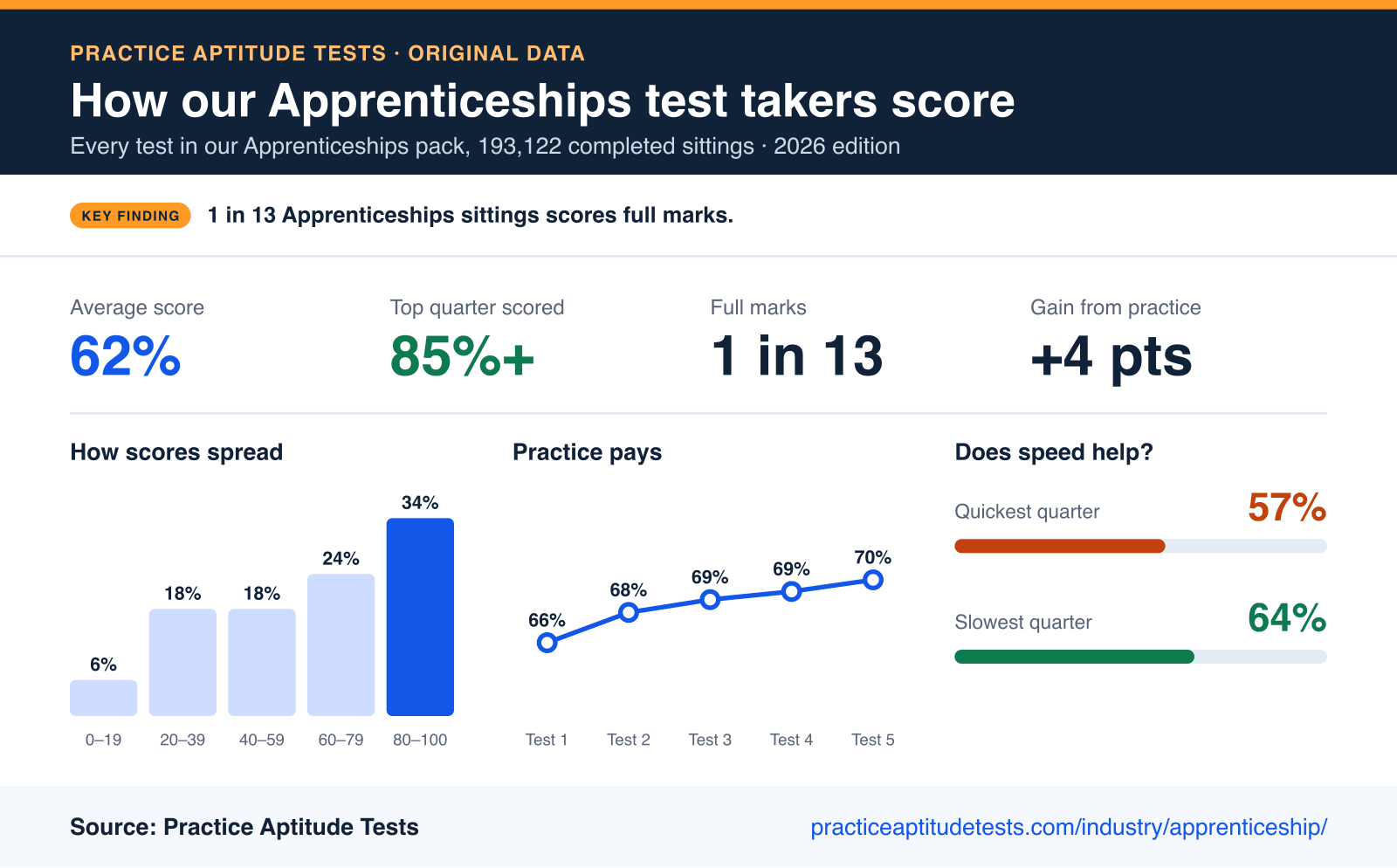
How our test takers score
Results from every test in our Apprenticeships pack, past and present.
Key finding1 in 13 Apprenticeships sittings scores full marks.
How scores spread
34% scored 80% or more, and 24% scored under 40%.
Share of sittings in each score band.
Practice pays
Regular practisers went from 66% on their first test to 70% on their fifth.
7,178 people who took five or more tests.
Does speed help?
Rushing costs marks. The quickest quarter scored 7 points lower than the slowest.
Typical pace: 48 seconds a question.
Share this data
Our practice tests mirror the formats used in Apprenticeship hiring. They are written by Practice Aptitude Tests and are not affiliated with or endorsed by any individual employer.