Spatial awareness is your sense of where things are in space, including you, and how they relate to each other: their distance, size, position and direction, and how that changes as they or you move. It is what lets you reverse into a parking space, pack a car boot so everything fits, or walk through a crowded station without bumping into anyone. In short, it is understanding space and your place in it.
Employers test the thinking side of this skill through spatial reasoning questions, where you turn, fold and compare shapes in your head. You can see what those questions look like in a free spatial reasoning test.
What is spatial awareness?
Spatial awareness has two parts that work together.
- Awareness of your own body in space. Knowing where your hands, feet and body are without looking, and how close you are to the things around you. This is what you use when you catch a ball, climb a ladder or step off a kerb.
- Awareness of objects in relation to each other. Judging how far apart two things are, whether one will fit inside another, which way something is facing, and what it would look like from another angle.
The second part shades into spatial reasoning: holding a picture of an object in your mind and changing it, for example by rotating it or unfolding it. People often use the two terms loosely, and our guide to what spatial reasoning is explains how the mental side is defined and tested.
Spatial awareness examples in everyday life
You use spatial awareness constantly, usually without noticing.
- Driving and parking. Judging the gap between your car and the kerb, the car behind and the bollard you cannot quite see.
- Packing. Working out how to fit boxes into a boot, a suitcase or a removal van with the least wasted space.
- Following directions. Turning a map so it matches the way you are facing, or keeping track of which way is north after several turns.
- Assembling flat-pack furniture. Reading a two-dimensional diagram and seeing how the panels become a three-dimensional cabinet.
- Sport. Positioning yourself for a pass, reading where a ball will land, or keeping track of teammates you cannot see directly.
- Arranging a room. Picturing whether a sofa will fit through a doorway or how a layout will look before you move anything.
Spatial awareness examples at work
Some jobs lean on spatial awareness every day, which is why employers in these areas often include spatial questions in their assessments.
- Engineering and manufacturing. Reading technical drawings, picturing how parts fit together and spotting where a component will clash with another.
- Architecture and design. Turning floor plans and elevations into a building in your head, and seeing how light and space will work.
- Electrical and building trades. Routing cables or pipes through walls and ceilings you cannot see inside.
- Logistics and warehousing. Loading pallets and vehicles safely and efficiently, and planning racking layouts.
- Aviation, driving and the armed forces. Keeping track of position, height, speed and direction relative to other vehicles and the ground.
- Healthcare. Working with scans and anatomy, where a flat image has to be understood as a three-dimensional body.
What spatial awareness looks like in a test
An aptitude test cannot watch you park a car, so it measures the reasoning side instead. Typical questions ask you to:
- pick out a shape after it has been rotated, and reject the one that has been mirrored
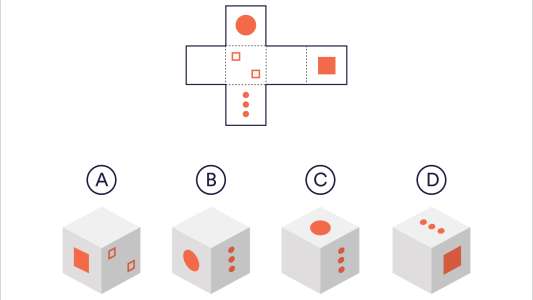
- work out which cube a flat net folds into
- count the blocks in a stack, including the ones hidden from view
- match a 3D object to its view from above, the front or the side
- keep track of direction on a map or route
Here is a simple orientation question of the kind you might meet.
Example. You leave a building facing north. You turn right, then right again, then left. Which direction are you now facing?
- Facing north, a right turn leaves you facing east.
- A second right turn leaves you facing south.
- A left turn from south leaves you facing east.
Answer: east. The trick is to update your direction after every turn rather than trying to picture the whole route at once.
Our spatial reasoning test tips and examples walks through the other main question types with worked answers.
Is spatial awareness something you are born with?
People do start from different places, and some find it easier than others. But spatial awareness responds well to practice. Activities such as sketching objects from different angles, building models, doing jigsaws and navigating without a satnav all exercise it, and practising test questions makes the specific formats much quicker. Our guide on how to improve spatial awareness sets out exercises you can start today.
Practise spatial awareness questions
If you have a spatial assessment coming up, the most useful step is to see the question types for yourself and find out which ones slow you down. Try a spatial reasoning practice test under timed conditions, then review each answer to see where your mental picture went wrong.