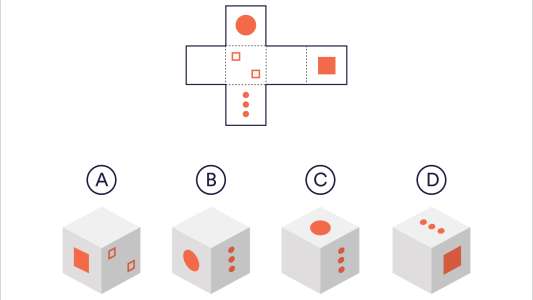
The best spatial reasoning test tips are: decide what the answer should look like before you read the options, track one distinctive feature instead of the whole shape, rule out mirror images early, and count hidden blocks deliberately. Each question type has its own quick method, and once you know them most questions come down to a few checks rather than a full mental picture. Then practise under time pressure so the methods hold up on the day.
Every type below appears in our free spatial reasoning test, with a worked solution for each question.
Tips that apply to every question
- Predict first, then look. Picture the answer before you read the options. Wrong options are built from common slips, such as the right rotation but flipped, and they look convincing if you have no prediction of your own.
- Track one feature, not the whole shape. Pick a dot, an arrow, a shaded corner or a short arm, and follow only that through the transformation. It is faster and far less error-prone than turning everything at once.
- Eliminate before you confirm. In most questions you can knock out two or three options with one quick check, then spend your time on the rest.
- Work out your time per question. Divide the time limit by the number of questions before you start. If a question is taking much longer than that, pick the best remaining option and move on, unless the test penalises wrong answers.
- Read the instructions. Some tests ask for the odd one out, some for the match, and some allow more than one correct answer. A practice question at the start is worth doing properly.
- Find out what you are sitting. Ask the recruiter which test you have been invited to. Formats and time limits vary, and knowing them lets you practise the right things.
Rotation questions: method and example
A rotation turns a shape in its own plane. It never flips it. So any option that is a mirror image of the original is wrong, however close it looks.
Example. A square has a black dot in its top right corner. It is rotated 90 degrees clockwise. Where is the dot now?
- Track only the dot.
- A quarter turn clockwise moves the top of the square to the right side, and the right side to the bottom.
- The top right corner therefore becomes the bottom right corner.
Answer: bottom right. If an option shows the dot in the top left, that is a reflection, not a rotation.
Mirror image questions: method and example
In a vertical mirror line, left and right swap but top and bottom stay where they are. In a horizontal mirror line, top and bottom swap but left and right stay. Reflect one element at a time.
Example. An arrow points up and to the left. What does its reflection in a vertical mirror look like?
The vertical mirror swaps left and right, and leaves up and down alone. Answer: the arrow points up and to the right.
The quickest check is handedness. Choose an asymmetric feature and ask whether you could reach the option by turning the shape without lifting it off the page. If you could, it is a rotation, not a reflection.
Cube net questions: method and example
Every face of a cube has four neighbours and one opposite face it can never touch. Two opposite faces can never be seen together in a single view of a cube, so start by finding the opposite pairs, then reject any option that shows a pair side by side.
Example. A net is a row of four squares labelled 1, 2, 3 and 4 from left to right. Square 5 is attached above square 2, and square 6 below square 2. Which faces are opposite each other?
- In a straight row, squares one apart end up opposite. So 1 is opposite 3, and 2 is opposite 4.
- Squares 5 and 6 are attached to opposite edges of the same square, so they fold to opposite sides.
Answer: 1 and 3, 2 and 4, 5 and 6. Any cube option showing 1 next to 3, 2 next to 4, or 5 next to 6 can be ruled out straight away. For the options that remain, check which way the symbols face as each square folds up.
Block counting questions: method and example
Count in layers, and count every block that must be there to hold up the ones you can see. Most wrong answers are undercounts.
Example. A stack has a bottom layer 3 blocks wide and 2 blocks deep. On top, along the back, is a row of 3 blocks. A single block sits on top of that row. How many blocks are there?
- Bottom layer: 3 × 2 = 6.
- Second layer: 3.
- Top: 1.
- Total: 6 + 3 + 1 = 10.
Answer: 10 blocks. In a drawing, several blocks in the bottom layer are hidden behind the second row, but they must exist to support it.
Map and orientation questions: method and example
Update your direction after every single turn. Do not try to hold the whole route at once.
Example. You leave the office heading north. You take a right turn, then a left, then another left. Which direction are you heading?
- North, then right: east.
- East, then left: north.
- North, then left: west.
Answer: west. Writing the direction after each turn takes seconds and removes most errors.
2D to 3D questions
Some questions show a 3D object and ask for its view from above, the front or the side, or show pieces and ask which shape they make. Count edges and compare proportions first, and rule out options with a part that is the wrong length or the wrong way round. Only then assemble the shape in your head.
Preparing in the days before your test
- Take a timed practice test first to see which question types cost you marks.
- Drill your weakest type on its own until the method is automatic, then return to mixed practice.
- Review every wrong answer and pin down the exact slip: a flip, a missed block, a turn in the wrong direction.
- Do not cram the night before. Sleep well, and set up a quiet room with a reliable internet connection for an online test.
If you want to build the underlying skill alongside test practice, see how to improve spatial awareness. For a fuller explanation of what these tests measure, read what spatial reasoning is.
Put the tips into practice
The methods above only become quick through use. Take a spatial reasoning practice test under timed conditions, apply one method per question type, and check each solution to see where your picture went wrong.