

Spatial Reasoning Tests

    • 10 tests |
    • 100 questions

Spatial reasoning tests measure how well you picture and manipulate shapes in two and three dimensions: rotating them, reflecting them, folding nets and counting hidden blocks. Practise with realistic questions and a worked solution for every one, so the visualisation becomes second nature.

What is a spatial reasoning test?

A spatial reasoning test measures how well you picture and manipulate shapes in two and three dimensions. Employers use it for roles that rely on visualising objects before interview. You work through tasks such as rotating shapes, matching them and folding nets into solids, choosing the correct answer from the options given. It rewards holding an image in mind and turning it accurately.

Spatial reasoning test at a glance
Questions 10
Typical time limit 10 minutes
Format Choose the shape or figure that matches after rotation, folding or assembly
Skills tested Mental rotation, 2D and 3D visualisation, shape matching, spatial awareness
Used by Engineering, architecture, design, military and technical employers

The test below is a full-length example with worked solutions for every question. It is free, and there is no sign-up.

Free Spatial Reasoning Test

Download this test as a PDF Same 10 questions and worked solutions, printable. No sign-up.

Question 1 of 10
01 / 10 Abstract Easy

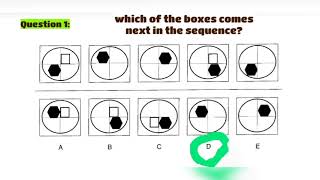
Which shape comes next in the sequence?

Show worked solution

The answer is C. Each triangle turns 90° clockwise from the one before it. Continuing the turn gives the triangle at 0°. Option A turns back the way the sequence came instead of continuing. Option B repeats the last shape without applying the final turn. Option D over-rotates by one extra 90° step.

Question 2 of 10
02 / 10 Abstract Medium

Which shape comes next in the sequence?

Show worked solution

The answer is B. Each arrow turns 45° anticlockwise from the one before it. Continuing the turn gives the arrow at 270°. Option A over-rotates by one extra 45° step. Option C repeats the last shape without applying the final turn. Option D turns back the way the sequence came instead of continuing.

Question 3 of 10
03 / 10 Abstract Easy

Which shape comes next in the sequence?

Show worked solution

The answer is D. The shaded cell moves one position clockwise around the grid at each step. The next clockwise position is the bottom-left cell. Option A skips a cell, moving two positions clockwise instead of one. Option B leaves the marker where it was, ignoring the move. Option C moves the marker anticlockwise, the wrong way round.

Question 4 of 10
04 / 10 Abstract Medium

Which shape comes next in the sequence?

Show worked solution

The answer is A. The triangle is flipped left-to-right at each step, so the orientation alternates. After the fourth shape (flipped) the sequence returns to the original, right angle at the bottom-left. Option B rotates the triangle 180° rather than reflecting it. Option C rotates the triangle 90° clockwise rather than reflecting it. Option D keeps the flipped orientation instead of alternating back.

Question 5 of 10
05 / 10 Abstract Medium

Which shape comes next in the sequence?

Show worked solution

The answer is C. Each chevron turns 45° clockwise from the one before it. Continuing the turn gives the chevron at 225°. Option A repeats the last shape without applying the final turn. Option B over-rotates by one extra 45° step. Option D turns back the way the sequence came instead of continuing.

Question 6 of 10
06 / 10 Abstract Medium

Which shape comes next in the sequence?

Show worked solution

The answer is B. Each chevron turns 45° clockwise from the one before it. Continuing the turn gives the chevron at 270°. Option A over-rotates by one extra 45° step. Option C turns back the way the sequence came instead of continuing. Option D repeats the last shape without applying the final turn.

Question 7 of 10
07 / 10 Abstract Hard

Which shape comes next in the sequence?

Show worked solution

The answer is A. The shaded cell moves one position clockwise around the grid at each step. The next clockwise position is the bottom-right cell. Option B skips a cell, moving two positions clockwise instead of one. Option C moves the marker anticlockwise, the wrong way round. Option D leaves the marker where it was, ignoring the move.

Question 8 of 10
08 / 10 Abstract Medium

Which shape comes next in the sequence?

Show worked solution

The answer is C. The triangle is flipped left-to-right at each step, so the orientation alternates. After the fourth shape (flipped) the sequence returns to the original, right angle at the bottom-left. Option A rotates the triangle 180° rather than reflecting it. Option B keeps the flipped orientation instead of alternating back. Option D rotates the triangle 90° clockwise rather than reflecting it.

Question 9 of 10
09 / 10 Abstract Easy

Which shape comes next in the sequence?

Show worked solution

The answer is B. Each arrow turns 90° anticlockwise from the one before it. Continuing the turn gives the arrow at 0°. Option A repeats the last shape without applying the final turn. Option C turns back the way the sequence came instead of continuing. Option D over-rotates by one extra 90° step.

Question 10 of 10
10 / 10 Abstract Easy

Which shape comes next in the sequence?

Show worked solution

The answer is D. Each right-angled triangle turns 90° clockwise from the one before it. Continuing the turn gives the right-angled triangle at 45°. Option A repeats the last shape without applying the final turn. Option B turns back the way the sequence came instead of continuing. Option C over-rotates by one extra 90° step.

How to interpret your score

Typical benchmarks for a 10-question spatial reasoning test
Score What it suggests
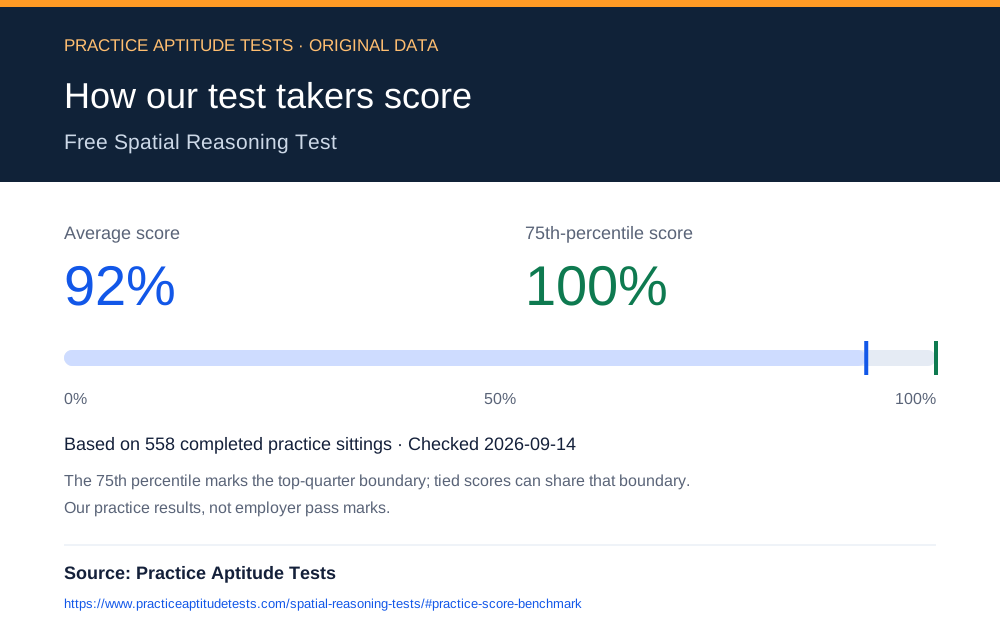
9 to 10 Comfortably above the bar for most graduate schemes
7 to 8 Around the typical pass mark. Worth practising for speed
5 to 6 Below most employer thresholds. Focus on method before speed
4 or fewer Work through the worked solutions above before retrying

Employers set their own thresholds and many sift on the top percentage of applicants rather than a fixed mark, so treat these as a guide.

Improve your hiring chances by 76%

Prepare for your Spatial Reasoning Assessments

Immediate access. Cancel anytime.

Pro

Pay Annually
Pay Monthly
--- --- ---
  • 20 Aptitude packages
  • 59 Language packages
  • 110 Programming packages
  • 39 Admissions packages
  • 48 Personality packages
  • 313 Employer packages
  • 34 Publisher packages
  • 35 Industry packages
  • Dashboard performance tracking
  • Full solutions and explanations
  • Tips, tricks, guides and resources

Basic

---
  • Access to free tests
  • Basic performance tracking
  • Solutions & explanations
  • Tips and resources

Prepare yourself for leading employers

I could prepare for specific companies and industries. It’s been an invaluable resource.

Sean used Practice Aptitude Tests to prepare for his upcoming job applications.

testimonial

Spatial Reasoning Tests Tips

1Do your research

Every spatial reasoning test is different. Find out as much information beforehand, such as who the test provider is, how long the test is and whether it’s an online or offline test. Once you know all of this, you’ll be able to practice accordingly.

2Find alternative ways to prepare

Practice doesn’t have to be limited to working through old tests: try alternative ways to improve your spatial awareness. Whether it’s looking at 3D models, trying your hand at some non-verbal reasoning tests or abstract reasoning tests, using mirrors to draw reflections or assembling models from flat plans, you can make the activities fun while honing skills for your spatial reasoning test.

3Consider pen and paper

Remember to bring a pen and paper along with you to the test (check this is allowed). It can really help you to visualise answers and solve challenges both in practice and on the day.

4Think logically

It’s important not to panic, even if you can’t work out an answer. The spatial reasoning test is multiple-choice, so you can usually rule out a few options as definite ‘nos’. Then, try to apply logic to make a judgement call between any remaining options. Remember, if you have time at the end you can always come back to any tricky questions.

5Put the practice in

It goes without saying, but practice really is the best way to prepare for any aptitude test. When you do mock tests and practice spatial questions, try to recreate exam conditions so you get used to working against the clock with no external help.

6Identify your strong and weak areas

Better not to practice any spatial reasoning question you find easy. Instead, try to concentrate only on those questions you may find difficult to answer. Work on your grey areas.

7Don't cheat

Many employers use verification tests to validate your previous test results. Publishers use special software which compares your answer patterns and performance between the online and subsequent supervised test.

Spatial Reasoning Video Tutorials

Spatial Tests: A Guide

6 mins

Mirror Images

2 mins

Rotated Views

1 min

Spatial Reasoning Tests FAQs

What is the difference between spatial reasoning and spatial awareness?

They refer to the same ability and the terms are used interchangeably. Spatial awareness describes the underlying skill of sensing how objects relate in space; a spatial reasoning test is simply how that skill is measured, through rotation, folding, matching and similar questions.

Can I use a pen and paper in a spatial reasoning test?

Usually yes, and it genuinely helps to sketch a rotation or fold rather than hold it in your head. Bring paper and check it is allowed, since some supervised or online tests do not permit it. Where it is allowed, use it for the harder folding and cube questions.

How long is a spatial reasoning test?

Most run for a fixed window at roughly a minute per question, so around 20 to 30 minutes depending on the number of questions. The exact length varies by publisher and role and is usually stated in your invitation email.

Why do reflected shapes catch people out?

Because a reflection matches the original on many features and only differs in handedness, so it looks right at a glance. Rotation can never turn a shape into its mirror image, so checking an asymmetric feature is the quickest way to separate a genuine rotation from a decoy reflection.

Do I need to be good at maths for a spatial reasoning test?

No. Spatial reasoning is about visualising shapes, not calculating, so there is no arithmetic beyond simple counting in block questions. It draws on a different ability from numerical reasoning, which is why some strong mathematicians find it harder than expected and vice versa.

How many practice tests should I do?

Enough that rotation, folding and counting feel automatic, which for most people is several full tests. Once your score stops improving between attempts, concentrate on the specific question types you keep getting wrong rather than repeating whole tests.

Reviews of our Spatial Reasoning tests

What our customers say about our Spatial Reasoning tests

  • Australia

    January 09, 2024

    Good test

    Very good substance in it. Had some good questions. Mixes of patterns. Make more free times tests just like this very one.

  • Canada

    November 02, 2023

    To pay attention to each shape separately, one by one.

    I liked how it increased in difficulty providing me with multiple levels of questions to help prepare me for future questions.

  • India

    October 24, 2023

    Interesting

    Well, it was a standard question set. And it consists of many apparently easy questions with a disguise of clever catch. I would really like to practice more through it to crack my job aptitude tests.

  • United States of America

    October 02, 2023

    Pay close attention

    Keep the multiple choices away from the pattern in order to clarify what one is looking and determine the answer

  • India

    September 30, 2023

    its important to analyse every small detail and exercise your brain fully.

    it was a helpful one for me to understand about the type of tests and the type of question one gets about spatial reasoning.

  • Australia

    July 01, 2023

    It was clear

    It was very nice, having very quality questions with clear answers and explanations, and it was quite difficult and quite easy in some parts of the test, and it was overall quite clear what to do. I liked it very much.

  • Australia

    May 18, 2023

    Good pattern questions

    I liked the test. I can detect a pattern, even though I find it takes me too long to determine which one is next in the sequence.

  • Ghana

    April 17, 2023

    Very engaging

    The test was very eye-opening.

  • Philippines

    March 28, 2023

    easy

    all patterns follow similar logic, if you can figure out one pattern you can probably figure out all the other questions, e.g. skill level doesn't change

  • Canada

    February 18, 2023

    Really Great Variety of Problems

    This is a set of interesting and challenging questions for the free version that makes for good practice!