Illustrative example
All deliveries arrive before noon.
“A delivery arrives at 2 pm.”
Verbal Ability
Judge whether the written evidence supports a statement. The test level changes the time allowance.
View guidanceThe Utopia, B2C and Mechanical streams, the abstract, numerical, verbal, error checking and mechanical tests with their question counts and time limits, the personality questionnaire’s 21 or 30 scales and the situational judgement test’s five areas, and how the red, amber, green result is built.
Free · No sign-up · Scored the moment you finish
The Criterion Partnership renamed itself Clevry in April 2021, and Criterion is no longer a trading name. Clevry sells its ability tests at three levels, and its own knowledge base maps each one onto the older suite name: Essential is the former CWS, Enhanced the former B2C, and Expert the former Utopia. This is a practice test covering the areas the Expert verbal test assesses, and it is not a copy of that test. Clevry publish no question counts and no timings at all, saying only that their limits come from the completion times of previous candidates, so every figure in circulation is a preparation site’s rather than theirs, and this test keeps our own standard pace.
You have 8 minutes to answer 10 questions. Every question carries one mark, the questions get harder as you go, and there is no penalty for a wrong answer, so answer every one. Calculators and rough paper are permitted.
Question 1 of 10
Blencathra Savings reports that the number of chargeable transactions its customers made rose 14% this year. Its report says the firm cut two of its four charges in April and left the other two unchanged. It records that customer numbers were broadly flat and that the charges are set out in a schedule updated twice a year. Blencathra has published the schedule since 2015 and says it consulted a customer panel before the cuts.
Based only on the information in the passage, is the following statement True, False, or Cannot say?
Statement: “Customers paid more in charges this year than last year.”
Answer: C. Cannot say
The statement is Cannot say. The report gives the change in chargeable transactions and says two of four charges were cut. It gives no total of charges paid in either year, and the two facts it does give run in opposite directions. The rule: a count does not settle a value, and one measure does not settle a different measure. The most tempting wrong answer is True, from reading more transactions as more charges collected.
Question 2 of 10
Priory Yard’s cottages and workshops share a single vehicle gate under the gatehouse arch. The gate is open to vehicles between seven in the morning and nine at night only; overnight it is barred, with the wicket door giving foot access to residents’ fobs. The rule keeps the yard’s cobbles quiet for the cottages that open onto them. Deliveries larger than a van book the crane gate on the river side through the yard office. Bin lorries come Tuesdays inside the vehicle hours.
Based only on the information in the passage, is the following statement True, False, or Cannot say?
Statement: “Vehicles may use the Priory Yard gate at any hour.”
Answer: B. False
The statement is False. The passage says “the gate is open to vehicles between seven in the morning and nine at night only; overnight it is barred”. The stated hours contradict the claim of access at any hour. The rule: False needs a stated contradiction, and the restrictive qualifier “only” with the overnight bar supplies one. The most tempting wrong answer is True, from reading the residents’ foot fobs as vehicle access.
Question 3 of 10
Inglewood Airport’s reporting policy sets out what happens to an occurrence report after it is filed. The duty manager reads every report on the day it arrives. The policy states that reports stay within the airport: none is passed to a contractor, a supplier or an airline. A monthly count of reports, carrying no descriptions, goes to the airport’s board. Reports about belt faults are the largest single group in this year’s counts. The belts are maintained by a contractor under a five-year agreement. The policy has been in force since January.
Based only on the information in the passage, is the following statement True, False, or Cannot say?
Statement: “Reports about belt faults are passed to the contractor that maintains the belts.”
Answer: B. False
The statement is False. The policy “states that reports stay within the airport: none is passed to a contractor, a supplier or an airline”. Reports about belt faults are reports, so that sentence rules out their being passed to the contractor that maintains the belts. The rule: a universal negative in the passage contradicts a claim about any member of the set it covers. The most tempting wrong judgement is True, because the passage puts the contractor and the largest group of reports next to each other at the end, and passing them on is what a reader expects an airport to do.
Question 4 of 10
Garnholt Supplies distributes cleaning and catering goods from a depot in Kettering. Overtime at the depot is voluntary except during the December stocktake, when all warehouse staff work one scheduled weekend, a term written into contracts. Overtime is offered first to staff on the volunteer list, refreshed each quarter. Saturday shifts carry a premium rate agreed with the staff forum. The depot picks orders overnight for morning deliveries, with routes planned by software introduced last year.
Based only on the information in the passage, is the following statement True, False, or Cannot say?
Statement: “Overtime at Garnholt Supplies is voluntary throughout the year.”
Answer: B. False
The statement is False. The passage says overtime “is voluntary except during the December stocktake, when all warehouse staff work one scheduled weekend”. The December exception contradicts the claim that overtime is voluntary throughout the year. The rule: False needs a stated contradiction, and the restrictive qualifier “except during the December stocktake” supplies one. The most tempting wrong answer is True, from reading the volunteer list as covering the whole year.
Question 5 of 10
The court’s counter services note says the counter is open from ten to four and closes for an hour at lunchtime. It says documents may be lodged at the counter or sent by email to the address on the notice. It says the court cannot accept a hearing bundle delivered to the counter on the day of the hearing, and that a bundle must be lodged at least three clear days beforehand. Payment for copies may be made by card or by cheque but not in cash. The note was updated in January.
Based only on the information in the passage, is the following statement True, False, or Cannot say?
Statement: “The court will accept a bundle delivered to the counter on the day of a hearing.”
Answer: B. False
The statement is False. The note says “the court cannot accept a hearing bundle delivered to the counter on the day of the hearing”, which contradicts the statement directly. The rule: False needs a stated contradiction, quotable as it stands. The most tempting wrong judgement is True, because the sentence before it says documents may be lodged at the counter, and the counter is open on the day.
Question 6 of 10
Kellsford Airport’s safety team has counted the occurrence reports filed at the airport last month. Nine reports were filed in total. The team’s note states that none of the nine was filed by a member of the cargo team. It gives the number filed by each of the other teams at the airport, and it does not name any individual. Cargo is the airport’s largest department by headcount, and it filed twelve reports the month before. The note is circulated to department heads and is held on the airport’s shared drive.
Based only on the information in the passage, is the following statement True, False, or Cannot say?
Statement: “Every one of the nine reports filed at Kellsford last month was filed by someone who is not a member of the cargo team.”
Answer: A. True
The statement is True. The note states that nine reports were filed in total and that “none of the nine was filed by a member of the cargo team”. Saying that none of the nine came from the cargo team is the same claim as saying that each of the nine came from someone outside it: the statement is the exact complement of the note’s negative and claims nothing wider. The rule: none of a stated group did X gives all of that group did not do X, and nothing beyond that. The most tempting wrong judgement is Cannot say, from a reader who notices that the note never identifies who did file and takes that to leave the claim open.
Question 7 of 10
Wold’s End farm park opens from lambing to pumpkin time, charging by the carload. Visits rose by a fifth this season, counted at the gate by number plate, after a wet spring gave way to a run of fine holidays. The park’s gift shop funnels leavers past shelves of wooden tractors and boiled sweets. The tea barn bakes its own scones, with the recipe printed on the apron sold beside the till. Season tickets admit a named car all year, popular with grandparents.
Based only on the information in the passage, is the following statement True, False, or Cannot say?
Statement: “Gift shop takings at the Wold’s End farm park rose this season.”
Answer: C. Cannot say
The statement is Cannot say. The passage says visits “rose by a fifth this season”, but visits and gift shop takings are different measures, and no takings figures are given for either season. The rule: a change in one measure never establishes a change in a different measure. The most tempting wrong answer is True, from letting the gate count stand for the tills.
Question 8 of 10
Radnor and Ilbury’s second office opened three years ago and now has seven of the firm’s forty-one partners. The office has grown each year since it opened and now houses about a fifth of the firm’s people. The firm’s annual review gives the current partner split between the two offices but has never given the figure for the year the office opened. Two partners moved from the main office to the second one last year. The firm’s total headcount has risen over the same period.
Based only on the information in the passage, is the following statement True, False, or Cannot say?
Statement: “The second office has more partners now than when it opened.”
Answer: C. Cannot say
The judgement is Cannot say. The passage gives the current partner figure, says the office has grown each year in people, records two partners moving there last year, and says the annual review “has never given the figure for the year the office opened”. The comparison the statement asks for needs a figure the passage does not have. The boundary the question turns on is the step from one measure to a different measure: growth in the office’s people is not growth in its partners. The most tempting wrong judgement is True, because everything in the passage points upwards and two partners are described arriving.
Question 9 of 10
Otterham District Council maintains twelve play areas across its towns and villages. In this year’s annual inspection round, none of the twelve play areas failed. The inspections check equipment, surfacing and fencing against a national standard, and are carried out by an accredited external inspector. Two play areas were closed for a fortnight in the summer while their wet-pour surfacing was replaced under a planned renewal budget. Inspection reports are published on the council’s website, and repairs are logged by the parks team.
Based only on the information in the passage, is the following statement True, False, or Cannot say?
Statement: “All twelve of Otterham’s play areas passed their annual safety inspection.”
Answer: A. True
The statement is True. The passage says that in this year’s round “none of the twelve play areas failed”. That none failed is exactly equivalent to all twelve passing, so the statement follows with certainty. The rule: a claim about none of a group failing is equivalent to the universal claim about all of it passing. The most tempting wrong answer is False, from reading the planned surfacing closures as inspection failures.
Question 10 of 10
The Compliance Standard requires every regulated firm to submit an annual compliance return by 30 April. Kentmere Advisers is a regulated firm and has been since 2016. The Standards Office publishes a list of firms whose registration lapsed during the year, and Kentmere is not on it. The Standard was amended last year to add two questions about outsourcing, and the Office publishes a template alongside it each January. Firms may submit the return through the Office’s portal or by post.
Based only on the information in the passage, is the following statement True, False, or Cannot say?
Statement: “Kentmere Advisers submitted its annual compliance return this year.”
Answer: C. Cannot say
The statement is Cannot say. The passage gives the requirement, its deadline, and confirms Kentmere is a firm it applies to. It never reports whether Kentmere submitted anything. The rule: a stated obligation is a fact about the rule and never a report of what a firm did. The most tempting wrong answer is True, because every element of the test is supplied except the one that settles it.






A Criterion assessment is an online psychometric assessment from the UK publisher Criterion Partnership, which now operates as Clevry following its combination with Nordic firm Studentwork. The range majors on soft skills: personality questionnaires and situational judgement tests sit alongside verbal and numerical reasoning, delivered through the Clevry platform that grew out of Criterion's Psycruit system. Test length varies with the role level being assessed.
Which Clevry test you sit depends on the employer and the role: an entry-level position will not be given the same assessment as a graduate or managerial one.
Four things to know before you sit one. Timings and difficulty vary with the level of the role.
Match the name in your invitation to the assessment below. Timings marked “approx.” are completion estimates; other published durations are limits for the named version.
| Assessment | What it measures | Questions | Timing |
|---|---|---|---|
| Clevry Abstract Reasoning (Enhanced / Expert) | The next figure in a sequence of shapes and patterns; also called inductive or diagrammatic | 16 | 24 / 45 min |
| Clevry Numerical Ability (Essential / Enhanced / Expert) | Arithmetic, ratios, fractions and percentages from tables, graphs and charts; calculator allowed | 16 | 15 / 18 / 20 min |
| Clevry Verbal Ability (Essential / Enhanced / Expert) | Paragraphs of text, then true, false or cannot say | 16 | 10 / 9 / 11 min |
| Clevry Checking (Enhanced) | Two pieces of reference material, usually stock lists, checked against each other; five options | 16 | 10 min |
| Clevry Mechanical Reasoning (Essential) | Levers, pulleys, gears and hydraulics from diagrams | 20 | 12 min |
| Clevry personality questionnaire | Workplace behaviour on 21 scales (Core) or 30 (Enhanced), often tailored to the sector | Rated statements | Untimed |
| Clevry situational judgement | The most appropriate response to workplace scenarios across five areas | Scenarios | Varies |
Counts and timings vary by role level and by the version an employer licences. Check the instructions on the screen before you start. Facts checked 11 September 2026.
Criterion Partnership is now Clevry. Essential, Enhanced and Expert are different difficulty levels, with different time limits. The test level matters as much as its name.
A visual guide to the skills and response formats covered on this page. Your invitation tells you which assessments to prepare for.
Illustrations by Practice Aptitude Tests · not official test screenshots
“A delivery arrives at 2 pm.”
Judge whether the written evidence supports a statement. The test level changes the time allowance.
View guidanceFind the missing shape
Enhanced and Expert versions use patterns, with different time limits.
View guidanceFind the difference
The last two digits have swapped.
If you know which company invited you, start there: the employer guide tells you which Clevry assessment sits at which stage of that firm's process.
Not listed? Browse all employer guides.
The free test shows you the style. A pack gives you the pace: Varies by level a question, marked, with the working shown.
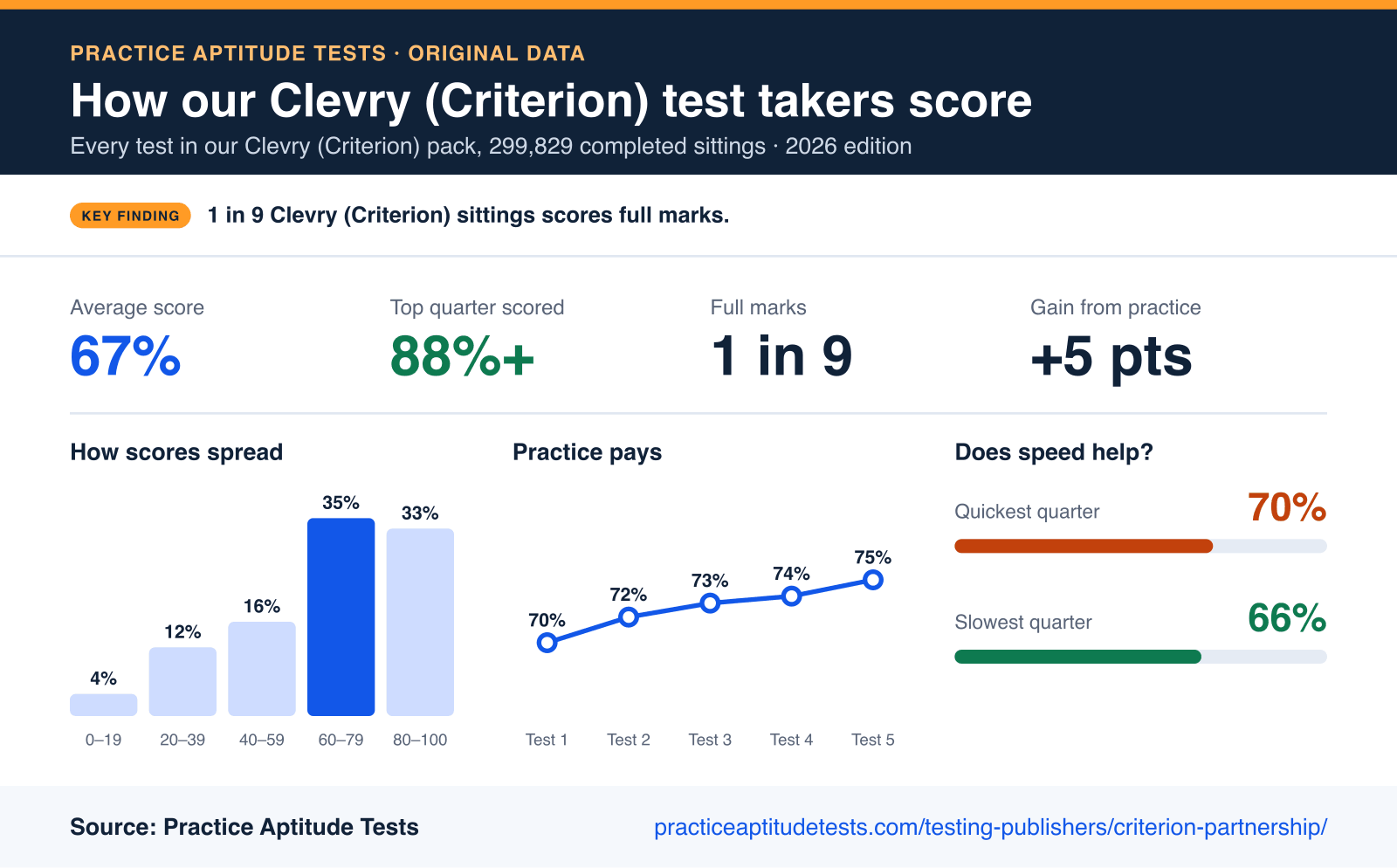
Practice Aptitude Tests · Original data
Results from every test in our Clevry (Criterion) pack, past and present.
Key finding1 in 9 Clevry (Criterion) sittings scores full marks.
33% scored 80% or more, and 16% scored under 40%.
Share of sittings in each score band.
Regular practisers went from 70% on their first test to 75% on their fifth.
5,362 people who took five or more tests.
Speed makes little difference here.
Typical pace: 44 seconds a question.
Clevry is a trademark of its respective owner. Practice Aptitude Tests is not affiliated with Clevry and our practice tests are not endorsed by them.