Illustrative example
80 Before→100 After
What is the percentage increase?
Elements Numerical
Interpret tables and charts. Each question has its own time allowance.
View guidanceThe Elements verbal, numerical and logical tests with their question counts and their separate timing allowances, Aspects Ability and Styles, the Dimensions and Drives questionnaires and the situational judgement test. How the adaptive questions work, why the data includes distractors, and how the benchmark is read.






A Talent Q test is an adaptive online assessment from the range now owned by Korn Ferry. The Elements tests measure verbal, numerical and logical reasoning, adjusting question difficulty to your answers, with a per question time limit of a time allowance shown on screen rather than one overall clock. Aspects covers high volume screening with different limits for verbal, numerical and checking tests, and the Dimensions questionnaire profiles personality untimed.
Which Talent Q test you sit depends on the employer and the role: an entry-level position will not be given the same assessment as a graduate or managerial one.
Four things to know before you sit one. Timings and difficulty vary with the level of the role.
Match the name in your invitation to the assessment below. Timings marked “approx.” are completion estimates; other published durations are limits for the named version.
| Assessment | What it measures | Questions | Timing |
|---|---|---|---|
| Elements Verbal | Conclusions from passages of text; adaptive | 15 | 16 min |
| Elements Numerical | Tables and charts with distractor data; adaptive | 12 | 16 min |
| Elements Logical | Rules in arrangements of shapes and symbols; adaptive | 12 | 15 min |
| Aspects Ability | Verbal, numerical and checking accuracy for volume roles | Varies by test | Verbal 8; numerical 10; checking 6 min |
| Aspects Styles | Workplace behaviour against the role's competencies | Questionnaire | Approx. 8 min; untimed |
| Dimensions | Personality; how you work, relate, communicate and what motivates you | Rated statements | Untimed; approx. 25 min |
| Drives (motivation questionnaire) | What drives you, rated from not important to extremely important | Rated statements | Untimed; approx. 25 min |
| Situational judgement | Your preferred response to workplace scenarios, against the role | Scenarios | Varies |
Counts and timings vary by role level and by the version an employer licences. Check the instructions on the screen before you start. Facts checked 11 September 2026.
Talent Q assessments are delivered by Korn Ferry. Elements questions are individually timed; the figures below are the published overall allowances. Questionnaire durations are estimates, not time limits.
A visual guide to the skills and response formats covered on this page. Your invitation tells you which assessments to prepare for.
Illustrations by Practice Aptitude Tests · not official test screenshots
What is the percentage increase?
Interpret tables and charts. Each question has its own time allowance.
View guidanceFind the missing shape
Find the difference
The last two digits have swapped.
Compare details quickly and accurately in a separately timed test.
View guidanceIf you know which company invited you, start there: the employer guide tells you which Talent Q assessment sits at which stage of that firm's process.
Not listed? Browse all employer guides.
These results come from our own practice test in a format covered on this page. They are not official Talent Q results, a benchmark for our entire Talent Q practice pack, or an employer pass mark.
Results from our numerical reasoning test.
Source: Practice Aptitude Tests
Based on 1280 completed practice sittings, all time. Checked 14 September 2026.
The 75th percentile marks the boundary of the top quarter of recorded scores; tied scores can share that boundary. These are our practice results, not employer pass marks.
We use all-time completed, scored attempts at this practice test. Repeat attempts count separately, so the sample is sittings rather than unique people.
The average is the mean score across those sittings. The 75th percentile comes from their recorded score distribution. The “checked” date is when we retrieved the figures, not the period when the tests were taken.
Sharing these figures? Please credit Practice Aptitude Tests and link to this page.
One question tells you the style. A pack gives you the pace: Individually timed a question, marked, with the working shown.
Talent Q tests were developed in 2006 by Roger Holdsworth, who also co-founded SHL, around one idea: a test that adapts to the candidate. Get a question right and a more complex one follows; get one wrong and the next is slightly easier, so every candidate works at their own limit.
They are also blended, with assessment types mixed into one sitting, and deliberately harder than most comparable tests. Questions carry more possible answers than usual and the data includes figures you do not need, so a large part of the work is finding the relevant information before you calculate. The per-question clock is the other pressure, and the reason timed practice matters more for Talent Q than for most publishers.
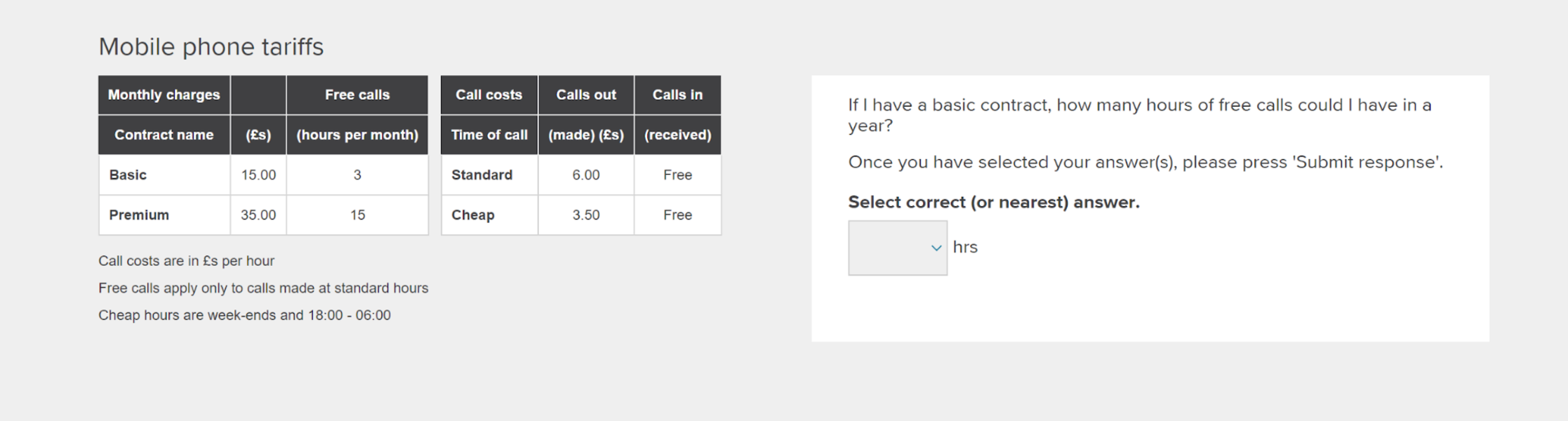
Built for graduate and managerial recruitment, the Elements tests assess verbal reasoning from passages of text, numerical reasoning from data, and logical reasoning from arrangements of shapes and symbols. Elements Verbal and Numerical allow 16 minutes; Logical allows 15 minutes. Each question is individually timed. A typical Elements numerical question:
Credit: https://www.trytalentq.com/
Answer: a basic contract entitles you to 3 hours of free calls per month. Multiply by 12 months to get 36 hours a year.
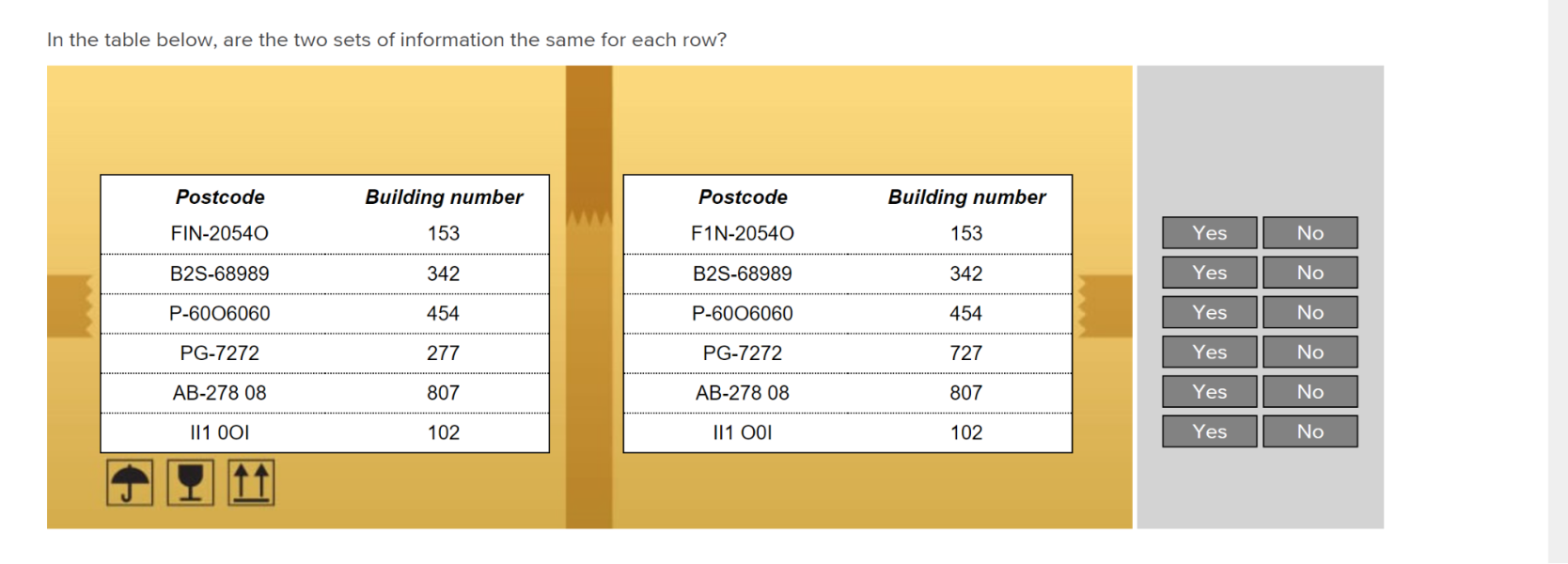
Aspects is the short screening range, used early in high-volume recruitment and taking about eight minutes a test. Aspects Ability, common in sales and customer service hiring, measures verbal, numerical and checking accuracy; Aspects Styles is a questionnaire that sets your workplace behaviour against the competencies for the role. An Aspects Ability question:
Credit: https://www.trytalentq.com/
Answer: they are the same in rows 2, 3 and 5.
Korn Ferry’s current candidate guidance names Dimensions and Drives. Both are untimed, with typical completion times of 25 minutes.
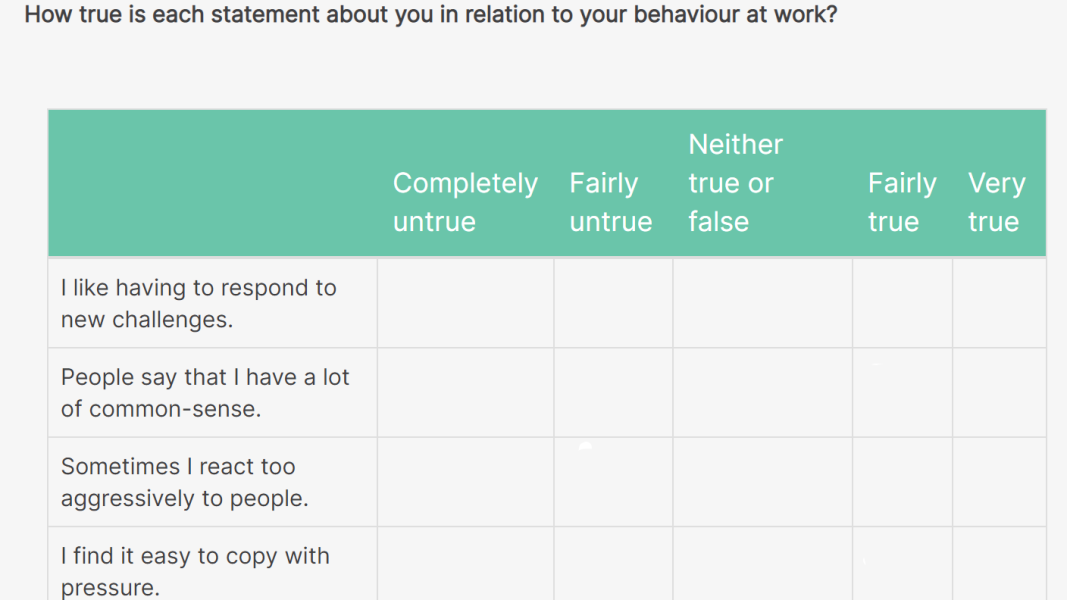
Dimensions is a personality questionnaire: you rate statements from very true to completely untrue, and the result feeds reports on your traits, behaviour at work, team fit, sales aptitude, match to the role, derailment risks under pressure and leadership potential. Motivations works the same way for what drives you, rated from not important to extremely important. Neither has right answers, and a profile built on honest answers is the one that lands you in the right job. A Dimensions question:
Credit: https://www.trytalentq.com/
The situational judgement test presents workplace scenarios and asks for your preferred response from a list, then compares your choices with what the role requires. Answer honestly, with the role’s requirements in mind: a sales role is looking for an instinct for customers and communication.
What candidates ask us most often
None in the test itself. Talent Q was acquired by the Hay Group in 2014, which became part of Korn Ferry in 2015, so the Elements and Aspects tests are now delivered under the Korn Ferry name. An invitation to either means the same adaptive, per-question-timed format.
Elements Verbal and Numerical have published allowances of 16 minutes, and Logical 15 minutes. Aspects Ability allows 8 minutes for Verbal, 10 for Numerical and 6 for Checking. Questions are individually timed; use the allowance shown on screen.
Either at home or at an assessment centre. The test will be taken online and is compatible with mobile phones, computers and other devices. However some of the drop-downs appear differently on certain devices, so a laptop or computer is usually recommended.
The employers listed above name Talent Q in their own processes, and Talent Q’s tests are used in over 40 languages. If yours is not listed, its employer guide says which assessment sits at which stage; the format is the one described here whether the invitation says Talent Q or Korn Ferry.
Rated 4.7 out of 5 across 60 reviews. A selection:
Timed test was very helpful in providing variety of graph-related questions, 1 test is free as well. Really appreciate practiceaptitudetests as there are not many sites out there with these questions.
liked the variation in how graphs and data were presented, questions complicated but manageable without data reduction
Graphs could be more straightforward - I didn't realize you could hover to see the actual values until after a few questions
Talent Q is a trademark of its respective owner. Practice Aptitude Tests is not affiliated with Talent Q and our practice tests are not endorsed by them.
Take a free test in any format, then upgrade when you know which one you need.