Illustrative example
All deliveries arrive before noon.
“A delivery arrives at 2 pm.”
Logiks verbal
Draw conclusions from written information in the Logiks ability assessments.
The Logiks General Intermediate and Advanced tests with their question counts and timings, the Logiks verbal, numerical and abstract sections, the PAPI N and PAPI I questionnaires and the situational judgement test. How the percentile is built from speed and accuracy, and what Talogy has to do with it.
Free · No sign-up · Scored the moment you finish
You have 13 minutes to answer 10 questions. Each question describes a workplace situation and four possible responses. For every question, select the response you believe would be MOST effective and the response you believe would be LEAST effective. There are no trick questions; judge each response on how well it would work in the situation described.
About this test: this is one of a set of practice tests covering the areas Cubiks tests typically assess. It is written by us: it is not published by Cubiks and none of the questions come from Cubiks.
Question 1 of 10
You are a quality inspector at a textile manufacturer. Checking a finished batch you notice the same small weaving fault on several rolls from one loom, and looking back at last week’s records you see it on that loom’s output too. Nobody has asked you to review previous batches. Last week’s output has already gone to a customer. Your quality manager is on site. The loom is running now. Which response below would be most effective, and which would be least effective?
Most effective: D. Take the current batch and last week's records to your quality manager now, show her the fault is recurring on one loom, and let her decide about the loom and the customer.
Least effective: A. Reject the current batch and say nothing about last week's records, since that output has already been accepted by the customer and reopening it would cause unnecessary trouble.
A: Hides the problem: it knowingly withholds that a customer has already received cloth with the same fault, in order to avoid trouble. Choosing silence about goods already delivered is concealment, not discretion.
B: Acts outside own authority on the wider issue: stopping the loom is reasonable and it leaves the shipped batch, which is the part with a customer at the other end, unaddressed and unreported.
C: Delays the decision: rejecting this batch protects this shipment and the log is reviewed later, so a loom producing faulty cloth keeps running and last week's delivery stays with the customer unmentioned.
The most effective response is to take the current batch and last week’s records to your quality manager now, show her the fault is recurring on one loom, and let her decide about the loom and the customer: the machine is running now and last week’s faulty output is already delivered, and only she can decide about both. Bringing the batch and the records together makes the pattern visible. It beats rejecting the batch and recording it in the quality log, because that leaves the loom running and the delivered goods unmentioned. It beats rejecting the batch and having the loom stopped for maintenance, because that addresses production while the customer who already has faulty cloth is still not considered. The least effective response is rejecting the batch and saying nothing about last week’s records: it deliberately withholds that faulty goods have already been delivered, to avoid trouble. That is worse than the other two, which act partially but do not conceal. The principle: when a fault turns out to have a history, take the history as well as the sample to whoever can act on both.
Question 2 of 10
You work in guest services at a theme park. A ride has broken down, queues everywhere have lengthened and you have been dealing with complaints for four hours without a break. A visitor tells you, in front of a crowd, that the park is a rip-off and that you personally have been useless. His family have queued ninety minutes for a ride that then closed. Your duty manager is contactable by radio. Which response below would be most effective, and which would be least effective?
Most effective: D. Acknowledge the ninety minutes his family lost, explain what is known about the ride, and offer the compensation the park provides for a closure of this kind.
Least effective: C. Tell him that the closure is nobody's fault, that shouting at staff will not reopen the ride, and ask him to move aside so you can help other guests.
A: Defends the park to an audience: it is accurate and it answers his insult rather than his ruined ninety minutes, in front of a crowd who are equally frustrated.
B: Passes responsibility to others: it hands over a complaint you are able to settle and makes a family who have already queued ninety minutes wait again.
C: Personalises the conflict: it rebukes a guest in front of a crowd and offers his family nothing at all for a wasted queue, which is the one response that adds a grievance rather than settling one.
The most effective response is to acknowledge the ninety minutes his family lost, explain what is known about the ride, and offer the compensation the park provides: that answers the complaint without engaging the insult, and it gives his family something for the queue. It beats explaining that the closure was for safety reasons outside guest services’ control, because defending the department, however fairly, argues with his anger while offering his family nothing. It beats radioing the duty manager to come and speak to him, because that makes a family who have already queued twice wait a third time for something you can resolve. The least effective response is telling him that shouting at staff will not reopen the ride and asking him to move aside: it corrects his behaviour publicly and offers nothing for the lost queue, so he leaves with both the original grievance and a new one. That is worse than explaining the closure, which at least explains, and worse than fetching the duty manager, which at least routes him to someone. The principle: acknowledge what the person actually lost, then give them the remedy your organisation already provides.
Question 3 of 10
You are an office junior at a solicitors’ firm. At 3pm a fee earner asks you to file a court document at the court office, which closes at 4pm and is fifteen minutes away. Your supervisor asked this morning for the archive boxes to be relabelled before you finish at 5pm; the labelling has no external deadline. A colleague has also asked you to order stationery this week. Which response below would be most effective, and which would be least effective?
Most effective: C. Leave now to file the court document before the office closes at 4pm, then relabel the archive boxes when you get back and order the stationery later in the week.
Least effective: B. Take the document to the court office and, if you arrive after it has closed, post it instead so it is on its way and say nothing further about it.
A: Substitutes own judgement for the stakeholder's: it treats an internal labelling job with no deadline as outranking a court filing whose window shuts at 4pm and cannot be reopened tomorrow without consequence.
B: Hides the problem: a posted document has not been filed, so the fee earner believes a court deadline has been met when it has not. Saying nothing about a missed filing is concealment with legal consequences.
D: Escalates prematurely: a court deadline against an internal labelling job is not a genuinely difficult call, and the minutes spent finding her come out of a forty-five minute window that includes a journey.
The most effective response is to leave now and file the court document before the office closes at 4pm, then relabel the archive boxes when you get back: the court office is fifteen minutes away, so the filing has a hard external deadline and barely enough time, while the labelling and the stationery have none. Leaving now is the only sequence that meets it. It beats relabelling the archive boxes as asked and taking the document first thing tomorrow, because that treats an internal task with no deadline as outranking a court filing that cannot simply be done the next day. It beats going to find your supervisor to ask which comes first, because the choice is not genuinely difficult and the search eats a window that already includes a journey. The least effective response is posting the document if you arrive after the office has closed and saying nothing further: it substitutes posting for filing and tells nobody, so the fee earner believes a court deadline has been met when it has not. That is worse than the other two, which delay the filing but leave everyone aware of where it stands. The principle: when one task has a closing external window and the others have none, go immediately, and never let anyone believe a deadline was met when it was not.
Question 4 of 10
You pick online grocery orders at a supermarket. A customer’s order includes a specific nut-free chocolate spread, which is out of stock. The system suggests a standard chocolate spread as a substitute. The order notes say it is for a child with a severe nut allergy. Another nut-free spread is available in a different size at a higher price. Your shift manager can authorise price matching. Which response below would be most effective, and which would be least effective?
Most effective: B. Substitute the alternative nut-free spread and ask your shift manager to price match it, so the order arrives with something the child can safely eat.
Least effective: D. Accept the system's suggested standard spread, since it is the recommended substitute and the customer can always refuse it at the door if it does not suit her.
A: Ignores the customer's actual need: a suitable nut-free spread is on the shelf, so leaving the line unfilled sends her nothing when a workable substitute exists.
C: Acts on assumptions without checking: the substitution is right and the price increase is assumed to be acceptable, when a shift manager who could price match it is available and has not been asked.
D: Ignores a stated allergy with a health consequence: the notes say the spread is for a child with a severe nut allergy, so accepting the system's suggestion sends the one product that could actually harm him. Following the system over a stated allergy is the worst of the four.
The most effective response is to substitute the alternative nut-free spread and ask your shift manager to price match it: the order notes state an allergy, a safe alternative is on the shelf, and the only obstacle is a price difference a manager can authorise away. That gets the child something safe at the price the customer expected. It beats substituting the alternative at its higher price, because that makes the same correct swap while assuming she will accept paying more, when the manager could remove that. It beats rejecting the substitution and leaving the item out of the order, because that sends her nothing when a suitable product exists. The least effective response is accepting the system’s suggested standard spread because she can refuse it at the door: it substitutes an ordinary spread for one flagged for a child with a nut allergy, which is the single product in the aisle that could harm him. That is worse than the other two, which cost her money or an item but send nothing unsafe. The principle: when a customer has stated an allergy, meet it with a safe product and use the authority above you to deal with the price.
Question 5 of 10
You work in the control room of a taxi firm. Drivers are paid a bonus for completing more than forty jobs a week. You notice a driver has logged three jobs this week that were cancelled by the customer before pickup, which would take him over forty. He says the customers cancelled at the door, so he drove the distance and should be credited. The firm’s rules on cancelled jobs are written and you have not read them. The operations manager is on shift. Which response below would be most effective, and which would be least effective?
Most effective: A. Check the written rules on cancelled jobs, and if they do not cover doorstep cancellations put it to the operations manager before the bonus is calculated.
Least effective: C. Leave the three jobs on his total and let the bonus be paid, since he did drive to each address and nobody audits the weekly figures in any detail.
B: Substitutes own judgement for the stakeholder's: the rules may well credit a driver who travelled to a doorstep cancellation, and striking the jobs out decides that without reading them.
C: Falsifies a payment record: it lets a bonus be paid on jobs recorded as completed that were not, without checking whether the rules allow it, and relies on the absence of an audit. That is dishonesty, not a judgement call.
D: Escalates prematurely: the written rules may entitle him to the credit, so a report of deliberate manipulation is made before the document that settles it has been read.
The most effective response is to check the written rules on cancelled jobs, and if they do not cover doorstep cancellations put it to the operations manager before the bonus is calculated: there is a rule that decides whether such a cancellation counts, reading it costs a minute, and he is on shift and can settle it in time. It answers the question without accusing anyone. It beats removing the three cancelled jobs from his total, because that decides the same question in the driver’s disfavour without reading the rule. It beats reporting him for logging cancelled jobs as completed work, because a serious accusation before checking risks condemning him over something the rules may allow. The least effective response is leaving the three on his total because nobody audits the weekly figures: it lets a bonus be paid on incomplete jobs without any check. That is worse than the other two, which act hastily but keep the payment honest. The principle: read the rule that governs it, and take the decision to whoever owns it rather than resolving it quietly either way.
Question 6 of 10
You work as a machine operative at a joinery workshop. Changing over the crosscut saw, you notice its blade guard is cracked and no longer locks into position. Workshop rules say a defective guard must be reported to the supervisor, who takes the machine out of use until it is repaired. It is the only crosscut saw in the workshop, several colleagues rely on it every day, and losing it would slow the whole team’s work; the last repair took most of a week. Which response below would be most effective, and which would be least effective?
Most effective: C. Report the cracked guard to your supervisor straight away, so the saw comes out of use until it has been repaired.
Least effective: A. Say nothing about the guard and plan your own jobs around the other machines, leaving the crosscut saw available for the colleagues who rely on it.
A: Stays silent about a known safety risk: keeping quiet while steering only yourself away from the saw protects you and nobody else; colleagues keep using a machine you know is unsafe, which is self-protective silence rather than a defensible reading of the risk.
B: Fails to escalate a genuine risk: care and warnings do not fix a guard that no longer locks, and waiting days for a meeting keeps a known hazard in daily use when the rules give you a route that acts today.
D: Escalates on assumptions without checking: widening one observed fault into a workshop-wide inspection request is built on a guess, bypasses the supervisor the rules name, and leaves the one saw you know is unsafe in use while the bigger process gets arranged.
The most effective response is to report the cracked guard to your supervisor straight away so the saw comes out of use: a guard that is cracked and no longer locks is a genuine injury risk, the rules name exactly who to tell, and the supervisor can act today. The disruption to the team is real, but it is the trade the workshop’s own rules have already made. It beats carrying on with extra care and raising it at the team meeting, because care and warnings do not make a broken guard safe, and waiting days keeps the hazard in daily use for the sake of avoiding a difficult report. It beats emailing the health and safety officer for a workshop-wide inspection, because that inflates one observed fault into an assumed general problem, bypasses the supervisor who can act now, and leaves the one saw you know is unsafe running while a bigger inspection is arranged. The least effective response is saying nothing and working around the saw yourself: unlike carrying on with warnings, which at least alerts the people at risk, and unlike the inspection request, which at least tells someone with authority, it tells nobody and quietly protects only you, leaving colleagues to use a machine you know is unsafe. The principle: a genuine safety risk is raised at once through the stated route, whatever the disruption, and never managed silently around yourself.
Question 7 of 10
You are an editorial assistant at a book publisher. A cookery book is due at the printer on Friday. On Wednesday you find that the oven temperatures throughout one chapter have been converted wrongly, giving instructions that would badly overcook the dishes. Correcting and re- proofing the chapter takes two days. The author is on a book tour and hard to reach. Your commissioning editor is in the office. Which response below would be most effective, and which would be least effective?
Most effective: B. Tell your commissioning editor today, showing her the chapter and that a proper correction needs two days, so she can decide about the print slot and reaching the author.
Least effective: C. Let the chapter go to the printer as it stands, since the schedule is fixed and a correction can be issued in the next printing or on the publisher's website.
A: Substitutes own judgement for the stakeholder's: recipe temperatures are the author's work and her name is on them. Correcting a whole chapter and telling her after it has gone to print removes her from a decision about her own book.
C: Hides the problem: it knowingly prints cooking instructions that would ruin the dishes and leaves readers to find out, relying on a future correction nobody will see. That is shipping a known defect, not a scheduling choice.
D: Delays the decision: it spends the one remaining day chasing an author on tour, and the editor who owns the print slot learns about it with no time left to move anything.
The most effective response is to tell your commissioning editor today, showing her the chapter and that a proper correction needs two days: the error is serious enough to matter to readers, fixing it costs two days against a Friday slot, and both the print schedule and the author relationship belong to her. She is in the office and can weigh a delayed slot against an unreachable author today. It beats correcting the conversions yourself against the manuscript and noting it for the author afterwards, because rewriting a chapter of her recipes and telling her after it has printed takes her out of a decision about her own book. It beats continuing to chase the author while the book proceeds towards Friday, because spending two days on that leaves the editor with no time to move anything. The least effective response is letting the chapter go to the printer and issuing a correction later: it prints instructions known to be wrong, which is a decision to ship a defect readers will meet in their kitchens. That is worse than correcting it yourself, which at least fixes the text, and worse than chasing the author, which at least keeps trying. The principle: when a defect forces a trade against a deadline, put it to whoever owns the deadline while there is still time to trade.
Question 8 of 10
You work in the accounts office of a small manufacturer. A supplier’s representative drops in with a Christmas hamper addressed to you personally, saying it is a thank you for prompt payment. The company’s policy requires gifts over a nominal value to be declared to a manager, and you are involved in approving that supplier’s invoices. Your finance manager is in the office. Which response below would be most effective, and which would be least effective?
Most effective: B. Accept it provisionally, declare it to your finance manager today given that you approve this supplier's invoices, and follow whatever she decides.
Least effective: A. Take the hamper home without mentioning it, since it was addressed to you personally, it is only a seasonal gesture and it will not change how you handle the supplier's invoices.
A: Breaches confidentiality or process: the declaration rule exists precisely because the recipient cannot vouch for their own impartiality, and taking a supplier's gift home unrecorded while approving their invoices is the conflict the policy is written to catch.
C: Applies the rule without using it: the policy provides for declaration, not blanket refusal, and turning it away at the door resolves it without the record that the policy exists to create.
D: Acts on assumptions without checking: sharing it changes who eats it, not whether a supplier gave a gift to someone who approves their invoices. The declaration is still owed and is now less likely to happen.
The most effective response is to accept it provisionally and declare it to your finance manager today, given that you approve this supplier’s invoices: that is exactly the situation the declaration rule exists for, and she is in the office and can decide whether it is kept, returned or shared. Declaring it puts the decision where the policy intends. It beats putting the hamper in the staff room for everyone to share, because that changes who benefits without removing the conflict or creating the record. It beats refusing it on the spot and telling the representative gifts are not allowed, because that is well meant but skips the declaration, so nothing is recorded about a supplier offering gifts to the people who approve their invoices. The least effective response is taking it home without mentioning it because it will not change how you handle the invoices: that assurance is precisely the one the policy exists because nobody can give about themselves. That is worse than the other two, which handle it imperfectly but do not conceal. The principle: declare the thing the policy asks you to declare, and let the person it names decide what happens to it.
Question 9 of 10
You work in a commercial laundry. Your colleague Aled is loading a large hotel order alone against a 2pm van departure, and it is 1pm. The load needs two people to make the deadline. You have finished your own machines and have nothing else assigned. The shift supervisor is dealing with a breakdown at the other end of the building. Aled has not asked for help. Which response below would be most effective, and which would be least effective?
Most effective: A. Go over to Aled, tell him your machines are finished and you will take half the load, and work with him until the order is ready for the van.
Least effective: B. Carry on tidying your own area, since the hotel order is Aled's job today and he has not asked anybody for help with it.
B: Waits to be asked: a two-person load is being done by one person against a van departure, and the reason for not helping is that he has not asked. Waiting to be asked is what causes the order to miss the van.
C: Substitutes own judgement for the stakeholder's: a colleague an hour from a van departure will usually say he is managing, so the question is polite and predictably leaves him loading alone.
D: Escalates prematurely: you are the person she would send, she is dealing with a breakdown, and the walk there and back costs minutes the load does not have.
The most effective response is to go over to Aled, tell him your machines are finished and you will take half the load, and work with him until the order is ready: the load needs two people, there is an hour, and your own machines are done, so joining him is the only response that actually makes the van. Telling him your work is finished removes any need for him to ask. It beats asking whether he wants help and getting on with something else if he says he is fine, because a colleague under time pressure will usually decline a general offer, and the load is no further forward. It beats finding the shift supervisor to say the order will miss the 2pm van, because you are the resource she would send, and fetching her costs minutes while she is handling a breakdown. The least effective response is carrying on tidying your own area because he has not asked anybody: it leaves a two-person load with one person and a van departure that will be missed. That is worse than offering, which at least asks, and worse than telling the supervisor, which at least raises it. The principle: when a colleague plainly cannot finish alone and you are free, take half the work rather than waiting to be asked.
Question 10 of 10
You are a library assistant at a university. Your colleague Priya is covering the enquiry desk alone during the lunch hour while you shelve returns. Walking past, you see six students queuing and Priya working through them one at a time; a seventh gives up and leaves. Shelving is a routine task with no deadline attached to it. Priya has not asked for help and looks flustered. Which response below would be most effective, and which would be least effective?
Most effective: B. Go to the desk, tell Priya you are free and will take the next student, and work through the queue with her until it clears before going back to the shelving.
Least effective: C. Carry on shelving, since the desk is Priya's responsibility during the lunch hour and stepping in uninvited might suggest to her that you think she cannot cope on her own.
A: Delays the decision: the rota may well need looking at, but that fixes next week. It leaves the six students in front of you queuing now, when you are free and trained to serve them.
C: Prioritises harmony over honesty: it dresses up doing nothing as respect for a colleague, while students give up and leave. Standing by a visible problem to avoid an awkward moment is avoidance, not tact.
D: Substitutes own judgement for the stakeholder's: a flustered colleague in front of a queue will usually say she is coping, so the offer as phrased gives her the harder answer to give and the queue stays.
The most effective response is to go to the desk, tell Priya you are free, and work the queue with her until it clears: the queue is visible, you are on a task with no deadline, and the fastest fix is a second person serving. Saying you are free and taking the next student removes the need for her to admit she is struggling. It beats reporting the understaffing to the duty manager, because a rota review helps tomorrow’s queue, not this one, while you are standing free beside it. It beats asking her whether she would like a hand, because putting that question to a flustered colleague in front of students invites the polite refusal, so it is well meant but predictably leaves the queue where it is. The least effective response is carrying on shelving because the desk is her responsibility: it is the only response where nobody helps and students continue to leave, and it justifies that by a concern about how she might feel rather than anything she has said. That is worse than telling the duty manager, which at least acts on the problem, and worse than offering, which at least opens the conversation. The principle: when a colleague is visibly swamped and your own task can wait, step in and start helping rather than asking whether help is wanted.






A Cubiks test is an online assessment from the range now published by Talogy. Logiks measures general or specific verbal, numerical and abstract ability, while PAPI explores work preferences. Talogy lists 20 to 50 items and 12 to 25 minutes across Logiks versions, so check the version in your invitation before choosing your practice.
Which Cubiks test you sit depends on the employer and the role: an entry-level position will not be given the same assessment as a graduate or managerial one.
Four things to know before you sit one. Timings and difficulty vary with the level of the role.
Match the name in your invitation to the assessment below. Timings marked “approx.” are completion estimates; other published durations are limits for the named version.
| Assessment | What it measures | Questions | Timing |
|---|---|---|---|
| Logiks (Intermediate and Advanced) | General, verbal, numerical and abstract ability | 20 to 50, by version | 12 to 25 min, by version |
| PAPI | Personality and work preferences | 44 to 162, by version | Approx. 20 to 30 min |
Counts and timings vary by role level and by the version an employer licences. Check the instructions on the screen before you start. Facts checked 11 September 2026.
Cubiks is now Talogy. Talogy publishes ranges across Logiks and PAPI versions; the exact form in your invitation determines the count and timing.
A visual guide to the skills and response formats covered on this page. Your invitation tells you which assessments to prepare for.
Illustrations by Practice Aptitude Tests · not official test screenshots
“A delivery arrives at 2 pm.”
Draw conclusions from written information in the Logiks ability assessments.
Find the missing shape
Recognise relationships between shapes and patterns.
Which is most like you?
Describe your work preferences. PAPI versions use different questionnaire formats.
The free test shows you the style. A pack gives you the pace: Varies by version a question, marked, with the working shown.
Practice Aptitude Tests · Original data
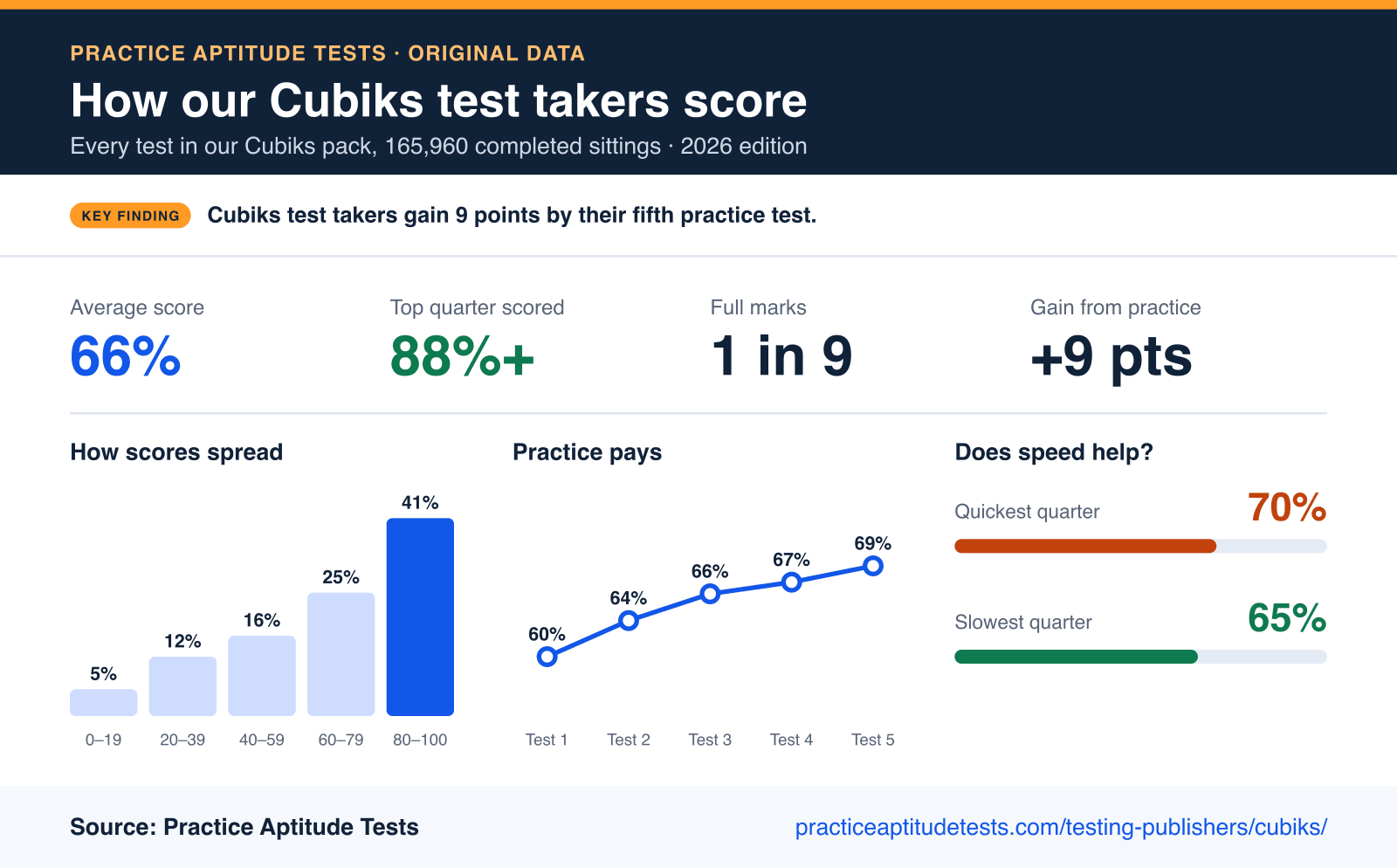
Results from every test in our Cubiks pack, past and present.
Key findingCubiks test takers gain 9 points by their fifth practice test.
41% scored 80% or more, and 18% scored under 40%.
Share of sittings in each score band.
Regular practisers went from 60% on their first test to 69% on their fifth.
5,306 people who took five or more tests.
Speed makes little difference here.
Typical pace: 37 seconds a question.
Cubiks is a trademark of its respective owner. Practice Aptitude Tests is not affiliated with Cubiks and our practice tests are not endorsed by them.