Illustrative example
80 Before→100 After
What is the percentage increase?
Numerical reasoning
Interpret numerical information within Sova’s role-specific assessment.
The blended whole-person format, the numerical, verbal and logical reasoning inside it, the situational judgement scenarios, the personality questionnaire and the video interview. How the employer configures the activities and their timing, and how the result is read against a norm group.
Free · No sign-up · Scored the moment you finish
You have 13 minutes to answer 10 questions. Each question describes a workplace situation and four possible responses. For every question, select the response you believe would be MOST effective and the response you believe would be LEAST effective. There are no trick questions; judge each response on how well it would work in the situation described.
About this test: this is one of a set of practice tests covering the areas Sova tests typically assess. It is written by us: it is not published by Sova and none of the questions come from Sova.
Question 1 of 10
You are a quality inspector at a textile manufacturer. Checking a finished batch you notice the same small weaving fault on several rolls from one loom, and looking back at last week’s records you see it on that loom’s output too. Nobody has asked you to review previous batches. Last week’s output has already gone to a customer. Your quality manager is on site. The loom is running now. Which response below would be most effective, and which would be least effective?
Most effective: D. Take the current batch and last week's records to your quality manager now, show her the fault is recurring on one loom, and let her decide about the loom and the customer.
Least effective: A. Reject the current batch and say nothing about last week's records, since that output has already been accepted by the customer and reopening it would cause unnecessary trouble.
A: Hides the problem: it knowingly withholds that a customer has already received cloth with the same fault, in order to avoid trouble. Choosing silence about goods already delivered is concealment, not discretion.
B: Acts outside own authority on the wider issue: stopping the loom is reasonable and it leaves the shipped batch, which is the part with a customer at the other end, unaddressed and unreported.
C: Delays the decision: rejecting this batch protects this shipment and the log is reviewed later, so a loom producing faulty cloth keeps running and last week's delivery stays with the customer unmentioned.
The most effective response is to take the current batch and last week’s records to your quality manager now, show her the fault is recurring on one loom, and let her decide about the loom and the customer: the machine is running now and last week’s faulty output is already delivered, and only she can decide about both. Bringing the batch and the records together makes the pattern visible. It beats rejecting the batch and recording it in the quality log, because that leaves the loom running and the delivered goods unmentioned. It beats rejecting the batch and having the loom stopped for maintenance, because that addresses production while the customer who already has faulty cloth is still not considered. The least effective response is rejecting the batch and saying nothing about last week’s records: it deliberately withholds that faulty goods have already been delivered, to avoid trouble. That is worse than the other two, which act partially but do not conceal. The principle: when a fault turns out to have a history, take the history as well as the sample to whoever can act on both.
Question 2 of 10
You are a support worker at a supported living service. A resident tells you that another member of staff has been shouting at him and that he is frightened of her. He asks you not to tell anyone because he does not want trouble. You have not witnessed anything. Your service manager is on duty. The service has a written safeguarding procedure that you have been trained on. Which response below would be most effective, and which would be least effective?
Most effective: B. Explain gently that you cannot keep this to yourself, and report it to your service manager today under the safeguarding procedure.
Least effective: D. Respect the resident's wish and say nothing, since he has asked you not to, he is an adult entitled to make his own choices and you did not see anything yourself.
A: Fails to escalate a genuine risk: the procedure asks you to report what is disclosed, not what you have seen, and waiting to witness it leaves a frightened resident in the same position for days.
C: Breaches confidentiality or process: approaching the person a disclosure is about, before it is reported, warns her and puts the resident at risk of exactly the trouble he is afraid of.
D: Breaches a safeguarding duty: a disclosure of frightening behaviour by a staff member cannot be held in confidence, and framing silence as respecting his choice leaves him alone with the person he is afraid of. That is a different order of failure from reporting it clumsily.
The most effective response is to explain gently that you cannot keep this to yourself, and report it to your service manager today under the safeguarding procedure: the procedure exists for exactly this disclosure, confidentiality cannot be promised where a resident says he is frightened of a member of staff, and she is on duty. Telling him honestly that you must pass it on keeps his trust better than a promise you would have to break. It beats keeping an eye on it over the next few shifts and reporting only what you witness, because that substitutes your own evidence threshold for the procedure’s and leaves him frightened meanwhile. It beats speaking to the member of staff first to hear her account, because that alerts her and exposes him to the very consequence he fears. The least effective response is respecting his wish and saying nothing: it leaves a resident who has disclosed being frightened alone with the person concerned, and dresses that up as respecting his autonomy. That is worse than the other two, which act too slowly or in the wrong order but do act. The principle: a safeguarding disclosure goes to the person the procedure names, today, and you never promise a confidence you cannot keep.
Question 3 of 10
You are a project coordinator at a translation agency. You and your colleague Owen allocate work to freelance translators. He has twice reallocated jobs you had already assigned, without telling you, and a freelancer has complained about being stood down at short notice. You share the allocation spreadsheet. Owen is experienced and well regarded. A large batch is due for allocation on Monday. Which response below would be most effective, and which would be least effective?
Most effective: B. Speak to Owen before Monday, tell him what the reallocations cost the freelancer, and agree between you how changes to an existing allocation will be handled in future.
Least effective: D. Say nothing and check the spreadsheet each morning so that you can spot any reallocations and warn the affected freelancers yourself before they are stood down.
A: Personalises the conflict: it settles the disagreement by taking control of a shared tool rather than talking, and Owen finds out through a locked file that he is no longer trusted with it.
C: Escalates prematurely: Owen has not been told there is a problem, so the first he hears of it comes from a manager, over something a conversation before Monday could settle.
D: Avoids the difficult conversation: it accepts that freelancers will keep being stood down and adds a daily workaround to soften it. Owen never learns anything is wrong, so the practice continues indefinitely.
The most effective response is to speak to Owen before Monday, tell him what the reallocations cost the freelancer, and agree how changes to an existing allocation will be handled: this is a working practice between two colleagues, there is a large allocation on Monday that will otherwise repeat it, and he has never been told the reallocations cause a problem downstream. One conversation settles both the grievance and the rule. It beats raising it with your manager and explaining that he has twice overridden your allocations, because involving a manager before Owen knows there is an issue turns a fixable habit into a complaint against an experienced colleague. It beats locking the spreadsheet so only you can change assignments, because that communicates distrust without ever saying what is wrong, and invites a worse argument. The least effective response is checking the spreadsheet each morning so you can warn the affected freelancers yourself: it leaves the behaviour untouched and builds a daily monitoring routine around it, so freelancers keep being stood down and the only change is that you spend longer managing the consequences. That is worse than the other two, which address it clumsily but do address it. The principle: raise a working-practice problem with the colleague causing it, before the next occasion that would repeat it.
Question 4 of 10
You work in sample reception at a testing laboratory. At 2pm three things need doing. A batch of clinical samples has arrived that must go into the fridge within thirty minutes or be discarded. A client is on hold asking for a results certificate. And your manager wants the weekly sample log by 5pm, which takes an hour. You are alone at the bench. The certificate takes ten minutes. Which response below would be most effective, and which would be least effective?
Most effective: C. Get the clinical samples into the fridge first, then produce the client's certificate, then do the sample log before 5pm.
Least effective: D. Refrigerate the samples, then leave the client on hold and do the log, ringing him back tomorrow when the log has been submitted and the bench is quieter.
A: Delays the decision: ten minutes on the phone eats a third of the thirty-minute window in which a batch of clinical samples is still usable, and they cannot be replaced once discarded.
B: Splits effort so nothing finishes: it starts the one task with three hours of room and leaves a thirty-minute window and a waiting client to be squeezed around it.
D: Ignores the customer's actual need: it leaves a client holding on the telephone with no answer at all and defers a ten-minute job to the next day, when three hours were available. Abandoning someone already on the line is the worst of the four.
The most effective response is to get the clinical samples into the fridge first, then produce the client’s certificate, then do the sample log before 5pm: only the samples have a window that closes, at 2.30, and losing them means they cannot be tested at all. Once they are refrigerated, ten minutes for the certificate and an hour for the log both fit comfortably. It beats taking the client off hold first because he is waiting on the phone, since that spends a third of the refrigeration window on something with no deadline attached. It beats starting the sample log because it is the longest job with a fixed deadline, because that leaves the irreversible task to be squeezed. The least effective response is refrigerating the samples and then leaving the client on hold to ring back tomorrow: it gets the samples right and then abandons a client already on the line, deferring a ten-minute job to the following day when there were three hours to spare. That is worse than the other two, which mis-sequence but serve everyone the same day. The principle: protect the thing that cannot be recovered first, then fit the rest around it in the time that remains.
Question 5 of 10
You work in a jewellers. A customer collects a ring left for resizing before an anniversary tomorrow. Checking it in front of her you see the setting has been marked during the work. The workshop jeweller is in and could repolish it in about forty minutes. The customer has not noticed. Your shop manager is on the floor and can authorise a goodwill gesture. Which response below would be most effective, and which would be least effective?
Most effective: C. Point out the mark to her yourself, apologise, and offer to have the jeweller repolish it in about forty minutes while she waits or comes back.
Least effective: A. Hand the ring over as it is, since the mark is small, she has not noticed and the anniversary is tomorrow so there is no time to do anything about it.
A: Hides a known defect: it passes damage caused by the shop to a customer who has not seen it, and claims there is no time when the jeweller could repolish it in forty minutes. Relying on her not noticing is concealment.
B: Passes responsibility to the customer: you have already seen the mark, so leaving her to find it puts the burden of noticing on her and risks her wearing it for the anniversary as it is.
D: Hides the problem: the outcome is right and she is never told that the workshop marked her ring, so she cannot judge the shop's work or decide whether she wants a goodwill gesture.
The most effective response is to point out the mark to her yourself, apologise, and offer to have the jeweller repolish it in about forty minutes: the shop marked the ring, you have seen it, and it can be put right before an anniversary tomorrow. Telling her yourself and offering the repolish is both honest and practical. It beats taking the ring back into the workshop without explaining why, because that gets it right and leaves her unaware that the shop damaged and repaired it. It beats handing it over with a suggestion to bring it back if she notices any marking, because you already know about the mark, so leaving her to find it makes her responsible for spotting the shop’s own error. The least effective response is handing the ring over as it is because the mark is small and she has not noticed: it passes on damaged work and claims there is no time when there is. That is worse than the other two, which end with the ring put right. The principle: when you have caused a defect and can still fix it, say so first and fix it.
Question 6 of 10
You are an account executive at a video production company. Your client’s marketing director, Elena, is launching a product at a trade show on Friday and opens her presentation with a film you are producing, promised for Wednesday so her team can rehearse with it. Today, Monday, your animator tells you the final effects cannot be finished before Thursday evening. Your account director is due at Elena’s offices on Thursday for the final run-through. Which response below would be most effective, and which would be least effective?
Most effective: B. Phone Elena today, explain plainly that the film cannot arrive before Thursday evening, apologise, and ask what would help most: a simpler cut for rehearsals or trimming the effects to deliver sooner.
Least effective: D. Say nothing to Elena, press the animator to finish faster, and deliver whatever is ready on Wednesday, treating the delay as an internal production matter unless her team notices and asks.
A: Delays the message: a senior person explaining difficult news in person is appealing, but Elena's team spends Monday to Thursday rehearsing around a Wednesday delivery that is not coming, and by the run-through there is no time left to adapt the launch plan.
C: Over-reassures the stakeholder: it contacts Elena promptly, which is right, but "in good time for Friday" dresses a Thursday-evening delivery as comfortable, so her team keeps rehearsal plans built on Wednesday and the real impact lands later, when nothing can be adjusted.
D: Hides the problem: handing over incomplete work as though it were the promised film, and telling the client nothing unless she notices, conceals a delay that directly affects her launch, a concealment failure unlike the other options, which all inform her eventually.
The most effective response is to phone Elena today, explain plainly that the film cannot arrive before Thursday evening, and ask what would help most: she is relying on Wednesday to rehearse the opening of a Friday launch, so the delay is her news now, and a call delivers it with an apology and real choices while four days remain to adapt. It beats holding the news until Thursday’s run-through, because that buys a better messenger at the cost of the four days in which she could actually re- plan; by Thursday the information is accurate but useless. It beats emailing that the effects are taking slightly longer but the film will arrive in good time, because that tells her promptly and trades accuracy for comfort: it invites her team to keep a rehearsal schedule you already know is broken, so the honesty is only partial. The least effective response is saying nothing and delivering whatever is ready on Wednesday: unlike waiting for the run-through, which ensures she hears the truth from a senior person before the launch, and unlike the softened email, which at least discloses that a delay exists, it conceals the problem entirely and passes off incomplete work, leaving her to discover at the trade show what you knew on Monday. The principle: transparency before comfort. Give a stakeholder bad news while they can still act on it, stated at its real size, with options.
Question 7 of 10
You are a train conductor. Your service has been delayed ninety minutes by a fault, the train is crowded and you have been answering the same questions for an hour. A passenger who will now miss a connection tells you loudly that you are useless and that the railway has ruined his evening. Passengers nearby are listening. You can check onward connections and the operator has a written delay compensation scheme. Which response below would be most effective, and which would be least effective?
Most effective: C. Acknowledge that he will miss his connection, check what onward services are running for him, and explain how to claim under the delay compensation scheme.
Least effective: B. Tell him that abuse of railway staff is not acceptable and that you will not discuss his connection until he speaks to you civilly.
A: Personalises the conflict: it defends your own performance in front of a listening carriage rather than dealing with his missed connection, which invites him to argue about you instead.
B: Escalates the confrontation: it makes his manner the condition of getting help with a missed connection, in front of a full carriage, which turns a service failure into a stand-off and leaves him with no information at all.
D: Passes responsibility to others: you can check the onward connections from where you are standing, and telling a passenger to sort it out at the end of the journey leaves him with nothing for the next hour.
The most effective response is to acknowledge that he will miss his connection, check what onward services are running, and explain how to claim under the delay compensation scheme: the useful things are what trains exist and what he is entitled to, and both are within your reach on board. It beats telling him the station staff at the destination can help with his onward journey and any claim, because you can check the connections now, and sending him on leaves him with nothing for the rest of the journey. It beats explaining that the delay was a technical fault outside your control and that you have done your best, because defending your own hour answers his insult rather than his problem, in front of a listening carriage. The least effective response is telling him you will not discuss his connection until he speaks to you civilly: it makes his manner a precondition for information he needs, in public, which escalates a service failure into a confrontation and leaves him with no help at all. That is worse than explaining the fault, which at least explains, and worse than referring him onward, which at least points somewhere. The principle: under personal criticism, give the person the concrete things that still help them, and leave your own defence out of it.
Question 8 of 10
You are a production planner at a manufacturer. You and the works manager, Dan, disagree about a schedule change he has made that puts a large export order behind a smaller domestic one. You believe the export order will miss its shipping slot, which is fixed and costly to rebook. Dan is senior to you and has already told the shop floor. The operations director is available today. Which response below would be most effective, and which would be least effective?
Most effective: B. Show Dan the shipping slot dates and what missing them would cost, and if he will not change the schedule take it to the operations director today.
Least effective: D. Say nothing further and let the export order miss its slot, since Dan owns the schedule and it will be clear soon enough whose decision caused the problem.
A: Prioritises the record over the outcome: an email protects you while a fixed shipping slot is missed, which is a cost to the business rather than a question about who was right.
C: Personalises the conflict: it reverses a senior colleague's decision behind his back on a schedule he has already briefed, which leaves the shop floor working to two different plans.
D: Fails to escalate a genuine risk: it allows a known and costly failure to happen in order to demonstrate who was right, which puts being proved correct ahead of the order. Choosing the loss is a different order of wrong from acting badly.
The most effective response is to show Dan the shipping slot dates and what missing them would cost, and if he will not change the schedule take it to the operations director today: whether the export order misses a fixed slot is a factual question with a cost attached, he owns the schedule so he gets the information first, and the director is available if he will not move. That is proportionate and fast enough to matter. It beats quietly moving the export order back up the schedule, because reversing a briefed plan behind his back leaves the shop floor working to two versions and destroys the working relationship. It beats accepting his schedule and putting your concern in an email, because a record protects you and does nothing for the slot. The least effective response is saying nothing further and letting the export order miss its slot: it allows a costly failure so that responsibility for it will be visible afterwards, which puts being proved right ahead of the business. That is worse than the other two, which are flawed but aimed at preventing the loss. The principle: put the facts to the person who owns the decision, and escalate the same day if the risk is real and they will not move.
Question 9 of 10
You are a process operator at a waste water treatment works. Passing a monitoring screen that is not part of your round, you notice the outflow ammonia reading has been climbing steadily for three days and is close to the permitted limit. Exceeding it is reportable to the environmental regulator. The operator responsible is on leave. Your works manager is on site. Which response below would be most effective, and which would be least effective?
Most effective: B. Take the three-day trend to your works manager now, show him the readings and how close they are to the limit, and let him decide what to do.
Least effective: D. Leave it, since the screen is not on your round, the reading is still inside the permitted limit and the plant's alarms would trigger if it went over.
A: Acts outside own authority: changing process settings on a plant running near a permitted limit can drive the reading the wrong way, and the works manager has not been told the trend exists.
C: Delays the decision: the log reaches the right person on the wrong day. The reading is close to a reportable limit now, and next week is after any breach would have happened.
D: Fails to escalate a genuine risk: a three-day climb towards a reportable limit is exactly the signal that precedes a breach, and relying on the alarm means acting only once the limit has already been exceeded.
The most effective response is to take the three-day trend to your works manager now, show him the readings and how close they are to the limit, and let him decide: a steady climb towards a reportable limit is a developing breach rather than a stable reading, you are the only person who has noticed with the responsible operator away, and he can act today. It beats adjusting the aeration settings yourself to bring the ammonia down, because that is a process decision beyond your authority on a plant running close to a limit, and could make the reading worse. It beats recording the trend in the shift log for the operator returning next week, because that arrives after the breach it should have prevented. The least effective response is leaving it because the reading is still inside the permitted limit and the alarms would trigger: it waits for an alarm that by definition sounds only once the limit has been exceeded and the breach is already reportable. That is worse than the other two, which act wrongly or slowly but do act. The principle: a trend towards a limit is information somebody needs before the limit is reached, so take it to whoever can act while it is still preventable.
Question 10 of 10
You pick online grocery orders at a supermarket. A customer’s order includes a specific nut-free chocolate spread, which is out of stock. The system suggests a standard chocolate spread as a substitute. The order notes say it is for a child with a severe nut allergy. Another nut-free spread is available in a different size at a higher price. Your shift manager can authorise price matching. Which response below would be most effective, and which would be least effective?
Most effective: B. Substitute the alternative nut-free spread and ask your shift manager to price match it, so the order arrives with something the child can safely eat.
Least effective: D. Accept the system's suggested standard spread, since it is the recommended substitute and the customer can always refuse it at the door if it does not suit her.
A: Ignores the customer's actual need: a suitable nut-free spread is on the shelf, so leaving the line unfilled sends her nothing when a workable substitute exists.
C: Acts on assumptions without checking: the substitution is right and the price increase is assumed to be acceptable, when a shift manager who could price match it is available and has not been asked.
D: Ignores a stated allergy with a health consequence: the notes say the spread is for a child with a severe nut allergy, so accepting the system's suggestion sends the one product that could actually harm him. Following the system over a stated allergy is the worst of the four.
The most effective response is to substitute the alternative nut-free spread and ask your shift manager to price match it: the order notes state an allergy, a safe alternative is on the shelf, and the only obstacle is a price difference a manager can authorise away. That gets the child something safe at the price the customer expected. It beats substituting the alternative at its higher price, because that makes the same correct swap while assuming she will accept paying more, when the manager could remove that. It beats rejecting the substitution and leaving the item out of the order, because that sends her nothing when a suitable product exists. The least effective response is accepting the system’s suggested standard spread because she can refuse it at the door: it substitutes an ordinary spread for one flagged for a child with a nut allergy, which is the single product in the aisle that could harm him. That is worse than the other two, which cost her money or an item but send nothing unsafe. The principle: when a customer has stated an allergy, meet it with a safe product and use the authority above you to deal with the price.






A Sova assessment is a blended online assessment from the UK publisher Sova, which combines numerical, verbal and logical reasoning, situational judgement and personality questions into a single whole person assessment rather than separate timed tests. It runs on any device, timing depends on the activities selected, and the mix is configured to the employer and role, so no two Sova assessments look quite the same.
Which Sova test you sit depends on the employer and the role: an entry-level position will not be given the same assessment as a graduate or managerial one.
Four things to know before you sit one. Timings and difficulty vary with the level of the role.
Match the name in your invitation to the assessment below. Timings marked “approx.” are completion estimates; other published durations are limits for the named version.
| Assessment | What it measures | Questions | Timing |
|---|---|---|---|
| Numerical reasoning | Arithmetic, percentages, fractions and averages applied to data sets; multiple choice | Set by employer | See activity instructions |
| Verbal reasoning | A passage you read or listen to, then true, false or cannot say | Set by employer | See activity instructions |
| Logical reasoning | Sequences, pictures and statements with four options; deductive, inductive or abstract | Set by employer | See activity instructions |
| Situational judgement | The most and least effective of three or four responses to a scenario | Set by employer | See activity instructions |
| Personality questionnaire | Most like me and least like me from groups of four statements | Set by employer | See activity instructions |
| Video interview | Recorded answers to the employer's questions; one attempt each | Set by employer | See activity instructions |
Counts and timings vary by role level and by the version an employer licences. Check the instructions on the screen before you start. Facts checked 11 September 2026.
Sova blends assessments for each role. Public product guidance does not specify a universal question count, video preparation time or answer limit; these are shown in your invitation and assessment instructions.
A visual guide to the skills and response formats covered on this page. Your invitation tells you which assessments to prepare for.
Illustrations by Practice Aptitude Tests · not official test screenshots
What is the percentage increase?
Interpret numerical information within Sova’s role-specific assessment.
Find the missing shape
Identify relationships and patterns in the information shown.
Consider the response
Evaluate possible responses to workplace scenarios.
If you know which company invited you, start there: the employer guide tells you which Sova assessment sits at which stage of that firm's process.
Not listed? Browse all employer guides.
The free test shows you the style. A pack gives you the pace: timed and marked, with the working shown.
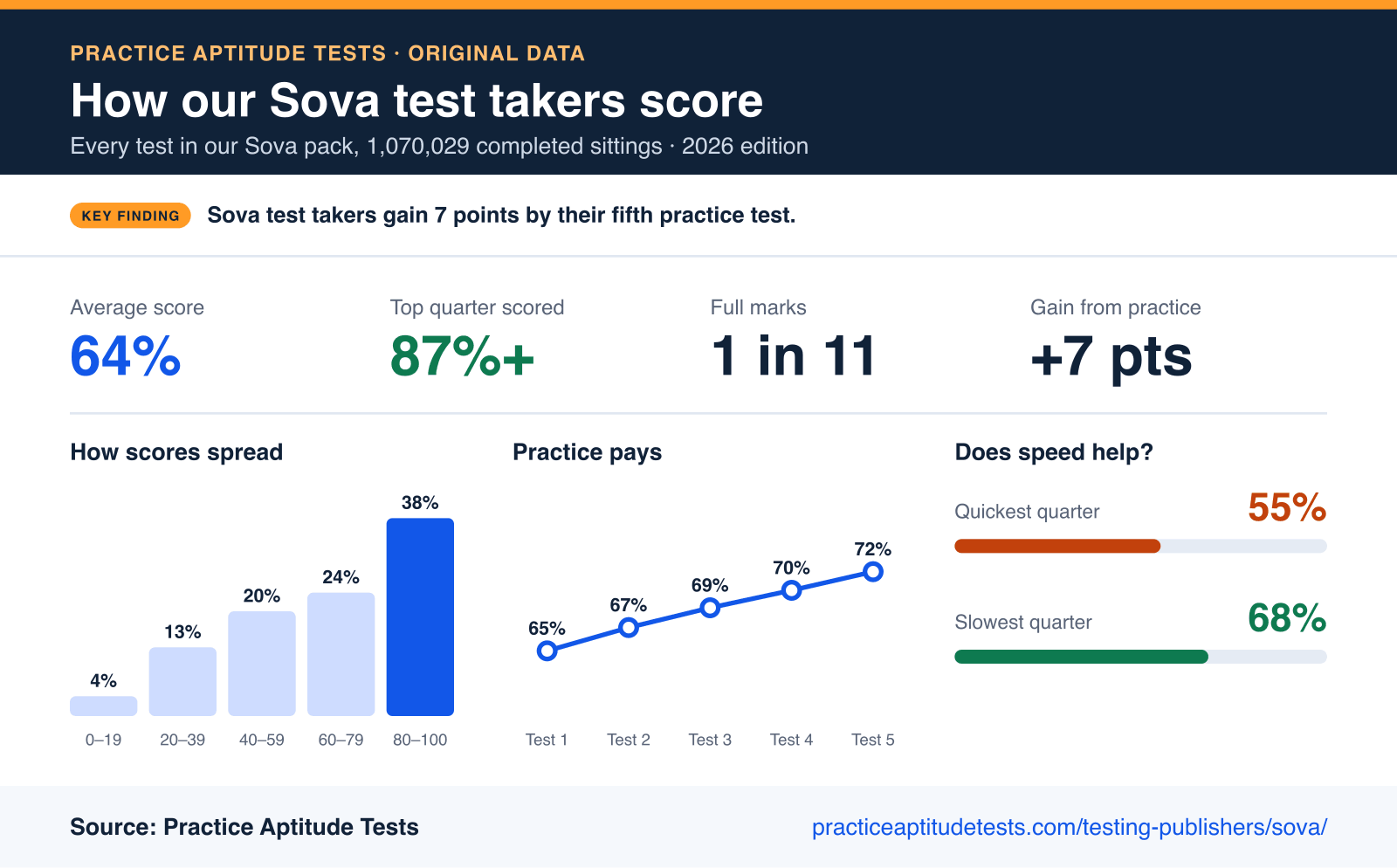
Practice Aptitude Tests · Original data
Results from every test in our Sova pack, past and present.
Key findingSova test takers gain 7 points by their fifth practice test.
38% scored 80% or more, and 17% scored under 40%.
Share of sittings in each score band.
Regular practisers went from 65% on their first test to 72% on their fifth.
17,955 people who took five or more tests.
Rushing costs marks. The quickest quarter scored 13 points lower than the slowest.
Typical pace: 40 seconds a question.
Sova is a trademark of its respective owner. Practice Aptitude Tests is not affiliated with Sova and our practice tests are not endorsed by them.