Situational Judgement Test
Workplace scenarios covering communication, teamwork, decision-making and professional judgement, in the formats employers actually set. Every scenario below comes with the scored key explained.
- 10 questions
- 20 minutes
- Scored key explained
- Printable PDF
Free · No sign-up · Scored the moment you finish






What is a situational judgement test?
A situational judgement test measures how well you handle realistic situations at work. Employers use it to sift graduate applicants before interview. You are given a short scenario and several possible responses, and you judge how effective each one would be. There are no calculations; the test is about the decisions you would make and the reasons behind them.
Free situational judgement test
Start the free test. It opens full screen, without leaving this page.
Prefer paper?
Download this test as a PDF or a second practice paper with different questions.
Worked solutions included. No sign-up.
Free Situational Judgement Test
-
Question 1 of 10
You have realised that a report you sent to a client last week contains an error. The client has not noticed, and correcting it now would be embarrassing. Rate each response.
- Say nothing and hope the mistake has no consequences.
- Tell your manager about the mistake but wait for their instructions before doing anything, even though the client may rely on the report meanwhile.
- Contact the client promptly, explain the error, and send a corrected version with an apology.
- Wait to see whether the client spots the error, and act only if they raise it.
Show the answer
Most effective: C. Contact the client promptly, explain the error, and send a corrected version with an apology.
Least effective: A. Say nothing and hope the mistake has no consequences.
Contacting the client promptly is most effective: a fast, honest correction limits the harm because the client may act on the flawed report at any moment, and owning the error protects the relationship. Saying nothing and hoping is least effective, as it leaves a known error live and risks far greater damage. Telling the manager but passively waiting for instructions is well-intentioned but middling, because it delays a correction that speed makes urgent; waiting to see if the client notices is also middling, monitoring the problem but gambling on their inaction.
-
Question 2 of 10
A colleague on your team is clearly overwhelmed and falling behind on a shared deadline, while you have some spare capacity this week. They have not asked for help and seem reluctant to admit they are struggling. Rate each response.
- Quietly finish some of their tasks yourself without telling them, to avoid embarrassing them.
- Mention to the wider team in a meeting that they seem to be falling behind and need support.
- Focus only on your own work, since they have not asked you for any help.
- Ask them privately how they are getting on and offer specific help with the shared deadline.
Show the answer
Most effective: D. Ask them privately how they are getting on and offer specific help with the shared deadline.
Least effective: B. Mention to the wider team in a meeting that they seem to be falling behind and need support.
Asking privately and offering specific help is most effective: it respects the colleague and directly addresses the shared deadline. Raising their struggles publicly in a meeting is least effective, as it embarrasses them and damages trust. Silently doing their tasks is well-meant but middling, since it is unilateral and could confuse who is doing what; focusing only on your own work is also middling, protecting your tasks but leaving a shared goal at avoidable risk.
-
Question 3 of 10
You receive critical feedback from your manager on a piece of work you were proud of. Some of the points feel unfair to you, but others may be valid. Rate each response.
- Defend your work point by point during the conversation to show the criticism is misplaced.
- Listen carefully, ask questions to understand the feedback, and reflect before responding.
- Dismiss the feedback afterwards and carry on working exactly as you did before.
- Accept every point without comment and change everything immediately to avoid further discussion.
Show the answer
Most effective: B. Listen carefully, ask questions to understand the feedback, and reflect before responding.
Least effective: C. Dismiss the feedback afterwards and carry on working exactly as you did before.
Listening, asking clarifying questions, and reflecting is most effective: it shows openness and lets you act on the valid points. Dismissing the feedback entirely is least effective, as it wastes a chance to improve and signals poor self-awareness. Defending everything immediately is middling, closing off learning in the moment; accepting all of it uncritically is also middling, since it may mean changing things that were actually fine.
-
Question 4 of 10
An urgent request from a senior colleague arrives while you are close to a firm deadline on other important work. You cannot complete both in the time available. Rate each response.
- Ignore the urgent request until your deadline is met, without telling the senior colleague anything.
- Quickly do the most urgent part of the senior request, then flag to your manager that your other deadline is now at risk.
- Attempt both at once and hope the quality of each does not suffer.
- Explain your current deadline to the senior colleague and agree together which should take priority.
Show the answer
Most effective: D. Explain your current deadline to the senior colleague and agree together which should take priority.
Least effective: A. Ignore the urgent request until your deadline is met, without telling the senior colleague anything.
Explaining your deadline and agreeing priorities together is most effective: the right work is done first with informed consent rather than guesswork. Silently ignoring the senior colleague’s urgent request is least effective, leaving them blind to the delay and damaging trust. Doing the most urgent part and flagging the risk is reasonable but middling, since it commits to an order unilaterally; attempting both at once is also middling, relying on hope and risking two weak outputs.
-
Question 5 of 10
A client emails you frustrated because a service they expected has been delayed, and the delay was caused by a genuine issue on your team’s side. The client is an important one and wants an explanation quickly. Rate each response.
- Delay replying until you have a full solution, leaving the client without any acknowledgement.
- Send a brief apology but avoid explaining the cause or committing to any next steps.
- Reply promptly, acknowledge the delay honestly, explain what happened, and set out the next steps.
- Reply blaming the delay on circumstances outside your control to avoid admitting fault.
Show the answer
Most effective: C. Reply promptly, acknowledge the delay honestly, explain what happened, and set out the next steps.
Least effective: D. Reply blaming the delay on circumstances outside your control to avoid admitting fault.
Replying promptly with an honest acknowledgement, explanation, and next steps is most effective: it shows accountability and reassures an important client. Blaming outside circumstances dishonestly is least effective, as it destroys trust when the cause was internal. Delaying any reply is middling, leaving the client anxious in silence; a bare apology with no explanation or next steps is also middling, offering little real reassurance.
-
Question 6 of 10
Two colleagues disagree sharply during a team discussion, and it is turning tense and personal. You can see valid points on both sides. Rate each response.
- Announce to the whole team that both colleagues are being unprofessional.
- Suggest the team refocus on the shared goal and calmly weigh the merits of each approach.
- Suggest the two colleagues continue the discussion privately after the meeting once tempers have cooled.
- Stay silent and let the two colleagues resolve the argument between themselves however it ends.
Show the answer
Most effective: B. Suggest the team refocus on the shared goal and calmly weigh the merits of each approach.
Least effective: A. Announce to the whole team that both colleagues are being unprofessional.
Refocusing on the shared goal and weighing both approaches calmly is most effective: it defuses the personal heat while still using the valid points on each side. Publicly announcing that both colleagues are unprofessional is least effective, humiliating them and escalating the conflict. Moving the discussion offline is a sensible middle, cooling tempers but deferring the decision; staying silent is also middling, avoiding inflaming things but letting a personal clash run unchecked.
-
Question 7 of 10
You have realised you will miss a deadline you committed to, because doing the work properly will take longer than expected. Rushing it would mean cutting corners. Rate each response.
- Tell the person expecting the work as soon as possible, explain why, and propose a realistic new timeline.
- Miss the deadline without telling anyone, and explain only if someone chases you.
- Submit on time but flag clearly which parts still need more work and offer to finish them shortly after.
- Deliver a small part on time and say the rest is coming, without agreeing a firm new date.
Show the answer
Most effective: A. Tell the person expecting the work as soon as possible, explain why, and propose a realistic new timeline.
Least effective: B. Miss the deadline without telling anyone, and explain only if someone chases you.
Giving early, honest notice with a realistic new timeline is most effective: it lets the other person replan and shows ownership. Missing the deadline in silence is least effective, leaving them expecting work that will not arrive and explaining only under pressure. Submitting on time while clearly flagging what is unfinished is a solid middle, though delivering knowingly incomplete work is second best; a partial delivery with no firm new date is also middling, giving little to plan around.
-
Question 8 of 10
You have noticed a flaw in a team process that occasionally causes small errors, though it has not caused a serious problem yet. Fixing it is not part of your assigned work. Rate each response.
- Mention it in passing to a colleague but take no further steps to have it looked into.
- Say nothing, since it has not caused a serious problem and is not your responsibility.
- Quietly change the shared process yourself without telling anyone else who relies on it.
- Raise the issue with your manager or team, explaining the flaw and suggesting how it could be fixed.
Show the answer
Most effective: D. Raise the issue with your manager or team, explaining the flaw and suggesting how it could be fixed.
Least effective: C. Quietly change the shared process yourself without telling anyone else who relies on it.
Raising the flaw through the right channel with a suggested fix is most effective: the people who own the process can improve it with full awareness. Quietly altering a shared process that others depend on, with no one told, is least effective and the most dangerous option, because it can break their work and create new, untraced errors worse than the original flaw. Mentioning it to a colleague with no follow-up is a weak middle; saying nothing lets a known flaw persist but at least changes nothing others rely on.
-
Question 9 of 10
A colleague asks you to support their version of events, which leaves out that they forgot a step, and to back them up if your manager asks. Rate each response.
- Tell the colleague you will not lie, but say you would rather not get involved beyond that.
- Agree to back up their account to protect the colleague from getting into trouble.
- Tell the colleague you will not misrepresent what happened, and offer to help them prepare an honest explanation for the manager.
- Say you would rather stay out of it, and give a vague answer if the manager asks.
Show the answer
Most effective: C. Tell the colleague you will not misrepresent what happened, and offer to help them prepare an honest explanation for the manager.
Least effective: B. Agree to back up their account to protect the colleague from getting into trouble.
Refusing to misrepresent events while offering to help the colleague prepare an honest explanation is most effective: it keeps your integrity and supports them toward the right course. Agreeing to back up a false account is least effective, as it is active dishonesty that risks you both and misleads the manager. Declining to lie but offering no further help is an honest but limited middle; staying out of it with a deliberately vague answer is weaker, edging toward misleading the manager.
-
Question 10 of 10
You are new and have been assigned a task that uses tools you are unfamiliar with. You are unsure how to do part of it, and the deadline is in a few days. Rate each response.
- Ask a colleague to explain the unfamiliar part, then complete it yourself and check it before submitting.
- Attempt the task yourself first, then ask an experienced colleague to point you in the right direction.
- Wait until the day of the deadline before admitting you were unsure how to do part of it.
- Guess your way through the unfamiliar part and submit it without checking or telling anyone.
Show the answer
Most effective: B. Attempt the task yourself first, then ask an experienced colleague to point you in the right direction.
Least effective: D. Guess your way through the unfamiliar part and submit it without checking or telling anyone.
Attempting the task first and then seeking targeted guidance is most effective: it shows initiative and makes best use of a colleague’s time, so you learn the tools rather than just being handed the answer. Guessing and submitting unchecked, with no one told, is least effective, risking wrong work and hiding the problem. Asking for an explanation then doing and checking the work yourself is a strong middle, just behind the best; waiting until deadline day to admit the difficulty is weaker, leaving no time to put things right.
Practise with the full pack
One test tells you the style. A pack gives you the pace: batches under time pressure, marked, with the working shown.
- 21
- Situational Judgement tests
- 210
- questions, all solved
Types of situational judgement question
Every scenario ends with an instruction, and the same scenario can ask four different things of you. Each guide below covers one format.
Most and least effective
Pick the single most effective response, or the least. The classic mistake is answering most when the question asked least.
How most and least questions workRating questions
Rate every response from very effective to very ineffective, each on its own merits.
How rating questions workRanking questions
Order the responses from best to worst. The middle positions are where the marks go.
How ranking questions workChoosing the best response
The elimination habits that narrow any format: rule out the unethical, the passive and the political first.
How to choose the best responseHow does a situational judgement test work?
A situational judgement test, or SJT, is a psychometric test that presents hypothetical workplace scenarios and asks how you would respond. Unlike aptitude tests that measure a concrete skill such as numeracy or verbal reasoning, an SJT assesses judgement and behaviour: how you handle a difficult colleague, a demanding client, a missed deadline or an ethical dilemma.
There is rarely one perfect answer. Your responses are compared against the behaviours the employer values for that role, usually drawn from an internal competency framework, which is why understanding the employer and how the job works in practice matters as much as the scenario itself.
An SJT does two things at once. It shows the employer how your judgement is likely to hold up in the situations the role involves, and it gives you a preview of the kinds of decision you would face if you took the job.
See worked sample questions for the most common test types.
How are situational judgement tests scored?
Most employers score you against other candidates, not against a fixed pass mark: your raw score becomes a percentile. Attempting questions matters, because most tests are built so few candidates finish, and guessing usually pays: negative marking is rare, but check the instructions.
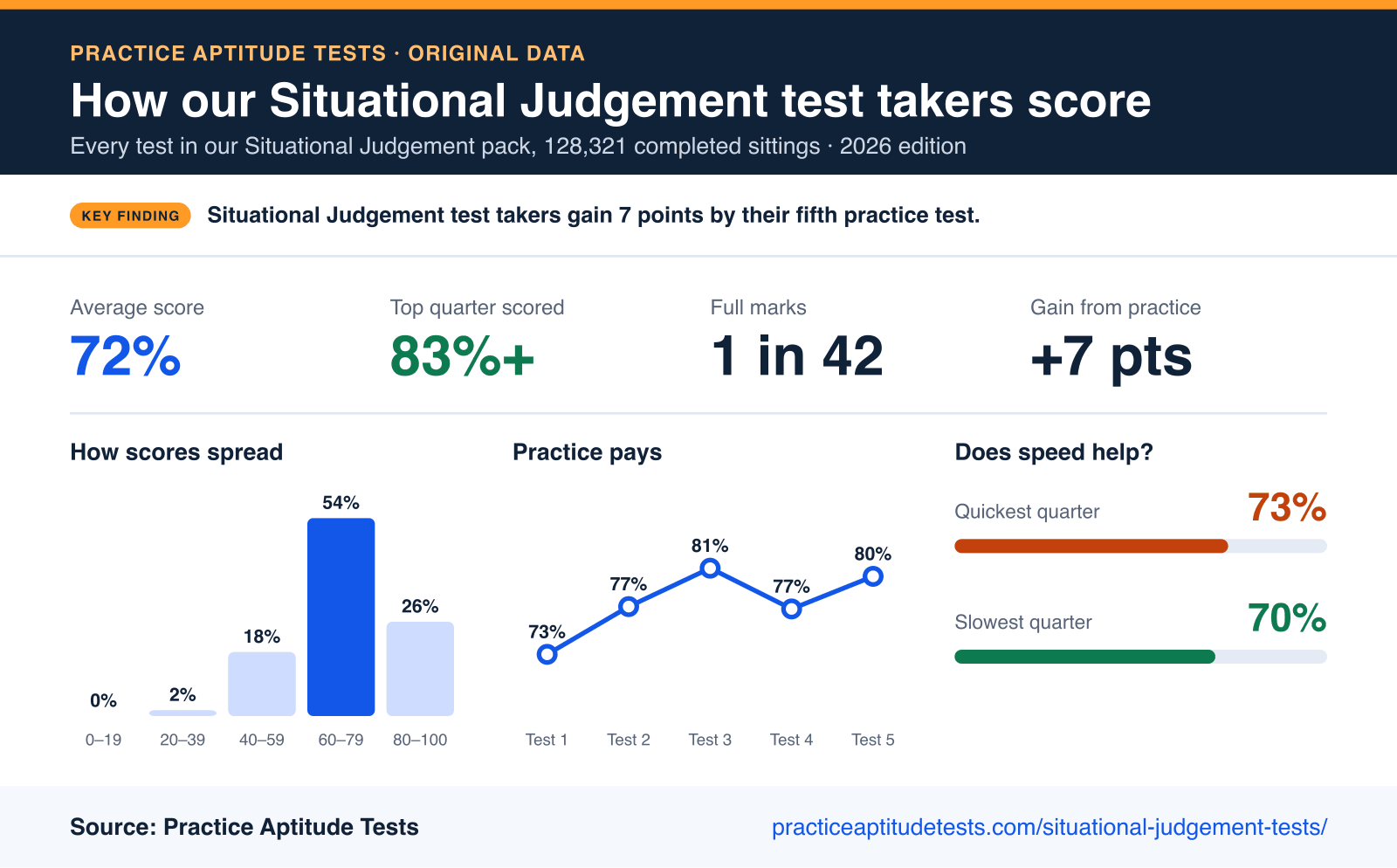
Practice Aptitude Tests · Original data
How our test takers score
Results from every test in our Situational Judgement pack, past and present.
Key findingSituational Judgement test takers gain 7 points by their fifth practice test.
How scores spread
26% scored 80% or more, and 2% scored under 40%.
Share of sittings in each score band.
Practice pays
Regular practisers went from 73% on their first test to 80% on their fifth.
2,437 people who took five or more tests.
Does speed help?
Speed makes little difference here.
Typical pace: 71 seconds a question.
Share this data
Video tutorials
The methods behind the questions above, from our team