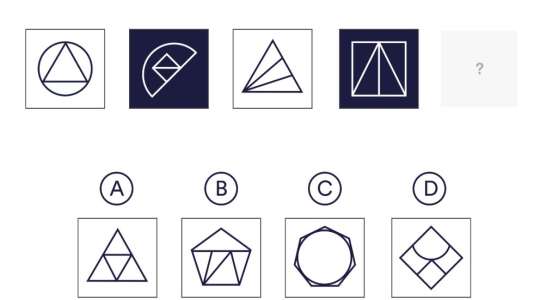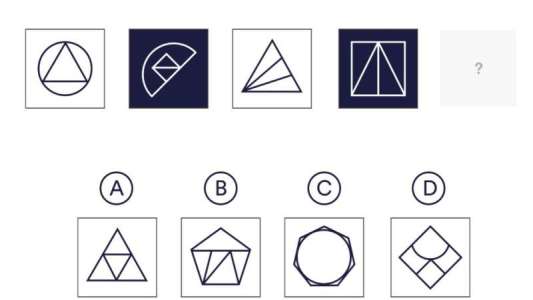
Below are eight logical reasoning examples with answers, covering the formats you are most likely to meet in an employer’s test: number and letter sequences, shape patterns, matrices, deductive statements, ordering problems, diagrammatic operators and critical reasoning arguments. Each one shows the question, the steps to solve it, and the answer. Try each question yourself before reading the solution.
When you have worked through them, test yourself on more questions in a free logical reasoning test, where every question has a worked solution.
How to approach every example
The same short method works across all of these formats. Decide whether you are finding a rule or applying one. State the rule in plain words. Test it against every element you are given, not just the last one or two. Then use the options to eliminate, and check your answer against every condition before you commit. Our logical reasoning test tips explain each step in more detail.
Example 1: number sequence
Question. What number comes next? 3, 7, 15, 31, ?
Steps. Look at the gaps: 4, 8, 16. Each gap doubles, so the next gap is 32. Another way to see it is that each number is double the previous one plus 1: 3 × 2 + 1 = 7, 7 × 2 + 1 = 15, 15 × 2 + 1 = 31.
Answer: 63. Both routes agree: 31 + 32 = 63, and 31 × 2 + 1 = 63. When two methods give the same answer, you can be confident in the rule.
Example 2: letter sequence
Question. Which letter comes next? B, E, H, K, ?
Steps. Convert letters to their positions in the alphabet: B is 2, E is 5, H is 8, K is 11. Each step adds 3, so the next is 14.
Answer: N. Turning letters into numbers makes letter patterns much easier to see.
Example 3: shape sequence
Question. Four boxes each contain one arrow. Box 1 points up and is white. Box 2 points right and is black. Box 3 points down and is white. Box 4 points left and is black. What is in box 5?
Steps. Check one feature at a time. Direction: up, right, down, left is a 90 degree clockwise turn at each step, so box 5 points up. Colour: white and black alternate, so box 5 is white.
Answer: a white arrow pointing up. The trap option will have the right direction but the wrong colour, because one rule is rarely the whole rule.
Example 4: matrix
Question. A three by three grid of shapes has the bottom right cell missing. Reading across each row, the shapes go triangle, square, pentagon. Reading down each column, the shading goes white, grey, black. What belongs in the missing cell?
Steps. Fix the row rule first and confirm it holds in rows one and two. The missing cell is in the third column, so it is a pentagon. Then fix the column rule. The missing cell is in the third row, so it is black.
Answer: a black pentagon. Solve one direction at a time, then combine the rules.
Example 5: deductive statements
Question. All analysts in the team use spreadsheets. Some people who use spreadsheets work remotely. Does it follow that some analysts work remotely?
Steps. The first statement places every analyst inside the group of spreadsheet users. The second says some spreadsheet users work remotely, but it does not say which ones. The remote workers could all be people who are not analysts.
Answer: no, it cannot be concluded. It might be true, but nothing in the statements makes it certain.
A related question. If the report is approved, it is published on Friday. The report was not published on Friday. What follows?
Answer: the report was not approved. If approval always leads to Friday publication, and there was no Friday publication, there cannot have been approval. The tempting wrong answer is “if a report is published on Friday, it was approved”, which reverses the rule. A report could be published on a Friday for some other reason.
Example 6: ordering
Question. Dana earns more than Eli. Farah earns less than Eli. Gus earns more than Dana. Who earns the second lowest amount?
Steps. Build the order one statement at a time. Dana is above Eli. Farah is below Eli, giving Dana, Eli, Farah. Gus is above Dana, giving Gus, Dana, Eli, Farah from highest to lowest.
Answer: Eli. Writing the order down as you go is quicker and safer than holding it in your head. For longer problems of this kind, our guide on how to solve logic puzzles shows the grid method.
Example 7: diagrammatic operators
Question. In a diagram, the symbol ★ reverses the order of a set of letters, and the symbol ● moves the first letter to the end. The input ABCD passes through ★ and then ●. What is the output?
Steps. Apply each operator in order and write down the result after each one. ★ reverses ABCD to DCBA. ● moves the first letter, D, to the end, giving CBAD.
Answer: CBAD. The common error is applying the operators in the wrong order. ● first would give BCDA, then ★ would give ADCB, which is a different answer.
Example 8: strong and weak arguments
Question. Should all staff complete data protection training every year?
- A. Yes, because data protection rules and the risks staff face change over time, and annual training keeps everyone up to date.
- B. No, because the last training session was boring.
Steps. A strong argument relates directly to the question and gives a reason that would actually affect the decision. A weak argument is off the point, personal or trivial.
Answer: A is strong and B is weak. A addresses the purpose of the training. B is a personal reaction that says nothing about whether the training is needed. Judge an argument on its relevance, not on whether you agree with it.
What these examples teach
Most wrong answers in logical reasoning tests come from a small number of habits: stopping after finding one rule, reversing a statement, adding information that was never given, and applying steps in the wrong order. Most of the examples above include one of these traps. If you can spot them here, you can spot them in a test.
For the bigger picture of the skill these questions measure, read what logical reasoning is. Then build speed and accuracy with a timed logical reasoning practice test.