
Accountancy Tests
Accountancy firms usually set numerical, verbal and situational judgement tests, and some add a job simulation before the final interview. Practise with a free situational judgement test set in accountancy work.
- 10 questions
- 13 minutes
- Worked solutions
Free · No sign-up · Scored the moment you finish
Accountancy Situational Judgement Test
You have 13 minutes to answer 10 questions. Each question describes a workplace situation and four possible responses. For every question, select the response you believe would be MOST effective and the response you believe would be LEAST effective. There are no trick questions; judge each response on how well it would work in the situation described.
About this test: this is one of a set of practice tests covering the areas Accountancy assessment processes typically include. It is written by us and is not any employer’s own assessment.
-
Question 1 of 10
You are an assurance trainee. A meeting note you wrote three weeks ago records that the client “would consider” a change. Your senior says the client has since told him they “agreed” it at that meeting, and asks you to amend the note to say agreed. You remember it as considered. Which response below would be most effective, and which would be least effective?
- Refuse and tell him the note cannot be touched, without offering any way to capture what the client has now said.
- Amend the original note to say the client agreed, since your senior was in the meeting too and the client has now confirmed that is what happened.
- Take it straight to the engagement partner as a request to falsify a record, without first putting the alternative to your senior.
- Offer to add a dated line recording what the client has now said, and explain that you would rather not change what the original note recorded at the time.
Show the answer
Most effective: D. Offer to add a dated line recording what the client has now said, and explain that you would rather not change what the original note recorded at the time.
Least effective: B. Amend the original note to say the client agreed, since your senior was in the meeting too and the client has now confirmed that is what happened.
A: Defends the record and drops the substance: the client's later position is real and needs recording somewhere.
B: Alters a contemporaneous record: the note's whole value is that it says what was recorded on the day, and rewriting it removes the only evidence of the difference.
C: Names it as falsification before asking: your senior may simply not have thought about it, and this is very hard to walk back.
The most effective response is to offer to add a dated line recording what the client has now said, and explain that you would rather not change what the original note recorded at the time: it protects what the note is for, captures the new information properly, and gives your senior an easy way to accept. It beats refusing outright and offering no way to capture what the client has now said, because that later position still needs to be on file. It beats taking it straight to the engagement partner as a request to falsify a record, because an unheralded partner conversation is a large response to a request he may withdraw at once. The least effective response is amending the original note to say the client agreed: the record of what was said on the day is overwritten to match what people now believe, which destroys the one thing a contemporaneous note provides. That is altering a record rather than handling the request rigidly or dramatically. The principle: never rewrite the old record; add a new one with today’s date on it.
-
Question 2 of 10
You are a purchase ledger clerk. Your manager asked you this morning to file last year’s invoices, which will take the day. At 10am you notice a supplier’s bank details were changed yesterday by someone outside the team, and nobody has confirmed with the supplier that the change is genuine. Your manager is at her desk. Which response below would be most effective, and which would be least effective?
- Finish the filing exactly as she asked and tell your manager about the changed bank details at the end of the day, when the job she gave you this morning is actually complete.
- Send a note about the bank details over to the payments team, mark it as theirs now, and carry on with the filing without checking that anybody has picked it up.
- Ask the supplier directly whether they changed their own bank details, then carry on with the filing and mention it to your manager when there is a moment.
- Stop and tell your manager about the changed bank details now, and ask whether the filing should wait while somebody looks at where the change came from.
Show the answer
Most effective: D. Stop and tell your manager about the changed bank details now, and ask whether the filing should wait while somebody looks at where the change came from.
Least effective: B. Send a note about the bank details over to the payments team, mark it as theirs now, and carry on with the filing without checking that anybody has picked it up.
A: Ranks the instruction above the information: a day is a long time for a change of this kind to sit unexamined.
B: Hands off the urgent item and keeps the routine one: the payments team has no context, nobody has confirmed they picked it up, and the filing was never the thing that mattered today.
C: Acts before anybody senior has looked: contacting the supplier on the number in the record is exactly what somebody would want to control first.
The most effective response is to stop and tell your manager about the changed bank details now, and ask whether the filing should wait while somebody looks at where the change came from: a bank detail change from outside the team is exactly the thing worth interrupting for, she is two steps away, and the filing has no deadline at all. It beats finishing the filing as asked and telling her at the end of the day, because a day is a long time to leave it. It beats asking the supplier directly whether they changed their own details, because that destroys the evidence before anybody has looked. The least effective response is sending a note to the payments team and carrying on with the filing without checking anybody picked it up: the urgent item is pushed to a team with no context and no confirmation. That is offloading it rather than sequencing it badly. The principle: an instruction from this morning does not outrank what you have found since.
-
Question 3 of 10
You are a management accounts assistant. Every month you rekey the same figures between two systems, which takes half a day and causes errors. You could write a small spreadsheet tool that does it automatically. Tools that move data between these systems have to be registered and reviewed by the systems team first. Which response below would be most effective, and which would be least effective?
- Build a prototype, show your manager the half-day saving, and ask them to put it to the systems team for registration before anybody uses it for real.
- Ask the systems team to build the tool themselves, since they own the registration process and will know how it should be done.
- Carry on rekeying each month and raise the idea at the next systems team forum in three months, when there is a proper slot for suggestions like this one.
- Build the tool and start using it for this month's close, and register it with the systems team afterwards once it has proved that it works properly.
Show the answer
Most effective: A. Build a prototype, show your manager the half-day saving, and ask them to put it to the systems team for registration before anybody uses it for real.
Least effective: D. Build the tool and start using it for this month's close, and register it with the systems team afterwards once it has proved that it works properly.
B: Hands away the part you are best placed to do: you know the process and the failure modes, and their queue is long.
C: Delays the decision for a quarter: three more months of half-days and known errors, to wait for a meeting.
D: Builds a workaround around a control: a month's reported figures come out of an unreviewed tool, and registration afterwards cannot undo that they already have.
The most effective response is to build a prototype, show your manager the half-day saving, and ask him to put it to the systems team for registration before anybody uses it for real: the prototype makes the case concrete, he owns the priority, and registration happens before anything real depends on it. It beats carrying on rekeying and raising the idea at the systems forum in three months, because three months of known errors is a real cost. It beats asking the systems team to build the tool themselves, because handing it to a long queue loses the knowledge that makes it work. The least effective response is building the tool, using it for this month’s close, and registering it afterwards: a month’s figures are produced by a tool that the review exists to look at before it is trusted. That is going around a stated control rather than moving too slowly or too fast. The principle: build it, show it, and get it approved before anything real runs on it.
-
Question 4 of 10
You are an accounts assistant. A supplier’s credit insurer emails asking you to confirm that your firm has “no disputed invoices” with them. There are two disputed invoices, both small, and your manager is on leave for a week. The insurer says a reply is needed within two days or cover will be withdrawn. Which response below would be most effective, and which would be least effective?
- Leave the email until your manager returns, since a request of this kind is plainly above your level to answer either way.
- Assure the insurer that there are no disputed invoices, since the two in question are small and will almost certainly be resolved within the week anyway.
- Reply that the request has to be answered by somebody with authority, tell the insurer when that will be, and put it to your manager's cover today.
- Reply setting out the two disputed invoices and the amounts, so that the insurer has an accurate answer inside their two-day deadline.
Show the answer
Most effective: C. Reply that the request has to be answered by somebody with authority, tell the insurer when that will be, and put it to your manager's cover today.
Least effective: B. Assure the insurer that there are no disputed invoices, since the two in question are small and will almost certainly be resolved within the week anyway.
A: Lets a deadline run out: cover is withdrawn in two days, and a cover exists precisely so that a week's absence does not do that.
B: Asserts something you know is untrue to a third party: an insurer withdraws or maintains cover on it, and the two disputes exist today whatever happens next week.
D: Answers on the firm's behalf without authority: an accurate disclosure to a credit insurer is still a disclosure somebody senior should make.
The most effective response is to reply that the request has to be answered by somebody with authority, tell the insurer when that will be, and put it to your manager’s cover today: it declines to answer without authority, protects the two-day deadline by saying what is happening, and puts it in front of the person standing in. It beats replying with the two disputed invoices and the amounts, because the disclosure itself needs authority even when it is true. It beats leaving the email until your manager returns, because a week’s silence loses the cover. The least effective response is confirming there are none on the grounds that the two are small and will be resolved within the week: a false confirmation goes to somebody who will act on it, from a person with no authority to send it at all. That is a false statement rather than an over-reach or a delay. The principle: when you cannot answer, say who can and by when, and start that today.
-
Question 5 of 10
You are a compliance analyst. A department head asks you whether his team’s new process “has been approved”. Your review is half done and the parts you have seen are fine, but two sections are untouched. He wants to start using the process on Monday and is pressing for an answer today. Which response below would be most effective, and which would be least effective?
- Tell him exactly which parts you have reviewed and which you have not, say when the remaining two will be done, and be clear that it is not approved yet.
- Tell him to raise it with your manager, since a question about whether something is approved should come from somebody more senior than you.
- Tell him the review is not finished and that you cannot say anything further about it until it is, without giving him any sort of date for the remaining two sections.
- Tell him it is fine to go ahead on Monday, since everything you have looked at so far has been perfectly in order and the rest is very unlikely to differ.
Show the answer
Most effective: A. Tell him exactly which parts you have reviewed and which you have not, say when the remaining two will be done, and be clear that it is not approved yet.
Least effective: D. Tell him it is fine to go ahead on Monday, since everything you have looked at so far has been perfectly in order and the rest is very unlikely to differ.
B: Passes a question you can answer: you know exactly what has and has not been reviewed, and he now waits for a diary slot.
C: Withholds the timing: he is planning a Monday start and a date is the one thing that would let him plan around it.
D: Gives an approval you have not reached: he starts a process on Monday believing it is signed off, and two unreviewed sections carry his name and yours.
The most effective response is to tell him exactly which parts you have reviewed and which you have not, say when the remaining two will be done, and be clear it is not approved yet: it is precise about what is done, honest about the status, and gives him a date he can plan against. It beats telling him the review is not finished and that you cannot say more, because a refusal without a date leaves him no better off. It beats telling him to raise it with your manager, because you hold the facts and she would only repeat them. The least effective response is telling him it is fine to go ahead on Monday: an approval is given for two sections nobody has read, and a department starts using the process on the strength of it. That is asserting something untrue rather than being unhelpfully vague. The principle: report the status precisely and give a date, never round it up to yes.
-
Question 6 of 10
You are an audit junior. Your manager needs the cash section closed by 6pm. Two of the twelve bank confirmations have not arrived and the banks will not answer until tomorrow. The file template requires each confirmation to be marked received before the section can be signed. Which response below would be most effective, and which would be least effective?
- Mark the two outstanding confirmations as received so the section can be closed at 6pm, and update the file properly tomorrow when they actually arrive.
- Close the section at 6pm leaving the two confirmations blank, so that nothing untrue is recorded and the gap is visible to whoever looks at it next.
- Tell your manager at once that two confirmations are outstanding until tomorrow, and ask whether to close the section with those two flagged or hold it.
- Keep telephoning the two banks past 6pm until somebody answers, and tell your manager the section is on track in the meantime.
Show the answer
Most effective: C. Tell your manager at once that two confirmations are outstanding until tomorrow, and ask whether to close the section with those two flagged or hold it.
Least effective: A. Mark the two outstanding confirmations as received so the section can be closed at 6pm, and update the file properly tomorrow when they actually arrive.
A: Records evidence as received that has not been received: the file says twelve confirmations are in hand, and the reviewer, the manager and the client all read it that way.
B: Signs a section that is not complete: nothing false is written down, and the section is still declared closed with two items outstanding.
D: Reports a position you cannot support: the banks will not answer until tomorrow, so "on track" is a hope offered as a status.
The most effective response is to tell your manager at once that two confirmations are outstanding until tomorrow, and ask whether to close the section with those flagged or hold it: the constraint is real and external, she owns whether to close or hold, and both options are still open at 6pm. It beats closing the section at 6pm leaving the two blank, because closing with known gaps is a decision above your level even when nothing false is written. It beats telephoning the two banks past 6pm while reporting the section on track, because that is a status nobody can rely on. The least effective response is marking the two outstanding confirmations as received: the file asserts evidence was received when it was not, and everybody downstream reads that as fact. That is a false record rather than a badly judged close or an optimistic update. The principle: never let the record say something the work does not.
-
Question 7 of 10
You are a management accounts assistant. Your department’s cost figure is £4,000 over its monthly target. A £5,000 invoice arrived on the last day and could reasonably be treated as next month’s. Your manager has said several times how important hitting the target is. Nobody would query either treatment. Which response below would be most effective, and which would be least effective?
- Report the figure as it stands without mentioning the invoice, so the number is accurate and no argument about treatment arises at all.
- Report the figure as it stands and tell your manager the £5,000 invoice dated on the last day is the reason, so she can decide how to treat it.
- Move the invoice into next month and mention it to your manager afterwards, once the reported figure has already gone out showing the target met.
- Move the £5,000 invoice into next month and record the month as complete with the department inside its target, since the treatment is defensible and nobody will ask.
Show the answer
Most effective: B. Report the figure as it stands and tell your manager the £5,000 invoice dated on the last day is the reason, so she can decide how to treat it.
Least effective: D. Move the £5,000 invoice into next month and record the month as complete with the department inside its target, since the treatment is defensible and nobody will ask.
A: Reports accurately and explains nothing: your manager sees an overrun she cannot account for and may go looking for a cause that is not there.
C: Decides first and tells afterwards: the choice was your manager's, and it is much harder to reverse once reported.
D: Records a result that was chosen rather than measured: the treatment was picked because of the number it produced, and nothing in the report says so.
The most effective response is to report the figure as it stands and tell your manager the £5,000 invoice dated on the last day is the reason: the figure is what it is, the invoice timing is the whole explanation, and how to treat it is a judgement she should make knowing why it is being asked. It beats moving the invoice into next month and mentioning it afterwards, because the decision is taken before she is told. It beats reporting the figure without mentioning the invoice at all, because an unexplained overrun wastes her time. The least effective response is moving the invoice and recording the month as inside target: an accounting treatment is selected for the result it produces and reported as though it were simply the position. That is making the record say what you want rather than sequencing the conversation badly. The principle: report what happened, then raise the judgement as a judgement.
-
Question 8 of 10
You are a reconciliations clerk. Four breaks need clearing before the 2pm cut-off and each takes about an hour. It is 10am. Three desks have each told you theirs is the priority. Your supervisor is uncontactable this morning. One of the four affects a client payment; the other three affect internal reporting only. Which response below would be most effective, and which would be least effective?
- Work the four breaks in the order the desks contacted you, and tell all three desks plainly that arrival order is the rule you are applying today.
- Clear the client payment break first, then wait for your supervisor to become contactable before deciding the order of the remaining three breaks.
- Clear the client payment break first, tell all three desks the order you are working in and why, and say which break will not make the cut-off.
- Send the three internal breaks over to another team without telling them which one is urgent, and treat all four as no longer yours to worry about.
Show the answer
Most effective: C. Clear the client payment break first, tell all three desks the order you are working in and why, and say which break will not make the cut-off.
Least effective: D. Send the three internal breaks over to another team without telling them which one is urgent, and treat all four as no longer yours to worry about.
A: Treats order of arrival as priority: it is at least transparent, and a client payment is not more or less urgent for having been raised second.
B: Stops after the easy call: the hard part is the other three, and waiting spends the morning that could have cleared two of them.
D: Moves the work rather than the decision: another team has no context on three breaks, the ordering problem is untouched, and three desks still do not know where they stand.
The most effective response is to clear the client payment break first, tell all three desks the order you are working in and why, and say which break will not make the cut-off: the client payment is the only one with an outside party behind it, and telling the desks the order and the casualty makes it a decision rather than a queue. It beats working the four in the order the desks contacted you and telling them arrival order is the rule, because arrival order has nothing to do with consequence. It beats clearing the client payment and waiting for your supervisor before deciding the rest, because waiting burns the hours that would have cleared two more. The least effective response is sending the three internal breaks to another team without saying which is urgent: they go to people who cannot judge them, nobody is told anything, and the decision that had to be made is simply not made. That is passing it on rather than sequencing it wrongly. The principle: rank by consequence, then tell the people who lose.
-
Question 9 of 10
You are a financial crime analyst. A colleague asks you to take twelve of her cases this week because she has “a lot on”. She asked the same last month and you agreed. Your own queue is full but manageable. Your team leader allocates cases and does not know about either request. Which response below would be most effective, and which would be least effective?
- Tell her you cannot take any of them this week, and leave it there without suggesting anything about the allocation.
- Tell her you can take a few but that this is the second time, and that the two of you should put the allocation to your team leader rather than rearranging it privately.
- Take a few of them without saying anything, since you managed last month and she would not ask twice without a reason for it.
- Send the twelve cases straight over to your team leader to reallocate, without telling your colleague that you have done so or that you were asked.
Show the answer
Most effective: B. Tell her you can take a few but that this is the second time, and that the two of you should put the allocation to your team leader rather than rearranging it privately.
Least effective: D. Send the twelve cases straight over to your team leader to reallocate, without telling your colleague that you have done so or that you were asked.
A: Refuses without a route: she still has a queue she cannot manage and nothing has been raised with anybody who could change it.
C: Prioritises harmony over honesty: a few cases move, the allocation stays hidden from the person who owns it, and the pattern is set for a third time.
D: Hands the request to a manager behind the colleague's back: she asked you directly, and the first she hears is a reallocation she did not expect.
The most effective response is to tell her you can take a few but that this is the second time, and that the two of you should put the allocation to your team leader: it helps a little, names the pattern honestly to her face, and takes the question to the person whose job it is. It beats taking a few without saying anything because you managed last month, since absorbing it twice hides a real allocation problem. It beats telling her you cannot take any this week and leaving it there, because a flat refusal leaves her exactly where she was. The least effective response is sending the twelve cases to your team leader to reallocate without telling her: the request is escalated over her head, so she is blindsided and the conversation you could have had is now a management one. That is going around a colleague rather than being too soft or too hard. The principle: say it to her, then take the allocation where it belongs, together.
-
Question 10 of 10
You are a settlements assistant. At the end of your shift one trade is unmatched because the counterparty’s reference does not match yours. You have worked out what is wrong but not fixed it. The night team will pick up the queue and does not usually see this counterparty. Your shift ends in five minutes. Which response below would be most effective, and which would be least effective?
- Write two lines on the handover saying what the mismatch is and what you think the fix is, and flag it to the night team lead before you leave.
- Email the counterparty explaining the reference problem, and leave the trade in the queue for the night team to pick up when the reply comes.
- Stay late and fix the mismatch yourself, since you understand it and the night team would take much longer to get to the same point.
- Put the unmatched trade over to the night team in the queue with the others, since it is their shift now and they will work through it the same way they work through everything else.
Show the answer
Most effective: A. Write two lines on the handover saying what the mismatch is and what you think the fix is, and flag it to the night team lead before you leave.
Least effective: D. Put the unmatched trade over to the night team in the queue with the others, since it is their shift now and they will work through it the same way they work through everything else.
B: Starts something the next shift cannot finish: a reply arrives to an inbox nobody on tonight is watching.
C: Absorbs a handover problem: it works tonight, and the night team is no better placed the next time this counterparty appears.
D: Hands over the problem without the part only you know: the night team has never seen this counterparty, and the diagnosis you already have leaves the building with you.
The most effective response is to write two lines on the handover saying what the mismatch is and what you think the fix is, and flag it to the night team lead: two lines transfer the diagnosis, the flag makes sure it is read, and they can act immediately. It beats staying late and fixing the mismatch yourself, because that fixes tonight and teaches nobody. It beats emailing the counterparty about the reference problem and leaving the trade in the queue, because a reply landing in your inbox overnight helps nobody on shift. The least effective response is putting the unmatched trade into the queue with the others: it is passed on stripped of the only thing that would let the next person solve it. That is offloading rather than handing over imperfectly. The principle: what you hand on is the problem plus what you learned about it.






What are Accountancy tests?
Accountancy tests are the online assessments accountancy firms set after the application form, before a video interview and an assessment centre or final interview. Most combine an untimed behavioural or skills assessment with a timed reasoning test. At KPMG, for example, the timed cognitive test covers numerical and logical reasoning and gives you 36 minutes.
The tests you are likely to sit
The exact tests depend on the role, so check the job advert or your invitation. These are the ones accountancy applicants most often meet.
| Assessment | What it measures |
|---|---|
| Numerical reasoning test | Working with financial tables, charts and business data |
| Verbal reasoning test | Judging statements about short written passages |
| Situational judgement test | Choosing effective responses to workplace scenarios |
| Behavioural assessment | How your preferred ways of working fit the role |
| Job simulation | Realistic tasks based on the work of the role |
| Assessment centre and interview | Your skills, motivation and fit at the final stage |
Employer guides
If you know which company you are applying to, start with its guide: it covers the tests that employer sets and when.
- DeloitteNumerical, verbal and situational judgement tests
- PwCSHL behavioural and cognitive assessments
- EYNumerical, verbal and situational judgement tests
- KPMGTwo online assessments and a video interview
- Grant ThorntonCritical thinking and personality tests
- BDOTask-based cognitive ability assessment
Not listed? Browse all employer guides.
Practise the real thing
Practice moves scores fastest on the tests set under time pressure, and every question in the pack comes with the working shown.
- 10
- practice tests
- 100
- questions, all solved
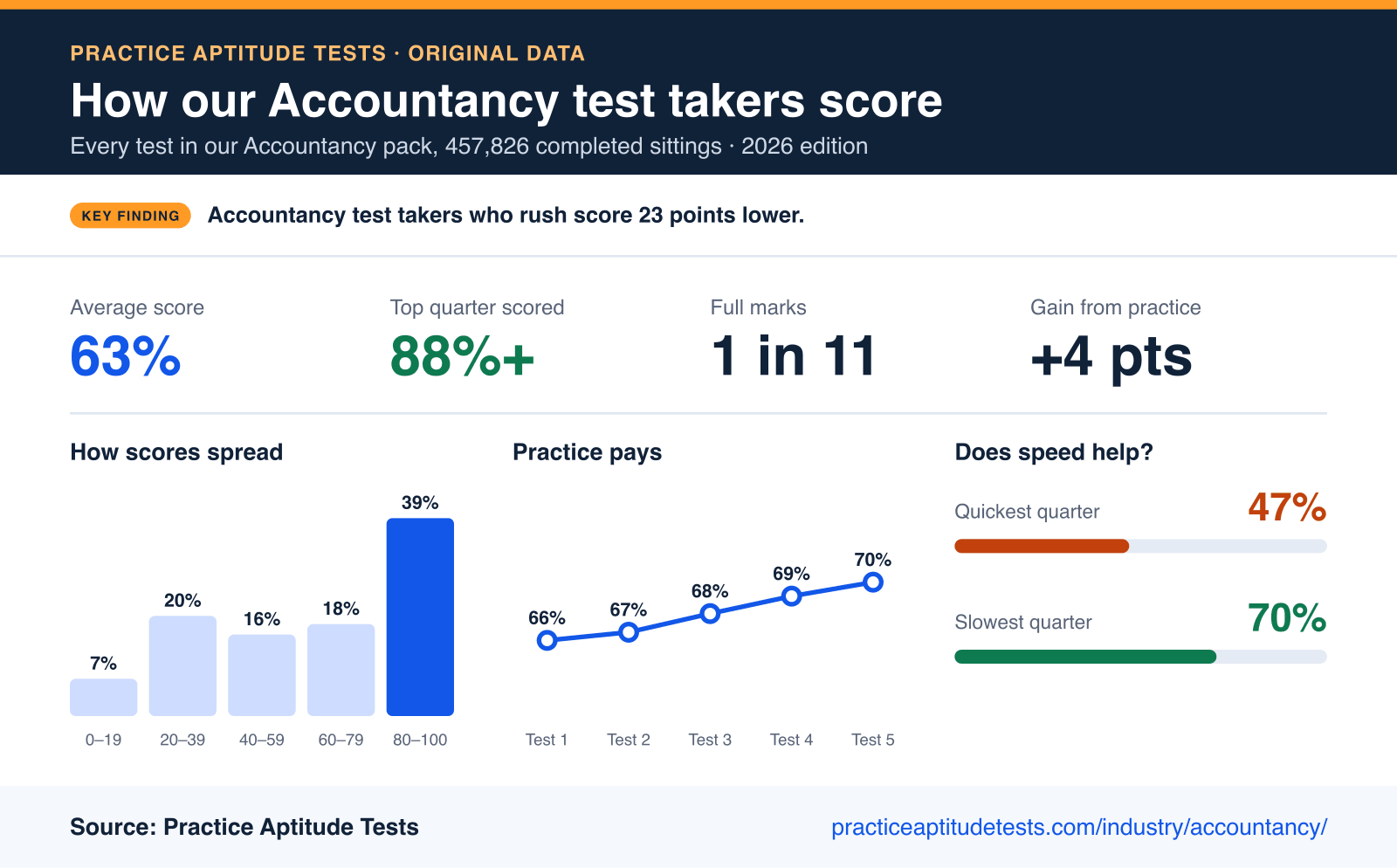
Practice Aptitude Tests · Original data
How our test takers score
Results from every test in our Accountancy pack, past and present.
Key findingAccountancy test takers who rush score 23 points lower.
How scores spread
39% scored 80% or more, and 27% scored under 40%.
Share of sittings in each score band.
Practice pays
Regular practisers went from 66% on their first test to 70% on their fifth.
6,865 people who took five or more tests.
Does speed help?
Rushing costs marks. The quickest quarter scored 23 points lower than the slowest.
Typical pace: 52 seconds a question.
Share this data
Our practice tests mirror the formats used in Accountancy hiring. They are written by Practice Aptitude Tests and are not affiliated with or endorsed by any individual employer.