Financial Reasoning Test
Graphs, tables and financial passages: margins, revenue, costs and ratios under time pressure. Every question comes with the full working.
- 10 questions
- 12 minutes
- Worked solutions
- Printable PDF
Free · No sign-up · Scored the moment you finish






What is a financial reasoning test?
A financial reasoning test measures how well you read financial figures and draw the right conclusion from them. Employers use it to sift applicants for finance and commercial roles before interview. You interpret data from statements, budgets and reports, then calculate figures such as margins, growth and ratios, choosing the best answer from four options. Clear reading of the numbers matters as much as the arithmetic.
Free financial reasoning test
Start the free test. It opens full screen, without leaving this page.
Prefer paper?
Download this test as a PDF or a second practice paper with different questions.
Worked solutions included. No sign-up.
Free Financial Reasoning Test
-
Question 1 of 10
A product sells for £80 and costs £52 to make. What is its gross profit margin?
- 35%
- 53.8%
- 65%
- 28%
Show the answer
Answer: A. 35%
Gross profit is £80 − £52 = £28. Gross profit margin expresses that profit as a percentage of the selling price, so 28 ÷ 80 = 0.35, which is 35%. Dividing the profit by the cost instead, 28 ÷ 52 = 53.8%, gives the mark-up, which uses the wrong base. Dividing the cost by the price, 52 ÷ 80 = 65%, gives the cost as a share of the price, the opposite of the margin. Reading the £28 cash profit itself as a percentage gives 28%, but a sum of money and the margin it represents are different quantities.
-
Question 2 of 10
Month Revenue (£) Costs (£) January 120,000 95,000 February 138,000 102,000 March 145,000 118,000 What was the total profit across all three months?
- £88,000
- £403,000
- £315,000
- £61,000
Show the answer
Answer: A. £88,000
Profit each month is revenue minus costs. January: 120,000 − 95,000 = £25,000. February: 138,000 − 102,000 = £36,000. March: 145,000 − 118,000 = £27,000. Total profit = 25,000 + 36,000 + 27,000 = £88,000. Adding the revenue column alone gives £403,000, and adding the costs column alone gives £315,000; neither is profit, and in fact 403,000 − 315,000 = 88,000 confirms the answer. Adding only January and February profit gives £61,000 and drops March.
-
Question 3 of 10
£12,000 is invested at 4% simple interest per year. How much interest is earned after 3 years?
- £1,440
- £480
- £1,498.37
- £13,440
Show the answer
Answer: A. £1,440
Simple interest is the same each year: 12,000 × 4% = £480 per year. Over 3 years that is 480 × 3 = £1,440. Answering £480 gives one year only and forgets to multiply by three. Using compound interest, 12,000 × 1.04³ − 12,000 = £1,498.37, adds interest on the interest, but the question specifies simple interest, where the base stays £12,000 every year. Answering £13,440 gives the final balance, principal plus interest, when the question asks only for the interest earned.
-
Question 4 of 10
A company pays a supplier $18,600. The exchange rate is £1 = $1.24, and the bank adds a 1.5% fee to the converted sterling amount. What is the total cost in pounds?
- £15,225
- £15,000
- £23,410
- £14,775
Show the answer
Answer: A. £15,225
Convert dollars to pounds by dividing by the rate: 18,600 ÷ 1.24 = £15,000. Then add the 1.5% fee: 15,000 × 0.015 = £225, so the total is 15,000 + 225 = £15,225. Stopping at £15,000 forgets the fee. Multiplying by 1.24 instead of dividing, then adding the fee, gives 23,064 × 1.015 = £23,410, which runs the conversion the wrong way: a dollar is worth less than a pound, so the sterling figure must be smaller. Deducting the fee rather than adding it gives 15,000 × 0.985 = £14,775, but a bank charge increases what is paid.
-
Question 5 of 10
Year Revenue (£) Operating profit (£) Year 1 500,000 60,000 Year 2 560,000 75,000 By what percentage did operating profit change from Year 1 to Year 2?
- 25% increase
- 20% increase
- 12% increase
- 2.5% increase
Show the answer
Answer: A. 25% increase
Percentage change uses the starting year as the base. Operating profit rose by 75,000 − 60,000 = £15,000, so 15,000 ÷ 60,000 = 0.25, a 25% increase. Dividing by the Year 2 figure, 15,000 ÷ 75,000 = 20%, uses the wrong base. Looking at revenue instead of profit, (560,000 − 500,000) ÷ 500,000 = 12%, answers about the wrong line of the table. Reading 0.25 as 0.025 gives 2.5% and misplaces the decimal point by one place.
-
Question 6 of 10
A £6,000 invoice offers a 2% discount for payment within ten days. How much is paid if the invoice is settled early?
- £5,880
- £120
- £6,120
- £4,800
Show the answer
Answer: A. £5,880
A 2% discount reduces the £6,000 by 6,000 × 0.02 = £120, so the amount paid is 6,000 − 120 = £5,880. Answering £120 gives only the size of the discount, not the amount payable. Adding the discount instead of subtracting it gives 6,000 + 120 = £6,120, but a discount lowers the bill. Taking 20% off rather than 2%, 6,000 × 0.80 = £4,800, misreads the rate by a factor of ten; 2% is 0.02, not 0.20.
-
Question 7 of 10
Product Selling price (£) Unit cost (£) Product A 25.00 15.00 Product B 40.00 22.00 Product C 80.00 50.00 Product D 100.00 80.00 Which product has the highest gross profit margin?
- Product A
- Product B
- Product C
- Product D
Show the answer
Answer: B. Product B
Margin is gross profit as a percentage of selling price, so divide each product’s profit by its price. Product A: (25 − 15) ÷ 25 = 40%. Product B: (40 − 22) ÷ 40 = 45%. Product C: (80 − 50) ÷ 80 = 37.5%. Product D: (100 − 80) ÷ 100 = 20%. Product B has the highest margin at 45%. Product C makes the most cash profit per unit at £30, but on an £80 price that is only 37.5%, so cash profit and margin are different measures. Product D has the highest selling price at £100, yet its £20 profit is just 20% of that price, the lowest margin here. Product A is the cheapest to make at £15, but a low cost does not guarantee the best margin: its 40% still trails Product B.
-
Question 8 of 10
£8,000 is deposited in an account paying 5% interest compounded annually. What is the balance after 2 years?
- £8,820
- £8,800
- £8,400
- £820
Show the answer
Answer: A. £8,820
Compound interest applies each year to the growing balance. After year one: 8,000 × 1.05 = £8,400. After year two: 8,400 × 1.05 = £8,820. Using simple interest, two lots of 5% of the original £8,000 gives 8,000 + 400 + 400 = £8,800, which misses the interest earned on the first year’s interest. Answering £8,400 applies only one year of growth and stops early. Answering £820 gives the total interest earned but not the balance the question asks for.
-
Question 9 of 10
Day Receipts (£) Payments (£) Monday 1,200 900 Tuesday 1,500 1,750 Wednesday 1,100 800 A market stall began the week with £500 in its cash float. Using the receipts and payments below, what was the closing cash balance at the end of Wednesday?
- £850
- £350
- £4,300
- £1,350
Show the answer
Answer: A. £850
Each day’s net change is receipts minus payments: Monday +300, Tuesday −250, Wednesday +300. The net movement is 300 − 250 + 300 = +£350. Add the £500 opening float: 500 + 350 = £850. Answering £350 gives the net movement but forgets the opening float. Answering £4,300 adds the float to total receipts (500 + 3,800) and ignores the payments entirely. Answering £1,350 treats Tuesday’s £250 shortfall as a gain rather than a loss, 500 + 300 + 250 + 300, when payments that week exceeded receipts on that day.
-
Question 10 of 10
Supplier Invoice amount Currency Exchange rate (units per £1) Supplier P 6,900 EUR 1.15 Supplier Q 9,000 USD 1.25 Supplier R 4,200 CHF 1.05 What is the combined value of the three invoices in pounds?
- £17,200
- £20,100
- £17,478
- £23,595
Show the answer
Answer: A. £17,200
Each rate is quoted as foreign-currency units per £1, so convert by dividing. Supplier P: 6,900 ÷ 1.15 = £6,000. Supplier Q: 9,000 ÷ 1.25 = £7,200. Supplier R: 4,200 ÷ 1.05 = £4,000. Combined, 6,000 + 7,200 + 4,000 = £17,200. Adding the face values without converting gives 6,900 + 9,000 + 4,200 = £20,100, treating three currencies as interchangeable. Adding those face values and converting the lot at a single rate, 20,100 ÷ 1.15, gives £17,478; each invoice has its own rate. Multiplying by the rate instead of dividing, 7,935 + 11,250 + 4,410, gives £23,595, running every conversion backwards.
How to interpret your score
| Score | What it suggests |
|---|---|
| 9 to 10 | Comfortably above the bar for most graduate schemes |
| 7 to 8 | Around the typical pass mark. Worth practising for speed |
| 5 to 6 | Below most employer thresholds. Focus on method before speed |
| 4 or fewer | Work through the worked solutions above before retrying |
Employers set their own thresholds and many sift on the top percentage of applicants rather than a fixed mark, so treat these as a guide.
Practise with the full pack
One test tells you the style. A pack gives you the pace: batches under time pressure, marked, with the working shown.
- 11
- Financial Reasoning tests
- 188
- questions, all solved
What maths and knowledge do financial reasoning tests require?
Financial reasoning tests require confident basic arithmetic plus a working grasp of a few finance concepts. You do not need an accountancy qualification, but you do need to recognise the terms and know which calculation each one implies.
The maths to be fluent in:
- The four operations on realistic, sometimes large, figures.
- Percentages, including increase, decrease and percentage of a total.
- Ratios and proportion, for comparing figures and splitting amounts.
- Averages, most often the mean.
- Interest, both simple and compound, and how it accumulates over periods.
The finance knowledge to have:
- Reading business statements such as profit and loss accounts and balance sheets.
- Understanding what profit, revenue, costs and margin mean and how they relate.
What financial terminology should you know?
Learn the core finance terms before you sit the test, because a question can be easy arithmetic wrapped in a word you do not recognise. The vocabulary is where candidates from a non-finance background lose the most marks.
The terms worth knowing cold:
- Profit margin: profit as a percentage of revenue. Gross margin and net margin use different profit figures, so read which one is meant.
- Market capitalisation: the total value of a company’s shares, found by multiplying share price by the number of shares.
- Gross and net: before and after deductions such as tax or costs.
- Interest rate, simple and compound: whether interest is charged on the original amount only, or on the running balance.
- Revenue, costs and profit: revenue minus costs gives profit, and questions often give you two of the three and ask for the missing one.
How do you read the data passage quickly?
Read the question before the passage, so you know which figures you are hunting for. A financial scenario deliberately gives you more information than any single question needs, and reading it all first wastes the time the test is measuring.
A reliable order:
- Read the question stem and note the exact figure it wants and its unit.
- Scan the passage and any table for those figures only. Ignore the rest until a later question needs it.
- Check the units and the wording. A figure in thousands, a rate quoted per year, or a margin asked as a percentage are all easy to misread under pressure.
- Do the calculation, then sanity-check the size of your answer against the scenario before choosing an option.
Watch for a fee, a tax or an exchange rate tucked into the text below a table, as it often carries the piece that makes the calculation possible.
How are financial reasoning tests scored?
Most employers score you against other candidates, not against a fixed pass mark: your raw score becomes a percentile. Attempting questions matters, because most tests are built so few candidates finish, and guessing usually pays: negative marking is rare, but check the instructions.
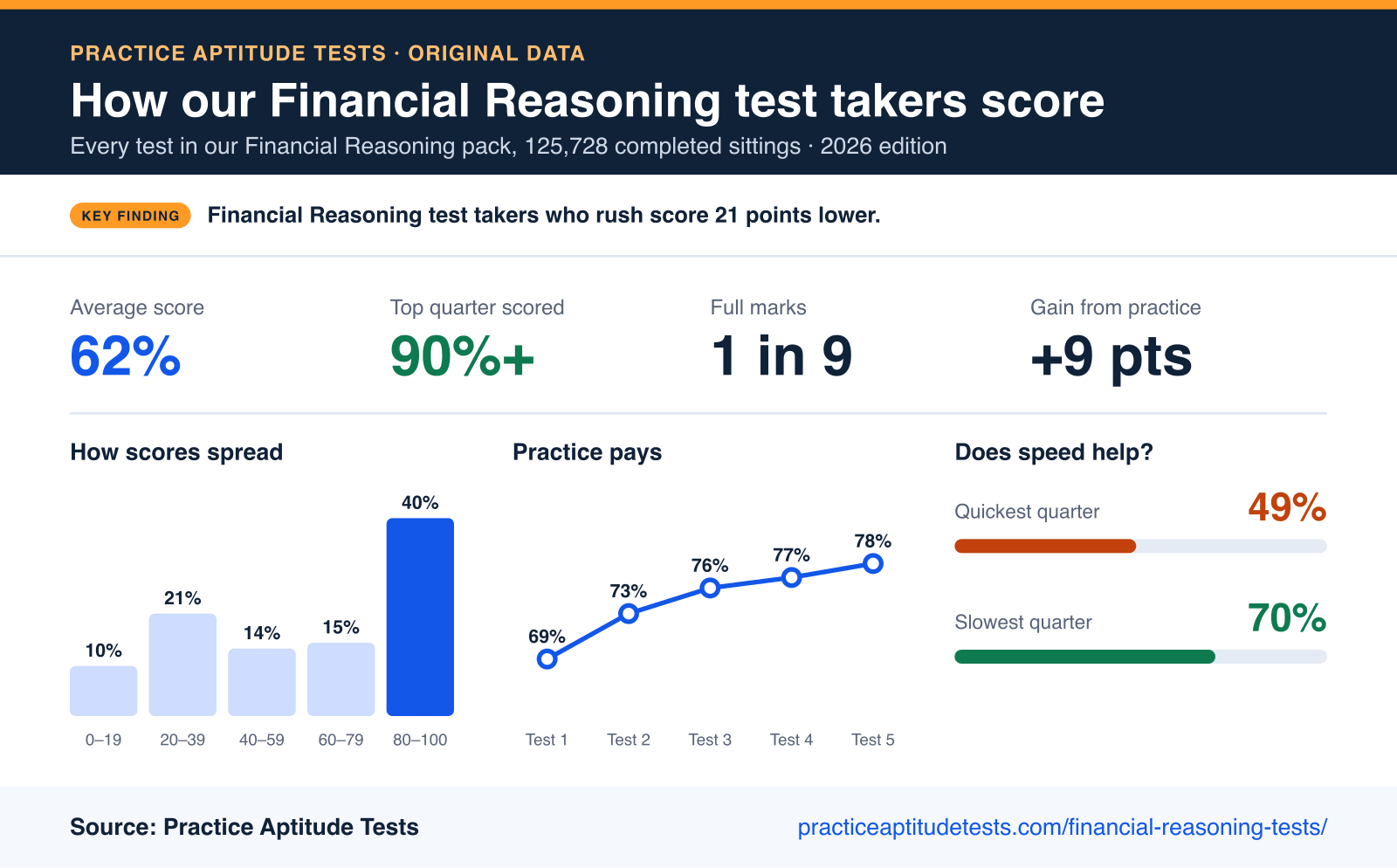
Practice Aptitude Tests · Original data
How our test takers score
Results from every test in our Financial Reasoning pack, past and present.
Key findingFinancial Reasoning test takers who rush score 21 points lower.
How scores spread
40% scored 80% or more, and 31% scored under 40%.
Share of sittings in each score band.
Practice pays
Regular practisers went from 69% on their first test to 78% on their fifth.
1,646 people who took five or more tests.
Does speed help?
Rushing costs marks. The quickest quarter scored 21 points lower than the slowest.
Typical pace: 45 seconds a question.
Share this data
Video tutorials
The methods behind the questions above, from our team