
Traffic Enforcement Agent Tests
The traffic enforcement agent exam tests deductive reasoning, information ordering, problem sensitivity, spatial orientation and written comprehension. Practise with a free situational judgement test set in enforcement work.
- 10 questions
- 13 minutes
- Worked solutions
Free · No sign-up · Scored the moment you finish
Traffic Enforcement Agent Situational Judgement Test
You have 13 minutes to answer 10 questions. Each question describes a workplace situation and four possible responses. For every question, select the response you believe would be MOST effective and the response you believe would be LEAST effective. There are no trick questions; judge each response on how well it would work in the situation described.
About this test: this is one of a set of practice tests covering the areas Traffic Enforcement Agent assessment processes typically include. It is written by us and is not any employer’s own assessment.
-
Question 1 of 10
You are an equipment store assistant at a traffic enforcement agency. Requests for items from the store are met in the order they arrive, and the waiting list is written up where the whole team can see it. This morning the person who runs your team asks you to move their own request to the front, because it is theirs. Three requests already ahead of it are for people who have said they need their items this week. Which response below would be most effective, and which would be least effective?
- Tell the person that the list runs in order, then offer to ask the three ahead of it whether any can wait, since only they can give up a place they hold.
- Move the request to the front of the waiting list as asked and agree with them to keep it between the two of you, so the people further down do not notice their wait has grown.
- Move the request up and tell the three people behind it that their items have slipped, leaving them to work out for themselves why the order changed.
- Refuse the request outright and say that nobody jumps the list, without checking whether the earlier three actually need their items this week or would happily be moved.
Show the answer
Most effective: A. Tell the person that the list runs in order, then offer to ask the three ahead of it whether any can wait, since only they can give up a place they hold.
Least effective: B. Move the request to the front of the waiting list as asked and agree with them to keep it between the two of you, so the people further down do not notice their wait has grown.
B: Agrees to a cover-up: three people who said they need their items this week are pushed back for a reason nobody may see, and the visible list is what told them their turn was coming.
C: Acts first and explains halfway: the three are told the cost without being told the reason, so they cannot say whether they could have absorbed it.
D: Applies the rule without testing it: the three may not all need their items now, and a minute spent asking them would have settled it without anybody overriding anything.
The most effective response is to tell the person that the list runs in order and that moving their request would push three earlier ones back, then offer to ask those three whether any can wait: it holds the rule and still looks for the outcome they want, and the only people who can give up their place are the ones who hold it. It is stronger than moving the request and telling the three afterwards that their items have slipped, because being informed of a decision is not the same as being asked, and they said this week for a reason nobody has heard. It is stronger than refusing outright, because that decides on behalf of three people who were never asked and may not mind. The least effective response is to move the request to the front and agree to keep it between the two of you: explaining afterwards at least lets the three know where they stand, and refusing at least keeps the written order true, whereas a quiet move makes the visible list wrong and buys the silence of the one person who benefits. The principle: who asked is never the reason, and a queue people can see is a promise you do not get to break privately.
-
Question 2 of 10
You are a course administration assistant at a traffic enforcement agency. You keep the sign in sheet for a five day course. At the end of day three the sheet shows 28 people signed in, but the course leader’s list has 30 names and your own room log has 30 people present. The stated rule is that the certificate list is built from the sign in sheet, and it is confirmed on Friday. Nobody else has noticed the gap. Which response below would be most effective, and which would be least effective?
- Add the two missing names to the sheet yourself and mark day three as checked, since you saw both of them in the room and two either way makes no practical difference.
- Raise it with the course leader on Friday when the certificate list is confirmed, since the sheet may well be corrected by then and two names is not much to chase in the meantime.
- Write a note beside the sheet saying the count did not agree on day three, and leave it for whoever confirms the certificate list on Friday to look into.
- Compare the room log and the leader's list against the sheet today, then tell the course leader which two names are missing and how the gap arose, so the sheet is right before Friday.
Show the answer
Most effective: D. Compare the room log and the leader's list against the sheet today, then tell the course leader which two names are missing and how the gap arose, so the sheet is right before Friday.
Least effective: A. Add the two missing names to the sheet yourself and mark day three as checked, since you saw both of them in the room and two either way makes no practical difference.
A: Writes into a record something you did not witness being signed: the sheet is the source the certificate list is built from, so an entry you made up is now the evidence that two people attended.
B: Delays the check to the deadline itself: Friday is when the list is confirmed, so a discrepancy raised that morning has to be resolved under time pressure or waved through.
C: Flags a problem without owning it: you are the person who holds the room log, so the one piece of evidence that would settle the gap sits with you and not with the reader of the note.
The most effective response is comparing the room log and the leader’s list against the sheet today and telling the course leader which two names are missing and how the gap arose. Nobody has assigned this to you, you hold the evidence that explains it, and Friday is a fixed point after which the certificate list is built from whatever the sheet says. It beats raising it with the course leader on Friday itself, because a gap found on the day of confirmation gets resolved in a hurry or not at all. It beats writing a note beside the sheet for whoever confirms the list, because the room log that would settle the question is yours and the reader of the note does not have it. The least effective response is adding the two missing names yourself and marking day three as checked: that puts into the source record an entry nobody signed, so a certificate list built from it now rests on your recollection presented as somebody’s signature. It is worse than the Friday conversation and worse than the note because both of those leave the record honest and merely late, while this leaves it wrong and looking right. The principle: when a total you own does not reconcile, find out why while there is still time, and never close the gap by writing the answer in.
-
Question 3 of 10
You are an enquiry desk assistant at a traffic enforcement agency. The written desk rule is that a caller is read something from their own record only after giving two pieces of information that match it. For the last month everybody on the desk has been accepting one, because the queue is long and the second question adds time to every call. Nobody has raised it. Your supervisor is working on the desk all this week. Which response below would be most effective, and which would be least effective?
- Go back to asking for both pieces on your own calls, and say nothing to anybody about what the rest of the desk is doing, so that at least your calls follow the rule.
- Send a note to the person who wrote the desk rule asking for it to be rewritten around the queue, and keep taking one piece until a new rule comes back.
- Carry on taking one piece of information like everybody else, reading callers what is on their record after a single answer, and say nothing to your supervisor this week.
- Ask your supervisor on the desk this week whether the second question stands, and say plainly that the desk has taken one piece for a month, since one answer covers everybody.
Show the answer
Most effective: D. Ask your supervisor on the desk this week whether the second question stands, and say plainly that the desk has taken one piece for a month, since one answer covers everybody.
Least effective: C. Carry on taking one piece of information like everybody else, reading callers what is on their record after a single answer, and say nothing to your supervisor this week.
A: Fixes it for yourself only: your own calls were never the problem, and a month-old drift across the whole desk carries on beside you with nobody any the wiser.
B: Delays the decision: a rewrite takes weeks, and every caller in the meantime is read their own record on one piece of information while the request sits in somebody's tray.
C: Breaches a stated rule because everybody else does: the rule governs who gets told what is on their record, and a month of collective drift is the reason to raise it rather than the reason not to.
The most effective response is asking your supervisor this week whether the second question still stands, and saying plainly that the desk has been taking one piece for a month: the rule is written, the whole desk has drifted from it, and one decision covers everybody instead of leaving each person to choose. It beats going back to asking for both pieces on your own calls while saying nothing about the rest of the desk, because your own calls were never the problem and the drift carries on beside you. It beats sending a note asking for the rule to be rewritten around the queue, since that leaves a month of callers being read their records on one piece while a rewrite is considered. The least effective response is carrying on taking one piece like everybody else: it is a written rule about who is told what is on their record, and the fact that everybody has been ignoring it is what makes raising it necessary. The principle: a rule everybody is quietly ignoring is exactly the rule somebody has to name out loud.
-
Question 4 of 10
You are an engagement events assistant at a traffic enforcement agency. A community group running Thursday’s joint event needs the final numbers and the room layout from you by noon tomorrow, which you agreed with its organiser a fortnight ago. Yesterday you were also given the write-up of feedback forms from last month’s events, wanted by the end of the week. It became clear this morning that you cannot finish both by noon tomorrow, and the organiser does not know that yet. Which response below would be most effective, and which would be least effective?
- Give the morning to the feedback write-up and the afternoon to the numbers and layout, then see tomorrow which of the two is nearer to being finished.
- Assume the community group will be relaxed about noon, say nothing to its organiser, and spend today and tomorrow morning on the feedback write-up, leaving the numbers and layout unfinished.
- Finish the numbers and the room layout for noon tomorrow, and tell the person who asked for the feedback write-up this morning that it will now come at the end of next week.
- Do the feedback write-up first because it was the most recent thing you were asked to do, and start the numbers and layout with whatever time is left tomorrow.
Show the answer
Most effective: C. Finish the numbers and the room layout for noon tomorrow, and tell the person who asked for the feedback write-up this morning that it will now come at the end of next week.
Least effective: B. Assume the community group will be relaxed about noon, say nothing to its organiser, and spend today and tomorrow morning on the feedback write-up, leaving the numbers and layout unfinished.
A: Splits effort so nothing finishes: noon tomorrow is fixed and the feedback is not due until the end of the week, so dividing today between them risks missing the only date somebody outside is waiting on.
B: Assumes goodwill instead of checking it: nobody has asked the organiser anything, she is expecting the layout at noon for an event two days later, and she finds out only when it fails to arrive.
D: Ranks the work by who asked most recently: recency is not a reason, the feedback has four more days and the layout has until noon, so the two dates are never actually compared.
The most effective response is finishing the numbers and the room layout for noon tomorrow and telling the person who asked for the feedback write-up that it will now come at the end of next week. One date is tomorrow with an outside group behind it and the other has the rest of the week, so the order is settled by the dates, and the person whose work slips hears it while they can still do something. It beats giving the morning to the feedback and the afternoon to the numbers, because the fixed noon deadline should not be spending half of today competing with work that is not due yet. It is also better than doing the feedback first because it was asked most recently, which orders the day by nothing at all. The least effective response is assuming the community group will be relaxed about noon: unlike alternating, which at least advances both, and unlike the recency order, which at least decides something, this rests the whole plan on goodwill nobody has tested, and the organiser learns of the slip only when noon passes. The principle: order work by the dates people are relying on, and tell whoever loses out while they still have room to move.
-
Question 5 of 10
You are a property store assistant at a traffic enforcement agency. Twelve items signed out three months ago have not come back. The person who chairs the monthly estates meeting has asked you to sit in tomorrow and say which of the two teams involved is at fault, so that the meeting can close the matter. Your register shows the dates items went out and who signed for them, and nothing about what happened next. Both teams will be in the room. Which response below would be most effective, and which would be least effective?
- Ask to be left out of the meeting altogether, since choosing between two teams is not a store assistant's job, and send the register over for the chair to read on their own.
- Name the team you believe is at fault in front of both teams, and blame their habit of signing items out and forgetting them, reading out the dates their people signed for them.
- Say at the meeting what the register can and cannot show, offer to check the twelve entries against the sign-out dates, and ask the chair who decides, since fault is not yours to find.
- Go to the meeting and say that nothing can be concluded until every item in the store has been counted, then start a full count that will take several weeks.
Show the answer
Most effective: C. Say at the meeting what the register can and cannot show, offer to check the twelve entries against the sign-out dates, and ask the chair who decides, since fault is not yours to find.
Least effective: B. Name the team you believe is at fault in front of both teams, and blame their habit of signing items out and forgetting them, reading out the dates their people signed for them.
A: Withholds help that costs nothing: the one person who can explain what the register does not cover is absent while two teams argue over twelve entries in it.
B: Blames a team in front of the room: a gap in the register becomes a judgement about people, delivered publicly, on evidence your own records do not hold.
D: Turns a narrow question into a large project: twelve entries could be checked this week, and a whole-store count answers a question nobody in the meeting asked.
The most effective response is setting out at the meeting what the register can and cannot show, and asking the chair who is to decide once the twelve entries have been checked: the register holds dates and signatures and nothing about what happened afterwards, so no honest finding of fault can come out of it. It beats asking to be left out of the meeting altogether and sending the register over on its own, because the one person who can explain what the register does not cover is then absent while two teams argue. It beats saying that nothing can be concluded until every item in the store has been counted, since the twelve are a question that can be answered this week and a full count is not. The least effective response is naming the team you believe is at fault and blaming their habit of signing items out: it turns a gap in the record into a public judgement about people, made in front of both teams, on evidence you do not hold. The principle: under pressure to settle something, say what your information can carry rather than what the room wants to hear.
-
Question 6 of 10
You are a public liaison assistant at a traffic enforcement agency. Six weeks ago a community group sent in a written offer to host an open evening, and the standard reply says an acknowledgement will be sent within twenty working days. That date passed nine days ago. The group’s secretary rings you this morning, polite but clearly fed up, and says she has heard nothing at all. You can see the offer sitting unallocated in the shared inbox, and the person who decides on open evenings is back on Thursday. Which response below would be most effective, and which would be least effective?
- Apologise on the call and promise the secretary a decision by Friday, since the person who decides is back on Thursday and the offer will be at the top of their list.
- Apologise on the call, send the written acknowledgement today with the delay explained, and tell her the offer goes to the person deciding on Thursday and when to expect an answer.
- Explain that the offer is waiting for one person who is back on Thursday, and ask her to ring again after that if she has still not had anything in writing.
- Pass her enquiry on to the team that owns the shared inbox, tell her they will be in touch, and take the call as dealt with for your own part.
Show the answer
Most effective: B. Apologise on the call, send the written acknowledgement today with the delay explained, and tell her the offer goes to the person deciding on Thursday and when to expect an answer.
Least effective: D. Pass her enquiry on to the team that owns the shared inbox, tell her they will be in touch, and take the call as dealt with for your own part.
A: Over-promises: nothing you can see guarantees a decision by Friday, so a group that has already been let down once by a stated date is given a second one you do not control.
C: Puts the chasing back on the customer: she has already waited nine days past a date the organisation set, and the effort of following it up stays with the person who did nothing wrong.
D: Passes the problem on without owning it: the offer is already sitting unallocated, which is precisely why no acknowledgement was sent, so moving it back into the same inbox repeats the failure she rang about.
The most effective response is to apologise, send the written acknowledgement today with the delay explained, and tell her when to expect an answer: the missed date is put right immediately by the person she has actually reached, and she leaves the call with something in writing and a realistic next step. That is better than promising a decision by Friday, because nothing you can see makes Friday certain and a second broken date costs far more than the first. It is also better than explaining that the offer is waiting for somebody back on Thursday and asking her to ring again, since the chasing is handed back to the person who has already waited nine days past a date the organisation itself set. The least effective response is to pass her enquiry on to the team that owns the shared inbox and treat the call as dealt with: the offer is unallocated in that very inbox, which is why no acknowledgement went out, so the enquiry returns to the place that failed her and nobody has picked it up. The principle: when a service standard has already been missed, the person who takes the call owns putting it right.
-
Question 7 of 10
You are a contact handling assistant at a traffic enforcement agency. A colleague on your team has twice described calls the two of you took, including what the callers said and where they live, to friends in a pub where other people could hear. They say it is harmless because no names were used. The rule you both signed says nothing about a call leaves the team. Your supervisor asks the team every Friday whether anything needs raising. Which response below would be most effective, and which would be least effective?
- Tell the colleague directly that what they described could identify a caller, say that you will raise it on Friday if it happens again, and then do exactly that.
- Repeat it around the team and spread the story of the pub, so that everybody knows who talks about callers and the colleague hears about it from somebody other than you.
- Raise it with the whole team on Friday without speaking to the colleague first, and restate the rule about calls without mentioning the pub or naming anybody at all.
- Leave it alone and take your breaks away from the colleague, on the basis that what they do in a pub is between them and the rule they signed.
Show the answer
Most effective: A. Tell the colleague directly that what they described could identify a caller, say that you will raise it on Friday if it happens again, and then do exactly that.
Least effective: B. Repeat it around the team and spread the story of the pub, so that everybody knows who talks about callers and the colleague hears about it from somebody other than you.
B: Turns it into gossip about a person: the confidentiality problem is left exactly where it was, the colleague learns it secondhand, and nobody who could act has been told anything.
C: Chooses the group over the person: a general restatement lets the one person it is aimed at conclude it was aimed at somebody else, and the retelling carries on.
D: Avoids the difficult conversation: the calls being described are ones you took as well, the colleague thinks it is harmless, and nobody has told them otherwise.
The most effective response is telling the colleague directly that what they described could identify a caller, and saying you will raise it on Friday if it happens again: they believe it is harmless, nobody has told them otherwise, and the rule they signed is what settles it. It beats raising it with the whole team on Friday without speaking to the colleague first, because a general restatement lets the person it is about decide it was meant for somebody else. It beats leaving it alone and taking your breaks elsewhere, since the calls being described are ones the two of you took and the next retelling is days away. The least effective response is repeating it around the team and spreading the story of the pub: it makes a confidentiality problem into entertainment about a colleague, and still nobody who could act on the rule has heard a word. The principle: deal with a colleague’s conduct with the colleague, and take it to the person who can act if it does not stop.
-
Question 8 of 10
You are a trainee at a traffic enforcement agency. Each morning the group is supposed to check its own equipment against the issue list and initial the sheet, which takes twenty minutes. For the past fortnight one of the group has initialled the sheet for everybody at once, before anyone has checked anything, and nobody has said a word, because it buys the group twenty minutes. The stated rule is that you initial only for equipment you have checked yourself. Which response below would be most effective, and which would be least effective?
- Agree with the person doing it to keep it between the group until somebody senior asks, since a fortnight has passed without trouble and raising it now would land everybody in it.
- Tell the person that from tomorrow you will initial only for equipment you have checked yourself, and raise the fortnight of unchecked sheets with the person running the course, since people rely on that equipment.
- Check your own equipment against the issue list each morning and initial only your own line on the sheet, and say nothing to anybody about the fortnight of sheets that were initialled before anybody had checked anything.
- Raise it with the person running the course as something the whole group has been doing for a fortnight, without saying anything first to the person who has been initialling the sheet for everybody before anybody has checked.
Show the answer
Most effective: B. Tell the person that from tomorrow you will initial only for equipment you have checked yourself, and raise the fortnight of unchecked sheets with the person running the course, since people rely on that equipment.
Least effective: A. Agree with the person doing it to keep it between the group until somebody senior asks, since a fortnight has passed without trouble and raising it now would land everybody in it.
A: Joins an agreement to keep it quiet: a fortnight of sheets says the equipment was checked when it was not, and you are now one of the people keeping that from anybody who relies on it.
C: Fixes your own conduct and leaves the sheet wrong: the fortnight of entries still says the equipment was checked, and the group carries on exactly as it was.
D: Escalates without speaking to the person first: they have been doing it openly for a fortnight in the belief that nobody minds, and the first they hear of the objection is from above.
The most effective response is telling the person that from tomorrow you will initial only for equipment you have checked yourself and raising it with the person running the course. The stated rule is that an initial means you checked it, a fortnight of sheets now says something untrue about the equipment, and both halves are needed: your own conduct from tomorrow, and somebody able to put the sheets right. It beats checking your own equipment and initialling only your own line while saying nothing about the fortnight, because the sheets already signed still assert checks that never happened. It beats raising it with the person running the course without speaking to the person doing it, because they have been doing it openly and deserve to hear the objection from you first. The least effective response is agreeing to keep it between the group until somebody senior asks: it makes you part of an arrangement to hold back something the people relying on that equipment need to know, and unlike the other two it makes the concealment deliberate and shared. It is worse than fixing only your own line, which at least stops adding to it, and worse than going over the person’s head, which at least gets it looked at. The principle: a shortcut that saves everybody time is still a false record, and an agreement to say nothing about it makes it yours as well.
-
Question 9 of 10
You are an equipment store assistant at a traffic enforcement agency. The yearly count of the store has to be finished by Friday, because the figure it produces is what the people who order replacements work from for the next twelve months. It was given three weeks ago to a colleague who has since moved to another team. This morning you find that nothing has been counted at all, and nobody else has noticed. Your supervisor is in meetings all day but answers messages. Which response below would be most effective, and which would be least effective?
- Start counting the store yourself today, working through the shelves in the order they are numbered, and keep going until Wednesday, then decide whether to raise it once you can see how much you have managed.
- Message your supervisor this morning that the count has not been started and that Friday is at risk, saying what you can cover today, so they can put people on it.
- Reassure the people who order replacements that the count is in hand and will reach them on Friday, then work out afterwards whether three days is enough.
- Ask the colleague who moved teams to come back for the rest of the week and finish the count, since it was handed to them three weeks ago and they know what was intended.
Show the answer
Most effective: B. Message your supervisor this morning that the count has not been started and that Friday is at risk, saying what you can cover today, so they can put people on it.
Least effective: C. Reassure the people who order replacements that the count is in hand and will reach them on Friday, then work out afterwards whether three days is enough.
A: Absorbs it quietly while the days run out: the hours in which somebody could have been put alongside you are the hours you spend counting on your own.
C: Gives an assurance nobody has checked: the people who depend on the figure stop watching for the one thing that may not arrive, and they stop watching on your word.
D: Chases somebody who no longer owns the work: they have another team's work in front of them, nothing obliges them to drop it, and Friday arrives whatever they answer.
The most effective response is to message your supervisor this morning that the count has not been started and that Friday is at risk. You are the only person who knows, Friday feeds a figure the people who order replacements use for a year, and your supervisor can put others alongside you while three days are left. Starting the count alone and deciding on Wednesday whether to raise it is weaker, because the days in which help could have been arranged are the days you spend counting. Asking the colleague who moved teams to come back and finish it is weaker too, because the work is no longer theirs and nothing obliges them to drop what they now do. The least effective response is to reassure the people who order replacements that the count is in hand and will reach them on Friday: it asserts as settled something nobody has checked, and the people the figure is for stop watching the one thing that may not come. Being the only person who knows is the reason to escalate, not a reason to try to absorb it.
-
Question 10 of 10
You are a course administration assistant at a traffic enforcement agency, and you send out joining instructions for training courses. A person booked onto next month’s course was told in writing that they would have their joining instructions by the 12th. It is now the 19th, they have rung twice, and they have travel to book. The person who prepares joining instructions is away until Thursday and nobody else can produce them. You do not know why the 12th was missed. Which response below would be most effective, and which would be least effective?
- Ring the person today, tell them the joining instructions are not ready, explain that the person who prepares them is back on Thursday, and promise a date by Friday, since they must book travel.
- Reply by email that their query has been logged and that somebody will be in touch about it, giving no date, so that you are not committing anybody else to a promise you cannot keep.
- Assure the person that their joining instructions were sent out last week and will reach them shortly, which buys quiet until Thursday and saves them a third phone call.
- Wait until Thursday and put it to the person who prepares joining instructions the moment they are back, so that the caller hears the real date from the person who actually owns the work.
Show the answer
Most effective: A. Ring the person today, tell them the joining instructions are not ready, explain that the person who prepares them is back on Thursday, and promise a date by Friday, since they must book travel.
Least effective: C. Assure the person that their joining instructions were sent out last week and will reach them shortly, which buys quiet until Thursday and saves them a third phone call.
B: Answers without the one fact they need: the person has travel to book and has already waited a week past the 12th, so a reply carrying no date leaves them exactly where the missed date left them.
C: Gives an assurance you have not checked: nothing tells you the instructions were ever sent, and the person may book travel around a course date that nobody has confirmed to them.
D: Delays the reply for a tidier answer: the caller has waited a week past the date they were given and has travel to book, and two more silent days is what the tidier answer costs them.
The most effective response is ringing the person today to say the joining instructions are not ready, that the person who prepares them is back on Thursday, and that you will call again by Friday with a date. That is better than replying by email that their query has been logged with no date attached, because the caller can do nothing with an acknowledgement and still cannot decide whether to book travel. It is also better than waiting until Thursday to put it to the person who prepares them, since the caller spends two more days with no word at all. The least effective response is assuring the person that their joining instructions were sent out last week: you have not checked that, the assurance stops them chasing, and they may spend money on travel for a date nobody has confirmed. Waiting at least leaves the caller free to keep asking, and a dateless email at least tells them nothing untrue. The principle: when you cannot give somebody the answer they were promised, give them the truth and the next date, never a comfortable version of the truth.
What are Traffic Enforcement tests?
Traffic enforcement agents in New York City are recruited through a civil service exam run by the Department of Citywide Administrative Services. The multiple-choice test is taken at a computer, and you need at least 70% to pass. It may test deductive reasoning, information ordering, problem sensitivity, spatial orientation, and written comprehension and expression. Your score sets your place on the eligible list.
The tests you are likely to sit
Every applicant takes these. Your invitation will tell you when each one is due.
| Assessment | What it measures |
|---|---|
| Deductive reasoning questions | Applying general rules to specific situations |
| Information ordering questions | Putting steps or rules in the correct order |
| Problem sensitivity questions | Spotting when something is wrong or likely to go wrong |
| Spatial orientation questions | Working out directions and positions on maps |
| Written comprehension and expression | Understanding written text and writing clearly |
Practise the real thing
Practice moves scores fastest on the tests set under time pressure, and every question in the pack comes with the working shown.
- 10
- practice tests
- 100
- questions, all solved
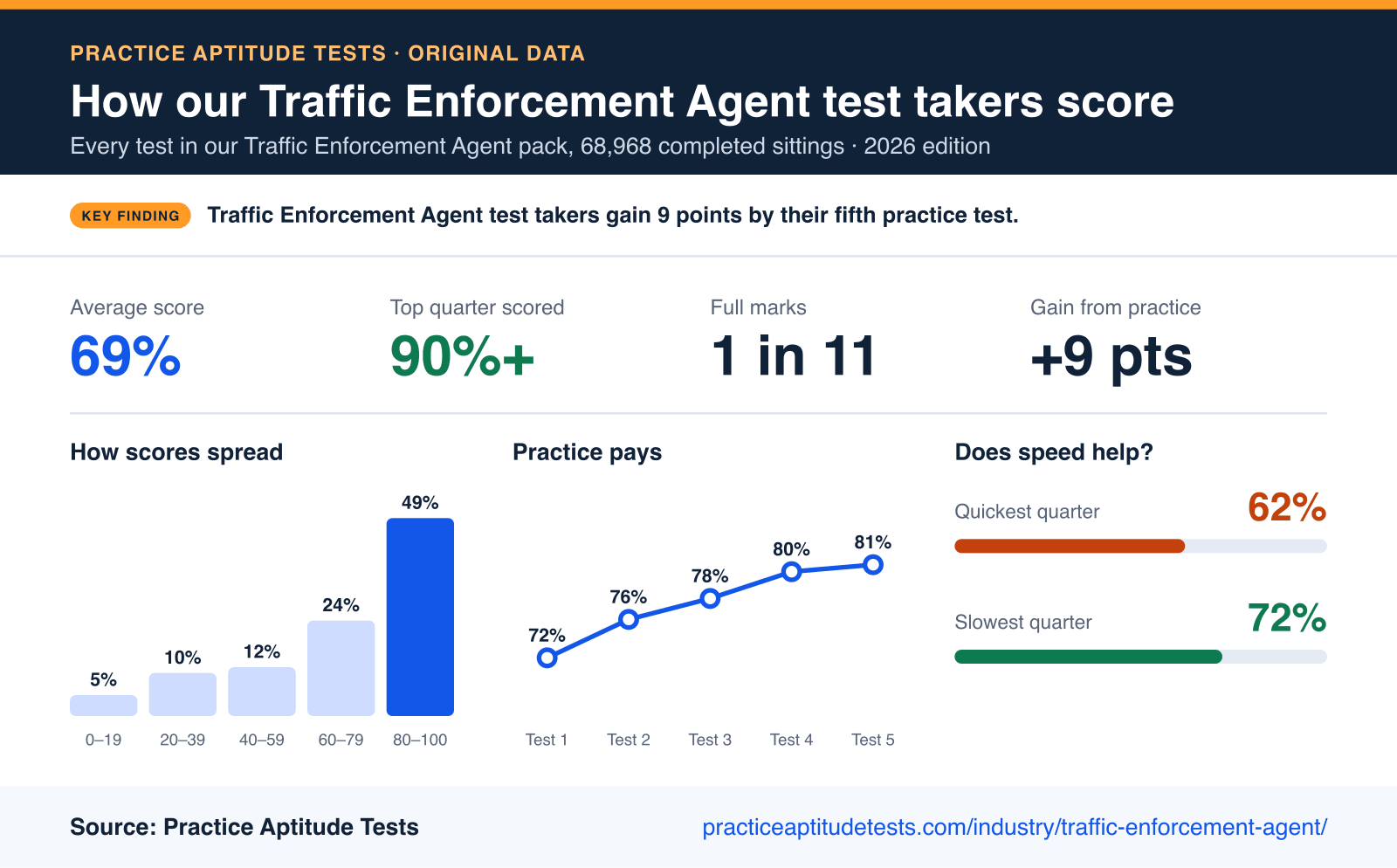
Practice Aptitude Tests · Original data
How our test takers score
Results from every test in our Traffic Enforcement Agent pack, past and present.
Key findingTraffic Enforcement Agent test takers gain 9 points by their fifth practice test.
How scores spread
49% scored 80% or more, and 16% scored under 40%.
Share of sittings in each score band.
Practice pays
Regular practisers went from 72% on their first test to 81% on their fifth.
1,293 people who took five or more tests.
Does speed help?
Rushing costs marks. The quickest quarter scored 10 points lower than the slowest.
Typical pace: 49 seconds a question.
Share this data
Our practice tests mirror the formats used in Traffic Enforcement hiring. They are written by Practice Aptitude Tests and are not affiliated with or endorsed by any individual employer.