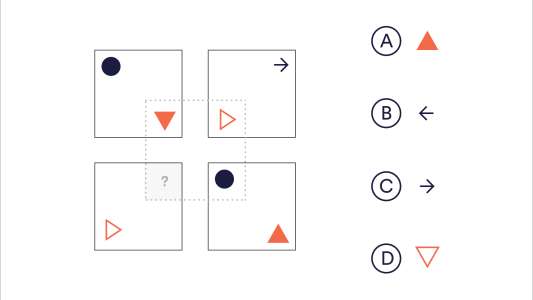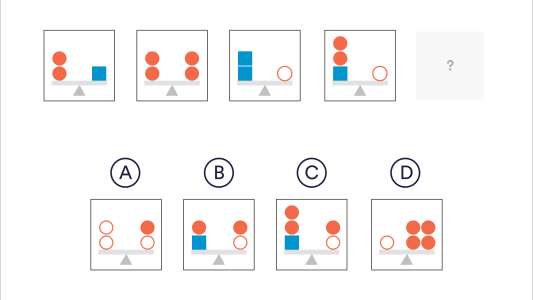

If you’ve just been invited to take a diagrammatic reasoning test, it can feel difficult to interpret straight away. The diagrams look unfamiliar, the rules aren’t explained, and with time pressure added, it’s not always clear where to start.
Diagrammatic reasoning is a type of non-verbal test that uses diagrams and visual rules to assess how well you identify patterns and apply logic. Employers use it to measure how quickly you can process unfamiliar information and solve problems under pressure.
In this guide, you’ll learn what diagrammatic reasoning involves, the main question types you’ll face, and how to approach them with a structured method. You’ll also see how to prepare effectively so you can improve quickly. To get started, explore our diagrammatic reasoning tests to practise with realistic questions under timed conditions.
What Is Diagrammatic Reasoning?
Diagrammatic reasoning is a type of aptitude test that uses diagrams, symbols, and visual processes to assess how you identify and apply logical rules. Instead of relying on written or numerical data, these tests present problems visually and require you to work out how elements change.
The core task is always to identify a rule and apply it correctly. This could mean spotting how a shape rotates across a sequence or understanding how an input is transformed through a series of steps.
Diagrammatic reasoning questions usually fall into two formats. Some are sequence-based, where you predict what comes next. Others involve processes or transformations, often referred to as operators, where you follow a rule to determine an output or missing input.
These tests assess:
- Logical reasoning
- Pattern recognition
- The ability to work with unfamiliar information
No prior knowledge is required. Success depends on recognising consistent visual rules and applying them accurately under time pressure. This is why diagrammatic reasoning is commonly used in graduate, technical, and analytical recruitment.
How Is Diagrammatic Reasoning Different from Abstract Reasoning?
Diagrammatic and abstract reasoning are often confused because both involve solving visual problems. However, they require slightly different approaches.
Abstract reasoning focuses on identifying patterns across a sequence of shapes. You are typically asked to select the next diagram based on consistent changes.
Diagrammatic reasoning builds on this by introducing processes. Instead of only spotting a pattern, you may need to follow a sequence of transformations that convert one diagram into another.
Key differences: Abstract reasoning
- Focus: Pattern recognition using shapes
- Format: Identify the next shape in a sequence
- Typical providers: SHL, Talent Q
Diagrammatic reasoning
- Focus: Rule-based transformations and processes
- Format: Identify outputs or inputs using operators
- Typical providers: Saville, Cappfinity
In practice, candidates often struggle when they treat diagrammatic questions like simple sequences. Process-based questions require you to apply rules step by step, not just recognise a pattern.
To understand how these differ in real assessments, you can practise both abstract reasoning tests and diagrammatic reasoning tests.
Types of Diagrammatic Reasoning Questions
Diagrammatic reasoning tests follow a small number of consistent formats. Recognising the type of question early helps you apply the right approach before you start analysing the details.
Format 1: Sequence completion
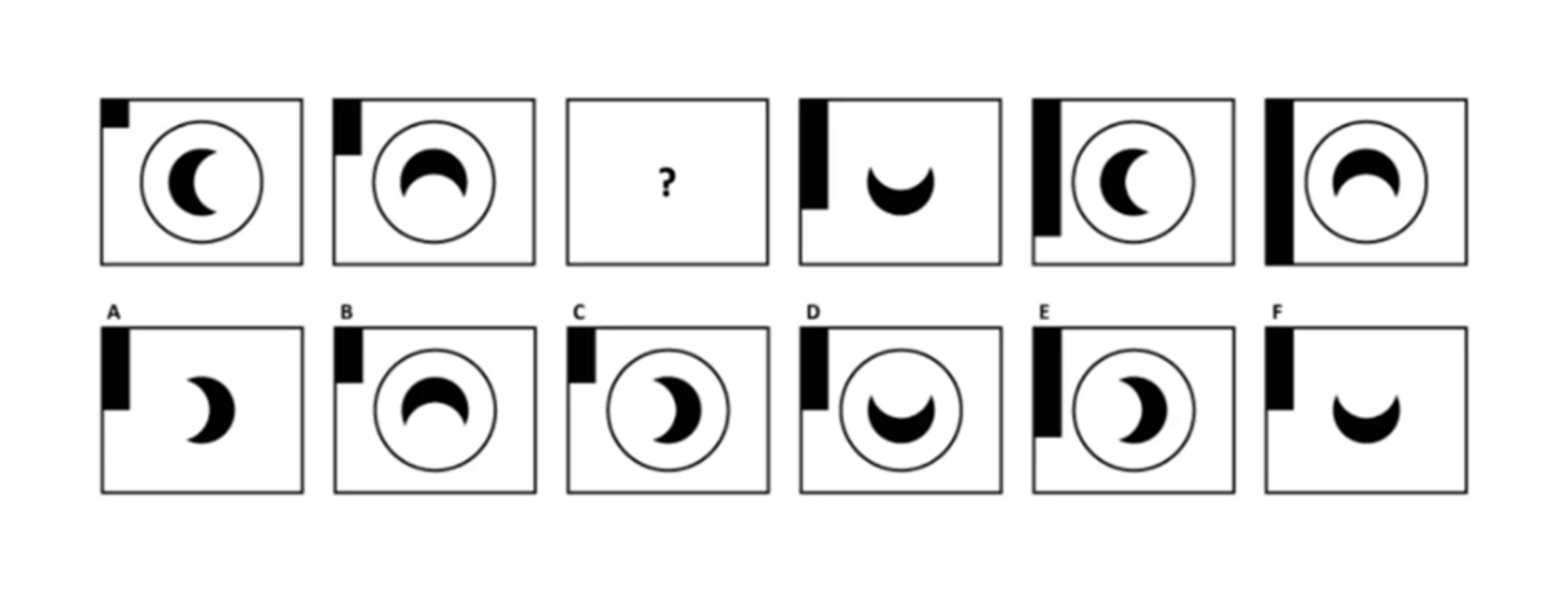
In sequence questions, you are shown a series of diagrams that follow a rule. Your task is to identify that rule and select the next diagram.
Common rules include rotation, reflection, size change, shading patterns, or changes in the number of elements.
Worked example:
A square rotates 90 degrees clockwise in each step, while the shading alternates between filled and empty. The correct answer must follow both rules.
A common mistake is choosing an option that fits one rule but ignores the other. Strong candidates test each rule across the full sequence before deciding.
To build confidence with this format, practise diagrammatic reasoning sequence questions.
Format 2: Process/flowchart diagrams (operator questions)
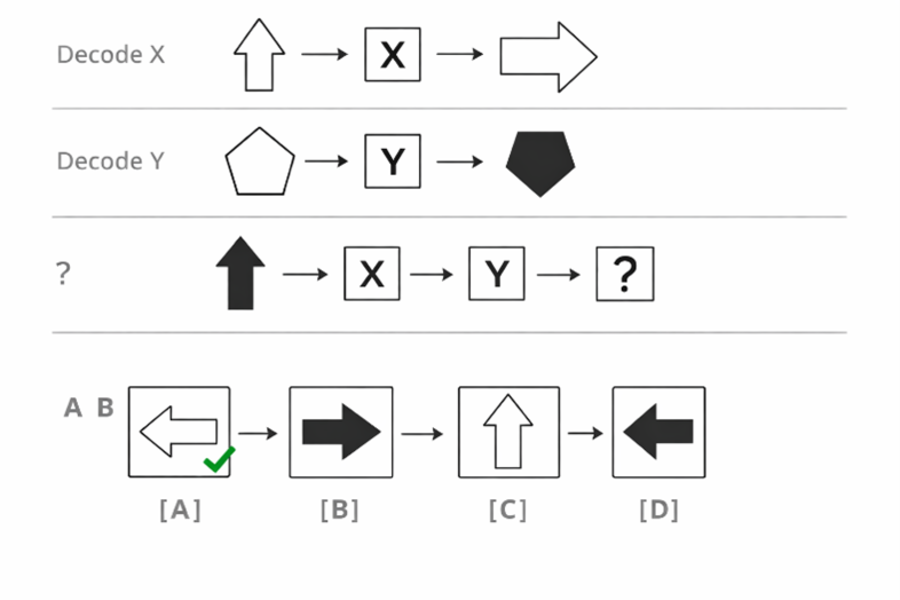
In this format, a diagram passes through one or more stages, often called operators. Each operator applies a rule that transforms the input into an output.
You may be asked to identify the final output, the missing step, or the original input. Worked example:
An input shape passes through two operators. The first rotates the shape 90 degrees. The second inverts its colour. If the input is a black triangle pointing up, the output must be a white triangle pointing right.
A common trap is losing track of the order of operations. Applying the correct rule in the wrong sequence will produce an incorrect answer.
These questions reward a structured approach. Label each operator clearly before applying it.
You can practise this type using mirror image questions and similar shape transformations.
Format 3: Logical condition grids
Logical grid questions present a set of shapes alongside multiple conditions. Your task is to find the option that satisfies every rule.
Worked example:
A grid requires that each shape appears once per row, no two shaded shapes are adjacent, and a circle must appear in the top row. Any option that breaks even one of these rules is incorrect.
The key is to treat each condition independently. Eliminate options as soon as they violate a rule, rather than trying to solve everything at once.
These questions are common in more advanced assessments and reward careful elimination rather than speed alone. You can develop this skill with unfolded shape practice.
How to Solve Diagrammatic Reasoning Questions: Step-by-Step
Improvement comes from applying a consistent method under time pressure.
Step 1: Identify the format
Decide whether the question is a sequence, process, or grid. This determines your approach.
Step 2: Isolate one element at a time
Track a single feature such as shape, colour, or position. Avoid trying to analyse everything at once.
Step 3: Name the operators
In process questions, label each transformation clearly. This reduces confusion when multiple steps are involved.
Step 4: Watch for distractors
Some elements are included to draw attention away from the real rule. Focus only on consistent changes.
Step 5: Eliminate wrong answers first
At least one option will clearly break a rule. Removing it quickly improves accuracy and saves time.
Step 6: Work backwards if needed
If you are unsure, test answer options against the final step. This can confirm which option fits the rule.
This structured approach improves both speed and accuracy in real tests. For a deeper breakdown, read our guide on how to answer diagrammatic reasoning tests.
How to Improve Your Diagrammatic Reasoning Score
Diagrammatic reasoning may look unfamiliar at first, but it follows consistent and learnable rules. Once you understand how patterns and operators work, the questions become far more structured.
The key is recognising that every diagram is governed by a rule. If you can identify and apply that rule consistently, you can solve even complex questions under time pressure.
The most effective next step is to practise with realistic questions and review your mistakes carefully. Start with our diagrammatic reasoning tests to apply what you’ve learned and build confidence quickly.
FAQs
What skills does diagrammatic reasoning test?
Diagrammatic reasoning tests logical thinking, pattern recognition, and the ability to apply rules to unfamiliar visual information under time pressure.
What types of questions appear in diagrammatic reasoning tests?
Common formats include sequence completion, operator-based process questions, and logical condition grids.
What is a diagrammatic reasoning operator?
An operator is a transformation rule applied to a diagram, such as rotation, reflection, or colour change. Multiple operators may be applied in sequence.
Is diagrammatic reasoning a type of non-verbal reasoning?
Yes. Diagrammatic reasoning is a form of non-verbal reasoning because it uses visual information rather than written or numerical data to assess logical problem-solving ability.