

An unfolded shapes question shows you a three dimensional object and asks which flat drawing matches it, or gives you the flat drawing and asks which solid it folds into. The flat version is usually one of two things: the net, meaning every face opened out onto a single surface, or the plan view, meaning the object as you would see it looking straight down from above.
Both forms test the same skill, which is holding an object in your head and folding or unfolding it without losing track of which face goes where. Nothing is measured but that, so the questions are solvable by method rather than by talent, and the method is quick to learn.
The two forms these questions take
Nets. A net is the shape cut along its edges and laid flat. A cube net is six squares joined edge to edge, and you are typically asked which of four nets folds into the cube shown, or which face ends up opposite a marked face. These appear in diagrammatic reasoning tests and, more often, in spatial reasoning tests.
Plan views. Here you look down on a solid and pick the outline you would see from directly above. Height disappears, so a tall block and a short block of the same footprint look identical from above.
Plan view questions: looking down on a solid
Imagine standing directly above a shape resting on the floor. From that perspective you would see shape C, which is the correct answer.
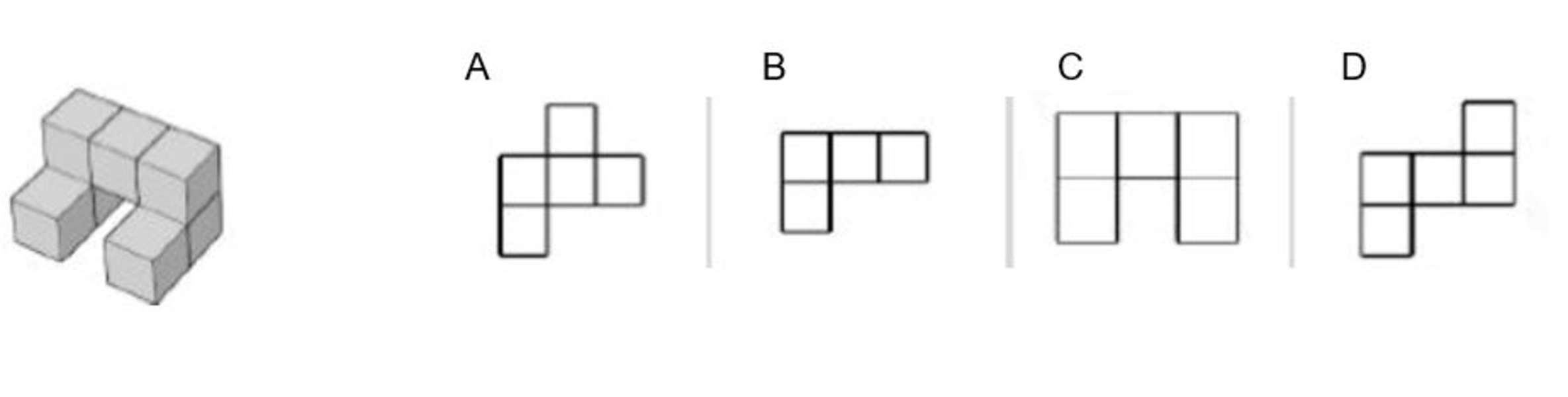
The trick is to count the sides first, work out what each one looks like flat, and then how they all fit together. That is what tells you how the shape reads from above.
Some people find this far easier than others, but it responds to practice more than almost any other question type.
Example question
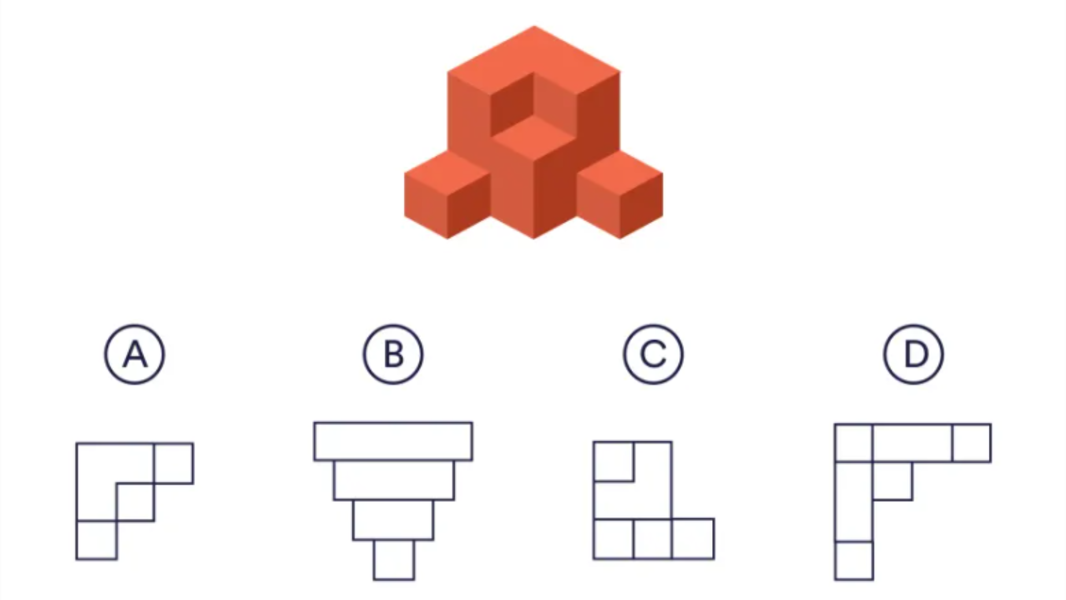
What would this shape look like in its plan view?
Solution
When you look from above, height does not matter, so the simplest thing to do is work out the outline of the shape. Once you have that, you can see it must be A, which is a triangle with a kind of jagged edge.
Correct Answer: A
How to fold a net in your head
Use the same routine every time, because the questions are quick and improvising is what causes mistakes.
- Count the faces. A cube net has exactly six squares. An option with five or seven is wrong before you fold anything.
- Pick a base and keep it still. Choose one face, treat it as the bottom, and fold everything else up around it rather than trying to move the whole net at once.
- Fold the neighbours first. Any square joined to your base becomes a side wall. Squares joined to those become the far wall or the lid.
- Use the opposite face rule. In a straight line of squares, two faces with exactly one square between them end up opposite each other. Two squares that touch on the net are always adjacent on the solid, never opposite.
- Anchor any pattern to an edge. If a face carries an arrow, a dot or a shaded corner, note which edge it points to. That edge is what fixes the orientation once the face is folded.
- Eliminate rather than construct. You rarely need to build the whole solid. One impossible face pairing rules an option out.
Worked examples: which face ends up opposite
Example 1. Picture four squares in a row, labelled A, B, C and D from left to right. A fifth square, E, is joined above B, and a sixth square, F, is joined below B. Fold it into a cube. Which face is opposite A?
Take the row first. In a straight strip of four squares, the first and third are opposite each other, and the second and fourth are opposite each other. So A is opposite C, and B is opposite D. That leaves E and F, the two squares attached above and below the same square, which must be the third pair. The answer is C.
It follows that E touches A, B, C and D on the finished cube, because every face is adjacent to all the others except its own opposite. That is a useful check: if an option shows two faces meeting at an edge that your folding says are opposite, the option is wrong.
Example 2. Now picture three squares in a row, P, Q and R from left to right. A square S sits above Q. Below Q there are two more squares, T directly under Q and U directly under T. Which face is opposite S?
Read the vertical strip S, Q, T, U as a line of four: S is opposite T, and Q is opposite U. P and R hang off either side of Q, one square apart, so they are the last pair. The answer is T. Note that the six faces account for exactly three pairs, which is the check that you have not double counted.
Example 3. A net is made of one square with four identical triangles, one joined to each side of the square. Which solid does it fold into?
Count and classify before folding. Six squares would be a cube, and three rectangles with two triangles would be a triangular prism. One square with four triangles folds up to meet at a single point above the square, so it is a square based pyramid. A rectangle with two circles is a cylinder, and a circle with a sector of a larger circle is a cone. Recognising the family from the face count alone answers a surprising number of these questions on its own.
Common traps
- Treating touching faces as opposite. Two squares joined on the net share an edge on the solid, so they can never be the opposite pair. This is the single most common mistake.
- Ignoring orientation. Two options can show the same faces in the same places with a symbol rotated by a quarter turn. Only one of them is achievable by folding.
- Mirror images. A reflection of the correct answer looks right at a glance and cannot be reached by folding. Check a distinctive corner rather than the whole face.
- Adding what height hides. On a plan view question, only what is visible from directly above counts. Detail on a vertical face does not appear.
- Trusting the first plausible option. Test all three pairs, or check one more feature, before committing. These questions are usually short on time but the answer options are built for people who stop early.
Practice unfolded shape questions
Folding accuracy improves quickly with repetition, and it transfers: the same mental move appears in rotation, cube view and mirror image questions. Work through diagrammatic reasoning tests for the sequencing and plan view formats, spatial reasoning tests for folding and rotation, and non-verbal reasoning tests for mixed shape questions under time pressure.
To grasp the other diagrammatic reasoning question types, read our Handbook for Diagrammatic Reasoning.