

A similar shapes question gives you one or more sample shapes and a set of answer options, then asks which option belongs with the samples. What you are looking for is the single property the samples share that only one option also has. Everything else in the picture is there to distract you.
The work is elimination rather than recognition. List what the samples have in common, throw out every property that all of the options share, because a property everyone has cannot pick a winner, and see what is left.
What “similar” means in these questions
In diagrammatic reasoning tests, similar usually means “shares a defining property”. Two shapes can look nothing alike and still count as similar in the sense the question intends, if they both have four sides, or both have a line of symmetry, or both are shaded the same way.
Some tests use the stricter mathematical sense instead, and the difference is worth knowing:
- Similar, in geometry, means one shape is a scaled copy of the other. Corresponding angles are equal and corresponding sides are in the same proportion. Size can differ, and the shape may also be rotated or reflected. All circles are similar to each other, all squares are similar to each other, and all equilateral triangles are similar to each other.
- Congruent is stricter: same shape and same size, so the scale factor is one. Every congruent pair is also similar, but most similar pairs are not congruent.
A quick test for triangles: if two angles in one match two angles in the other, the triangles are similar, because the third angle follows. A quick counterexample for shapes in general: a square and a rectangle have all the same angles, but their sides are not in the same proportion, so they are not similar.
The properties worth checking
Run down a fixed list rather than staring at the picture. In practice the answer nearly always turns on one of these:
- Number of sides, and whether they are straight or curved
- Number of corners, and whether any angle is a right angle
- Symmetry, and how many lines of it
- Shading or fill, including which part of the shape is shaded
- Number of internal elements such as dots, lines or smaller shapes
- Position of an internal element relative to the shape
- Size relative to the other shapes
- Whether the shape is open or closed
Worked example
Look at the two sample shapes below. What do they have in common, and which of the options shares it?
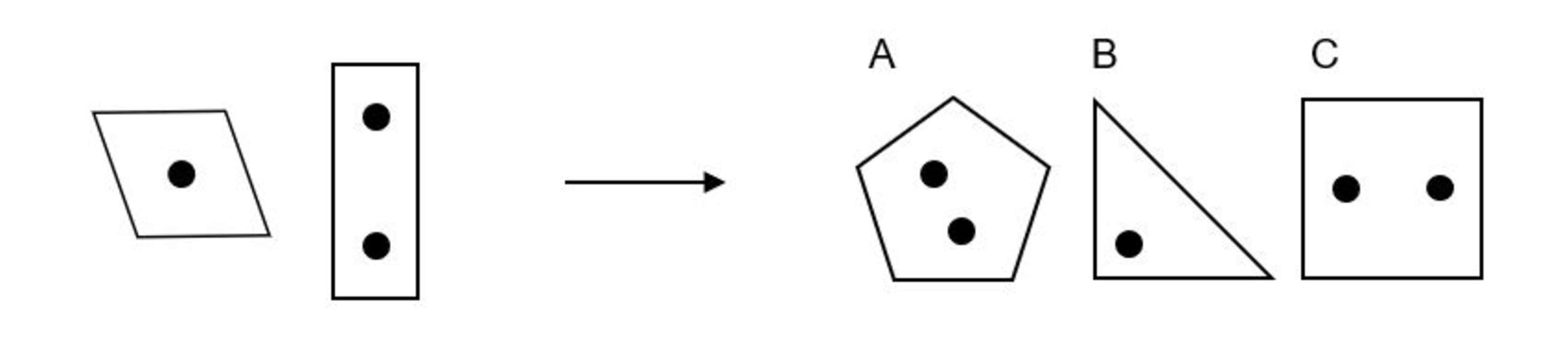
The first thing most people notice is the dots inside the shapes. That is genuinely a shared property, but every one of the options has dots too, so it cannot separate them. A property that all the options satisfy is never the answer, and spotting that early saves the time you would otherwise spend comparing dot counts.
The property that does discriminate is the number of sides. Both samples are quadrilaterals, and only one option, C, also has four sides. Nothing else is shared by the samples and unique to a single option.
Correct answer: C
A method that works every time
- List the samples’ properties. Sides, corners, symmetry, shading, internal elements. Do this before you look hard at the options.
- Keep only what all the samples share. A property one sample has and another lacks is not what the question is about.
- Cross off anything every option has. These cannot discriminate, and they are usually the most eye catching feature on the page.
- Test the survivors against the options. Take one property at a time and eliminate.
- Stop when exactly one option is left. If two options survive, you have missed a property. If none survive, you have read a property too strictly, for example treating size or orientation as fixed when it is not.
Common traps
- The loud shared feature. Shading, dots and arrows are used precisely because they draw the eye. Check whether the options all share them before you spend any time on them.
- Expecting the answer to look like the sample. The correct option may be larger, smaller, rotated or reflected. Only the defining property has to match.
- Reading orientation as a property. Unless the samples clearly agree on orientation, which way a shape faces is usually irrelevant.
- Counting too quickly. Side counts and dot counts are easy to get wrong on small printed shapes, and one miscount takes the whole item with it.
- Committing to the first plausible option. These questions are quick, so confirm that no second option also satisfies your property before you move on.
Practice similar shapes questions
These items seem tricky at first, but the pattern spotting they need builds quickly with repetition. Work through diagrammatic reasoning tests for this format, abstract reasoning tests for the odd one out and matching variants, and non-verbal reasoning tests for mixed shape questions under time pressure.
Explore the other diagrammatic reasoning question types with our Handbook for Diagrammatic Reasoning.