

A mirror image question shows you a shape and a dotted line acting as a mirror, then asks which of the answer options is that shape as it would appear reflected in the line. The reflection is the same shape reversed: every point sits the same distance from the mirror line as it did on the original, but on the opposite side.
The quickest way to picture it is to imagine the shape and the dotted line drawn on a sheet of paper. Fold the paper along the line, and wherever the shape lands is the reflection. Nothing about the shape itself changes, only which way it faces. That is the whole of what diagrammatic reasoning questions of this type are testing.
What a reflection changes and what it leaves alone
Most wrong answers get picked because a candidate assumes a reflection alters more than it does.
Unchanged by a reflection
- Size and proportions
- Side lengths and angles
- The number of sides, corners and internal features
- Shading, dots and any pattern inside the shape
- How far each point sits from the mirror line
Changed by a reflection
- Which side of the mirror line the shape sits on
- The order features appear in as you read across the mirror line
- Handedness: a shape that leaned one way now leans the other
A vertical mirror line swaps left and right and leaves top and bottom untouched. A horizontal mirror line swaps top and bottom and leaves left and right untouched. A diagonal mirror line is the awkward one, because it turns horizontal features into vertical ones, so a shape that was wide comes back tall.
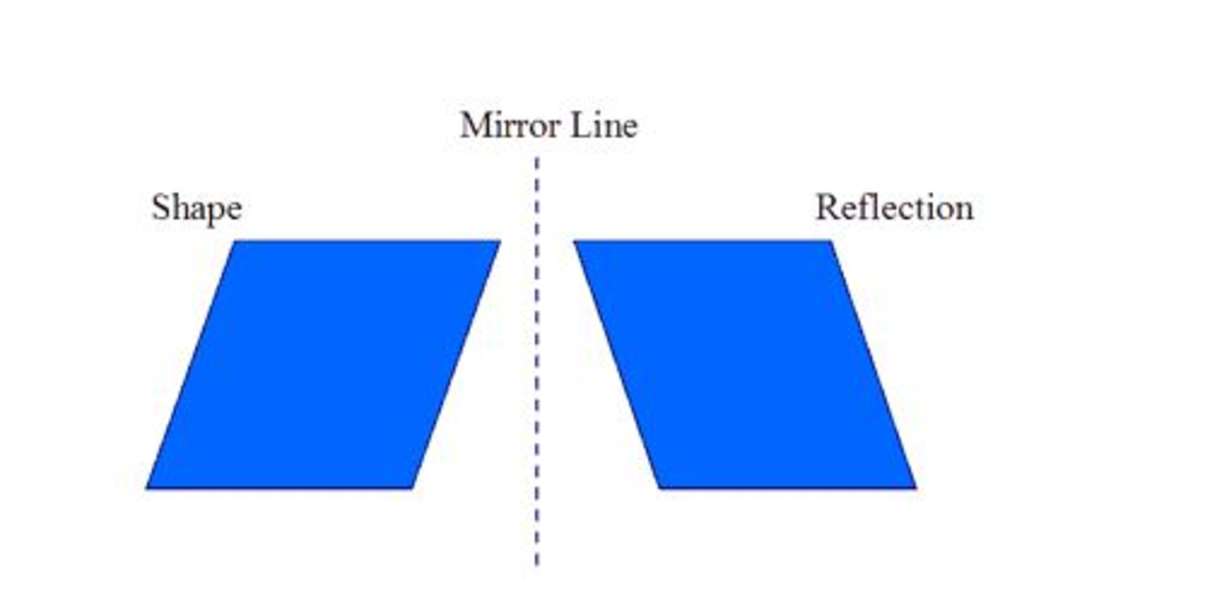
In the image below, the shape and the dotted line are drawn on the same piece of paper. Fold along the line and the parallelogram lands on its partner: each corner is exactly as far from the line as it was before, just on the other side. That is what makes one a reflection of the other.
How to check an answer in a few seconds
You do not need to redraw the whole shape in your head. Reflect one feature and use it to eliminate.
- Find the mirror line and note its direction. Vertical, horizontal or diagonal decides which way the reversal runs.
- Pick one distinctive feature. A notch, an arrow head, a shaded corner or the longest side. Asymmetric features are the useful ones, because a symmetric feature looks the same either way and tells you nothing.
- Reflect that feature only. Judge how far it sits from the mirror line, then put it the same distance on the far side.
- Eliminate. Discard every option that puts the feature somewhere else. That usually leaves one or two.
- Check a second feature before committing. One matching feature can be a coincidence, and the distractors are built to survive a single check.
The traps these questions are built around
- A rotation presented as a reflection. This is the most common wrong answer. Turn a shape through half a turn and it points the other way, which looks reflected at a glance, but the handedness is wrong. Only an asymmetric feature separates the two, so find one and follow it.
- The right reflection in the wrong place. The shape faces correctly but sits nearer to or further from the mirror line than the original. Distance from the line has to match.
- A reflection in the wrong line. The shape is flipped top to bottom when the mirror was vertical, or the other way round.
- The original, untouched. When a shape is close to symmetrical its reflection looks almost identical to it, so an unchanged copy is offered to catch anyone who does not check.
- One detail moved. Everything reflects correctly except a single dot, arrow or shaded section. Check the internal detail, not just the outline.
Example questions
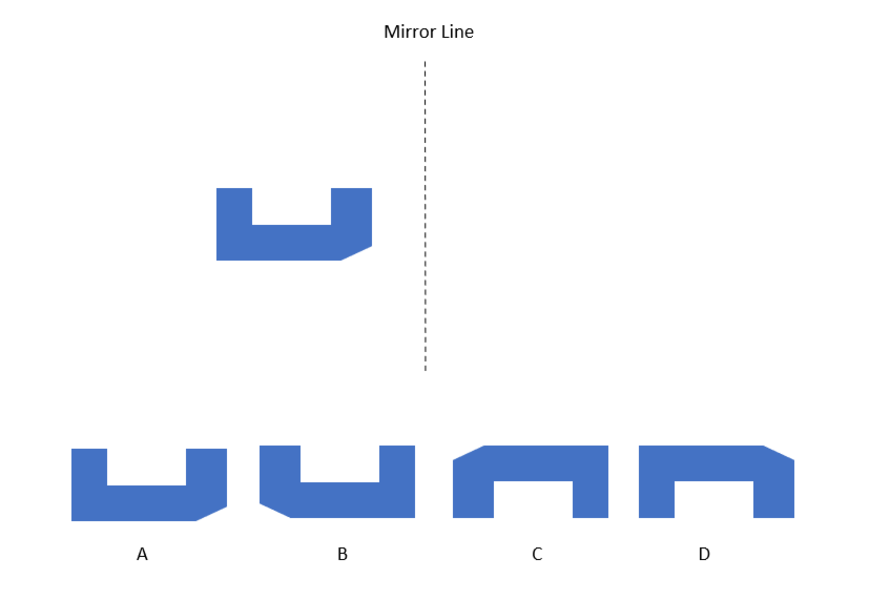
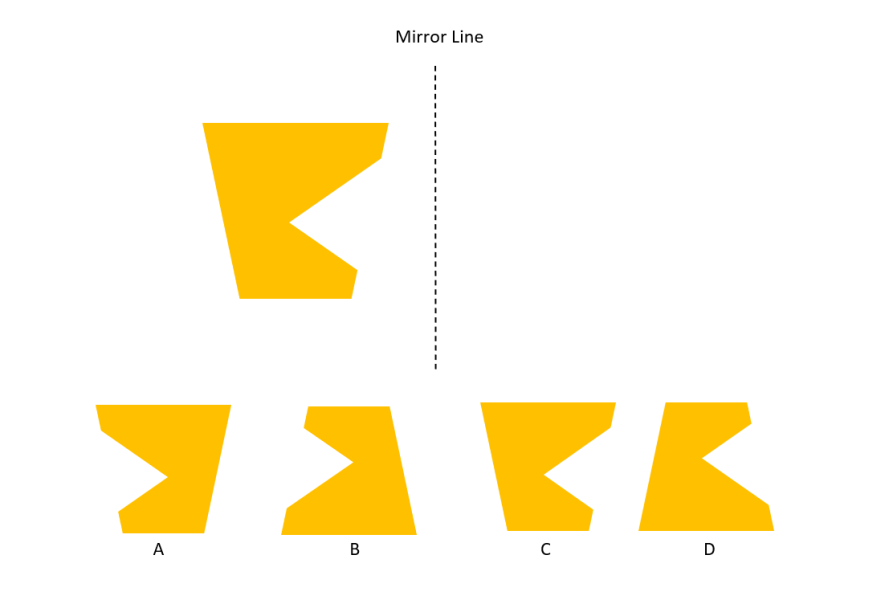
Select the correct reflected shape.
Example 1:
Example 2:
Solutions
Example 1. Correct answer: B. Work outwards from the dotted line. Take the corner closest to the mirror and place it the same distance on the far side, then do the same with the feature furthest away. B is the only option where both land where the fold puts them. Anything that looks close but faces the same way as the original is a rotation rather than a reflection.
Example 2. Correct answer: A. Use the same routine, and start with the most distinctive detail rather than the outline. Mirror that one detail, then rule options out against it. Testing a single clear feature is faster than picturing the whole reflected shape, and it is normally enough to leave one option standing. If two survive, check a second feature on the other side of the shape.
Practice mirror image questions
Mirror image items are quick to answer once the method is automatic, and the same mental move turns up in rotation, cube and net questions, so the practice transfers. Work through diagrammatic reasoning tests for the standard formats, spatial reasoning tests for reflection and rotation under time pressure, and non-verbal reasoning tests for mixed shape questions.
Understand all the other diagrammatic question types with our Handbook for Diagrammatic Reasoning.