
6 minute read

Diagrammatic Reasoning Tests: How to Prepare, With Examples

Diagrammatic reasoning tests ask you to find the rule linking a set of shapes. The three question types, the rules that recur, and two worked examples.

Guy Thornton

Published 14 September 2021 · Updated 15 August 2026

prepare for diagrammatic reasoning tests

A diagrammatic reasoning test shows you a set of shapes and asks you to work out the rule that connects them, then apply that rule to something new. No outside knowledge is involved: everything you need is on the screen, and what is being measured is how quickly you can isolate a rule and test it. That is why preparation works. The rules are drawn from a small, repeatable set, and once you recognize them on sight you stop solving every question from first principles.

The three question types you will meet

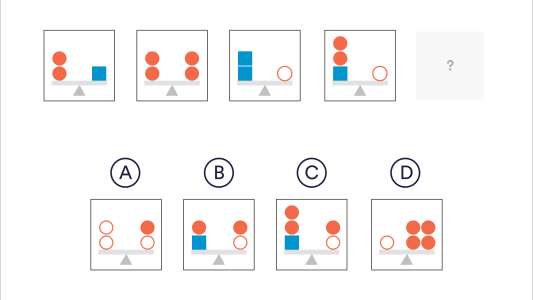
Sequences. Four or five frames are shown in order and you choose the one that comes next. Each frame differs from the one before it by one or more consistent changes: a shape gains a side, an element turns by a fixed angle, shading swaps, a marker moves around the frame.

Operators. A shape enters a chain of labeled boxes and comes out altered. Each label stands for one fixed instruction, such as rotate 90 degrees clockwise, invert the shading, or add a side. You are given completed rows first so that you can deduce what each label does, then asked for a missing output or a missing input.

Matrices. A three by three grid has one cell left blank. Rules run along the rows and down the columns at the same time, so the missing cell has to satisfy both. A common convention is that the third cell in a row combines the first two: elements appearing in exactly one of them are kept, and elements appearing in both cancel out.

Reading an operator question

Suppose two completed rows are shown to you.

In the first row, a white triangle goes into a box labeled P, and a black triangle comes out. Nothing else about it changes.

In the second row, a black square goes into P and then into a box labeled Q, and what comes out is a white square standing on one corner.

Take the rows one at a time. Row one tells you that P turned white into black. Row two tells you that after P and then Q, a black square ended up white and turned by 45 degrees. If P simply painted shapes black, the row two output would be black, and it is not. So P is better described as invert the shading: white becomes black, black becomes white. That reading fits both rows. Whatever is left unexplained in row two belongs to Q, and what is left is the 45 degree turn.

Now the question. A white square passes through Q and then P. Q turns it by 45 degrees, giving a white shape standing on one corner. P inverts the shading, giving a black one. The answer is a black square standing on a corner.

Two things fall out of that. An operator has a single effect and keeps it everywhere, so a reading that fits one row but not another is the wrong reading. And the chain runs strictly left to right, which matters because some pairs of operators give different results in different orders, a turn combined with a mirror image being the usual case.

Reading a sequence question

Treat every feature as a separate track and fill in each track on its own.

Say the first four frames are:

  1. a white triangle with a small dot at the top of the frame
  2. a black square with the dot at the right
  3. a white pentagon with the dot at the bottom
  4. a black hexagon with the dot at the left

Three tracks are running at once. The side count goes 3, 4, 5, 6, so the fifth frame has seven sides. The shading goes white, black, white, black, so the fifth frame is white. The dot goes top, right, bottom, left, a quarter turn clockwise each time, so on the fifth frame it is back at the top. The answer is a white seven sided shape with the dot at the top.

Then use the options. If two of them are white seven sided shapes differing only in where the dot sits, the dot is the feature the question is really testing and the side count was there to occupy you.

The rules that recur

  • a fixed rotation, usually 45, 90 or 180 degrees, in a consistent direction
  • a reflection in a vertical or horizontal axis, which reads as a rotation until a lopsided shape gives it away
  • the number of sides, or the number of elements, changing by a fixed amount
  • shading swapping between two states, or cycling through three
  • an element moving a fixed number of positions around the frame or around the shape
  • one element added and another removed in the same step
  • size alternating, or one element growing while another shrinks

Most questions run two or three of these together. The five steps below are how you pull them apart under time pressure.

Step 1: Work out the rule before you look at the options

The answer options are written to be plausible, so reading them first plants ideas that are hard to shake off. Cover them, look only at the shapes, and put the change into words: turns 90 degrees clockwise, gains a side, shading swaps. Then look at the options and use them to confirm the rule you already hold, rather than to go hunting for one.

Step 2: Isolate one operator at a time

In an operator question, look for two completed rows that differ by exactly one box. Whatever differs in their outputs is that box’s job, and the rest can be set aside. If no two rows differ by a single operator, start with the shortest chain, because it carries the fewest unknowns.

Note each label in a word or two as you settle it, and keep the wording precise. Invert the shading and make it black look the same on one row and contradict each other on the next.

Step 3: Track each feature separately

Rather than trying to take in the whole change at once, name the features: number of sides, number of elements, shading, size, rotation, position in the frame, whether one element sits inside or outside another. Fill in each track across the frames you are given, then extend only the tracks that are actually moving. Features that never change are there to hide the ones that do.

Step 4: Check your answer against every rule, not just the first

Before committing, run your chosen option back through all of the rules you found. A wrong option in a well written question usually satisfies most of them and breaks one, which is why an answer that looks right at a glance proves nothing.

If two options both survive the check, you have missed a rule. Go back to the shapes rather than guessing between the two.

Step 5: Practice under the timing you will actually face

Diagrammatic tests are timed tightly, often around a minute a question, and some publishers set a limit per question rather than for the paper as a whole. Practice with a clock running from the first attempt, because the skill you are building is recognizing a rule quickly, not solving a puzzle at leisure.

If the limit covers the whole paper, bank the questions you can see straight away and return to the rest. If it is set per question, take the best supported option and move on: unused time does not carry forward.

The underlying rules change very little between publishers, so the fastest gain comes from seeing enough of them that recognition replaces deduction. Work through a full set of diagrammatic reasoning tests under timed conditions, then widen out to inductive reasoning tests, which use the same shape rules under a different name. For a shorter warm up, the free aptitude tests cover the same formats, and there is more on question by question technique in our guide to answering diagrammatic reasoning tests.

Start practising today

Take a free test in any format, then upgrade when you know which one you need.