
Manufacturing Tests
Manufacturing employers often set numerical and mechanical reasoning tests and a situational judgement test, then an assessment centre or interview. Practise with a free situational judgement test set in manufacturing work.
- 10 questions
- 13 minutes
- Worked solutions
Free · No sign-up · Scored the moment you finish
Manufacturing Situational Judgement Test
You have 13 minutes to answer 10 questions. Each question describes a workplace situation and four possible responses. For every question, select the response you believe would be MOST effective and the response you believe would be LEAST effective. There are no trick questions; judge each response on how well it would work in the situation described.
About this test: this is one of a set of practice tests covering the areas Manufacturing assessment processes typically include. It is written by us and is not any employer’s own assessment.
-
Question 1 of 10
You are a junior designer at a graphic design studio. You and a colleague, Ines, are producing a brand pack due to the client on Friday. It is Wednesday. Ines has been given a second urgent project and tells you she can now only do about half her share of the brand pack. You have capacity for some but not all of the rest. Your studio manager assigns work and is in the office. Which response below would be most effective, and which would be least effective?
- Take on all of Ines's remaining share and work late Wednesday and Thursday so the brand pack is delivered on Friday as promised.
- Work out with Ines exactly what is left, then tell the studio manager today what the two of you can cover and what still needs someone, before Friday.
- Tell Ines the brand pack has to come first since it has a client deadline on Friday, and ask her to push back on the second project herself.
- Carry on with your own share and let Ines deliver what she can, and raise it on Friday if the brand pack turns out to be incomplete.
Show the answer
Most effective: B. Work out with Ines exactly what is left, then tell the studio manager today what the two of you can cover and what still needs someone, before Friday.
Least effective: D. Carry on with your own share and let Ines deliver what she can, and raise it on Friday if the brand pack turns out to be incomplete.
A: Hides the strain until failure: it absorbs a shortfall the studio manager created and never learns about, so she keeps assigning on the assumption that both projects fit.
C: Passes responsibility to others: the studio manager assigns the work, so asking Ines to argue about her own workload leaves the person who made the clash out of the conversation.
D: Hides the problem / silent deadline slip: it is known on Wednesday that the pack will be short, and the plan is to mention it on the day it is due, when nothing can be done. Waiting to report a certainty is concealment.
The most effective response is to work out with Ines exactly what is left, then tell the studio manager today what the two of you can cover and what still needs someone: the shortfall is known on Wednesday, its size can be worked out in ten minutes, and she both created the clash and is the only person who can resolve it. Bringing her the specifics rather than the problem lets her act. It beats taking on all of Ines’s remaining share and working late, because quietly absorbing the gap hides from the manager that two projects were assigned into one person’s week, so she does it again. It beats telling Ines to push back on the second project herself, because that leaves the person who assigns the work out of a conversation about her own assignment. The least effective response is letting Ines deliver what she can and raising it only if the pack turns out incomplete: it knows on Wednesday that Friday will fall short and plans to mention it when no resource can be added. That is worse than absorbing the work, which delivers, and worse than asking her to push back, which at least raises it. The principle: size the gap, then take it to whoever controls the resource while there is still time to fill it.
-
Question 2 of 10
You are an apprentice with an electrical contractor, working alone today finishing sockets in an office refurbishment. Opening a wall box you find an older cable that appears to be connected to a live circuit but is not on the drawings and is not what you were sent to work on. You are not qualified to test it. Your supervisor is on another site. The client’s fit-out team are due to board over this wall tomorrow morning. Which response below would be most effective, and which would be least effective?
- Stop work at that box, ring your supervisor now to describe what you have found, and tell the client's fit-out team the wall must not be boarded until it has been checked.
- Photograph the cable, finish the sockets you were sent to do, and raise the unidentified cable with your supervisor at the end of the day when you report back on the job.
- Isolate the circuit at the board yourself so the cable is dead, then carry on with the sockets and mention it to your supervisor later.
- Say nothing and board the wall as planned, since the cable is not on the drawings, is not part of your work, and whoever installed it presumably knew what they were doing.
Show the answer
Most effective: A. Stop work at that box, ring your supervisor now to describe what you have found, and tell the client's fit-out team the wall must not be boarded until it has been checked.
Least effective: D. Say nothing and board the wall as planned, since the cable is not on the drawings, is not part of your work, and whoever installed it presumably knew what they were doing.
B: Delays the decision: the record is useful and the wall is boarded over tomorrow morning. An end-of-day report may still be in time, but it leaves no margin and nobody has been asked to act.
C: Acts on assumptions without checking: isolating a circuit you cannot identify may kill something the building needs, and you are not qualified to test what the cable feeds. It makes one thing safe by guessing at another.
D: Fails to escalate a genuine risk: it seals an unidentified, apparently live cable inside a wall where nobody will find it. The reason given, that someone else must have known, is the assumption the missing drawing already disproves.
The most effective response is to stop work at that box, ring your supervisor now, and tell the client’s fit-out team the wall must not be boarded until it has been checked: an unidentified live cable is outside your competence, and the wall is boarded tomorrow morning, so it has to be stopped and reported while both are still possible. Warning the fit-out team is the part that prevents the real damage, because a supervisor informed after boarding cannot undo it. It beats photographing the cable, finishing the sockets, and raising it when you report back at the end of the day, because that leaves no margin against a morning boarding and warns nobody actually holding a sheet of plasterboard. It beats isolating the circuit at the board yourself, because cutting a circuit you cannot identify may kill something the building depends on, and still does not tell you what the cable is. The least effective response is saying nothing and boarding the wall as planned: it seals an apparently live, undocumented cable inside a wall on the assumption that whoever installed it knew what they were doing, which the missing drawing already contradicts. That is worse than the other two, which act imperfectly but do not hide it. The principle: when you find something outside your competence that is about to become inaccessible, stop the work, tell the person who can assess it, and warn whoever would seal it.
-
Question 3 of 10
You are a warehouse administrator at a medical devices distributor. Reconciling stock you notice that a batch of single-use surgical instruments recorded as quarantined has been picked and despatched to two hospitals. The quarantine was applied last month and you do not know why. The person who applied it has left. Your quality manager is on site. Which response below would be most effective, and which would be least effective?
- Take the records to your quality manager immediately, showing that quarantined stock has gone to two hospitals, and let her decide what happens next.
- Find out first why the quarantine was applied, since the reason may be administrative, and take it to the quality manager once you know what you are reporting.
- Contact the two hospitals to ask them to hold the batch until its status has been confirmed, then report it to the quality manager.
- Correct the stock record to show the batch as despatched and let the quarantine flag lapse, since the goods have already gone and the person who applied it is no longer here.
Show the answer
Most effective: A. Take the records to your quality manager immediately, showing that quarantined stock has gone to two hospitals, and let her decide what happens next.
Least effective: D. Correct the stock record to show the batch as despatched and let the quarantine flag lapse, since the goods have already gone and the person who applied it is no longer here.
B: Delays the decision: quarantined stock is already in two hospitals, and establishing the reason yourself postpones a decision the quality manager is qualified to make today.
C: Acts outside own authority: contacting customers about potentially unsafe medical devices is a regulated communication, and a warehouse administrator making it first commits the company before anyone qualified has assessed the batch.
D: Conceals a potential safety failure: it tidies away the only evidence that quarantined medical devices reached two hospitals, so nobody can assess whether patients are at risk. That is a different order of wrong from acting too slowly.
The most effective response is to take the records to your quality manager immediately, showing that quarantined stock has gone to two hospitals, and let her decide what happens next: the reason for the quarantine is unknown and may be a safety matter, and she is on site and decides about recall and about telling the customers. Speed matters because the devices may be used. It beats finding out first why the quarantine was applied, because researching it yourself delays a decision she can take now, on stock already in clinical settings. It beats contacting the two hospitals to ask them to hold the batch, because a communication about potentially unsafe devices is regulated and must come from the company’s quality function. The least effective response is correcting the stock record to show the batch as despatched and letting the flag lapse: it removes the quarantine and the evidence, so nobody can establish whether patients are at risk. That is worse than the other two, which act slowly or beyond their authority but keep the problem visible. The principle: when a control has failed on something already with customers, go straight to the person who owns the control, and change nothing yourself.
-
Question 4 of 10
You are a waiter in a restaurant. Your colleague Tomasz has been given a large party of sixteen on top of his own section and is visibly falling behind; starters have not gone out and the party has been seated twenty minutes. Your own tables are all served and content. The restaurant manager is dealing with a supplier at the door. Tomasz has not asked for help. Which response below would be most effective, and which would be least effective?
- Ask Tomasz whether he would like help with the party and stay with your own section if he says he has it, since he knows what the party has ordered.
- Go to Tomasz, tell him your tables are settled, and take the drinks and starters for the party of sixteen while he works his own section.
- Stay with your own section and let Tomasz manage, since the party was assigned to him and stepping in might confuse who is serving which table.
- Interrupt the restaurant manager at the door to tell her that the party of sixteen is not being served and that Tomasz needs someone put on it.
Show the answer
Most effective: B. Go to Tomasz, tell him your tables are settled, and take the drinks and starters for the party of sixteen while he works his own section.
Least effective: C. Stay with your own section and let Tomasz manage, since the party was assigned to him and stepping in might confuse who is serving which table.
A: Substitutes own judgement for the stakeholder's: a waiter twenty minutes behind on a party of sixteen will usually say he has it, so the offer is courteous and leaves the party waiting.
C: Stands available and does nothing: a party of sixteen has waited twenty minutes for starters while a waiter with nothing to do stands by, and the reason given is a worry about table allocation. Standing idle beside a visible failure is the worst of the four.
D: Escalates prematurely: you are the person she would send, she is with a supplier, and the walk over costs minutes that the party has already spent waiting.
The most effective response is to go to Tomasz, tell him your tables are settled, and take the drinks and starters for the party of sixteen: they have waited twenty minutes, and splitting the work that way is the fastest route back to a normal service. Telling him your section is done removes any need for him to admit he is behind. It beats asking whether he would like help and staying with your own section if he says he has it, because a colleague that far behind will usually decline a general offer, and the party waits regardless. It beats interrupting the restaurant manager at the door to say the party is not being served, because you are the resource she would assign, and fetching her costs minutes. The least effective response is staying with your own section and letting him manage: it leaves sixteen covers unserved while you stand available, justified by a concern about who is assigned to which table. That is worse than offering, which at least asks, and worse than telling the manager, which at least raises it. The principle: when your own section is settled and a colleague is visibly drowning, take a defined part of his work and start.
-
Question 5 of 10
You are a technician in a dental laboratory. You and a colleague, Rhian, share a batch of crowns due to the practice tomorrow morning. She has been working slowly since returning from leave and tells you she is struggling to get back up to speed. Six crowns remain and you can complete about four by the end of the day. Your laboratory manager is on site. Which response below would be most effective, and which would be least effective?
- Send the crowns that are ready in the morning and say nothing about the missing ones, since the practice will probably not use them all on the same day.
- Take all six crowns yourself and work late to finish them, so the practice gets the full batch and Rhian is not put under more pressure.
- Complete the four you can manage and leave the remaining two for Rhian, since they are her share of the batch and she needs to get back up to speed.
- Work out with Rhian how many the two of you can realistically finish, and tell the laboratory manager today so the shortfall can be covered or the practice warned.
Show the answer
Most effective: D. Work out with Rhian how many the two of you can realistically finish, and tell the laboratory manager today so the shortfall can be covered or the practice warned.
Least effective: A. Send the crowns that are ready in the morning and say nothing about the missing ones, since the practice will probably not use them all on the same day.
A: Hides the problem / silent deadline slip: an incomplete batch arrives with nobody told, so the practice discovers the shortfall with patients booked. Assuming they will not need them is a guess made on their behalf.
B: Hides the strain until failure: it delivers tomorrow and conceals from the manager that the batch needed one person working late, so the same workload is planned again next week.
C: Passes responsibility to others: it hands the shortfall to the person who has already said she cannot keep pace, which makes the batch late and teaches her nothing.
The most effective response is to work out with Rhian how many the two of you can realistically finish, and tell the laboratory manager today: the shortfall is real and knowable now, and he is the only person who can add capacity or warn the practice in time for tomorrow morning. Working the number out with her first makes it accurate rather than pessimistic. It beats taking all six yourself and working late, because absorbing it delivers tomorrow and hides that the batch was never deliverable in normal hours, so it recurs. It beats completing four and leaving the remaining two for Rhian, because leaving them with a colleague who has said she cannot keep pace guarantees the batch is late and helps nobody. The least effective response is sending the crowns that are ready and saying nothing about the missing ones: it sends an incomplete batch to a practice with patients booked, on an assumption about what they will need. That is worse than the other two, which mishandle the workload but do not conceal the outcome. The principle: size the gap with your colleague, then tell whoever can fix or communicate it while tomorrow can still be changed.
-
Question 6 of 10
You are a physiotherapy assistant at a community clinic. A patient attending for knee rehabilitation mentions in passing that he has had chest tightness when walking uphill for the past fortnight and has not told anyone. He seems well now and is keen to get on with his exercises. You are not clinically qualified to assess this. A physiotherapist is with another patient next door and free in fifteen minutes. Which response below would be most effective, and which would be least effective?
- Carry on with the session as planned, since he seems well, the chest tightness is not what he has been referred for, and it is not your place to ask about symptoms outside your remit.
- Advise him to see his GP about the chest tightness, then carry on with his knee exercises as planned for today's session.
- Hold off starting the exercises, tell the physiotherapist about the chest symptoms as soon as she is free, and let her decide whether today's session should go ahead.
- Ask him more about the chest tightness, how long it lasts and what brings it on, so you can judge whether it needs raising with the physiotherapist today.
Show the answer
Most effective: C. Hold off starting the exercises, tell the physiotherapist about the chest symptoms as soon as she is free, and let her decide whether today's session should go ahead.
Least effective: A. Carry on with the session as planned, since he seems well, the chest tightness is not what he has been referred for, and it is not your place to ask about symptoms outside your remit.
A: Stays silent about a known clinical risk: exertional chest tightness is exactly the symptom that matters before exercise, and the reason for saying nothing is that it falls outside your remit, which is why it needs passing to someone whose remit it is.
B: Passes responsibility to others: the advice is sound and it leaves a patient about to exercise now, with a symptom nobody qualified has assessed, on his own to arrange a GP appointment.
D: Acts outside own training: gathering symptoms is reasonable and deciding what they mean is not. Filtering the information through your own untrained judgement risks it never reaching anyone qualified.
The most effective response is to hold off starting the exercises and tell the physiotherapist about the chest symptoms as soon as she is free: exertional chest tightness matters most immediately before exercise, you are not qualified to assess it, and someone who is will be free in fifteen minutes. Holding the session costs a quarter of an hour and removes the risk. It beats asking him more about how long it lasts and what brings it on, because collecting detail is fine but deciding on its significance is not yours to do, and the filtering is where it could be lost. It beats advising him to see his GP and carrying on with the knee exercises, because that leaves him exercising today with the symptom unassessed. The least effective response is carrying on with the session because he seems well and it is outside your remit: it proceeds with exertion despite a symptom that specifically concerns exertion, and tells nobody. That is worse than sending him to his GP, which at least directs him somewhere, and worse than questioning him, which at least explores it. The principle: when something outside your competence could matter now, pause and put it to the qualified person who is minutes away.
-
Question 7 of 10
You work in a shoe repair and key cutting shop. A customer collects a key cut yesterday and says it does not turn in her front door; she has been locked out once already. Recutting takes ten minutes and there is no queue. She is annoyed and says she has wasted a morning. Your shop manager is in the back and can authorise refunds. Which response below would be most effective, and which would be least effective?
- Explain that keys sometimes need easing in older locks, and suggest she try a little lubricant on the lock before assuming the key was cut incorrectly.
- Apologise, take the key and the original back, and ask her to return this afternoon once it has been recut and checked properly.
- Recut the key straight away and hand it over with an apology, since the fastest fix is the best answer and she plainly wants to get on with her day.
- Apologise, recut the key now while she waits since it takes ten minutes, and ask the manager about refunding the original charge for the trouble.
Show the answer
Most effective: D. Apologise, recut the key now while she waits since it takes ten minutes, and ask the manager about refunding the original charge for the trouble.
Least effective: A. Explain that keys sometimes need easing in older locks, and suggest she try a little lubricant on the lock before assuming the key was cut incorrectly.
A: Ignores the customer's actual need: it explains away a key that does not work, puts the remedy back onto a customer who has already been locked out, and never offers the ten-minute recut that would settle it.
B: Adds a second journey: the recut takes ten minutes and there is no queue, so asking her to come back a second time adds another journey to a morning she has already lost.
C: Ignores part of the customer's actual need: the recut solves the key and not the wasted morning, when a manager who could offer a refund is a few steps away and has not been asked.
The most effective response is to apologise, recut the key now while she waits since it takes ten minutes, and ask the manager about refunding the original charge: the key does not work, there is no queue, and she has lost a morning, so both the practical fix and the goodwill question can be dealt with while she is here. It beats recutting the key straight away and handing it over with an apology, because that addresses the key and not the wasted morning, when a manager who could refund the charge is a few steps away. It beats taking the key back and asking her to return this afternoon, because a second journey for a ten-minute job adds to exactly the cost she is complaining about. The least effective response is suggesting she tries a little lubricant because older locks need easing: it offers a theory instead of a working key, and makes the customer responsible for solving a fault the shop created. That is worse than the other two, which both end with a key that turns. The principle: fix the fault on the spot when you can, and use the authority above you for the part that is about the customer’s lost time.
-
Question 8 of 10
You are a dispensing assistant at an opticians. It is 3pm. A customer is waiting for glasses promised for today, and the lenses need twenty minutes of fitting work. At the same time the practice manager asks you to complete the monthly stock return, due to head office by 5pm, which takes about an hour. A third customer is browsing frames and has not been greeted. You are alone in the dispensary. Which response below would be most effective, and which would be least effective?
- Tell the practice manager you cannot do the stock return today and ask her to submit it herself, since two customers are in the practice and you are alone in the dispensary.
- Start the stock return first because head office has a fixed 5pm deadline, then fit the lenses and greet the browsing customer once the return has been submitted.
- Greet the browsing customer and say you will be with her shortly, fit the waiting customer's lenses, then do the stock return before 5pm.
- Fit the lenses, then the stock return, and leave the browsing customer to look at the frames on her own, since she has not asked for help and may prefer to browse undisturbed.
Show the answer
Most effective: C. Greet the browsing customer and say you will be with her shortly, fit the waiting customer's lenses, then do the stock return before 5pm.
Least effective: A. Tell the practice manager you cannot do the stock return today and ask her to submit it herself, since two customers are in the practice and you are alone in the dispensary.
A: Passes responsibility to others: it hands a manageable task back to the manager before doing the arithmetic. Twenty minutes of fitting and an hour of reporting sit comfortably inside the two hours available, so the refusal is based on a clash that does not exist.
B: Substitutes own judgement for the stakeholder's: it puts an hour of internal reporting ahead of a customer who was promised her glasses today and is already waiting in the practice.
D: Ignores the customer's actual need: a few seconds of greeting costs nothing and is what stops a browsing customer leaving. Treating silence as a preference is an assumption made for your own convenience.
The most effective response is to greet the browsing customer, fit the waiting customer’s lenses, then do the stock return before 5pm: two hours remain, the fitting takes twenty minutes and the return an hour, so everything fits if it is sequenced properly, and a greeting costs seconds. Doing the promised glasses first honours the commitment already made. It beats starting the stock return first because head office has a fixed deadline, since that treats an internal report as outranking a customer who was promised her glasses today and is sitting there waiting for them. It beats leaving the browsing customer to look at the frames on her own, because a customer who is never greeted is the one most likely to leave, and acknowledging her costs nothing. The least effective response is telling the practice manager you cannot do the stock return today: it hands a manageable task back to her without checking that it fits, when twenty minutes and an hour sit comfortably inside the two hours available. That is worse than the other two, which at least attempt everything. The principle: check whether the work actually fits before declining any of it, then sequence by who is waiting and what was promised.
-
Question 9 of 10
You are a supervisor at a coffee shop. Your two colleagues have both called in sick, you are running the shop alone through the morning rush, and the queue is out of the door. Your area manager rings to say she is coming in at midday to review the shop’s cleaning records with you, which will take an hour. You have not had a break. The records are up to date. It is 10am. Which response below would be most effective, and which would be least effective?
- Say nothing about being short-staffed, serve through the rush, and get through the review at midday as arranged so that your area manager is not given the impression you cannot cope.
- Tell your area manager now that you are alone with both colleagues off, ask whether the review can move or whether she can send cover, and carry on serving while she decides.
- Close the shop for fifteen minutes to take your break and reset before the review, since you have been alone since opening and cannot keep serving without one.
- Ask your area manager to postpone the review, explaining that you are on your own, and leave it to her to find a new date when the shop is properly staffed.
Show the answer
Most effective: B. Tell your area manager now that you are alone with both colleagues off, ask whether the review can move or whether she can send cover, and carry on serving while she decides.
Least effective: C. Close the shop for fifteen minutes to take your break and reset before the review, since you have been alone since opening and cannot keep serving without one.
A: Hides the strain until failure: it conceals the one fact that would change her plan, so she arrives to a shop with a queue and no cover, and the next rota is built as though today worked.
C: Abandons own committed work: shutting a trading shop mid-rush with a queue outside is a unilateral decision affecting customers and takings, taken without telling the area manager who is on the phone at that moment.
D: Passes responsibility to others: it raises the problem, which is right, then narrows it to one solution. Cover for the shop would suit her visit and you better than a cancelled review, and it is never offered.
The most effective response is to tell your area manager now that you are alone with both colleagues off, and ask whether the review can move or whether she can send cover: she set the midday review without knowing, that is the fact that would change her plan, and she is on the phone now. Offering her the choice keeps both options open while you keep serving. It beats asking her to postpone the review and leaving her to find a new date, because that raises the same problem but presents only one solution, when cover would suit the shop and her visit better than a cancellation. It beats serving through the rush in silence so she is not given the impression you cannot cope, because that leaves her arriving to a queue and no cover, and confirms to the business that a single-staffed rush is workable. The least effective response is closing the shop for fifteen minutes to take your break: it shuts a trading shop mid-rush on your own authority, with a queue outside and your area manager on the phone, without telling her. That is worse than the other two, which mishandle the conversation but keep the shop open. The principle: when circumstances have changed under someone else’s plan, give them the fact and the options while they can still act, and keep working meanwhile.
-
Question 10 of 10
You work for a tour operator. A group of twenty-four is flying out on Saturday on a walking holiday. On Wednesday the mountain hut booked for two nights closes after a water supply failure. An alternative hut is available but is four hours’ walk further on, which changes two days of the itinerary. The group leader is contactable. Your operations manager is available today. Which response below would be most effective, and which would be least effective?
- Rebook the alternative hut and send the group leader a revised itinerary, so the holiday is secured and everyone knows the new plan before they fly.
- Wait until the water supply position is clearer later in the week, since the hut may reopen before Saturday and a change of itinerary would unsettle the group unnecessarily.
- Let the group travel as booked and have the guide explain the change of route when they reach the mountain, since the alternative hut will be arranged by then anyway.
- Ring the group leader today, explain the hut closure and what the alternative would mean for two days of walking, and agree the plan before anything is rebooked.
Show the answer
Most effective: D. Ring the group leader today, explain the hut closure and what the alternative would mean for two days of walking, and agree the plan before anything is rebooked.
Least effective: C. Let the group travel as booked and have the guide explain the change of route when they reach the mountain, since the alternative hut will be arranged by then anyway.
A: Substitutes own judgement for the stakeholder's: adding four hours' walking to two days changes what the group signed up for, and some members may not be able to do it. That is the group leader's call, not a booking amendment.
B: Delays the decision: the alternative hut may be taken by another group while you wait, and the leader loses the days in which walkers could have prepared or withdrawn.
C: Hides the problem: twenty-four people are told on the mountain that two days now involve four hours' more walking, when some may be unable to manage it and none of them can do anything about it there. That is concealment with a safety dimension.
The most effective response is to ring the group leader today, explain the hut closure and what the alternative would mean for two days of walking, and agree the plan before anything is rebooked: four extra hours on two days is a material change, some of twenty-four people may not manage it, and only he can judge that for his group. Wednesday leaves time to prepare, adjust or withdraw. It beats rebooking the alternative hut and sending a revised itinerary, because that presents the change as settled when its acceptability depends on the group. It beats waiting until the water supply position is clearer later in the week, because that risks losing the alternative hut and burns the days the group needs. The least effective response is letting them travel as booked and having the guide explain the change of route on the mountain: it tells twenty-four walkers the route has lengthened substantially at the one point where nobody can opt out. That is worse than the other two, which decide or delay but do not spring it on people in the field. The principle: when a change affects what people are physically committing to, tell whoever speaks for them while they can still choose.






What are Manufacturing tests?
Manufacturing tests are the short online assessments employers set for production, engineering and apprentice roles. Passing often depends on your scores, and the next step is usually an assessment centre with a presentation and an interview. At JLR, for example, the three online assessments are a situational judgement test, a personality questionnaire and timed aptitude tests, with one hour set aside for all three.
The tests you are likely to sit
The exact tests depend on the role, so check the job advert or your invitation. These are the ones manufacturing applicants most often meet.
| Assessment | What it measures |
|---|---|
| Numerical reasoning test | Working with numbers, data and charts |
| Mechanical reasoning test | Applying basic mechanical and physical principles |
| Situational judgement test | Choosing effective responses to workplace scenarios |
| Assessment centre | Presentation and scenario exercises with an interview |
| Interview | Your motivation and suitability for the role |
Employer guides
If you know which company you are applying to, start with its guide: it covers the tests that employer sets and when.
- Jaguar Land RoverAptitude, personality and technical assessments
- Rolls RoyceProblem-solving, technical knowledge and logical reasoning
- UnileverPersonality test, online assessment and interviews
- P&GPersonality, reasoning and situational judgement tests
- BMWNumerical and verbal reasoning aptitude tests
- ToyotaSituational judgement and mechanical reasoning tests
Not listed? Browse all employer guides.
Practise the real thing
Practice moves scores fastest on the tests set under time pressure, and every question in the pack comes with the working shown.
- 10
- practice tests
- 100
- questions, all solved
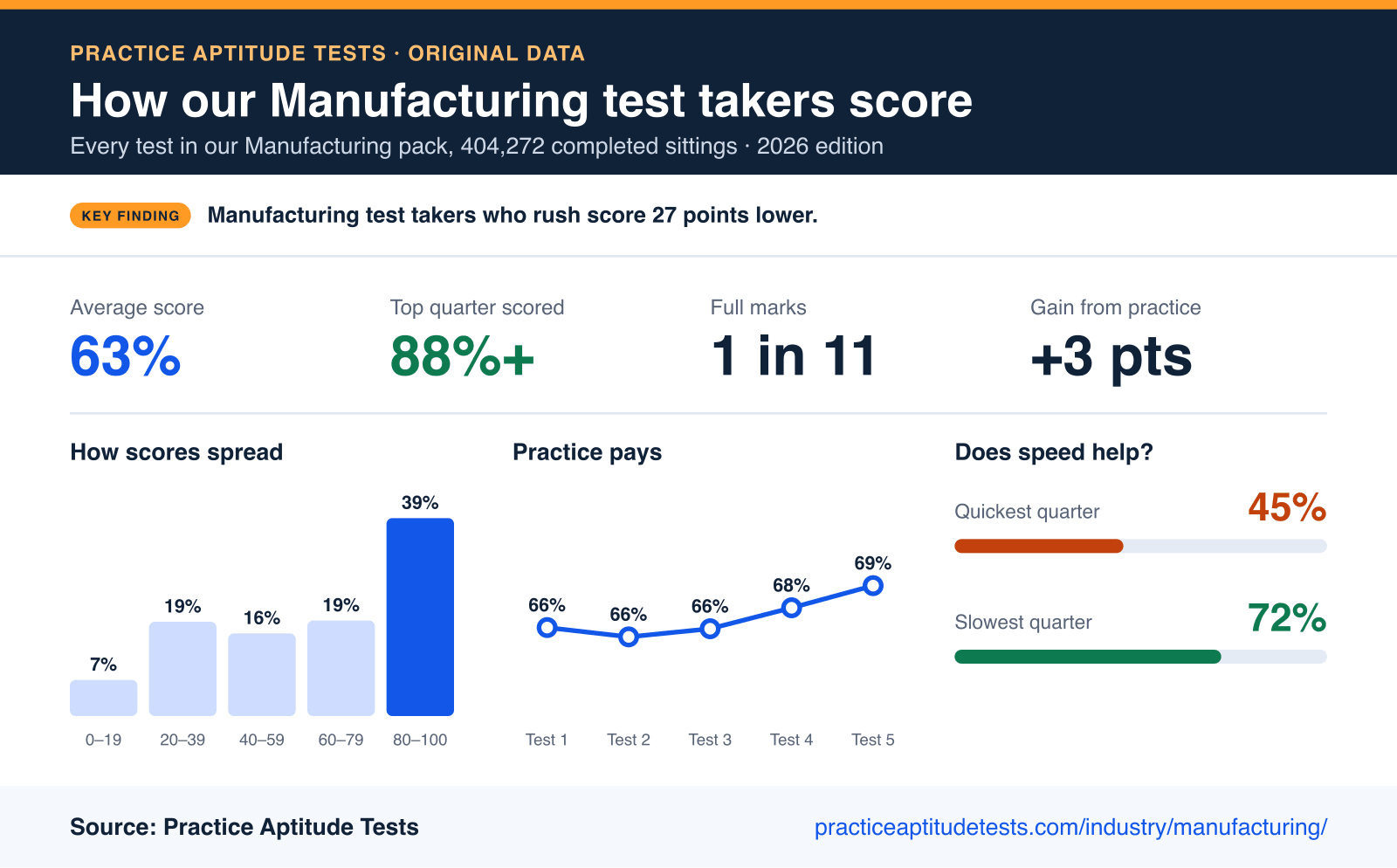
Practice Aptitude Tests · Original data
How our test takers score
Results from every test in our Manufacturing pack, past and present.
Key findingManufacturing test takers who rush score 27 points lower.
How scores spread
39% scored 80% or more, and 26% scored under 40%.
Share of sittings in each score band.
Practice pays
Regular practisers went from 66% on their first test to 69% on their fifth.
6,491 people who took five or more tests.
Does speed help?
Rushing costs marks. The quickest quarter scored 27 points lower than the slowest.
Typical pace: 51 seconds a question.
Share this data
Our practice tests mirror the formats used in Manufacturing hiring. They are written by Practice Aptitude Tests and are not affiliated with or endorsed by any individual employer.