
Correctional Officer Tests
Correctional officer exams test reading, grammar, basic maths and how you would handle situations on the job. Practise with a free situational judgement test set in correctional work.
- 10 questions
- 13 minutes
- Worked solutions
Free · No sign-up · Scored the moment you finish
Correctional Officer Situational Judgement Test
You have 13 minutes to answer 10 questions. Each question describes a workplace situation and four possible responses. For every question, select the response you believe would be MOST effective and the response you believe would be LEAST effective. There are no trick questions; judge each response on how well it would work in the situation described.
About this test: this is one of a set of practice tests covering the areas Correctional Officer assessment processes typically include. It is written by us and is not any employer’s own assessment.
-
Question 1 of 10
You are a candidate liaison assistant at a correctional service. An applicant telephones to ask why she was not put through to the next stage and how she was scored. The stated rule is that scores are released only in the written feedback the selection team sends, which takes ten working days. She says she has another application closing on Friday and needs to know what to work on. Her scores are on the screen in front of you. Which response below would be most effective, and which would be least effective?
- Take her number and offer to ring her back once the written feedback has been sent in ten working days, which is the point at which you will be able to talk her through the scores line by line.
- Tell her there is nothing on file beyond the written feedback she will be sent, and that everybody at her stage receives the same, so that she stops asking about the scores.
- Explain the ten working day rule and that it applies to every applicant, say you cannot help further, and end the call politely, since the rule is clear and the selection team is the only route to her scores.
- Explain that the scores come only in the written feedback and when it is due, ask the selection team today whether anything can be given sooner given her Friday date, and ring her back either way.
Show the answer
Most effective: D. Explain that the scores come only in the written feedback and when it is due, ask the selection team today whether anything can be given sooner given her Friday date, and ring her back either way.
Least effective: B. Tell her there is nothing on file beyond the written feedback she will be sent, and that everybody at her stage receives the same, so that she stops asking about the scores.
A: Ignores the deadline she has told you about: ten working days lands well after Friday, so the call she is offered arrives when it can no longer help her.
B: Denies information you are holding: her scores are on the screen as you speak, and she is being told they do not exist in order to end an awkward call.
C: Stops at the rule: it is true and it is not the whole answer, because nobody has asked the selection team whether her Friday date changes anything.
The most effective response is to explain when the written feedback is due, ask the selection team today whether anything can be given sooner in light of her Friday date, and ring her back either way: it keeps the release rule where it belongs, with the team that owns it, and still puts her actual deadline in front of somebody who could act on it. It is stronger than taking her number and offering a call after the feedback is sent, because ten working days lands after Friday and the offer is worth nothing to her. It is stronger than explaining the rule and ending the call, because that is accurate and incurious: nobody has been asked whether her date makes any difference. The least effective response is to tell her there is nothing on file beyond the written feedback and that everybody at her stage receives the same: the delayed callback at least keeps the door open, and the polite refusal at least tells her the truth about the rule, whereas denying that the scores exist while looking at them is untrue and leaves her working on the wrong thing before Friday. The principle: a rule you cannot bend is still explained honestly, and somebody else’s deadline is worth one question to the people who own the decision.
-
Question 2 of 10
You are a selection centre assistant at a correctional service. Eleven candidates are waiting to have their identity documents checked before the day starts, and the stated cut-off is nine o’clock: anybody not checked in by then cannot take part and has to be offered another date. It is twenty to nine and each check takes about three minutes. Two of the eleven have already told you they cannot come back on another day. Which response below would be most effective, and which would be least effective?
- Hand the queue to a colleague from the room next door and go and set up the first exercise, since the checks are somebody's job for the day and the room has to be ready.
- Work through the eleven in the order they are standing, starting at the front of the line and working straight back along it, at three minutes each, and see how far you get before nine rather than making anybody feel singled out.
- Ask the person running the day to move the nine o'clock cut-off back by fifteen minutes, explaining that eleven checks at three minutes each will not fit into the twenty left, so that everybody can be checked before anything begins.
- Check the two who cannot come back first, then work through the rest in order, and tell the person running the day now how many will not be checked by nine, so that another date can be offered.
Show the answer
Most effective: D. Check the two who cannot come back first, then work through the rest in order, and tell the person running the day now how many will not be checked by nine, so that another date can be offered.
Least effective: A. Hand the queue to a colleague from the room next door and go and set up the first exercise, since the checks are somebody's job for the day and the room has to be ready.
A: Passes responsibility to others: the colleague inherits a queue they cannot clear either, and nobody has told the person running the day that eleven will not be checked by nine.
B: Treats order of arrival as fairness: it spends the last checks on people who can be offered another date, and the two who cannot come back are at the mercy of where they happened to stand.
C: Reopens a fixed constraint before working inside it: the cut-off was stated to every candidate and the whole day is built on it, and you have not yet tried the one ordering that saves the people who cannot return.
The most effective response is to check the two who cannot come back first, then work through the rest in order, and tell the person running the day at once how many will not be checked by nine: the cut-off is fixed and cannot be met for eleven people, so the thing left to protect is the two for whom another date is no use, and the person running the day needs the number while a second date can still be arranged. It is better than working through the eleven in the order they are standing, because order of arrival is not a reason and it spends the last checks on people who can come back. It is better than asking for the nine o’clock cut-off to be moved, because the cut-off was stated to every candidate and the day is built on it. The least effective response is to hand the queue to a colleague from the room next door and go and set up the first exercise: the checks were yours, the colleague inherits a queue they cannot clear either, and nobody has told the person running the day what is about to happen. The principle: when a stated cut-off will pass, work the queue by who has most to lose and tell the person who can still act.
-
Question 3 of 10
You are a course administration assistant at a correctional service. Another assistant on the course team has fallen behind: forty trainees’ preparation tasks are unmarked on the completion log, which has to be complete before Monday’s assessment. They have told only you and have asked you not to make a fuss. You can see which tasks have actually been submitted and which have not. Which response below would be most effective, and which would be least effective?
- Mark all forty preparation tasks on the completion log as done so the log is ready for Monday, and let the colleague check the submissions afterwards when they have caught up.
- Tell the colleague you will help, that the person who runs the course has to know today, since only they can move Monday, then mark with them only what is genuinely in.
- Work through all forty unmarked tasks yourself in the evenings on top of your own work, checking each submission as you go, and tell nobody, so that the colleague is not embarrassed and the log is ready by Monday.
- Send the person who runs the course a note this morning saying the colleague is forty tasks behind on the completion log, before saying anything to the colleague, so that Monday's assessment is not put at risk.
Show the answer
Most effective: B. Tell the colleague you will help, that the person who runs the course has to know today, since only they can move Monday, then mark with them only what is genuinely in.
Least effective: A. Mark all forty preparation tasks on the completion log as done so the log is ready for Monday, and let the colleague check the submissions afterwards when they have caught up.
A: Records work as done that was never checked: the log then says trainees have prepared when you can see that some have not, and Monday's assessment runs on it.
C: Avoids the difficult conversation: one person quietly absorbing a two-person backlog gets Monday through and leaves the same colleague in the same position next month.
D: Goes over the colleague's head first: they confided in you, a word to them costs nothing, and the note arrives without any account of what has actually been submitted.
The most effective response is telling the colleague you will help while making clear that the person who runs the course has to know today: Monday is fixed, forty tasks are unmarked, and the only person who can move the assessment or find another pair of hands is the one nobody has told. It beats working through the unmarked tasks yourself in the evenings and telling nobody, because one person quietly absorbing a two-person backlog leaves the same problem standing next month. It beats sending a note about the colleague before saying anything to them, since they confided in you and a word first costs nothing and keeps them in the conversation. The least effective response is marking all forty tasks on the completion log as done: the log then says trainees have prepared when you can see that some have not, and Monday’s assessment runs on a record you know to be wrong. The principle: help a struggling colleague by getting the right people involved, never by making the paperwork say something that is not so.
-
Question 4 of 10
You are a service desk assistant at a correctional service. A member of the public arrives for an appointment that a different team booked, and it turns out the appointment was cancelled last week without anybody telling them. They are angry with you, they have taken a day off work to come in, and they say this is the second time it has happened to them. You can see the cancellation on your screen but not the reason for it, and the team that made the booking can be reached this morning. Which response below would be most effective, and which would be least effective?
- Apologise, explain that the appointment was booked by a different team and that you cannot see why it was cancelled, and give the person the number for the team who can tell them, along with the booking reference from your screen.
- Apologise for the wasted day, ring the team who made the booking while the person waits with you, and come back with either a new appointment or a time today when they will hear from somebody.
- Blame the team who made the booking, telling the person that this happens every time their bookings come through this desk and that they ought to be complaining about them rather than about you.
- Offer the person the next available appointment on the spot, checking the date is one they can take without another day off, and suggest they raise the cancellation with the team who booked it if they want to know why nobody told them.
Show the answer
Most effective: B. Apologise for the wasted day, ring the team who made the booking while the person waits with you, and come back with either a new appointment or a time today when they will hear from somebody.
Least effective: C. Blame the team who made the booking, telling the person that this happens every time their bookings come through this desk and that they ought to be complaining about them rather than about you.
A: Sends the person on with the problem: they have already lost a day and been let down twice, and a phone number puts the next piece of effort back onto them.
C: Personalises the complaint: the person wants an appointment and an explanation, and turning a wasted day into an argument about which team is at fault leaves them holding neither.
D: Fixes the diary and leaves the grievance: a second cancellation with no warning is the thing they came in angry about, and nobody has taken responsibility for finding out why.
The most effective response is apologising for the wasted day, ringing the team who made the booking while the person waits with you, and coming back with either a new appointment or a time today when they will hear from somebody. The team is reachable this morning, so the person can leave with something instead of another errand. That is better than explaining that a different team booked it and giving them the number, because somebody who has lost a day and been let down twice should not have to make the next call themselves. It is better than offering the next appointment and suggesting they chase the cancellation, because that answers the diary and not the reason they are angry. The least effective response is blaming the team who made the booking and telling the person that they ought to be complaining about them: handing over the number at least points somewhere useful, and offering an appointment at least gives them a date, whereas an argument about whose fault it is puts your own position ahead of the person standing in front of you and gets them no closer to either. The principle: anger about something another team did is still your problem to resolve while the person is in front of you.
-
Question 5 of 10
You are a candidate liaison assistant at a correctional service. An applicant rings, angry, having been told he was unsuccessful at the selection stage he sat last week. You had no part in that decision and cannot change it. The stated rule is that written reasons are sent by the team that runs the selection centre within five working days, and three days have passed. You have not seen his reasons and do not know how he scored. He wants somebody to tell him what went wrong. Which response below would be most effective, and which would be least effective?
- Tell him the decision was close and that he will very likely succeed if he applies again, even though you cannot see how he scored or what the reasons say.
- Read the stated five working days back to him, repeat that his reasons are not due for another two days, and end the call politely once you have said it a second time.
- Offer to raise a formal complaint on his behalf about the selection stage today, and take down what he wants it to say, so that somebody senior looks at the decision again before his written reasons arrive.
- Let him finish, tell him only what you can confirm when his reasons are due, and check today with the team that runs the selection centre that the date holds.
Show the answer
Most effective: D. Let him finish, tell him only what you can confirm when his reasons are due, and check today with the team that runs the selection centre that the date holds.
Least effective: A. Tell him the decision was close and that he will very likely succeed if he applies again, even though you cannot see how he scored or what the reasons say.
A: Gives an assurance you cannot stand behind: you have not seen his reasons, so a comfort offered now becomes a second contradiction when the written reasons arrive inside the five days.
B: Ignores the applicant's actual need: the process is quoted correctly and the man is left with nothing he did not already have, three days into a five-day wait he is already struggling with.
C: Escalates prematurely: the reasons he is entitled to are still two days away, and starting a complaint before he has read them commits him to a route he has not asked for.
The most effective response is letting him finish, telling him only what you can confirm when his reasons are due, and checking today with the team that runs the selection centre that the date holds. He is angry about something you cannot change, so the only things you own are hearing him out and making sure the one commitment the organisation has made to him is kept. It beats reading the five working days back to him and ending the call, because quoting a rule at somebody who has already understood it answers nothing and leaves the five-day date unchecked. It is also better than offering to raise a complaint on his behalf, which starts a process he has not asked for before he has read the reasons he is waiting for. The least effective response is telling him the decision was close and that he will very likely succeed if he applies again: unlike the quoted process, which is at least true, and unlike the offered complaint, which he could decline, this is a statement you have no basis for, and it will be contradicted in writing within two days by the very document he is waiting on. The principle: when you cannot change a decision, give the person the facts you can stand behind and make sure the promises already made to them are kept.
-
Question 6 of 10
You are an information handling assistant at a correctional service. Over lunch a colleague tells you, asking you to keep it to yourself, that a letter about a member of the public went to the wrong address last week. Back at your desk you find that another team is due to post a second letter to that same address on Thursday. The stated rule is that a letter sent to a wrong address is reported the same day to the person who owns the record. Which response below would be most effective, and which would be least effective?
- Assume the colleague has already reported it themselves, since the rule is well known, and leave Thursday's letter to the team that is sending it.
- Warn the other team to hold Thursday's letter without saying why, so that the confidence is kept and the second letter does not go to the same wrong address.
- Tell the colleague you must report the wrong address today, because a second letter goes there on Thursday, and report it to the person who owns the record.
- Raise it at the team meeting next week, where the people who own the record will all be present and the pattern can be looked at properly.
Show the answer
Most effective: C. Tell the colleague you must report the wrong address today, because a second letter goes there on Thursday, and report it to the person who owns the record.
Least effective: A. Assume the colleague has already reported it themselves, since the rule is well known, and leave Thursday's letter to the team that is sending it.
A: Assumes the report has been made rather than checking: the colleague asked you to keep it quiet, which is a poor sign that they have declared it, and Thursday posts a second letter to the same wrong address.
B: Hides the reason from the people acting on it: Thursday is covered, but the person who owns the record still does not know, and a team asked to stop without a reason will send it next time.
D: Delays past Thursday: the second letter is posted before the meeting happens, so the one action that could have prevented a repeat arrives after the repeat.
The most effective response is telling the colleague you must report the wrong address today and reporting it to the person who owns the record. A confidence cannot cover something that is about to happen again on Thursday, and telling the colleague first is what keeps it straight with them while still meeting the rule’s same day deadline. That is better than warning the other team without saying why, since Thursday is saved but the owner of the record is still unaware and the team has no reason to check next time. It is also better than raising it at next week’s meeting, because the second letter goes out first and the meeting can then only discuss what has already happened twice. The least effective response is assuming the colleague has reported it and leaving Thursday’s letter alone: somebody who asks you to keep a thing quiet is unlikely to have declared it, so nobody checks, nobody reports, and the same address receives a second letter, which is worse than a partial warning or a late discussion. The principle: a confidence stops being yours to keep the moment it bears on work somebody else is about to do.
-
Question 7 of 10
You are a candidate liaison assistant at a correctional service. A colleague you share the applicant enquiry inbox with did not come in yesterday and did not tell anybody. Six applicants who were promised calls got none. This morning they ask you, quite forcefully, to write in the shared log that they were working from home and to tell the person who runs the inbox the same if asked. You have already said you are not comfortable with it, and they are now annoyed with you. Which response below would be most effective, and which would be least effective?
- Refuse again and tell the person who runs the inbox this morning what your colleague asked you to write, without speaking to your colleague again first.
- Tell your colleague directly that you will not write anything untrue, that the six missed calls need fixing today, and that they should explain their own absence, since you were not there yourself.
- Assure the person who runs the inbox that your colleague was working from home yesterday, which is what they asked, so that the disagreement ends and you can both get on with the day.
- Agree to say nothing either way and simply ring the six applicants yourself today, leaving your colleague to explain their absence or not as they choose.
Show the answer
Most effective: B. Tell your colleague directly that you will not write anything untrue, that the six missed calls need fixing today, and that they should explain their own absence, since you were not there yourself.
Least effective: C. Assure the person who runs the inbox that your colleague was working from home yesterday, which is what they asked, so that the disagreement ends and you can both get on with the day.
A: Escalates prematurely: your colleague has not yet been given a clear chance to put their own absence right, and going straight past them hardens a disagreement that could still be settled between you.
C: Denies a fact you are holding: the absence is stated as unexplained, so this is not a version of events you are unsure about, and the person relying on the inbox is given a false account to keep a colleague comfortable.
D: Prioritises harmony over honesty: the six applicants are looked after, but you have accepted a share in covering an absence, and the person who runs the inbox still has no idea why the calls were missed.
The most effective response is to tell your colleague directly that you will not write anything untrue and that they should explain their own absence themselves: it settles the demand at its source, leaves the explaining with the person whose absence it was, and keeps the six missed calls on today rather than tomorrow. That is better than refusing again and reporting the request without speaking to your colleague first, because a disagreement that could still be resolved between two people is turned into a formal matter before either of them has tried. It is also better than saying nothing either way and quietly ringing the six applicants yourself, since that buys peace by taking on a share of the cover while the missed calls stay unexplained. The least effective response is to assure the person who runs the inbox that your colleague was working from home: the absence was unexplained and you know it, so a person relying on that inbox is handed something untrue, which is a different order of wrong from an awkward or premature conversation. The principle: settle the conflict with the person in front of you, and never settle it with a statement you know to be false.
-
Question 8 of 10
You are a contact handling assistant at a correctional service. You have spent a fortnight clearing a backlog of written enquiries. This morning you find that eleven of them have been reassigned overnight to a colleague, with no message to you, and six are ones you had already drafted replies for. The desk rule is that only the person an enquiry is assigned to may answer it, and the stated service standard is a reply within ten working days. Which response below would be most effective, and which would be least effective?
- Answer the six you had already drafted that afternoon and close them off, although the desk rule is that only the person an enquiry is assigned to may answer it.
- Say nothing and start on the next set of enquiries, telling yourself the fortnight of work still got done and that arguing about who answers what would only look petty.
- Ask the person who moved the enquiries, today, why they were reassigned and what should happen to the six replies you have drafted, then agree with them how the ten day standard is met.
- Raise it straight away with the person your supervisor reports to, as a fortnight of your work taken without a word, before speaking to anybody who moved the enquiries.
Show the answer
Most effective: C. Ask the person who moved the enquiries, today, why they were reassigned and what should happen to the six replies you have drafted, then agree with them how the ten day standard is met.
Least effective: A. Answer the six you had already drafted that afternoon and close them off, although the desk rule is that only the person an enquiry is assigned to may answer it.
A: Breaches a stated rule to take the work back: two people are now answering the same eleven enquiries with no record of who said what, and the ten day standard is put at risk to settle a point about ownership.
B: Swallows it in silence: the six drafted replies exist and nobody knows it, so the colleague starts them again and the ten day clock runs while the work is done twice.
D: Escalates before asking: nobody has yet given a reason for the move, so the complaint is made about a decision whose purpose you have not heard, and the six drafts still go nowhere.
The most effective response is asking the person who moved the enquiries why they were reassigned and what should happen to the six replies you have drafted. Eleven enquiries are running against a ten day standard, six of them already have replies that only you know about, and one conversation today settles both the reason and the plan. It beats saying nothing and starting on the next set, because the drafts are then wasted and the colleague repeats a fortnight of work under the same clock. It beats going straight to the person your supervisor reports to, because you would be complaining about a decision before hearing why it was made. The least effective response is answering the six yourself in spite of the desk rule that only the assigned person may reply: it breaks the rule the stem states, and it risks two replies going out on the same enquiry, which is a worse outcome for the public than either the silence or the early escalation. It is worse than saying nothing, which only wastes your own effort, and worse than the early escalation, which at least leaves the enquiries in one pair of hands. The principle: when work you own is taken, find out why before you react, and never take it back by breaking the rule that says who answers.
-
Question 9 of 10
You are a volunteer coordination assistant at a correctional service. A volunteer who has helped at events for two years asks whether they can bring a friend to Saturday’s event. The stated process is that anybody helping as a volunteer is registered a week beforehand, and Saturday is three days away. Two volunteers have dropped out and the event is short of people. The volunteer says the friend has done this at other events. Which response below would be most effective, and which would be least effective?
- Tell the volunteer the friend can probably come and that you will sort the registration out afterwards, then spend the next two days asking colleagues whether anybody has the authority to approve it before Saturday.
- Reply that registration needs a week's notice and leave it there, without asking the person running the event whether an exception is possible or telling the volunteer anything more, since the process is set by others.
- Tell the volunteer today that the friend cannot be registered in time, explain what the week's notice is there for, and ask the person running the event how the shortfall can be covered.
- Put the friend on Saturday's list yourself and let them turn up on the day, since the event is short of people and nobody checks the list once everybody is on site.
Show the answer
Most effective: C. Tell the volunteer today that the friend cannot be registered in time, explain what the week's notice is there for, and ask the person running the event how the shortfall can be covered.
Least effective: D. Put the friend on Saturday's list yourself and let them turn up on the day, since the event is short of people and nobody checks the list once everybody is on site.
A: Over-promises: a probably that turns into a no on Saturday morning costs the volunteer more than a clear answer today, and the registration cannot be done afterwards.
B: Ignores the volunteer's actual need: they are given a rule with no reason and no alternative, and the event is still two pairs of hands short on Saturday.
D: Breaches the stated process quietly: the registration week exists for a reason, and doing it privately means nobody who could have found a proper answer is ever asked.
The most effective response is telling the volunteer today that the friend cannot be registered in time, explaining what the week’s notice is there for, and asking the person running the event how the shortfall can be covered: the volunteer needs an answer they can act on, and the shortage belongs to somebody who can actually solve it. It beats telling the volunteer the friend can probably come while you look for somebody to approve it, because a probably that turns into a no on Saturday morning is worse for them than a clear answer today. It beats replying that the process is a week’s notice and leaving it there without asking whether an exception is possible, since the volunteer is left with a rule and no reason and the event is still short. The least effective response is putting the friend on the list yourself and letting them turn up on the day: it sets aside a registration process the organisation runs for a reason, and it does so quietly, so nobody who could have found another answer is ever asked. The principle: a good reason to break a process is a good reason to take it to the people who own it.
-
Question 10 of 10
You are a correspondence assistant at a correctional service. A member of the public wrote in three weeks ago, and a colleague replied promising a full written answer by Friday. You now know the answer cannot be prepared before the middle of next month, and the colleague who made that reply has left for two weeks. The person has already rearranged a meeting of their own so that they can act on the answer on Friday. Which response below would be most effective, and which would be least effective?
- Wait until Friday morning and then telephone the person with the news, so that there is a chance the answer is further along by the time you have to explain the delay.
- Write to the person today, say the answer cannot come before the middle of next month, apologise, and offer what Friday allows, since they can still put their own meeting back.
- Let Friday pass without telling the person anything, since the answer is genuinely not ready, and wait until the middle of next month when there is something real to send.
- Send the person a short note today saying their enquiry is still being worked on, and leave the date alone so that nobody has to explain a promise somebody else made.
Show the answer
Most effective: B. Write to the person today, say the answer cannot come before the middle of next month, apologise, and offer what Friday allows, since they can still put their own meeting back.
Least effective: C. Let Friday pass without telling the person anything, since the answer is genuinely not ready, and wait until the middle of next month when there is something real to send.
A: Delays the difficult message: the meeting they moved is on Friday, so news that arrives that morning reaches them too late to be worth anything to them.
C: Silent deadline slip: they rearranged a meeting on the strength of a date this organisation gave them, and the first thing they will learn is that Friday came and nothing arrived.
D: Answers without correcting the expectation: a note that does not touch Friday leaves them still planning around it, which is the one thing they needed changing.
The most effective response is to write to the person today, say the answer cannot come before the middle of next month, apologise for the reply they were given and offer what can be provided by Friday: they rearranged a meeting around a date that will not hold, and today is the last point at which they can rearrange it back. It is stronger than telephoning on Friday morning, because by then the meeting they moved is upon them and the information has lost the only value it had. It is stronger than sending a note that says the enquiry is still being worked on, because that leaves the wrong date standing and the wrong date is the whole problem. The least effective response is to let Friday pass without telling them anything and wait until there is something real to send: a late call at least reaches them, and a holding note at least shows somebody is there, whereas silence means the first thing they learn is that a date they were given passed unremarked. The principle: when a commitment made to somebody outside the organisation cannot be kept, tell them while they can still act on the news.






What are Correctional Officer tests?
Correctional officer tests are the written exams and physical tests that US corrections departments set, and each department sets its own. The written exam often covers reading comprehension, grammar, spelling and basic maths, and some include situational or memory questions. It is usually followed by fitness, background, psychological and medical checks.
The tests you are likely to sit
The exact tests depend on the role, so check the job advert or your invitation. These are the ones correctional officer applicants most often meet.
| Assessment | What it measures |
|---|---|
| Reading comprehension | Understanding written passages |
| Grammar, spelling and punctuation | Accurate written English |
| Basic mathematics | Simple arithmetic |
| Situational questions | How you would act in situations on the job |
Practise the real thing
Practice moves scores fastest on the tests set under time pressure, and every question in the pack comes with the working shown.
- 10
- practice tests
- 100
- questions, all solved
Practice Aptitude Tests · Original data
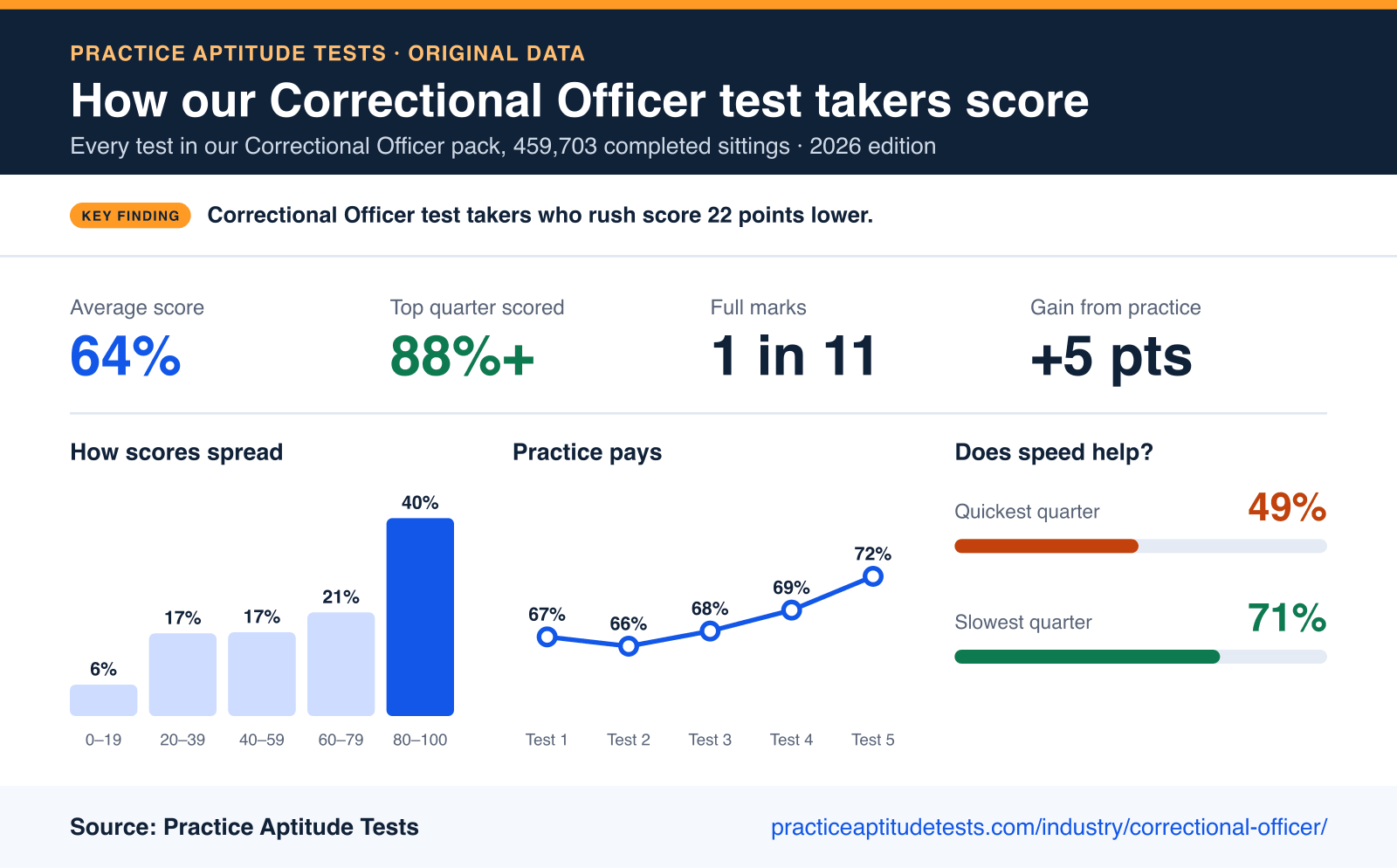
How our test takers score
Results from every test in our Correctional Officer pack, past and present.
Key findingCorrectional Officer test takers who rush score 22 points lower.
How scores spread
40% scored 80% or more, and 23% scored under 40%.
Share of sittings in each score band.
Practice pays
Regular practisers went from 67% on their first test to 72% on their fifth.
7,392 people who took five or more tests.
Does speed help?
Rushing costs marks. The quickest quarter scored 22 points lower than the slowest.
Typical pace: 48 seconds a question.
Share this data
Our practice tests mirror the formats used in Correctional Officer hiring. They are written by Practice Aptitude Tests and are not affiliated with or endorsed by any individual employer.