












Get 25% off all test packages.

Inductive Reasoning Tests

    • 21 tests |
    • 240 questions

Got an inductive reasoning test coming up? Practice Aptitude Tests gives you 21 full-length tests and 240 questions built to mirror the real assessments used by employers. Start with a free test today — no payment details required.

Prepare yourself for leading employers

Free practice inductive reasoning questions

We offer a range of inductive reasoning questions that have been designed to assess your ability to think rationally. Our questions will help you practise how to spot patterns and form logical rules from the diagrams provided.

Below we have provided three practice questions. For more sample questions and answers, download our inductive reasoning test PDF. You might also find our article on how to answer inductive reasoning tests useful.

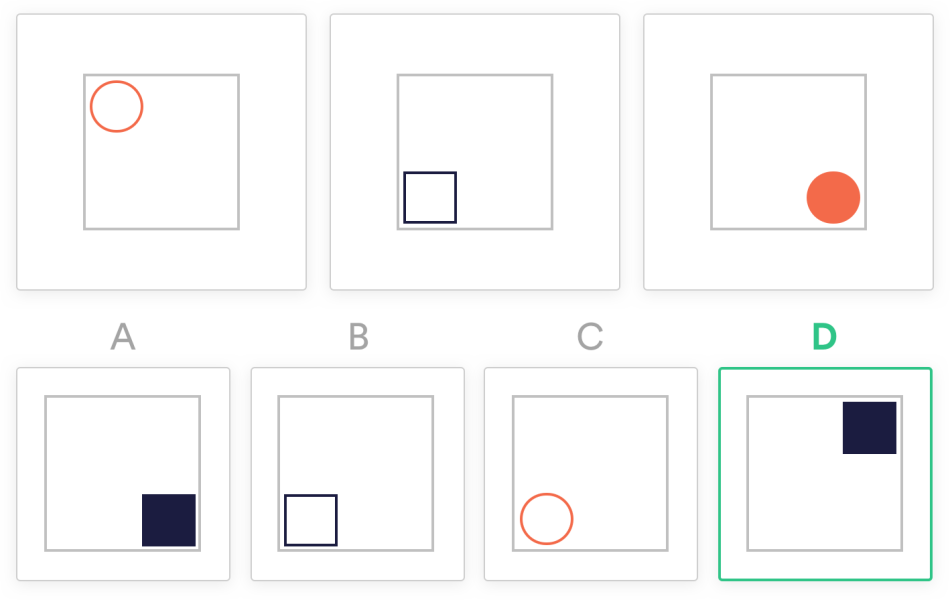
Q1) Which suggested image would come next in the following sequence?

Answer: D. The shapes are moving around the corners in an anti-clockwise direction. Therefore D is the only shape that is in the correct position.

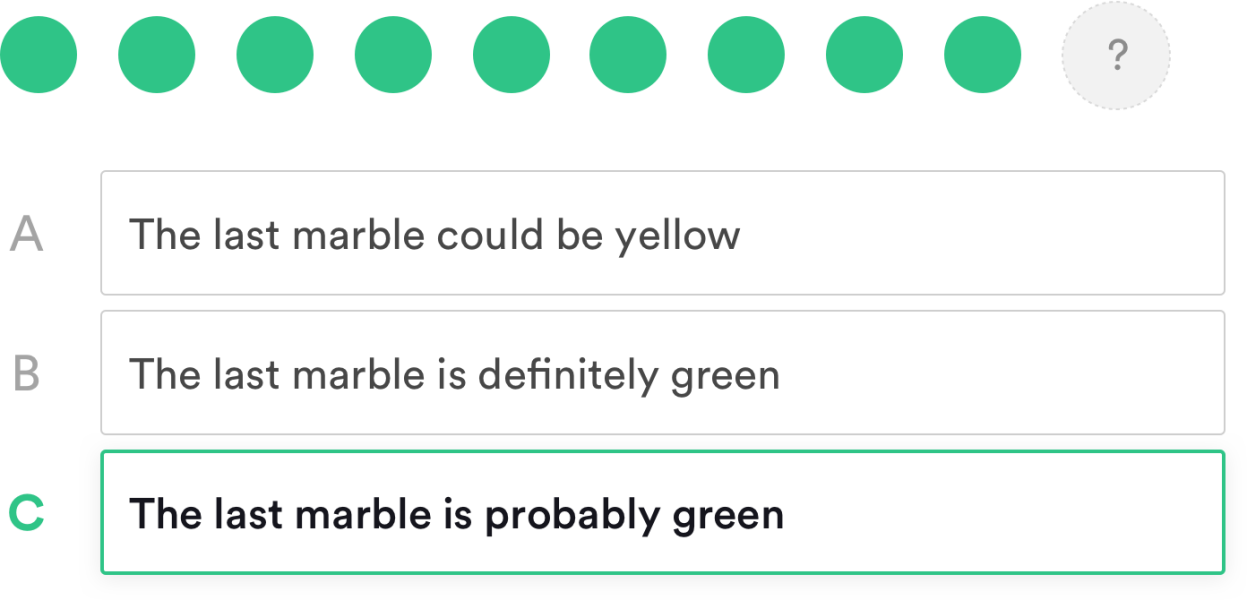
Q2) There are ten marbles in a bag. One by one you remove them from the bag to see what colour each marble is. So far, you have removed 9, all of which have been green.

Answer: C. Inductions are inferences based on reasonable probability, so if 9 out of 10 marbles have been green it is reasonable to assume that the last one will be green also.

There is no way to tell this for certain and whilst it could be yellow, nothing in the premise has suggested it would be.

Sample Inductive Reasoning Tests question Test your knowledge!

Consider a pattern where a sales team consistently exceeds targets in a specific quarter each year. Given the historical data, if the sales team exceeded their target in Q3 last year, which quarter should management focus on to potentially capitalize on this trend?

  • Q1
  • Q2
  • Q3
  • Q4

If the sequence of numbers 2, 4, 8, 16 follows a logical pattern, what would be the next number in the sequence?

  • 24
  • 32
  • 18
  • 34

Imagine a scenario where a new policy is introduced in an organization, and employees show a pattern of behavior: Adaptation, Improved Efficiency, Autonomy, and finally Mastery. After observing this pattern with several policies, what might you predict will follow an employee's adaptation to a subsequent new policy?

  • Consistent Performance
  • Improved Efficiency
  • Immediate Mastery
  • Resistance to Change

A project timeline is usually planned in phases: Conception, Initiation, Execution, and Closure. If a project manager observes that in the last five projects, major setbacks occurred during the Execution phase, what should the project manager anticipate and plan for in the next project's Execution phase?

  • Smoothing team conflicts
  • Celebrating early successes
  • Potential for significant setbacks
  • Effortless completion of tasks

After the introduction of a new database system, the learning progression among employees was recorded as follows: Week 1 - Understanding Basic Functions, Week 2 - Efficient Data Entry, Week 3 - Executing Complex Queries, Week 4 - Training Others. What can you infer about the expected learning progression by Week 3 after implementing another system upgrade?

  • Still mastering basic functions
  • Running reports and analysis without assistance
  • Undertaking autonomous complex tasks
  • Executing complex queries

Start your success journey

Access one of our Inductive Reasoning tests for FREE.

Within two hours of practice I have improved my score from 50% correct to 88%.

Joseph used Practice Aptitude Tests to improve his numerical reasoning scores.

testimonial
Neuroworx

Hire better talent

At Neuroworx we help companies build perfect teams

Join picked Try Neuroworx today

Inductive Reasoning Video Tutorials

Input Type

2 mins

Mirror Images

2 mins

Rotated Views

1 min
Improve your hiring chances by 76%

Prepare for your Inductive Reasoning Assessments

Immediate access. Cancel anytime.

Pro

Pay Annually
Pay Monthly
--- --- ---
  • 20 Aptitude packages
  • 59 Language packages
  • 110 Programming packages
  • 39 Admissions packages
  • 48 Personality packages
  • 313 Employer packages
  • 34 Publisher packages
  • 35 Industry packages
  • Dashboard performance tracking
  • Full solutions and explanations
  • Tips, tricks, guides and resources

Basic

---
  • Access to free tests
  • Basic performance tracking
  • Solutions & explanations
  • Tips and resources

Inductive Reasoning Tests FAQs

How are inductive reasoning tests scored?

Your raw score is converted into a percentile rank by comparing your result against a norm group: a large sample of candidates who have previously taken the same test. Most employers don’t publish a fixed pass mark. Instead, they set a percentile threshold that depends on the role and the volume of applicants.

For competitive graduate schemes and entry-level roles at large employers, a score at or above the 50th percentile is typically expected. For more selective roles in consulting, finance, or engineering, the bar is often higher, closer to the 65th–80th percentile.

Practising under timed conditions is the most reliable way to improve your percentile score before test day.

What is the difference between inductive, abstract, and diagrammatic reasoning tests?

The three terms are often used interchangeably by employers and test publishers, but there are subtle differences.

  • Inductive reasoning tests focus on identifying rules within sequences of shapes or figures.
  • Abstract reasoning tests follow a very similar format but may place greater emphasis on pattern recognition across a grid or matrix.
  • Diagrammatic reasoning tests typically involve following logical rules applied to diagrams, such as flowcharts or process maps, rather than pure shape sequences.

If your test invitation doesn’t specify the format, check which publisher the employer uses; this will tell you what to expect. Our non-verbal reasoning tests page covers all three types.

Is there a free inductive reasoning test I can take online?

Yes, Practice Aptitude Tests offers a full free inductive reasoning test, no payment details or credit card required. Simply create a free account to access the test, get your results instantly, and review worked solutions for every question.

Upgrading to a Pro account unlocks 21 full-length inductive reasoning tests with 240 questions, performance tracking across all attempts, and access to publisher-specific practice packs for SHL, AON, Kenexa, Saville, and Talent Q.

What do inductive reasoning tests measure?

Inductive reasoning tests measure your ability to identify patterns, apply rules, and draw logical conclusions from unfamiliar information, a capability often described as fluid intelligence. This is distinct from knowledge or experience: the tests are specifically designed to be culturally and linguistically neutral, so prior subject knowledge gives no advantage.

Employers value this because it reflects how you will perform when encountering genuinely new problems on the job, whether that’s analysing an unfamiliar dataset, troubleshooting a novel technical issue, or spotting a trend in a market you haven’t worked in before.

Where can I practice inductive reasoning tests?

To achieve high results, it is crucial to understand how inductive reasoning tests work. The best path to that is consistent practice. You can find all the best inductive reasoning tests on our website alongside guides, tips, and trial test keys.

Which employers use inductive reasoning tests?

Inductive reasoning tests are among the most widely used psychometric assessments in graduate and professional recruitment. Employers that routinely include them as part of their hiring process include:

  • Major consulting firms (McKinsey, BCG, Deloitte, Accenture)
  • Investment banks and financial services firms (Goldman Sachs, J.P. Morgan, HSBC)
  • Engineering and technology companies (Rolls-Royce, BAE Systems, BT, IBM)
  • Fast-moving consumer goods businesses (Unilever, P&G, L’Oréal)
  • Public sector programmes including the Civil Service Fast Stream and NHS Graduate Management Training Scheme.

If you’re applying to a large employer with a structured graduate or management scheme, there is a high probability that an inductive reasoning test is part of the process.

How can I improve my inductive reasoning test score?

The most effective way to improve is structured, timed practice with worked solutions, reviewing not just whether you got each answer right, but why the correct pattern holds.

Familiarise yourself with the most common pattern types (rotation, reflection, alternation, progression, and combination rules) and develop a systematic approach for scanning each question rather than relying on intuition.

For a full preparation strategy, see our guide: how to prepare for inductive reasoning tests.

Reviews of our Inductive Reasoning tests

What our customers say about our Inductive Reasoning tests

  • United States of America

    September 24, 2023

    Shapes

    I liked that it changed the styles of the problems, there was some word problems and some shapes, ect.

  • Portugal

    July 16, 2023

    Finding the sequence

    I liked the test, although I would like to see more exercises about the "trying to find the sequence."

  • United Arab Emirates

    February 15, 2023

    From internet

    Its quite interesting and challenging. The instructions are quite clear, and no ambiguity in the questions.

  • Nigeria

    January 17, 2023

    Excellent

    The questions were a bit tricky but I'm familiar with inductive reasoning questions, so it went well

  • Germany

    August 31, 2022

    great design of the user interface

    I liked that it was different forms of inductive reasoning questions, not just those concerning patterns.

  • United Arab Emirates

    August 17, 2022

    good

    a very good test to test your brain power and did give a better understanding of how this type of reasoning exam is. I hope your team all the best for creating such a useful test.

  • Zambia

    June 13, 2022

    A bit vague but makes one think

    Interesting and a bit thought-provoking but was too easy compared with the Crossover version am trying to practice for

  • Czechia

    April 05, 2022

    The logical order of the subsequent figure.

    I liked this test because it was easy to follow and I understood all the images displayed by the test.

  • Viet Nam

    March 23, 2022

    Logical thinking

    I like it because it evaluates my interpretation skills with respect to patterns, number sequences, relationships, shapes.

  • United States of America

    March 22, 2022

    Look up definition of "deductive reasoning" prior to starting

    Understanding the definition of "deductive reasoning" is essential - it is part of the test and helps anchor you while you take it.