
Probation Officer Tests
Probation officer applicants usually complete a values-based assessment, a written test, a role play and an interview. Practise with a free situational judgement test set in probation work.
- 10 questions
- 13 minutes
- Worked solutions
Free · No sign-up · Scored the moment you finish
Probation Officer Situational Judgement Test
You have 13 minutes to answer 10 questions. Each question describes a workplace situation and four possible responses. For every question, select the response you believe would be MOST effective and the response you believe would be LEAST effective. There are no trick questions; judge each response on how well it would work in the situation described.
About this test: this is one of a set of practice tests covering the areas Probation Officer assessment processes typically include. It is written by us and is not any employer’s own assessment.
-
Question 1 of 10
You are a course administration assistant at a probation service. Another assistant on the course team has fallen behind: forty trainees’ preparation tasks are unmarked on the completion log, which has to be complete before Monday’s assessment. They have told only you and have asked you not to make a fuss. You can see which tasks have actually been submitted and which have not. Which response below would be most effective, and which would be least effective?
- Mark all forty preparation tasks on the completion log as done so the log is ready for Monday, and let the colleague check the submissions afterwards when they have caught up.
- Tell the colleague you will help, that the person who runs the course has to know today, since only they can move Monday, then mark with them only what is genuinely in.
- Work through all forty unmarked tasks yourself in the evenings on top of your own work, checking each submission as you go, and tell nobody, so that the colleague is not embarrassed and the log is ready by Monday.
- Send the person who runs the course a note this morning saying the colleague is forty tasks behind on the completion log, before saying anything to the colleague, so that Monday's assessment is not put at risk.
Show the answer
Most effective: B. Tell the colleague you will help, that the person who runs the course has to know today, since only they can move Monday, then mark with them only what is genuinely in.
Least effective: A. Mark all forty preparation tasks on the completion log as done so the log is ready for Monday, and let the colleague check the submissions afterwards when they have caught up.
A: Records work as done that was never checked: the log then says trainees have prepared when you can see that some have not, and Monday's assessment runs on it.
C: Avoids the difficult conversation: one person quietly absorbing a two-person backlog gets Monday through and leaves the same colleague in the same position next month.
D: Goes over the colleague's head first: they confided in you, a word to them costs nothing, and the note arrives without any account of what has actually been submitted.
The most effective response is telling the colleague you will help while making clear that the person who runs the course has to know today: Monday is fixed, forty tasks are unmarked, and the only person who can move the assessment or find another pair of hands is the one nobody has told. It beats working through the unmarked tasks yourself in the evenings and telling nobody, because one person quietly absorbing a two-person backlog leaves the same problem standing next month. It beats sending a note about the colleague before saying anything to them, since they confided in you and a word first costs nothing and keeps them in the conversation. The least effective response is marking all forty tasks on the completion log as done: the log then says trainees have prepared when you can see that some have not, and Monday’s assessment runs on a record you know to be wrong. The principle: help a struggling colleague by getting the right people involved, never by making the paperwork say something that is not so.
-
Question 2 of 10
You are an enquiry desk assistant at a probation service. The written desk rule is that a caller is read something from their own record only after giving two pieces of information that match it. For the last month everybody on the desk has been accepting one, because the queue is long and the second question adds time to every call. Nobody has raised it. Your supervisor is working on the desk all this week. Which response below would be most effective, and which would be least effective?
- Go back to asking for both pieces on your own calls, and say nothing to anybody about what the rest of the desk is doing, so that at least your calls follow the rule.
- Send a note to the person who wrote the desk rule asking for it to be rewritten around the queue, and keep taking one piece until a new rule comes back.
- Carry on taking one piece of information like everybody else, reading callers what is on their record after a single answer, and say nothing to your supervisor this week.
- Ask your supervisor on the desk this week whether the second question stands, and say plainly that the desk has taken one piece for a month, since one answer covers everybody.
Show the answer
Most effective: D. Ask your supervisor on the desk this week whether the second question stands, and say plainly that the desk has taken one piece for a month, since one answer covers everybody.
Least effective: C. Carry on taking one piece of information like everybody else, reading callers what is on their record after a single answer, and say nothing to your supervisor this week.
A: Fixes it for yourself only: your own calls were never the problem, and a month-old drift across the whole desk carries on beside you with nobody any the wiser.
B: Delays the decision: a rewrite takes weeks, and every caller in the meantime is read their own record on one piece of information while the request sits in somebody's tray.
C: Breaches a stated rule because everybody else does: the rule governs who gets told what is on their record, and a month of collective drift is the reason to raise it rather than the reason not to.
The most effective response is asking your supervisor this week whether the second question still stands, and saying plainly that the desk has been taking one piece for a month: the rule is written, the whole desk has drifted from it, and one decision covers everybody instead of leaving each person to choose. It beats going back to asking for both pieces on your own calls while saying nothing about the rest of the desk, because your own calls were never the problem and the drift carries on beside you. It beats sending a note asking for the rule to be rewritten around the queue, since that leaves a month of callers being read their records on one piece while a rewrite is considered. The least effective response is carrying on taking one piece like everybody else: it is a written rule about who is told what is on their record, and the fact that everybody has been ignoring it is what makes raising it necessary. The principle: a rule everybody is quietly ignoring is exactly the rule somebody has to name out loud.
-
Question 3 of 10
You are a correspondence assistant at a probation service. A member of the public wrote in three weeks ago, and a colleague replied promising a full written answer by Friday. You now know the answer cannot be prepared before the middle of next month, and the colleague who made that reply has left for two weeks. The person has already rearranged a meeting of their own so that they can act on the answer on Friday. Which response below would be most effective, and which would be least effective?
- Wait until Friday morning and then telephone the person with the news, so that there is a chance the answer is further along by the time you have to explain the delay.
- Write to the person today, say the answer cannot come before the middle of next month, apologise, and offer what Friday allows, since they can still put their own meeting back.
- Let Friday pass without telling the person anything, since the answer is genuinely not ready, and wait until the middle of next month when there is something real to send.
- Send the person a short note today saying their enquiry is still being worked on, and leave the date alone so that nobody has to explain a promise somebody else made.
Show the answer
Most effective: B. Write to the person today, say the answer cannot come before the middle of next month, apologise, and offer what Friday allows, since they can still put their own meeting back.
Least effective: C. Let Friday pass without telling the person anything, since the answer is genuinely not ready, and wait until the middle of next month when there is something real to send.
A: Delays the difficult message: the meeting they moved is on Friday, so news that arrives that morning reaches them too late to be worth anything to them.
C: Silent deadline slip: they rearranged a meeting on the strength of a date this organisation gave them, and the first thing they will learn is that Friday came and nothing arrived.
D: Answers without correcting the expectation: a note that does not touch Friday leaves them still planning around it, which is the one thing they needed changing.
The most effective response is to write to the person today, say the answer cannot come before the middle of next month, apologise for the reply they were given and offer what can be provided by Friday: they rearranged a meeting around a date that will not hold, and today is the last point at which they can rearrange it back. It is stronger than telephoning on Friday morning, because by then the meeting they moved is upon them and the information has lost the only value it had. It is stronger than sending a note that says the enquiry is still being worked on, because that leaves the wrong date standing and the wrong date is the whole problem. The least effective response is to let Friday pass without telling them anything and wait until there is something real to send: a late call at least reaches them, and a holding note at least shows somebody is there, whereas silence means the first thing they learn is that a date they were given passed unremarked. The principle: when a commitment made to somebody outside the organisation cannot be kept, tell them while they can still act on the news.
-
Question 4 of 10
You are a service desk assistant at a probation service. A member of the public arrives for an appointment that a different team booked, and it turns out the appointment was cancelled last week without anybody telling them. They are angry with you, they have taken a day off work to come in, and they say this is the second time it has happened to them. You can see the cancellation on your screen but not the reason for it, and the team that made the booking can be reached this morning. Which response below would be most effective, and which would be least effective?
- Apologise, explain that the appointment was booked by a different team and that you cannot see why it was cancelled, and give the person the number for the team who can tell them, along with the booking reference from your screen.
- Apologise for the wasted day, ring the team who made the booking while the person waits with you, and come back with either a new appointment or a time today when they will hear from somebody.
- Blame the team who made the booking, telling the person that this happens every time their bookings come through this desk and that they ought to be complaining about them rather than about you.
- Offer the person the next available appointment on the spot, checking the date is one they can take without another day off, and suggest they raise the cancellation with the team who booked it if they want to know why nobody told them.
Show the answer
Most effective: B. Apologise for the wasted day, ring the team who made the booking while the person waits with you, and come back with either a new appointment or a time today when they will hear from somebody.
Least effective: C. Blame the team who made the booking, telling the person that this happens every time their bookings come through this desk and that they ought to be complaining about them rather than about you.
A: Sends the person on with the problem: they have already lost a day and been let down twice, and a phone number puts the next piece of effort back onto them.
C: Personalises the complaint: the person wants an appointment and an explanation, and turning a wasted day into an argument about which team is at fault leaves them holding neither.
D: Fixes the diary and leaves the grievance: a second cancellation with no warning is the thing they came in angry about, and nobody has taken responsibility for finding out why.
The most effective response is apologising for the wasted day, ringing the team who made the booking while the person waits with you, and coming back with either a new appointment or a time today when they will hear from somebody. The team is reachable this morning, so the person can leave with something instead of another errand. That is better than explaining that a different team booked it and giving them the number, because somebody who has lost a day and been let down twice should not have to make the next call themselves. It is better than offering the next appointment and suggesting they chase the cancellation, because that answers the diary and not the reason they are angry. The least effective response is blaming the team who made the booking and telling the person that they ought to be complaining about them: handing over the number at least points somewhere useful, and offering an appointment at least gives them a date, whereas an argument about whose fault it is puts your own position ahead of the person standing in front of you and gets them no closer to either. The principle: anger about something another team did is still your problem to resolve while the person is in front of you.
-
Question 5 of 10
You are a contact handling assistant at a probation service. Over lunch a colleague tells you, asking you to keep it to yourself, that they have not managed to reach a person who has been ringing the enquiry line for three weeks. That same person is on the list of callers another team is writing to on Friday, and that team is working on the basis that contact has been made. Your supervisor, who reports to the person running the department, is in the office this afternoon. Which response below would be most effective, and which would be least effective?
- Tell the other team that contact with the caller has been made and that nothing on their Friday list needs changing, so that your colleague's confidence is kept and the letters still go out on time.
- Ask your colleague to tell the other team themselves before Friday and leave it with them, since the information is theirs and they are the one who knows what has and has not been tried.
- Go to your supervisor this afternoon, say a caller on Friday's list may not have been reached, since that team assumes otherwise, and let them decide who needs telling, without repeating the lunchtime conversation.
- Send the other team a note suggesting they check that caller's record before Friday, saying nothing about where your doubt came from, and let them reach their own conclusion.
Show the answer
Most effective: C. Go to your supervisor this afternoon, say a caller on Friday's list may not have been reached, since that team assumes otherwise, and let them decide who needs telling, without repeating the lunchtime conversation.
Least effective: A. Tell the other team that contact with the caller has been made and that nothing on their Friday list needs changing, so that your colleague's confidence is kept and the letters still go out on time.
A: States as fact what you have not checked: your colleague said only that they had failed to reach the caller, so Friday's letters would go out on an assurance nobody in the organisation can stand behind.
B: Leaves the outcome resting on somebody else's nerve: Friday is three days away, and if your colleague says nothing you will have spent the time that could have fixed it.
D: Hints instead of raising it: a note with no reason behind it is easy to file, and the team has no way of knowing the doubt is solid enough to hold Friday's letters for.
The most effective response is going to your supervisor this afternoon to say a caller on Friday’s list may not have been reached and letting them decide who needs telling. The judgement here is whose problem this is: a confidence does not survive contact with work that somebody else is about to act on, and your supervisor is the person who can weigh both without you retelling the lunchtime conversation. That is better than asking your colleague to tell the other team themselves, because the deadline then depends on somebody who has already chosen to keep it quiet. It is better than sending an unexplained note suggesting a record check, because the team cannot tell a real warning from routine tidying and Friday arrives either way. The least effective response is telling the other team that contact has been made and nothing needs changing: the note at least prompts a check and the request to your colleague at least involves somebody who knows the facts, whereas an assurance you invented removes the last chance anybody had of catching it. The principle: a confidence binds you to discretion about how you raise something, never to silence about work that other people are relying on.
-
Question 6 of 10
You are a contact handling assistant at a probation service. A colleague on your team has twice described calls the two of you took, including what the callers said and where they live, to friends in a pub where other people could hear. They say it is harmless because no names were used. The rule you both signed says nothing about a call leaves the team. Your supervisor asks the team every Friday whether anything needs raising. Which response below would be most effective, and which would be least effective?
- Tell the colleague directly that what they described could identify a caller, say that you will raise it on Friday if it happens again, and then do exactly that.
- Repeat it around the team and spread the story of the pub, so that everybody knows who talks about callers and the colleague hears about it from somebody other than you.
- Raise it with the whole team on Friday without speaking to the colleague first, and restate the rule about calls without mentioning the pub or naming anybody at all.
- Leave it alone and take your breaks away from the colleague, on the basis that what they do in a pub is between them and the rule they signed.
Show the answer
Most effective: A. Tell the colleague directly that what they described could identify a caller, say that you will raise it on Friday if it happens again, and then do exactly that.
Least effective: B. Repeat it around the team and spread the story of the pub, so that everybody knows who talks about callers and the colleague hears about it from somebody other than you.
B: Turns it into gossip about a person: the confidentiality problem is left exactly where it was, the colleague learns it secondhand, and nobody who could act has been told anything.
C: Chooses the group over the person: a general restatement lets the one person it is aimed at conclude it was aimed at somebody else, and the retelling carries on.
D: Avoids the difficult conversation: the calls being described are ones you took as well, the colleague thinks it is harmless, and nobody has told them otherwise.
The most effective response is telling the colleague directly that what they described could identify a caller, and saying you will raise it on Friday if it happens again: they believe it is harmless, nobody has told them otherwise, and the rule they signed is what settles it. It beats raising it with the whole team on Friday without speaking to the colleague first, because a general restatement lets the person it is about decide it was meant for somebody else. It beats leaving it alone and taking your breaks elsewhere, since the calls being described are ones the two of you took and the next retelling is days away. The least effective response is repeating it around the team and spreading the story of the pub: it makes a confidentiality problem into entertainment about a colleague, and still nobody who could act on the rule has heard a word. The principle: deal with a colleague’s conduct with the colleague, and take it to the person who can act if it does not stop.
-
Question 7 of 10
You are a new entrant at a probation service. You are helping with the paperwork for the next intake. Yesterday you heard a colleague tell an applicant on the phone that the intake starts on the ninth. This morning the course timetable you were given shows it starting on the sixteenth, and the applicant has to give a month’s notice to leave their current job. The colleague is away until next week, and the person running the course is at their desk today. Which response below would be most effective, and which would be least effective?
- Ring the applicant yourself and say the timetable you were given this morning shows the sixteenth, without first finding out from anybody at the course which of the two dates the intake is actually running to.
- Say nothing to anybody and carry on with the paperwork, since the colleague knows the intake better than you do and will be back next week to put it right.
- Check the intake date with the person running the course today, and tell them what the applicant was told, since the applicant must give a month's notice against that date.
- Leave a note on the colleague's desk setting out both dates for their return next week, so that the person who gave the applicant the date is the one who corrects it with them.
Show the answer
Most effective: C. Check the intake date with the person running the course today, and tell them what the applicant was told, since the applicant must give a month's notice against that date.
Least effective: B. Say nothing to anybody and carry on with the paperwork, since the colleague knows the intake better than you do and will be back next week to put it right.
A: Acts on an assumption without checking: you hold one timetable and a colleague told them something else, so a second date from a second person may leave the applicant no better informed.
B: Withholds a fact somebody needs now: the applicant is about to give a month's notice on a date that may be wrong, and next week is after the point at which that becomes hard to undo.
D: Waits for the person who made the mistake: the correction then arrives a week later than it could have, and the applicant may already have handed in notice against the wrong date.
The most effective response is checking the intake date with the person running the course today and telling them what the applicant was told yesterday. One of the two dates is wrong, the person running the course can settle which in a minute, and the applicant is about to act on it by giving notice. It beats ringing the applicant yourself with the sixteenth, because you would be the second person to give them an unverified date. It beats leaving a note for the colleague to deal with next week, because notice given in the meantime cannot easily be taken back. The least effective response is saying nothing to anybody and carrying on with the paperwork, leaving it for the colleague to put right next week: the one person who needs the fact is the applicant, and the whole cost of the delay falls on them. It is worse than ringing the applicant, which at least gets the timetable date to them, and worse than the note, which at least starts a correction moving. The principle: when you hold a fact that contradicts what somebody outside has been told, raise it with whoever can confirm it while there is still time for the correction to matter.
-
Question 8 of 10
You are a shift team member at a probation service. At the end of each shift every person is supposed to write and sign their own entry in the handover record, so that the team coming on knows who to ask about what. To get everybody away on time, one of your team has taken to writing and signing all four entries in advance. Everybody knows, nobody has raised it, and the team coming on has twice asked you about an entry you did not write. Which response below would be most effective, and which would be least effective?
- Raise it with the colleague first, say that you will be writing and signing your own entry from now on, and tell them why the team coming on needs to know who to ask.
- Write and sign your own entry each shift without saying anything to the colleague, and let the team coming on work out for themselves whose entries are whose.
- Report the practice to your supervisor without speaking to the colleague first, since the rule is plain and it is not your place to police the habits of your own team.
- Bring it up in front of the whole team at the start of the next shift, naming the colleague and reading out the entries, and say they have been signing for work they did not do.
Show the answer
Most effective: A. Raise it with the colleague first, say that you will be writing and signing your own entry from now on, and tell them why the team coming on needs to know who to ask.
Least effective: D. Bring it up in front of the whole team at the start of the next shift, naming the colleague and reading out the entries, and say they have been signing for work they did not do.
B: Fixes it only for yourself: three of the four entries stay in one hand, so the people coming on are still asking the wrong person about most of the shift.
C: Escalates before speaking to the person: nobody has ever raised it, so the colleague has had no chance to stop, and a report lands as an accusation rather than a correction.
D: Blames a colleague in front of the team: it makes a private correction into a public accusation, aimed at the person everybody relies on to get them away on time.
The most effective response is to raise it with the colleague first, say that you will be writing and signing your own entry from now on, and tell them why the team coming on needs to know who to ask: the shortcut has a real benefit so it deserves a conversation rather than an ambush, and the team coming on has already been sent to the wrong person twice. It is better than writing and signing your own entry each shift without saying anything, because the other three entries stay in one hand and the people coming on still cannot tell whose is whose. It is better than reporting the practice to your supervisor without speaking to the colleague first, because nobody has ever raised it and the colleague has had no chance to stop. The least effective response is to bring it up in front of the whole team at the start of the next shift and say the colleague has been signing for work they did not do: it makes a private correction into a public accusation, aimed at somebody the whole team relies on. The principle: a shortcut that breaks a stated rule is raised with the person taking it, in private, before it is raised anywhere else.
-
Question 9 of 10
You are an engagement events assistant at a probation service. A community group running Thursday’s joint event needs the final numbers and the room layout from you by noon tomorrow, which you agreed with its organiser a fortnight ago. Yesterday you were also given the write-up of feedback forms from last month’s events, wanted by the end of the week. It became clear this morning that you cannot finish both by noon tomorrow, and the organiser does not know that yet. Which response below would be most effective, and which would be least effective?
- Give the morning to the feedback write-up and the afternoon to the numbers and layout, then see tomorrow which of the two is nearer to being finished.
- Assume the community group will be relaxed about noon, say nothing to its organiser, and spend today and tomorrow morning on the feedback write-up, leaving the numbers and layout unfinished.
- Finish the numbers and the room layout for noon tomorrow, and tell the person who asked for the feedback write-up this morning that it will now come at the end of next week.
- Do the feedback write-up first because it was the most recent thing you were asked to do, and start the numbers and layout with whatever time is left tomorrow.
Show the answer
Most effective: C. Finish the numbers and the room layout for noon tomorrow, and tell the person who asked for the feedback write-up this morning that it will now come at the end of next week.
Least effective: B. Assume the community group will be relaxed about noon, say nothing to its organiser, and spend today and tomorrow morning on the feedback write-up, leaving the numbers and layout unfinished.
A: Splits effort so nothing finishes: noon tomorrow is fixed and the feedback is not due until the end of the week, so dividing today between them risks missing the only date somebody outside is waiting on.
B: Assumes goodwill instead of checking it: nobody has asked the organiser anything, she is expecting the layout at noon for an event two days later, and she finds out only when it fails to arrive.
D: Ranks the work by who asked most recently: recency is not a reason, the feedback has four more days and the layout has until noon, so the two dates are never actually compared.
The most effective response is finishing the numbers and the room layout for noon tomorrow and telling the person who asked for the feedback write-up that it will now come at the end of next week. One date is tomorrow with an outside group behind it and the other has the rest of the week, so the order is settled by the dates, and the person whose work slips hears it while they can still do something. It beats giving the morning to the feedback and the afternoon to the numbers, because the fixed noon deadline should not be spending half of today competing with work that is not due yet. It is also better than doing the feedback first because it was asked most recently, which orders the day by nothing at all. The least effective response is assuming the community group will be relaxed about noon: unlike alternating, which at least advances both, and unlike the recency order, which at least decides something, this rests the whole plan on goodwill nobody has tested, and the organiser learns of the slip only when noon passes. The principle: order work by the dates people are relying on, and tell whoever loses out while they still have room to move.
-
Question 10 of 10
You are a records assistant at a probation service. On Monday your supervisor told you to clear a backlog of two hundred record corrections by Thursday, because the team that uses those records cannot work from them until it is done. This morning the person who runs the department, to whom your supervisor reports, tells you to put everything else down and prepare a set of figures for a meeting on Wednesday. You cannot do both by Thursday, and neither of them knows what the other has asked you for. Which response below would be most effective, and which would be least effective?
- Start the figures this morning and keep chipping at the corrections in the evenings, so that both land on time, and raise the clash with both of them only if it becomes clear you cannot finish.
- Do the figures first because the request came from the person your supervisor reports to, and tell your supervisor on Thursday that the corrections have slipped and will need another few days.
- Hand the corrections to a colleague on the team and ask them to carry them until Thursday while you do the figures, leaving them to explain where it has got to if anybody asks about it.
- Tell both of them today that the requests clash, since neither knows of the other, set out what you can finish by each date, and ask which should give way and what happens to it.
Show the answer
Most effective: D. Tell both of them today that the requests clash, since neither knows of the other, set out what you can finish by each date, and ask which should give way and what happens to it.
Least effective: C. Hand the corrections to a colleague on the team and ask them to carry them until Thursday while you do the figures, leaving them to explain where it has got to if anybody asks about it.
A: Splits the effort so neither finishes: two hundred corrections and a set of figures cannot both be done properly in three days, and by the time you can see that, the dates the two of them could have moved have gone.
B: Settles a clash by seniority and reports it too late: the team waiting on the records finds out on Thursday, when nobody can move the date or find anybody else to do the work.
C: Passes the problem on without owning it: your colleague never accepted Thursday, does not know which of the two hundred matter most, and neither of the people who set the dates learns that they clash.
The most effective response is telling both of them today that the two requests clash, setting out what you can finish by each date, and asking which of the two should give way. Only the two people who set the dates can decide which matters more, and today is the last point at which either of them can act on the answer. That is better than starting the figures and chipping at the corrections in the evenings, because three days will not stretch to cover both and the clash stays invisible until it is too late. It is better than doing the figures first and reporting the slip on Thursday, because seniority is not a reason and Thursday is after the day the records were needed. The least effective response is handing the corrections to a colleague and leaving them to explain where it has got to: working evenings at least keeps the job with the person who was given it, and doing the figures first at least reflects a real decision, whereas a colleague who never took on the deadline cannot judge which corrections matter and the two people who could resolve it are still unaware. The principle: when two instructions cannot both be met, the clash belongs with the people who set them, while they can still change one.
What are Probation Officer tests?
Probation officer tests are the assessments HM Prison and Probation Service sets for trainee probation officers on the Professional Qualification in Probation (PQiP). After the application form, candidates may be invited to an online values-based assessment, which has no time limit. Those who pass attend a half-day online assessment centre with a written test, a role play with an offender and an interview.
The tests you are likely to sit
Every applicant takes these. Your invitation will tell you when each one is due.
| Assessment | What it measures |
|---|---|
| Values-based assessment | Whether your values suit the role |
| Written test | Your written communication |
| Role play | How you handle a conversation with an offender |
| Interview | Your motivation and suitability for the role |
Practise the real thing
Practice moves scores fastest on the tests set under time pressure, and every question in the pack comes with the working shown.
- 10
- practice tests
- 100
- questions, all solved
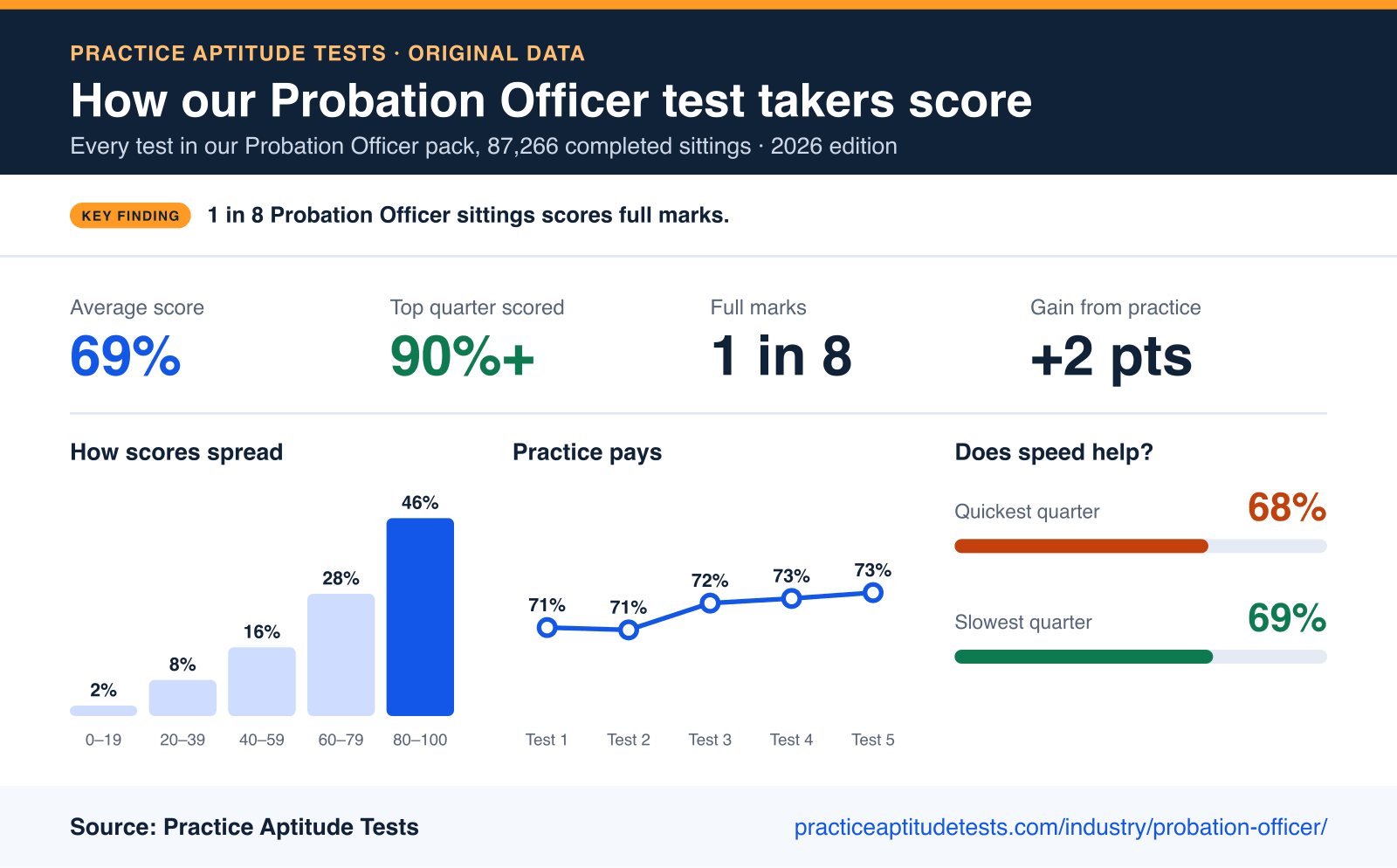
Practice Aptitude Tests · Original data
How our test takers score
Results from every test in our Probation Officer pack, past and present.
Key finding1 in 8 Probation Officer sittings scores full marks.
How scores spread
46% scored 80% or more, and 11% scored under 40%.
Share of sittings in each score band.
Practice pays
Regular practisers went from 71% on their first test to 73% on their fifth.
2,931 people who took five or more tests.
Does speed help?
Speed makes little difference here.
Typical pace: 50 seconds a question.
Share this data
Our practice tests mirror the formats used in Probation Officer hiring. They are written by Practice Aptitude Tests and are not affiliated with or endorsed by any individual employer.