Verbal Reasoning Test
Reading comprehension, verbal critical reasoning and the true, false or cannot say format, in the styles employers actually set. Every question comes with the reasoning explained, not just the answer.
- 20 questions
- 20 minutes
- Worked solutions
- Printable PDF
Free · No sign-up · Scored the moment you finish






What is a verbal reasoning test?
A verbal reasoning test measures how accurately you read a passage of text and judge what it does and does not support. Employers use it to sift graduate applicants before interview. You are given a short passage and a series of statements, and for each one you decide whether it is true, false or cannot be said from the passage alone. Reading closely matters as much as reading quickly.
Free verbal reasoning test
Start the free test. It opens full screen, without leaving this page.
Prefer paper?
Download this test as a PDF or a second practice paper with different questions.
Worked solutions included. No sign-up.
Free Verbal Reasoning Test
-
Question 1 of 20
A regional logistics firm installed automated sorting equipment at three of its five warehouses last year, while the remaining two continued to sort parcels by hand. Managers wanted to see whether the machinery would lift output before deciding on any wider rollout, so the operations team was asked to track the results carefully at every site over the year.
In the twelve months that followed, the three automated warehouses each processed more parcels per shift than they had in the previous year. The two manual warehouses recorded no change in the number of parcels processed per shift over the same period. The figures were collected shift by shift and presented to the board, which noted that the automated sites had handled their busiest weeks without the delays that had troubled them a year earlier.
All three warehouses that installed the automated equipment processed more parcels per shift than they had in the previous year.
- True
- False
- Cannot say
Show the answer
Answer: A. True
True: the passage states the three automated warehouses “each processed more parcels per shift than they had in the previous year”, and “each” covers all three. False is wrong because nothing in the text contradicts the increase. Cannot say is wrong because the increase is stated directly, so the reader can decide it from the passage alone rather than being left uncertain.
-
Question 2 of 20
Following a year-long trial of automated sorting equipment at three of its five warehouses, a logistics firm reviewed whether to extend the machinery to the two sites that still sort parcels by hand. The trial had been closely watched by the board, which asked for a full account of the costs and the benefits before any further spending was approved.
A board member observed that the upfront cost of the equipment was substantial, and that the firm would need to weigh this against the productivity gains before committing further funds. At the close of the review the firm has not decided whether to install the equipment at the two remaining warehouses, and no timetable for reaching a decision was announced. The matter, the board said, would be revisited once the trial figures had been studied in full.
The firm will install the automated equipment at its two remaining warehouses within the next year.
- True
- False
- Cannot say
Show the answer
Answer: C. Cannot say
Cannot say: the passage states the firm “has not decided whether to install the equipment at the two remaining warehouses”, so it gives no timetable. True is wrong because no future installation is asserted. False is wrong because the passage does not rule installation out either; it simply leaves the decision open, which is exactly what cannot say describes.
-
Question 3 of 20
After a logistics firm fitted automated sorting equipment at three of its five warehouses, managers noted that the automated sites also reported fewer sorting errors than they had before. Some staff were quick to credit the new machinery for the improvement and pressed for it to be rolled out across every warehouse as soon as the budget would allow.
The firm’s analysts were more cautious. They pointed out that error rates had been falling gradually across all five sites for several years before the equipment arrived, including at the two warehouses that still sorted parcels by hand. Better staff training and revised checking procedures had been introduced across the business over the same period, and the analysts said it was not possible to attribute the whole of the recent fall to any single change.
The automated equipment was the sole cause of the reduction in sorting errors at the automated warehouses.
- True
- False
- Cannot say
Show the answer
Answer: B. False
False: the passage explicitly cautions that error rates “had been falling gradually across all five sites for several years before the equipment arrived”, so a factor other than the equipment was already reducing errors, which is enough to contradict the equipment being the sole cause. True is wrong because the text never credits the equipment alone. Cannot say is wrong because the passage does not leave the matter open: it names a pre-existing cause, so the sole-cause claim can be judged false against the text rather than treated as unknown.
-
Question 4 of 20
A logistics firm published an internal review of the three warehouses where it had installed automated sorting equipment, comparing them with the two warehouses that still sorted parcels by hand. The review set out detailed figures for parcels processed per shift and for sorting errors at each of the five sites over the course of the year.
The review made no attempt to compare staffing levels between the automated and manual sites, and the report did not record how customer complaints had changed over the period. Its authors explained that the study had been commissioned to measure output and accuracy alone, and that questions about staffing and about customer service would be examined separately in a later piece of work that had not yet begun at the time the review was published.
The automated warehouses employed fewer staff than the manual warehouses.
- True
- False
- Cannot say
Show the answer
Answer: C. Cannot say
Cannot say: the passage states the review “made no attempt to compare staffing levels between the automated and manual sites”, so the text gives no information about relative staffing. True is wrong because it assumes automation must have cut headcount, a real-world guess the passage never supports. False is wrong because the passage does not state that staffing was equal or higher either; it is simply silent on the comparison, so neither direction can be settled.
-
Question 5 of 20
Deep-sea vents on the ocean floor release mineral-rich fluids that are heated by activity beneath the crust. Around these vents live communities of organisms that do not depend on sunlight for energy, even though no light of any kind reaches the sea floor at such extreme depths, where the water is permanently dark and intensely cold.
Instead, certain bacteria there convert chemicals dissolved in the vent fluids into energy, a process known as chemosynthesis. Larger animals, including tube worms and some species of crab, feed on these bacteria or host them within their own bodies. Because the whole community is built on chemical energy rather than on light, it can flourish far below the levels that sunlight from the surface is ever able to reach.
The bacteria living around the deep-sea vents rely on sunlight to produce energy.
- True
- False
- Cannot say
Show the answer
Answer: B. False
False: the passage says these communities “do not depend on sunlight for energy” and that the bacteria instead use chemosynthesis to convert dissolved chemicals into energy, which contradicts reliance on sunlight. True is wrong because it asserts the opposite of the text. Cannot say is wrong because the passage explicitly settles the point, so the reader can decide it rather than being left uncertain.
-
Question 6 of 20
Researchers studying a field of deep-sea vents tracked how the animal and bacterial communities around each vent changed over several years. They left recording instruments in place on the sea floor and returned at intervals to collect data on exactly which organisms were present at each of the vents they were monitoring.
The researchers observed that when a vent stopped releasing fluid, the community of organisms around it declined within months, as the chemical supply that sustained the local bacteria was cut off. Vents that continued to release fluid, by contrast, supported stable communities throughout the study. The team described the link between an active vent and the life around it as one of the clearest and most consistent patterns in all of their data.
When a vent stopped releasing fluid, the community of organisms around it declined.
- True
- False
- Cannot say
Show the answer
Answer: A. True
True: the passage states researchers “observed that when a vent stopped releasing fluid, the community of organisms around it declined within months”. False is wrong because it reverses the reported outcome. Cannot say is wrong because the decline is directly reported as an observation, so the text decides the statement and leaves nothing for the reader to guess.
-
Question 7 of 20
A team studying deep-sea vents found that new vents, once they became active, were colonised by organisms similar to those living at established vents nearby. Within a year of a vent starting to release fluid, tube worms, crabs and the bacteria they rely on had all appeared around it and begun to form a community much like the others in the field.
The same researchers, however, did not establish how the organisms travelled between vent sites, which can lie many kilometres apart across open sea floor. They suggested that larvae might drift on deep ocean currents, but stressed that this was only a hypothesis and that they had gathered no direct evidence of the route any organism actually took. Identifying the mechanism, they wrote, would require a very different kind of study.
The researchers determined how the organisms travelled from one vent site to another.
- True
- False
- Cannot say
Show the answer
Answer: B. False
False: the passage says that although new vents were colonised by similar organisms, the researchers “did not establish how the organisms travelled between vent sites”, which directly contradicts the claim that they determined it. True is wrong because it asserts something the text explicitly denies. Cannot say is wrong because the passage states plainly that the mechanism was not established, deciding the statement.
-
Question 8 of 20
To learn more about life around deep-sea vents, a research team collected fluid and mineral samples from several vents and analysed the microbes that they contained. The work was difficult: the extreme pressure and temperature at these depths make direct observation almost impossible, so most of the material had to be gathered by instruments lowered from a ship far above.
When the samples were sequenced, they contained bacteria that were genetically distinct from any previously catalogued. The team recorded these new types alongside the more familiar species and noted that the vents may host many more microbes that science has yet to describe. Each expedition, they added, tended to turn up at least a few organisms that matched nothing at all in the existing scientific databases.
Some bacteria found in the vent samples did not match any bacteria previously catalogued.
- True
- False
- Cannot say
Show the answer
Answer: A. True
True: the passage states samples “contained bacteria that were genetically distinct from any previously catalogued”, which is what the statement asserts. False is wrong because it denies a directly stated finding. Cannot say is wrong because the passage confirms the finding explicitly, leaving nothing undecided for the reader to weigh up.
-
Question 9 of 20
A city introduced a scheme allowing residents to borrow bicycles from docking stations placed across its central districts. Under the scheme, the first thirty minutes of each hire are free, and hires that run for longer than that are charged to the rider by the hour, with the fee added automatically to the account linked to their travel card.
In its first year, the scheme recorded more than two million individual hires. Surveys carried out by the operator found that most hires lasted less than thirty minutes, with riders typically making short trips between nearby stations rather than keeping a bicycle for a long journey. The operator said this pattern of quick, local trips matched closely what it had hoped the scheme would encourage when it first set the pricing.
Most hires under the scheme were free of charge.
- True
- False
- Cannot say
Show the answer
Answer: A. True
True: the passage states the first thirty minutes of each hire are free and that surveys “found that most hires lasted less than thirty minutes”; a hire under thirty minutes falls entirely within the free period, so most hires carried no charge. False is wrong because it denies this entailment. Cannot say is wrong because the two stated facts together settle the point without needing outside information.
-
Question 10 of 20
The operator of a city bicycle-hire scheme published figures showing how demand for the bicycles varied through the week. Use was heaviest on weekday mornings and evenings, with far fewer hires recorded in the middle of the day and at weekends right across the whole network of docking stations that the scheme ran.
The operator attributed this pattern to people travelling to and from work, pointing to the timing of the peaks as its evidence. It did not, however, carry out any survey asking riders why they were making their trips, and acknowledged that it held no direct information about the purpose of individual journeys. The morning and evening peaks, it said, were consistent with commuting but had not been confirmed against riders’ own accounts.
The heavy weekday morning and evening use was caused by people travelling to and from work.
- True
- False
- Cannot say
Show the answer
Answer: C. Cannot say
Cannot say: the passage reports only that the operator “attributed” the peak pattern to people travelling to and from work; an attribution is a suggested explanation, not an established cause, and the text offers no confirmation. True is wrong because the passage confirms only the operator’s view, not the cause itself. False is wrong because commuting is not contradicted; it is simply left unproven.
-
Question 11 of 20
Six months after launching its bicycle-hire scheme in the central districts, a city added new docking stations in the outer districts to widen the scheme’s reach. The operator then monitored how often the stations in each area were used over the remainder of the first year, keeping a separate record for the central and the outer sites.
The outer-district stations, which had been added later, were used less frequently than those in the centre throughout that period. The operator suggested that fewer journeys began or ended in the outer areas because homes and workplaces there were more spread out, making a short bicycle hire less convenient than in the dense central districts. It said it would keep the outer stations under review before deciding their future.
The outer-district docking stations were used more often than those in the central districts.
- True
- False
- Cannot say
Show the answer
Answer: B. False
False: the passage states the outer-district stations “were used less frequently than those in the centre”, which is the opposite of the statement. True is wrong because it reverses the stated comparison. Cannot say is wrong because the passage gives a direct comparison of the two areas, so the statement can be decided against rather than left open.
-
Question 12 of 20
After a successful first year, the operator of a city bicycle-hire scheme announced plans to expand it with additional docking stations. It said any expansion would depend on securing further funding, and that no work would begin until a full review of the first year had been completed and formally published for the council to consider.
At the time of the announcement the operator has not confirmed where the new stations will be placed. Local groups in several districts, both central and outer, have asked for stations of their own, but the operator said it would decide the locations only after studying where demand across the city was strongest. No shortlist of possible sites has been published, and residents were told to expect further details later in the year.
The new docking stations added during the expansion will be placed in the outer districts.
- True
- False
- Cannot say
Show the answer
Answer: C. Cannot say
Cannot say: the passage states the operator “has not confirmed where the new stations will be placed”, so their location is unknown. True is wrong because no location is asserted. False is wrong because the passage does not rule the outer districts out either; it leaves the placement undecided, which is the definition of cannot say.
-
Question 13 of 20
A publishing house studied the borrowing habits of subscribers to its digital library, drawing on records of every title borrowed over the course of a full year. It then grouped the results by category to see which kinds of book were the most popular among the many thousands of readers who used the service each month.
The house found that among all subscribers, fiction was borrowed more often than non-fiction, a gap that held in every single month of the year studied. Within fiction, crime and romance titles were borrowed most, while among non-fiction, biographies and popular science led the way. The house said the findings would help it decide which categories to expand in the year ahead, while still offering a broad range of both.
Non-fiction was borrowed more often than fiction among the library’s subscribers.
- True
- False
- Cannot say
Show the answer
Answer: B. False
False: the passage states that “among all subscribers, fiction was borrowed more often than non-fiction”, which is the reverse of the statement. True is wrong because it asserts the opposite of the text. Cannot say is wrong because the passage gives the direct comparison between fiction and non-fiction, so the reader can decide the statement rather than being left uncertain.
-
Question 14 of 20
A publishing house examined how the device a subscriber used related to how much that person read on its digital library. It compared subscribers who mainly read on large tablets with those who mainly read on small-screen phones, looking closely at how many books each of the two groups managed to finish in a typical month.
Subscribers who read on tablets finished, on average, more books each month than those who read on small-screen phones. The analysts suggested that the larger screen made longer reading sessions more comfortable, though they noted they had not tested that explanation directly. The house offers the same catalogue to every subscriber, so the difference could not be put down to some titles being unavailable on one type of device.
Subscribers who read on tablets finished more books per month, on average, than those who read on small-screen phones.
- True
- False
- Cannot say
Show the answer
Answer: A. True
True: the passage states subscribers reading on tablets “finished, on average, more books each month than those who read on small-screen phones”. False is wrong because it denies a directly stated comparison. Cannot say is wrong because the averages are explicitly compared in the text, so the reader can decide it rather than treating it as unresolved.
-
Question 15 of 20
A publishing house looked at whether a goal-setting feature in its reading app was linked to how much its subscribers used the library. Subscribers could choose to set themselves a monthly reading goal, and the house compared the borrowing of those who chose to set a goal with the borrowing of those who did not set one at all.
Subscribers who set a monthly reading goal borrowed more titles than those who did not. However, the study did not measure whether borrowing more titles meant reading more of them, nor whether those who set goals actually met the targets they had chosen. The analysts cautioned that a borrowed title is not necessarily a finished one, and said a separate study would be needed to see how much of each book was actually read.
Subscribers who set a monthly reading goal read more books than those who did not set one.
- True
- False
- Cannot say
Show the answer
Answer: C. Cannot say
Cannot say: the passage says goal-setters “borrowed more titles”, but adds the study “did not measure whether borrowing more titles meant reading more of them”, so reading more cannot be inferred. True is wrong because borrowing is not the same as reading, and the text blocks that leap. False is wrong because the passage does not state goal-setters read fewer or the same; reading was simply not measured.
-
Question 16 of 20
A publishing house runs a digital library that its subscribers can read across a wide range of devices, from large tablets to small-screen phones. It reviewed how the service worked on each type of device before publishing a wider report on the reading habits of subscribers and on the way those habits varied from one group of readers to another.
The house offers the same catalogue to all subscribers regardless of the device they use, so every title in the library can be borrowed on any supported device. It confirmed that neither the price of a subscription nor the range of available books changed from one device to another. Any differences in how much people read, it said, therefore could not be put down to some books being missing on particular devices.
The publishing house offered a different catalogue to subscribers depending on the device they read on.
- True
- False
- Cannot say
Show the answer
Answer: B. False
False: the passage states the house “offers the same catalogue to all subscribers regardless of the device they use”, which contradicts a device-dependent catalogue. True is wrong because it asserts the opposite of the text. Cannot say is wrong because the passage directly addresses the catalogue and settles the matter, so the statement can be decided.
-
Question 17 of 20
A national survey examined how households changed their spending after a sharp rise in energy prices. The authors set out their method in careful detail so that readers could judge for themselves how reliable the findings were likely to be, and so that later researchers could see clearly how the figures in the report had been gathered.
The survey was conducted once, at the end of the period, and relied on households recalling their earlier spending rather than on records kept at the time. The authors acknowledged that this method could introduce inaccuracies, since people do not always remember past spending correctly, and recommended that future surveys collect data at several points during the period rather than asking about all of it at the very end.
The survey collected spending data at several points during the period studied.
- True
- False
- Cannot say
Show the answer
Answer: B. False
False: the passage states the survey “was conducted once, at the end of the period, and relied on households recalling their earlier spending”, and that collecting data at several points was only a recommendation for future surveys. True is wrong because it claims the opposite of the single, end-of-period method. Cannot say is wrong because the passage explicitly describes the method, deciding the statement.
-
Question 18 of 20
A national survey of household budgets looked at how families in different income groups responded to a rise in energy prices. It divided respondents into income bands and tracked the changes in spending that each band reported over the period being studied, so that the experience of richer and poorer households could be compared side by side.
The survey found that across all income groups, spending on non-essential goods fell during the period studied. When asked how they had adjusted their budgets, the most common response was cutting back on eating out, followed by delaying larger purchases such as furniture and electrical goods. Although the size of the cutback varied from one income band to another, the direction of the change was the same in every group.
Spending on non-essential goods fell across all income groups during the period studied.
- True
- False
- Cannot say
Show the answer
Answer: A. True
True: the passage states that “across all income groups, spending on non-essential goods fell during the period studied”. False is wrong because it denies a directly stated finding. Cannot say is wrong because the passage explicitly covers all income groups, so the reader can decide the statement rather than treating some groups as unaccounted for.
-
Question 19 of 20
A national survey asked households how they had coped with higher energy bills after prices rose. Alongside cutting back on their day-to-day spending, some of the respondents said that they had found extra ways to bring more money into the household during the period, hoping to offset at least part of the increase in what they were paying.
The report noted that some households reported taking on additional paid work to offset higher bills, but it did not record how many hours this involved or whether the extra income fully covered the increase. The authors said they had asked only whether households had taken on extra work, not how much they had earned from it, and that judging whether the income was enough would need far more detailed data.
The additional paid work fully covered the higher energy bills for the households that took it on.
- True
- False
- Cannot say
Show the answer
Answer: C. Cannot say
Cannot say: the passage says some households reported taking on extra paid work, but that the report “did not record how many hours this involved or whether the extra income fully covered the increase”. True is wrong because full coverage is exactly what was not recorded. False is wrong because the passage does not state the income fell short either; whether it covered the bills is simply unknown.
-
Question 20 of 20
A national survey examined how households in different income groups changed their heating habits after energy prices rose. It compared the responses of the lowest and the highest income bands in particular detail, setting the two groups side by side so that the difference in how each had reacted to the higher bills could be seen clearly.
Households in the lowest income group reduced their heating use more than households in the highest income group did, often turning the heating on for fewer hours or heating only the rooms they used most. Higher-income households made smaller changes, with many reporting that they had kept their heating much as before. The survey suggested the sharper cutbacks reflected the greater pressure that rising bills placed on tighter budgets.
The lowest-income households reduced their heating use by more than the highest-income households did.
- True
- False
- Cannot say
Show the answer
Answer: A. True
True: the passage states households “in the lowest income group reduced their heating use more than households in the highest income group did”, which is exactly the two groups the statement names. False is wrong because it reverses the stated comparison. Cannot say is wrong because the passage compares those two income groups directly, so the reader can decide the statement rather than leaving it unresolved.
How to interpret your score
| Score | What it suggests |
|---|---|
| 17 to 20 | Comfortably above the bar for most graduate schemes |
| 13 to 16 | Around the typical pass mark. Worth practising for speed |
| 9 to 12 | Below most employer thresholds. Focus on method before speed |
| 8 or fewer | Work through the worked solutions above before retrying |
Employers set their own thresholds and many sift on the top percentage of applicants rather than a fixed mark, so treat these as a guide.
Practise with the full pack
One test tells you the style. A pack gives you the pace: batches under time pressure, marked, with the working shown.
- 54
- Verbal Reasoning tests
- 685
- questions, all solved
Types of verbal reasoning question
Most tests are built from a handful of formats: critical reasoning from a passage at the graduate end, language skills at the foundation end. Each guide below covers one, with practice questions.
True, false or cannot say
The graduate standard: judge whether a statement follows from a passage, using only the passage.
Practise true, false or cannot say questionsWord analogies
Complete the relationship between word pairs. The trap is the plausible near-relation.
Practise word analogy questionsWord meaning
Choose the word that best fits a sentence or definition.
Practise word meaning questionsHow are verbal reasoning tests scored?
Most employers score you against other candidates, not against a fixed pass mark: your raw score becomes a percentile. Attempting questions matters, because most tests are built so few candidates finish, and guessing usually pays: negative marking is rare, but check the instructions.
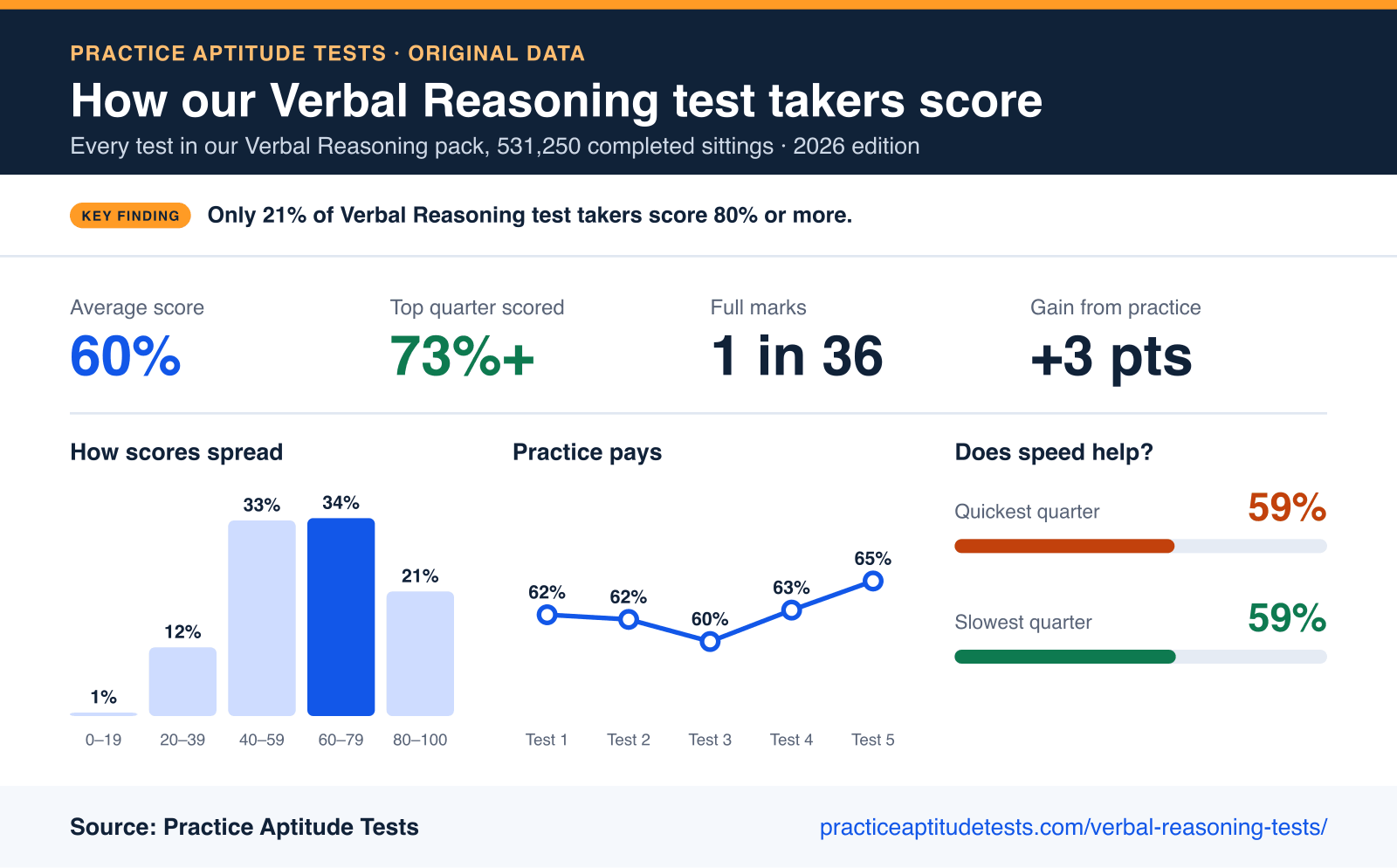
Practice Aptitude Tests · Original data
How our test takers score
Results from every test in our Verbal Reasoning pack, past and present.
Key findingOnly 21% of Verbal Reasoning test takers score 80% or more.
How scores spread
21% scored 80% or more, and 12% scored under 40%.
Share of sittings in each score band.
Practice pays
Regular practisers went from 62% on their first test to 65% on their fifth.
14,426 people who took five or more tests.
Does speed help?
Speed makes little difference here.
Typical pace: 37 seconds a question.
Share this data
Video tutorials
The methods behind the questions above, from our team