Patterns, sequences, premises and arguments, across the five formats employers set: deductive, inductive, diagrammatic, abstract and critical reasoning. Every question below comes with a worked solution.
A logical reasoning test measures how well you spot patterns and follow rules to reach a sound conclusion. Employers use it to sift applicants before interview, often without any need for words or numbers. You are shown a sequence or set of relationships and asked to work out what comes next or what must be true, choosing the best answer from four options. Clear thinking matters as much as speed.
Logical reasoning is an umbrella term: your invitation may name any of five related formats, each with its own free test and guide. If it does not name one, practise across them.
Deductive reasoning
Stated premises, usually word problems, and the conclusion that must follow.
A logical reasoning test measures your ability to work out the rule
governing a set of information and apply it to reach the correct
conclusion. It is a test of problem-solving, pattern recognition and
decision-making, and it deliberately avoids relying on knowledge you have
learned elsewhere.
Most versions are non-verbal and multiple choice. You are shown shapes,
symbols, sequences or short scenarios, and you reach the answer by deduction
rather than by recall. Everything you need is in the question, which is what
lets an employer set the same test across candidates from very different
backgrounds.
Employers use it because logic sits underneath so much of the working day.
The same skill that finds the next figure in a sequence is used to develop
strategy, assess risk and forecast, so a logical reasoning score is treated
as a signal of how well someone will handle unfamiliar problems on the job.
How are logical reasoning tests scored?
Most employers score you against other candidates, not against a fixed
pass mark: your raw score becomes a percentile. Competitive graduate
schemes commonly sift at around the 70th to 80th percentile. Attempting
questions matters, because most tests are built so few candidates finish,
and guessing usually pays: negative marking is rare, but check the
instructions.
Timing is tight, usually around a minute a question, and the tests are built so that few candidates finish comfortably. ** A minute spent on one stubborn item is a later question you never reach, and both cost the same mark.
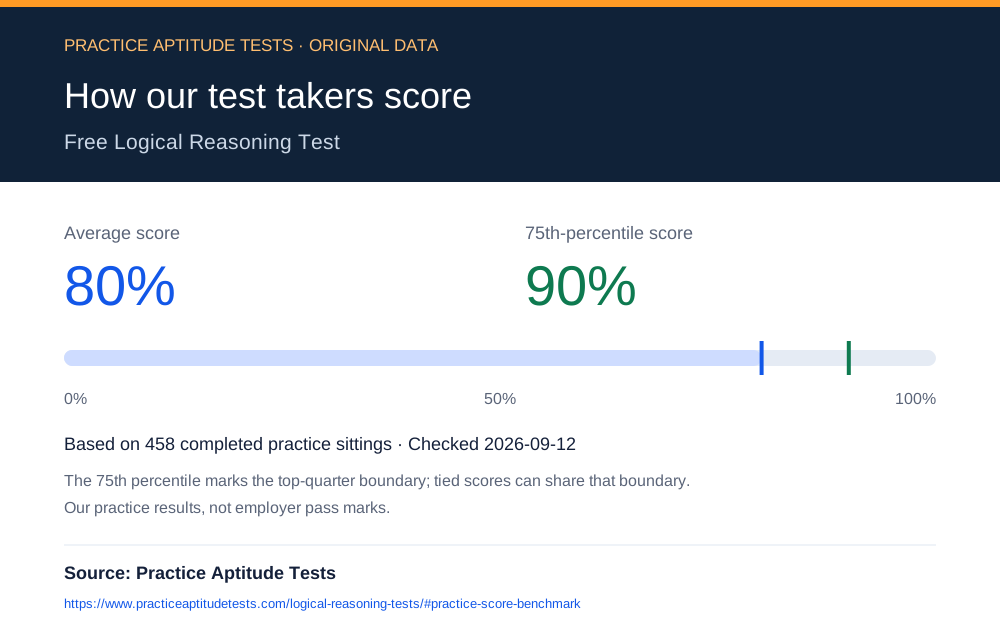
Based on 826 completed practice sittings, all time. Checked 16 September 2026.
The 75th percentile marks the boundary of the top quarter of recorded scores; tied scores can share that boundary. These are our practice results, not employer pass marks.
How we calculate these figures
We use all-time completed, scored attempts at this practice test. Repeat attempts count separately, so the sample is sittings rather than unique people.
The average is the mean score across those sittings. The 75th percentile comes from their recorded score distribution. The “checked” date is when we retrieved the figures, not the period when the tests were taken.
Sharing these figures? Please credit Practice Aptitude Tests and link to this page.
Who uses logical reasoning tests?
Logical reasoning tests are common for managerial roles and above, and across
graduate schemes, in sectors including law, investment banking, consultancy,
human resources, customer service and market research. If a role involves
analytical or decision-making work, expect one.
Most employers license their tests from a small number of publishers,
and the timing and question style vary between them, so find out which
publisher your employer uses before you prepare seriously. It is usually
named in the invitation email. Our test publisher guides
cover each format, and the employer guides
cover specific companies’ processes.
Video tutorials
The methods behind the questions above, from our team
Is a logical reasoning test the same as an IQ test?
They are related but not the same. Both probe reasoning without relying on learned knowledge, but a logical reasoning test is aimed at predicting job performance and is usually built around specific formats such as shape sequences or argument analysis, rather than producing a single intelligence score.
What is the difference between logical and abstract reasoning?
Abstract reasoning is one type of logical reasoning. “Logical reasoning” is the umbrella term covering deductive, inductive, diagrammatic, abstract and critical formats, while “abstract” refers specifically to finding the rule that links a visual sequence. If you are set an abstract test, you are sitting a logical reasoning test.
Do I need any prior knowledge for a logical reasoning test?
No. The questions are self-contained and most are non-verbal, so no subject knowledge or vocabulary is assumed. Everything needed to find the answer is in the question itself, which is the point: the test measures reasoning, not what you have already learned.
Can I use a calculator?
Most logical reasoning questions are pattern-based and need no arithmetic, so a calculator rarely helps. Where a format includes numerical elements, any sums are kept simple. Check your invitation for the rules, but the deciding factor is almost always your reasoning, not your calculation.
What is the best way to prepare?
Practise under the real time limit from the start, and review every answer you got wrong; untimed work builds accuracy but not the speed the test measures. Our logical preparation guide covers the full sequence. The improvement guide and our question-solving guide go deeper.
Reviews
Rated 4.8 out of 5 across 595 reviews. A selection:
Fast analytical processing
I liked the test was timed and that it was timed overall and not for specific questions so you can be consistent with your timing in different level of question difficulty. It was exactly the same as the practice test making it unfairly easy.
Rapha Deering · UK · January 2023
Repetition of sample practice test
I like the practice test. I didn't expect the same questions to repeat even for the timed test. So this score would not be my real score, as I already attempted these same questions while taking the untimed practice test.
Rajitha Rao · USA · November 2022
Great one to start with
Great test to practice finding patterns. Other practices tests I have taken were more intimidating, but this one is a good place to start. I felt like I actually had enough time to think and find the pattern, as opposed to being rushed and having questions disappear.
Kelsey Rogers · USA · October 2021
Start practising today
Take a free test in any format, then upgrade when you know which one you need.