
Most bartender interviews are behavioral rather than technical. Expect questions about a difficult customer, what you do when someone has had too much, how you cope with a rush and how you work with the rest of the bar team, plus two or three on drinks knowledge. Many venues finish with a short trial behind the bar.
What the manager is really deciding is whether you are safe to leave alone with the license, quick enough for a Friday night, and pleasant to work beside. Every answer below is built to show one of those three things.
The STAR interview method is the structure to use for anything that starts “tell me about a time”. Set the Situation in one line, say what your Task was, spend most of the answer on the Action you took, and finish on the Result. It stops a good story turning into a rambling one.
10 bartender interview questions and example answers
1. How did you become interested in bartending?
This is a warm-up, but it is also a check on whether you see bar work as a career or as a stopgap. Give a real story with a person or a place in it, and land on something about the craft rather than the social life.
Example answer: “I started as a barback in a busy pub while I was studying, mostly for the money. The head bartender used quiet Tuesdays to teach me the classics, and once I could build a round without thinking about it I started reading properly about spirits. What kept me in it is that the job is half craft and half reading a room, and no two shifts are the same.”
2. Can you briefly explain the process of making a popular cocktail?
This tests whether you actually know specs or have only watched other people work. Give a full recipe with measurements, the method, the glass and the garnish, and add one sentence explaining why the method is what it is. That last part is what separates a bartender from someone who has memorized a card.
Example answer: “An Old Fashioned. Two ounces of bourbon, about 60ml, a quarter ounce of simple syrup or a sugar cube, and two dashes of Angostura bitters. Stir over ice for around thirty seconds until it is cold and properly diluted, strain over one large cube in a rocks glass, then express an orange peel over the surface and drop it in. I stir rather than shake because there is no citrus, dairy or egg in it, so shaking would only cloud the drink.”
3. How do you handle a difficult or unruly customer?
One of the two questions that decide the interview. The manager wants to hear de-escalation, not a story about winning an argument. Use STAR, keep yourself calm in the telling, and include the moment you involved someone else.
Example answer: “On a Saturday night a customer started shouting at the group next to him. I moved to the section of bar directly in front of him and dropped my voice, so he had to lean in to hear me, then asked him to come down to the quiet end for a glass of water. That gave the other group room to move away and let him back down without an audience. I told my supervisor straight away, kept an eye on him, and checked with her before serving him again.”
4. How do you stay updated with the latest trends in bartending?
Name real sources rather than claiming a general interest. Publications, competitions, producer tastings and other bars all count, and one specific recent example is worth more than a list.
Example answer: “I read Difford’s Guide and follow a few bar accounts, but mostly I drink in other bars on my nights off and order whatever I do not recognize, then ask how it was built. That is where I picked up a clarified milk punch method recently, and I have been testing a batched version with a house rum so it can be poured to order on a busy night.”
5. Describe a time when you had to work as part of a team to accomplish a goal.
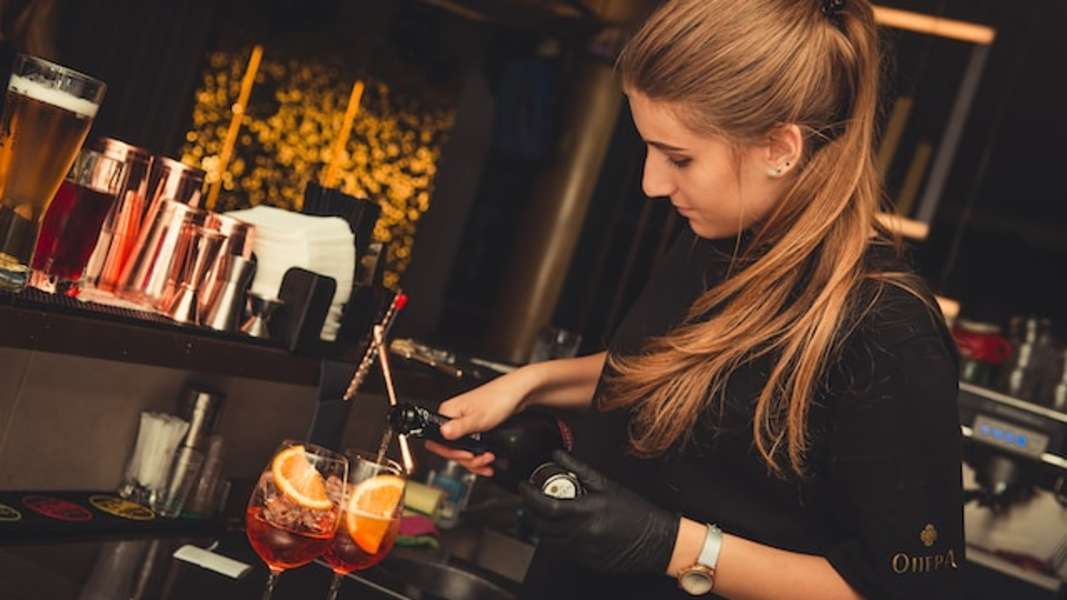
A bar runs on people covering each other without being asked. Pick a shift that went wrong and was rescued by the team, and be careful to describe your part accurately: claiming the whole result is a common way to lose this one.
Example answer: “We lost a bartender to illness an hour before a New Year’s Eve service. The three of us left split the bar into stations rather than all working the whole length of it. I took the well and the taps because I am fastest on volume, and we agreed that whoever had a gap would run glassware and restock. We got through the night without a walkout, and the manager kept that station split for busy shifts afterwards.”
6. What would you do if a customer has had too much to drink?
The other question that decides the interview. This is where the manager is checking whether you would put the license at risk. Refuse service clearly, involve the team, and think about how the person gets home. Do not turn it into a negotiation, and do not describe throwing anyone out on your own.
Example answer: “I would stop serving alcohol and say so once, politely and clearly, rather than making it a discussion. I would offer water and something to eat, tell the manager and the door team so we are all giving the same answer, and stay friendly about it, because the aim is for the person to leave in a reasonable mood. I would also make sure they had a safe way home before they went.”
7. How do you keep your workspace clean and organized during a busy shift?
An easy question to answer badly, because most people say “I clean as I go” and stop. Give the actual routine. Managers know that a bartender who resets properly is faster by the end of the night, not slower.
Example answer: “I work in a fixed order whenever there is a gap: clear, wipe, restock. I set the well up the same way every shift so I can find a bottle without looking down, run glassware in small loads instead of letting it build, and change bar mats and rinse pourers at every changeover. At close I do the fridges and the speed rail first, because those are the two things that slow the next shift down if they are left wrong.”
8. How do you handle the pressure of a busy evening or an understaffed situation?
Answer with a system rather than an assurance that you stay calm. Triage, communication and pace are what the manager is listening for.
Example answer: “We were two down on a bank holiday Sunday. I asked the manager to close the far service point so everyone queued in one place, which made the wait feel fair and stopped people shouting across each other. I served in rounds rather than one drink at a time, and told each group roughly how long they were looking at. We ran slower than usual, but nobody left and there were no complaints.”
9. If asked by a customer, can you suggest food and drink pairings?
This is really an upselling question in disguise. Show that you start with what the guest likes rather than with what you would drink, then give one worked pairing with the reasoning attached.
Example answer: “I ask what they are eating and what they normally drink, and the second answer matters more, because a good pairing they do not enjoy is a wasted recommendation. With something rich like a burger I would suggest a hoppy pale ale or a bourbon sour, since the bitterness and the acidity both cut through the fat. With spicy food I steer people towards something cold and off dry, a riesling or a lager, and away from high proof spirits, because alcohol carries the heat and makes the spice sharper.”
10. Why do you think you are the best candidate for this bartender position?
Keep this short and concrete. Two or three claims, each with evidence, and one reason you want this bar rather than any bar. Reliability is worth as much as flair here, because it is the thing a manager is most often let down on.
Example answer: “I am quick, I work clean, and I have handled this kind of volume before. I covered Friday and Saturday late shifts at my last bar for two years, trained two new starters, and never had a complaint escalated to a manager. I have wanted to work here since you changed the drinks list, and I live fifteen minutes away, so if you are ever short at short notice I can actually get here.”
Questions worth asking them
An interview that ends with no questions from you reads as a lack of interest. Ask what a typical Friday looks like in covers, how the tips are split, who writes the drinks list and how often it changes, and whether there is a trial shift. The answers tell you a great deal about how the bar is run, and asking them signals that you have worked somewhere serious before.
Before you go in
Arrive early enough to watch a service, bring your own bar knife and pourer if you have them, and be ready for a practical trial: usually a couple of drinks off the list, made while someone watches your speed and your cleanliness rather than your flourishes.
If you are applying to a large pub, hotel or restaurant group rather than an independent bar, the process may start with an online questionnaire before anyone meets you. That is normally a customer service assessment rather than anything about drinks, and it is testing the same judgment as question three above. Our employer profiles set out how the larger hospitality companies run their hiring.