

To order fractions you first have to make them comparable. There are two reliable ways to do that: give every fraction the same denominator and compare the numerators, or divide each numerator by its denominator and compare the decimals. Once the fractions share a denominator the smallest numerator marks the smallest fraction, so writing the set from least to greatest is simply reading the numerators in ascending order.
Use the common denominator method when the denominators are small or share obvious factors, and whenever you need to show your working or give the answer as fractions. Use the decimal method when the denominators are awkward, when the fractions have nothing in common, or when you only need the order rather than a tidy set of equivalent fractions.
Ordering fractions turns up regularly in numerical reasoning tests and basic numeracy tests, usually disguised as a question about which option is largest, or which figure sits closest to a target.
How to order fractions step by step
Step 1: Find the least common denominator
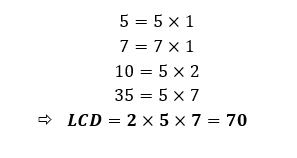
The least common denominator (LCD) is the lowest number that every denominator in the set divides into.
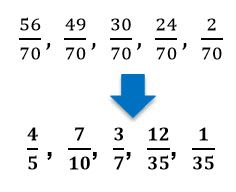
Take the set 1/35, 3/7, 7/10, 4/5 and 12/35, which we are asked to arrange from greatest to least. The denominators are 35, 7, 10 and 5. Every one of them divides into 70, and no smaller number does, so 70 is the LCD.
Step 2: Write each fraction as an equivalent fraction over the LCD
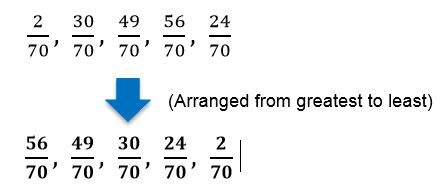
Scale every fraction up so that they all share the denominator of 70. Whatever you multiply the denominator by, multiply the numerator by the same amount, so the value of the fraction does not change, only the way it is written.
1/35 becomes 2/70, 3/7 becomes 30/70, 7/10 becomes 49/70, 4/5 becomes 56/70 and 12/35 becomes 24/70.
Step 3: Put the numerators in order
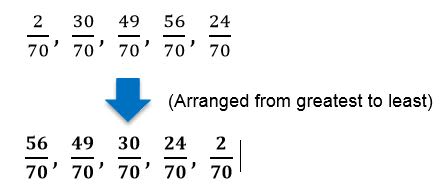
With a shared denominator the numerators alone decide the order, so you can ignore the bottom of every fraction from here on.
Greatest to least, the numerators run 56, 49, 30, 24, 2. Least to greatest, they run 2, 24, 30, 49, 56.
Step 4: Rewrite the fractions in their original form
Swap each equivalent fraction back for the fraction you were given, keeping the order you have just worked out.
From greatest to least the set is 4/5, 7/10, 3/7, 12/35, 1/35. From least to greatest it is the same list reversed: 1/35, 12/35, 3/7, 7/10, 4/5.
Ordering fractions examples
Example 1: order 3/4, 2/3, 5/6 and 7/12 from least to greatest
The denominators are 4, 3, 6 and 12, and every one of them divides into 12, so the LCD is 12.
3/4 = 9/12, 2/3 = 8/12, 5/6 = 10/12, and 7/12 already has the right denominator.
The numerators in ascending order are 7, 8, 9, 10.
Answer: 7/12, 2/3, 3/4, 5/6.
Example 2: which is the greatest fraction of 5/7, 7/9 and 2/3?
3 divides into 9, and 7 shares no factor with 9, so the LCD is 7 × 9 = 63.
5/7 = 45/63, 7/9 = 49/63, 2/3 = 42/63.
The largest numerator is 49, so 7/9 is the greatest fraction.
Answer: from least to greatest, 2/3, 5/7, 7/9.
Example 3: order 5/8, 3/5, 11/16 and 2/3 from least to greatest
The LCD here is 240, which is heavy going for four fractions, so the decimal method is quicker. Divide each numerator by its denominator:
5 ÷ 8 = 0.625
3 ÷ 5 = 0.6
11 ÷ 16 = 0.6875
2 ÷ 3 = 0.666…, which is 0.667 to three decimal places
Ordering the decimals gives 0.6, 0.625, 0.667, 0.6875.
Answer: 3/5, 5/8, 2/3, 11/16.
Example 4: arrange 41/96, 17/48, 11/36 and 17/24 from greatest to least
The denominators share no obvious multiple, so break them into factors: 96 = 32 × 3, 48 = 16 × 3, 36 = 4 × 9 and 24 = 8 × 3. The largest power of 2 in the set is 32 and the largest power of 3 is 9, so the LCD is 32 × 9 = 288.
Rewrite the fractions so that they share the denominator 288.
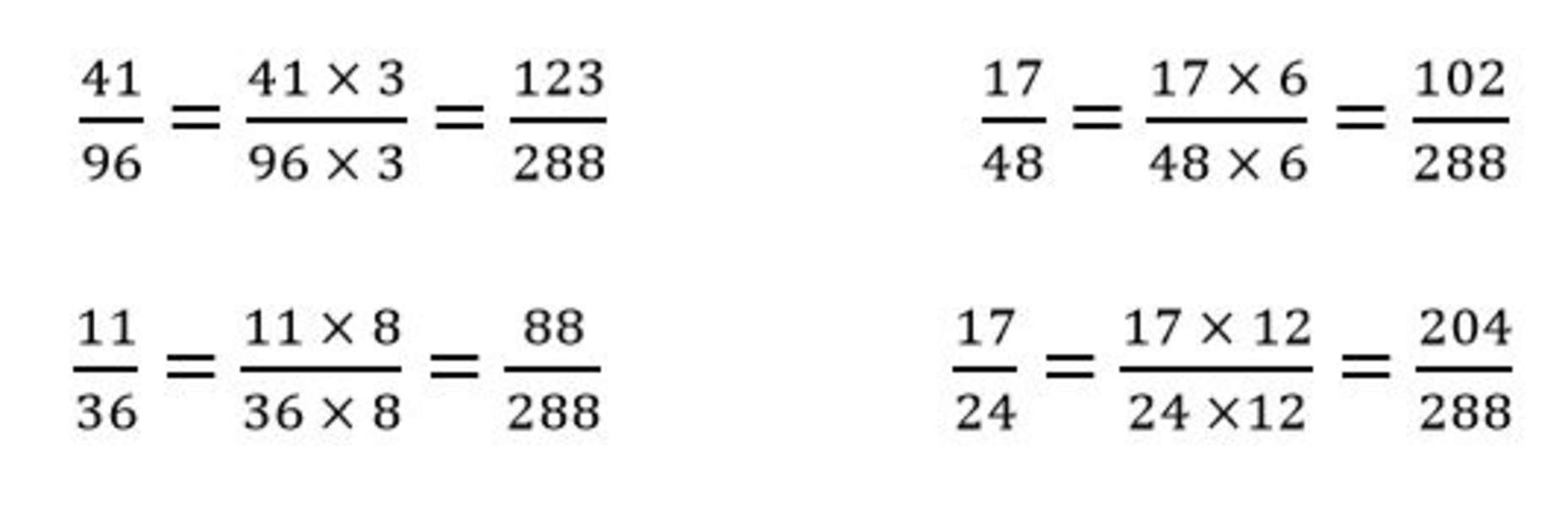
41/96 = 123/288, 17/48 = 102/288, 11/36 = 88/288 and 17/24 = 204/288. With the denominators matched, arrange the numerators from greatest to least.
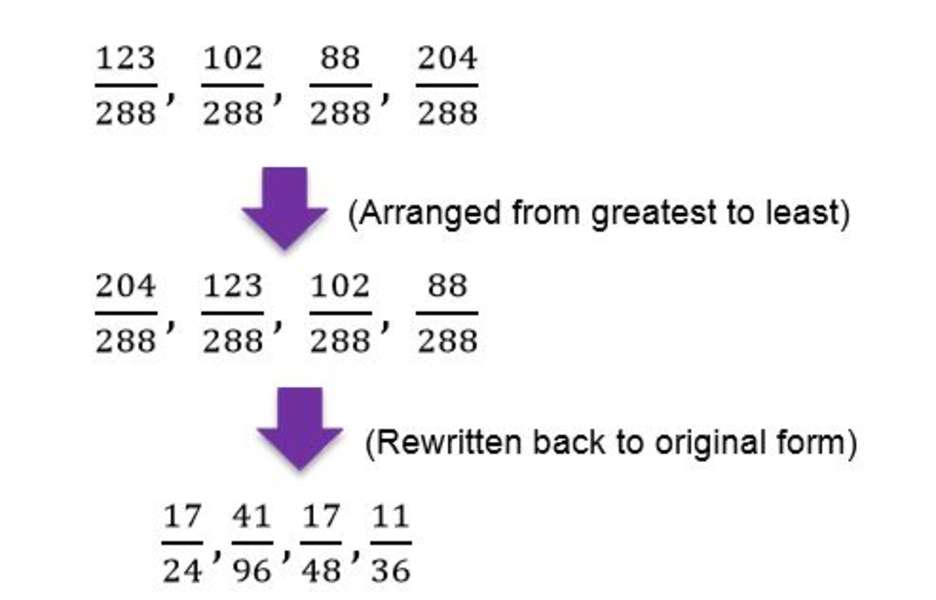
Then rewrite each equivalent fraction back in its given form.
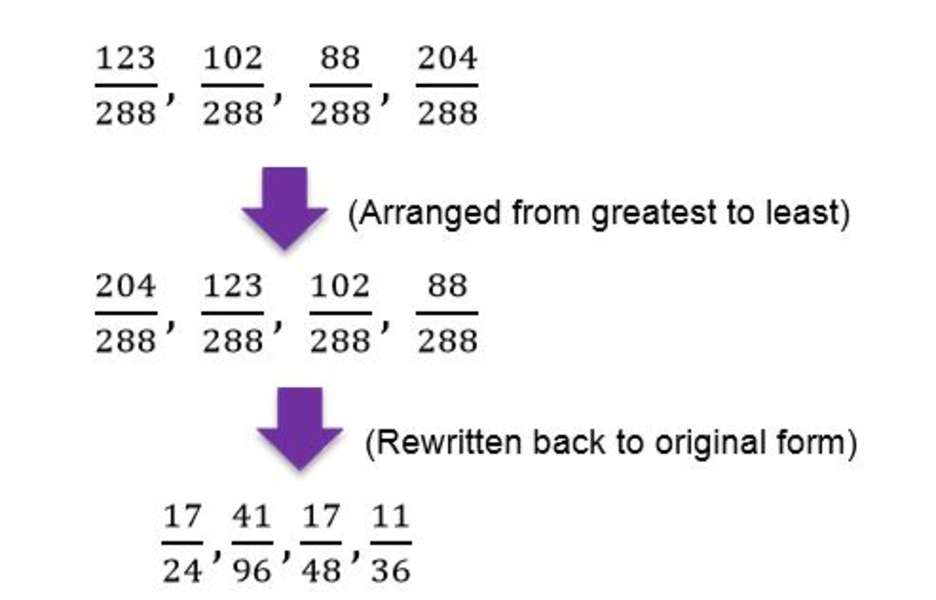
Answer: from greatest to least, 17/24, 41/96, 17/48, 11/36. Read the other way, from least to greatest, the set is 11/36, 17/48, 41/96, 17/24.
Shortcuts that save time under exam pressure
Matching denominators: compare the numerators and stop there. 3/11 is less than 5/11, which is less than 9/11.
Matching numerators: the larger the denominator, the smaller the fraction, because the whole has been cut into more pieces. 3/8 is smaller than 3/5, and the decimals confirm it: 0.375 against 0.6.
Only two fractions to compare: cross multiply. For 4/7 and 5/9, multiply 4 by 9 to get 36, then 5 by 7 to get 35. The bigger product belongs to the bigger fraction, so 4/7 is greater than 5/9.
Splitting a set in two: compare each fraction with a half. Half of 15 is 7.5 and 7 sits below that, so 7/15 is less than a half. Half of 16 is 8 and 9 sits above it, so 9/16 is more than a half. Those two are ordered without any common denominator at all.
Ordering mixed numbers and improper fractions
With mixed numbers the whole numbers decide the order first. 2 1/5 is greater than 1 7/8 whatever the fraction parts look like, and you only compare the fractions when the whole numbers are equal.
An improper fraction is one whose numerator is greater than its denominator, so it is worth at least one whole. Order them with exactly the same method. To arrange 7/4, 5/3 and 11/6 from least to greatest, use an LCD of 12: 7/4 = 21/12, 5/3 = 20/12 and 11/6 = 22/12. The numerators run 20, 21, 22, so the answer is 5/3, 7/4, 11/6.
Mistakes that cost marks
- Comparing numerators before the denominators match. 2/3 is greater than 3/5 even though 3 is greater than 2, because 2/3 = 10/15 and 3/5 = 9/15.
- Scaling the denominator but forgetting the numerator, which changes the value of the fraction instead of just its appearance.
- Handing in the equivalent fractions as the answer. Unless the question says otherwise, put the fractions back into the form you were given.
- Rounding decimals too early. 5/8 = 0.625 and 8/13 = 0.615…, and both round to 0.6 at one decimal place, so the order disappears.
- Reversing the direction. Least to greatest is ascending and greatest to least is descending, and questions that bury the wording in a sentence are easy to misread.
Practice ordering fractions questions
Ordering fractions rarely appears as a question in its own right. It hides inside data questions, where you have to spot which department, product or year holds the largest share, so speed matters more than elegance.
Work through numerical reasoning tests for the data table versions, basic numeracy tests for the pure arithmetic, and the free aptitude tests if you want to time yourself before committing to a full practice set.