How you add two percentages depends on what they are percentages of. If both refer to the same total, add them directly: 30% of 200 plus 20% of 200 is 50% of 200, which is 100. If one change follows another, you cannot add them, because the second change is applied to a value the first change has already altered.
That is why a 10% rise followed by a further 10% rise comes to 21%, not 20%. In that case you multiply the multipliers: 1.10 x 1.10 = 1.21.
Case 1: percentages of the same base
When two percentages refer to the same starting amount, they behave like ordinary numbers and you can simply add them.
Say a budget of 200 is split between two costs. One takes 30% of the budget and the other takes 20%. Together they take 30% + 20% = 50% of the budget, which is 100.
The long way round gives the same answer: 30% of 200 is 60, 20% of 200 is 40, and 60 + 40 = 100.
The test to apply is short. Ask what each percentage is a percentage of. If the answer is the same amount both times, add them.
Case 2: percentage changes one after another
Consecutive, or successive, percentage changes are the case most people get wrong. Here the second percentage acts on the result of the first, so the two do not simply add up.
Take an increase of 300 by 10%, followed by an increase of the result by 20%. The answer is not a 30% increase. Work through the four steps below.
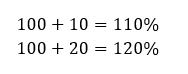
Step 1: Add each percentage to 100
Work with the whole amount, not just the change. To increase 300 by 10% and then increase the result by 20%, write each change as 100% plus the change, giving 110% and 120%.
Step 2: Convert the percentages to decimals
Move the decimal point two places to the left, so 110% becomes 1.10 and 120% becomes 1.20. These decimals are your multipliers.
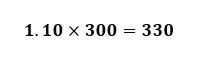
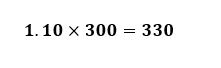
Step 3: Multiply the base value by the first multiplier
Apply the first change to the starting value. For our example, 300 x 1.10 = 330.
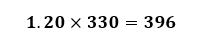
Step 4: Multiply that result by the second multiplier
Apply the second change to the new value, not to the original. Here, 330 x 1.20 = 396. The rise from 300 to 396 is 96, which is 32% of 300, so the two changes come to 32%, not 30%.
Worked examples
Example 1: two mark-ups applied one after the other
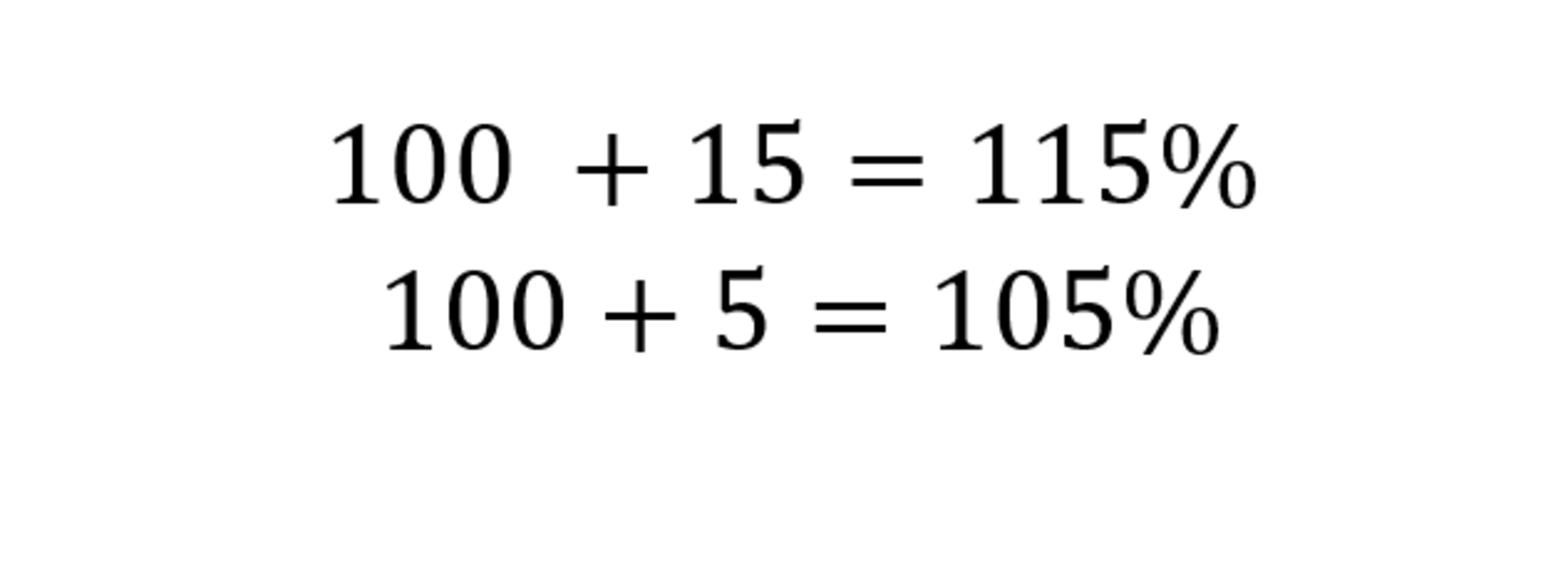
A store sells a pair of pants at a profit of 15%. A concessionaire adds a further 5% on top of that price. If the supplier cost of the pants is $800, how much would a customer pay at the concessionaire?
Add each percentage to 100 first:
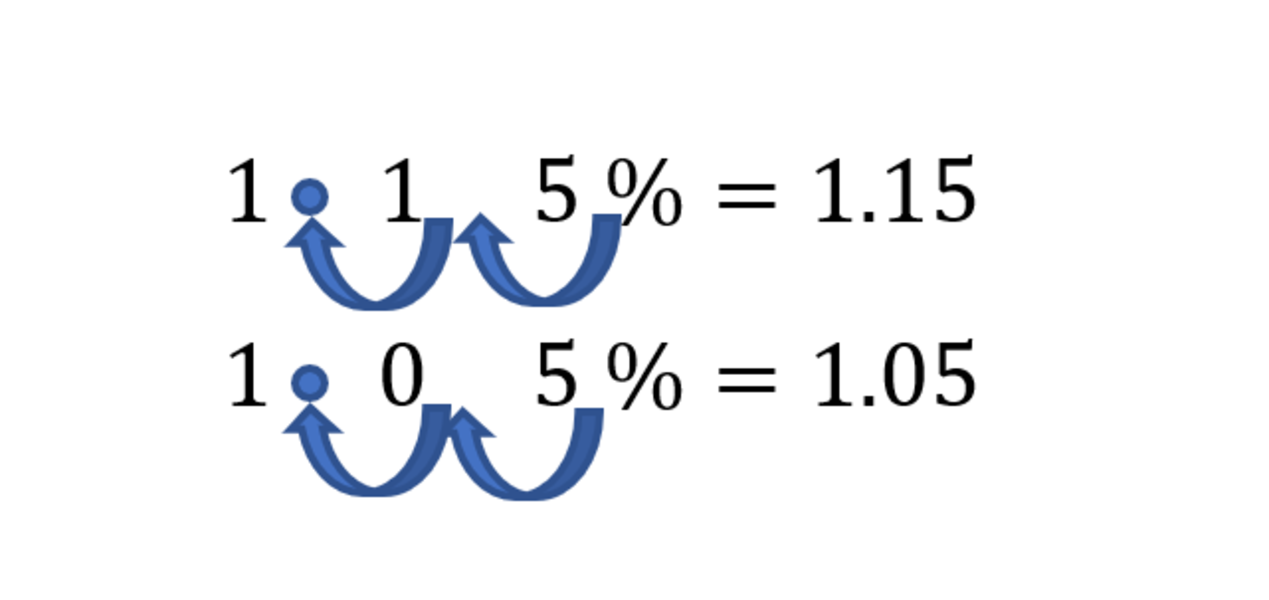
Move the percentages two decimal places to the left to get the multipliers:
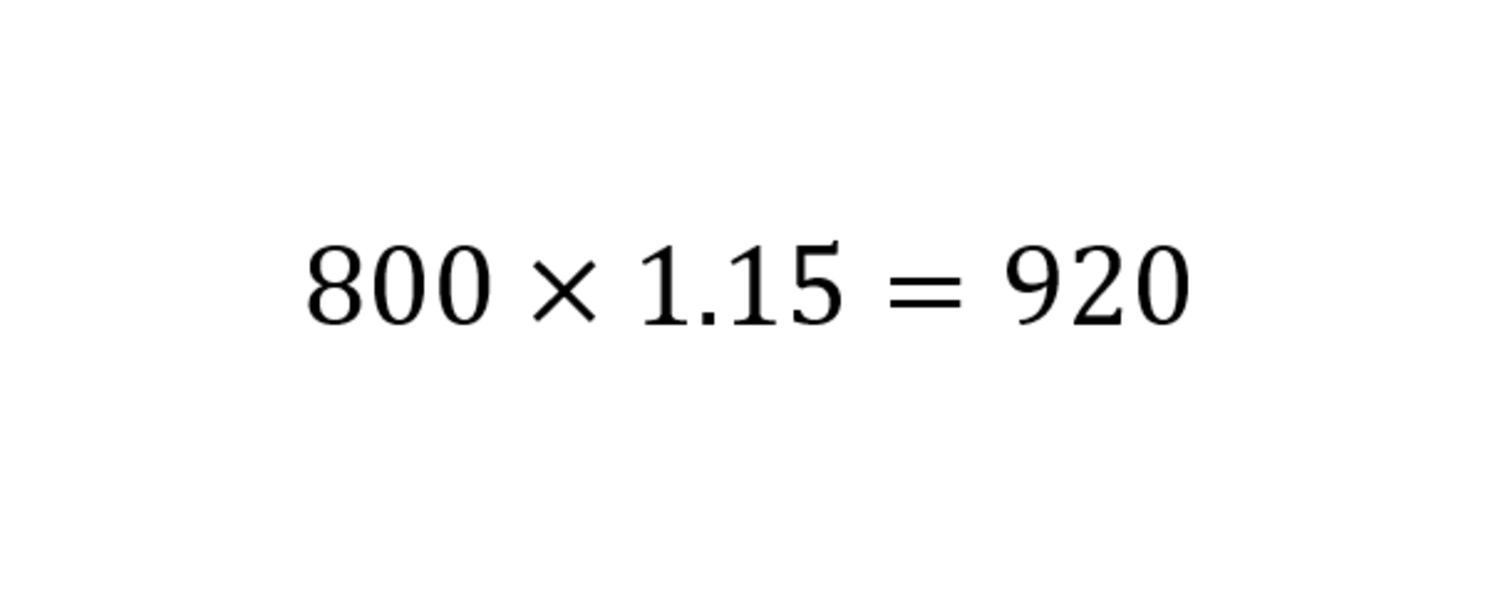
Apply the first multiplier to the supplier cost, so 800 x 1.15:
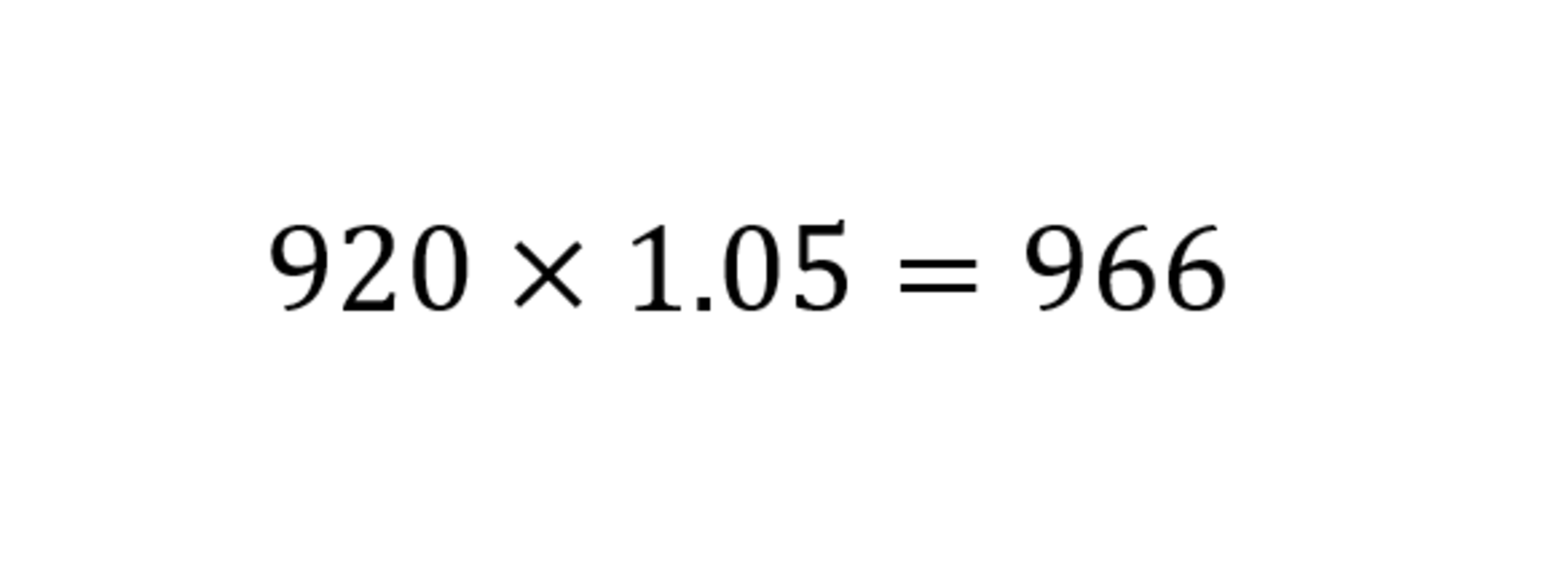
Apply the second multiplier to that result, so 920 x 1.05:
The customer pays $966. Notice that the combined effect is 966 ÷ 800 = 1.2075, an increase of 20.75%, not the 20% you would get by adding 15% and 5%.
Example 2: a rise followed by a fall of the same size
A salary of 40,000 rises by 10% one year, then falls by 10% the next. Is it back where it started?
No. A 10% rise is a multiplier of 1.10 and a 10% fall is a multiplier of 0.90.
40,000 x 1.10 = 44,000
44,000 x 0.90 = 39,600
The multipliers combine to 1.10 x 0.90 = 0.99, so the salary ends 1% below where it began. Equal-sized rises and falls never cancel out, because the fall is taken from a larger amount than the rise was added to.
Example 3: three changes in a row
Visitor numbers rise 20% in January, fall 15% in February and rise 5% in March. What is the overall change across the quarter?
Turn each change into a multiplier, then multiply them all together:
1.20 x 0.85 = 1.02
1.02 x 1.05 = 1.071
The overall change is an increase of 7.1%. Adding 20, then subtracting 15, then adding 5 would have given 10%, which is wrong.
Example 4: combining two percentages that come from different totals
60 candidates sat a test at one site and 20 sat it at another. The pass rate was 50% at the first site and 80% at the second. What is the overall pass rate?
This is the case behind questions like “how do I combine two percentages into one overall percentage”. You cannot average 50% and 80% to get 65%, because the two percentages are shares of different totals. Convert each back to a count first:
50% of 60 = 30 passes
80% of 20 = 16 passes
That is 46 passes out of 80 candidates in total, and 46 ÷ 80 = 0.575, so the overall pass rate is 57.5%.
Averaging two percentages only works when both are shares of the same sized group.
Common mistakes to avoid
- Adding successive changes. Two 10% rises make 21%, not 20%. Multiply the multipliers instead.
- Assuming a rise and an equal fall cancel out. They leave you slightly below where you started, as Example 2 shows.
- Averaging percentages from different totals. Weight each one by the size of its group, as in Example 4.
- Confusing percentages with percentage points. A conversion rate moving from 4% to 6% has risen by 2 percentage points, which is a 50% increase in relative terms. Both statements are true and they describe the same change.
Practice percentage questions
Percentage questions of this kind appear throughout graduate and professional assessments, usually under time pressure and without a calculator. The quickest way to make the multiplier method automatic is to work through timed questions.
Try a set of numerical reasoning tests for percentage change in context, or basic numeracy tests if you want to drill the arithmetic on its own first. You can also warm up with our free aptitude tests.